


Nouvelles
Cet article fait partie d’une série continue de rassemblement de la recherche entomologique canadienne (Canadian Entomology Research Roundups). Voici ce que les étudiants de cycle supérieur canadiens ont fait récemment:
De la part des auteurs:
Finn Hamilton (University of Victoria)
C’est bien connu que la majorité des insectes sont hôtes à des bactéries symbiotiques qui ont de profondes conséquences sur la biologie de l’hôte. Dans certains cas, ces symbioses peuvent protéger l’hôte contre de virulents parasites et pathogens, même si dans la plupart des cas planent encore un mystère sur la façon dont les symbionts réussissent à atteindre cette défense. Dans cet article, nous avons démontré qu’une souche de la bactérie Spiroplasma qui protège son hôte drosophile contre un nématode parasitaire virulent encode une toxine sous forme de protéine. Cette toxine semble attaquer l’hôte du nématode durant une défense induite par Spiroplasma. Ceci représente, à ce jour, une des démonstrations les plus claires des mécanismes sous-jacents de la symbiose promouvant la défense des insectes. Lien vers l’article

Voici une mouche Drosophila falleni infecté par le nematode, Howardula aoronymphium, dont Spiroplasma la protège. Crédit phot: Finn Hamilton.
Lucas Roscoe (University of Toronto)
L’agrile du frêne (Agrilus planipennis Fairmaire) est un buprestide ravageur s’attaquant aux frênes d’Amérique du Nord. Dans l’optique du développement de plans de gestion à long-terme de l’agrile du frêne, plusieurs projets détaillant la biologie et l’écologie de parasitoïdes indigènes peu étudiés auparavant ont été amorcés. Un des projets s’intéresse à la séquence de reproduction d’un parasitoïde, Phasgonophora sulcata Westwood. Plusieurs insectes entreprennent des actions répétées avant la reproduction qui sont souvent induites par des phéromones. Les résultats de cette étude sont la description de la séquence de reproduction de P. sulcata et la preuve que les phéromones produites par les femelles sont à la base de ses actions. Liens vers l’article

Phasgonophora sulcata, un parasitoïde important de l’agrile du frêne. Crédit photo: Lucas Roscoe.
Marla Schwarzfeld (University of Alberta)
Les guêpes parasitiques du genre Ophion (Hymenoptera: Ichneumonidae) sont presqu’entièrement inconnu dans la région Néarctique, où la majorité des espèces ne sont pas décrites. Dans cette étude, nous publions la première phylogénie moléculaire de ce genre, basé sur les régions COI, ITS2, and 28S. Bien que nous mettions l’accent sur les spécimens Néarctique, nous avons aussi inclus des représentants des espèces les plus connus de de l’ouest de la région Paléarctique et plusieurs séquences d’autre régions géographiques. Nous avons délimités 13 groupes d’espèces, la plupart étant reconnu pour la première fois dans cette étude. Cette phylogénie nous fournit un cadre essentiel qui pourra, nous espérons, inspirer les taxonomistes à divisier et conquérir (et décrire!) de nouvelles espèces dans ce genre qui présente de grands défis morphologiques. Liens vers l’article

A parasitoid wasp in the genus Ophion. Photo credit: Andrea Jackson
Seung-Il Lee (University of Alberta)
Seung-Il Lee et ses collègues (University of Alberta) ont trouvé que de larges territoires de rétention (> 3.33 ha) minimisent « l’effet de bordure » négatif sur les coléoptères saproxyliques dans les peuplements boréals d’épinette blanche. Liens vers l’article Billet de blogue (EN)

Un coléoptère saproxylique, Peltis fraterna. Crédit photo: Seung-Il Lee.
Paul Abram (Université de Montréal)
La relation entre la taille des insectes et certains traits distinctifs (tel que la longévité, la fécondité, …) a été largement étudié, mais l’effet additionnel de la taille sur les traits comportementales sont moins bien connus. En utilisant le parasitoïde d’oeuf Telenomus podisi Ashmead (Hymenoptera: Platygastridae) et trois de ses hôtes punaises comme système modèle, nous avons démontrés que la différence de taille était associé a un changement dans la plusieurs traits distinctifs (longévité, masse d’oeufs, taille des oeufs), mais aussi de certains traits comportementales (vitesse de marche, taux d’oviposition, taux de marquage des oeufs). Nos résultats mettent en relief comment la phénotype complet (comportement et traits distinctifs) doivent être considéré quand nous évaluons l’association entre la taille et la condition physique. Liens vers l’article
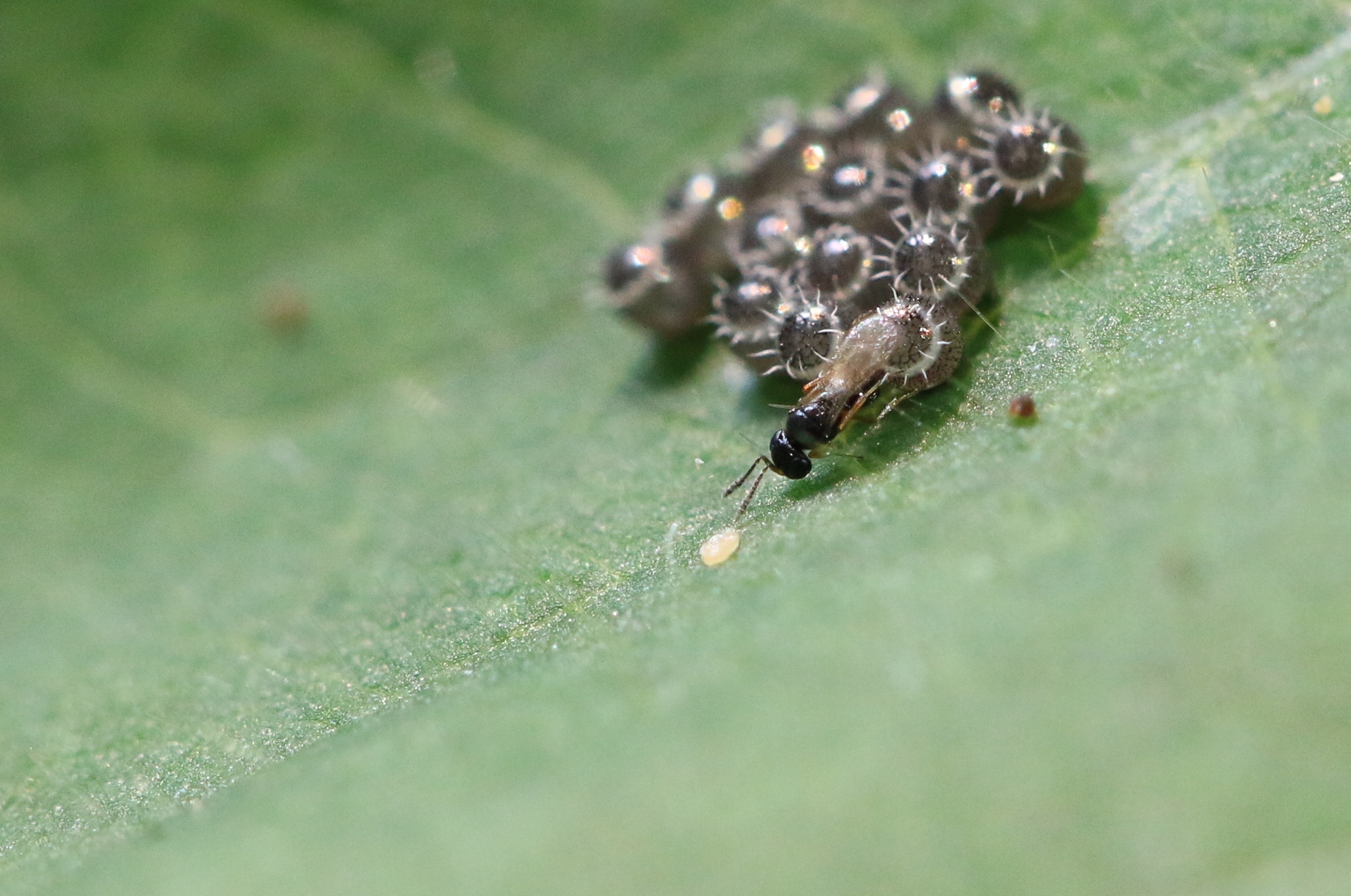
Le parasitoïde Telenomus podisi parasitisant les oeufs de la punaise Podisus maculiventris. Crédit photo: Leslie Abram.
Delyle Polet (University of Alberta)
Les ailes de insectes ont souvent des éléments directionnels rugueux – comme des poils et des écailles- qui perdent des gouttes d’eau dans le sens des éléments, mais pourquoi ces éléments ne pointent pas toujours dans la même direction? Nous avons proposé que trois stratégies sont en jeu. Les gouttes pourrait être (1) évacuer loin du corps, (2) être perdues aussi vite que possible et (3) évacuer de « vallées » formés entre les veines des ailes. Un modèle mathématique combinant trois de ces stratégies concorde avec l’orientation des poils sur un taon (Penthetria heteroptera) assez bien et pourrait être appliqué à d’autres espèces ou à des matériaux inspirés par la biologie. Liens vers l’article
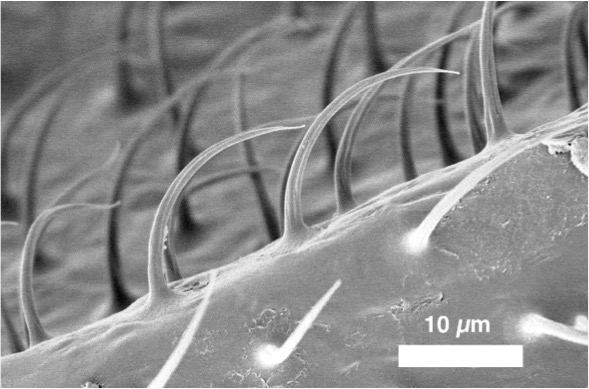
Poils sur l’aile d’un taon (Penthetria heteroptera). Crédit photo: Delyle Polet.
Résumés bref de recherche
Taxonomie, Systématique, and Morphologie
Thomas Onuferko du laboratoire Packer à York University et ses collègues ont réalisé un vaste étude sur les espèces d’abeilles dans la région de Niagara, Ontario. Onuferko et al. ont collecté plus de 50 000 abeilles et ont découvert 30 espèces qui n’avait pas été rapporté dans la région. Liens vers l’article
Christine Barrie et ses collègues ont signalé que des mouches de la famille Chloropidae sont associés aux phragmites au Canada. Lien vers l’article
Comportment et écologie
Blake Anderson (McMaster University) et ses collègues ont étudié l’hypothèse du découplage du comportement social et de l’activité dans les mouches larvaires et adultes. Lien vers l’article
Susan Anthony du laboratoire Sinclair à Western University, ainsi que Chris Buddle (McGill University), ont déterminé que le pseudoscorpion de Béringie peut tolérer tant les basses températures et l’immersion. Lien vers l’article
Une étude par Fanny Maure (Université de Montréal) démontre que le status nutritionnel d’un hôte, la coccinelle maculée (Coleomegilla maculata), influence le destin de l’hôte et condition physique du parasitoïde. Lien vers l’article
Est-ce que la connectivité est la clé? Des laboratoires Buddles et Bennet à l’Université McGill et du laboratoire James à l’Université de Montréal, Dorothy Maguire (Université McGill) et ses collègues ont utilisé la connectivité du paysage et les insectes herbivores pour proposer un cadre pour examiner les compromis associés aux services ecosystèmiques. Lien vers l’article
Alvaro Fuentealba (Université Laval) et ses collègues ont découvert que différentes espèces d’arbres hôtes montrent des variations à la résistance naturelle à la tordeuse du bourgeon de l’épinette. Lien vers l’article
Gestion des insectes ravageurs
Rachel Rix (Dalhousie University) et al. ont observé qu’un stress modéré induit par l’insecticide pour augmenter la reproduction et aider les pucerons a mieux se débrouiller avec le stress subséquent. Lien vers l’article
Lindsey Goudis (University of Guelph) et ses collègues ont découvert que la meilleure façon de contrôler Striacosta albicota (Smith) est d’appliquer de la lamba-cyhalothrine de la chlorantraniprole 4 à 18 jours après l’éclosion de 50% des oeufs. Lien vers l’article
Matthew Nunn (Acadia University) et ses collègues ont documenté la diversité et densité d’importantes espèces ravageuses des bleuets sauvages en Nouvelle-Écosse. Lien vers l’article
Physiologie et génétique
Est-ce que l’heterozygositie améliore la symétrie de Xeromelissa rozeni? Margarita Miklasevskaja (York University) et ses collègues ont testé cette hypothèse dans leur plus récent article. Lien vers l’article

Un male Xeromelissa rozeni. Crédit photo: Margarita Miklasevskaja.
Jasmine Janes, récemment graduée de University of Alberta, et d’autres ont exploré les systèmes de reproduction et de structure génétique à petite échelle pour la gestion efficace du Dendroctone du pin ponderosa. Lien vers l’article
Du laboratoire Sperling à University of Alberta, Julian Dupuis et Felix Sperling ont examiné l’interaction complexe de l’hybridation et de la spéciation. Ils ont caractérisé le potentiel d’hybridation dans un groupe de Papilonidae. Lien vers l’article
Marina Defferrari (University of Toronto) et ses collègues ont identifié un nouveau peptide similair à l’insuline dans Rhodnius prolixus. Ses peptides sont impliqués dans l’homéostasie métaboliques des lipides et carbohydrates. Lien vers l’article
Techniques
Crystal Ernst (McGill University) et ses collègues ont collecté des coléoptères et des araignées dans différents habitats du Nord. Ils ont trouvé que la diversité des coléoptères et des araignées par habitat et type de trappes. Lien vers l’article
Nous continuous à aider à divulguer les publications des étudiants de cycle supérieur à la plus vaste communauté entomologique grâce aux rassemblement de recherche. Si vous avez publié un article récemment et souhaitez le divulguer, envoyez-nous un email à entsoccan.students@gmail.com. Vous pouvez aussi nous envoyer des photos et une courte description de votre recherche dans le but apparaître dans notre prochain rassemblement de recherche.
Pour des mises à jour régulières sur la nouvelle recherche entomologique canadienne, vous pouvez joindre la page Facebook de ESC Students ou nous suivre sur Twitter @esc_students (EN) ou @esc_students_fr (FR).

If you are a fan of Canadian neuropteroids, your bucket list should include a trip out west to see one of our best selling points: the Raphidioptera, or snakeflies. The most common of these are in the genus Agulla, and this morning I found several female Agulla when out for a walk at Mt. Tolmie in Victoria.

The way the pronotum curls around the anterior of the elongated thorax like a little jacket is strangely pleasing.

Snakeflies have a fully motile pupal stage, something I found out just the other day, finding this pupa in a decaying branch of Garry Oak.

Here is a freshly-emerged snakefly I found in Oregon a few weeks ago. Note how the wings appear milky and the antennae are not fully hardened.

I had hoped to catch these against a blazing orange dawn, but like so many dawns on the west coast, today was rather cloudy.

Against the mossy bedrock of the Garry Oak meadow, the female snakefly blends in quite well.
One of the most surprising things I have learned about snakeflies over the years is that the larvae have a very effective reverse locomotion that allows them to quickly back away from danger. Check it out:
[youtube https://www.youtube.com/watch?v=vGkoaRd4_fc&w=640&h=480]
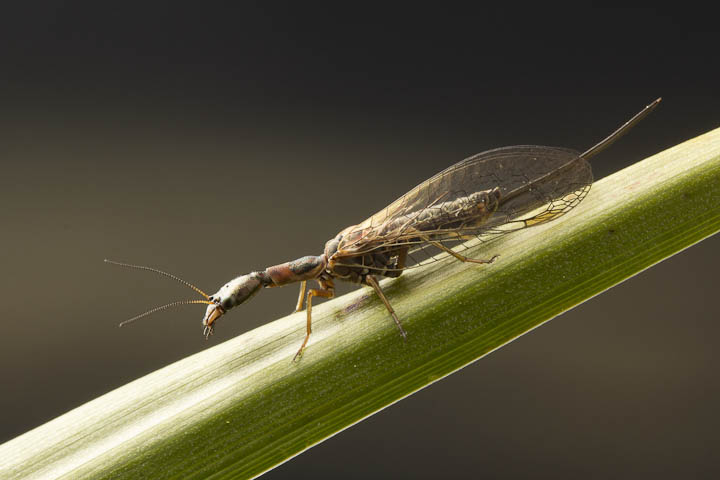
So if you are ever on the west coast at this time of year, please look for these awesome creatures. You will be glad you did.

Staffan with Graduate student Jeanne Robert, 2005. Jeanne went on to do a PhD at UBC, then came back to UNBC, where she worked as a post-doctoral fellow and then a Research coordinator for the UNBC NRESi Biodiversity Monitoring & Assessment Program. She is now the Regional Entomologist, Northern Region, for the BC Ministry of Forest, Lands and Natural Resources Operations, Prince George, BC. I was lucky to have a great graduate student. Was she lucky? Only through hard work!
The following is a guest post by Staffan Lindgren
When I was about 10 years old I won a competition in a hobby magazine, which landed me a nice race car track. Since then I have not won anything, really. Yet, I consider myself a lucky person, not only because of a great family life, but because opportunities have always seemed to pop up just when I needed them. But looking back, I would say that my luck was in large part self-made. Over the years, I had made sure I had summer and temporary jobs that gave me appropriate experience, e.g., as a substitute teacher, forest regeneration surveyor, etc.
When I was doing my undergraduate degree in Sweden, the course offerings in the fall of 1973 were not to my liking, so I landed a job as a research assistant to a PhD student studying spiders. But the reason I did, was that I had a longstanding interest in spiders, so I had connected with the student long before that. For example, as a 12-year-old, I wrote to Professor Åke Holm, Uppsala University, after reading a newspaper article posted on a board in my English teachers classroom. Dr. Holm was then Sweden’s pre-eminent spider taxonomist, and had published my first spider book (Holm 1947). His kindness and encouragement has served as a model for me throughout my career. After I graduated with my undergraduate degree, I made a misguided attempt at a PhD in medical endocrinology, studying testosterone secretion in rats. Apart from five small publications (Carstensen et al. 1976, Lindgren et al. 1976, Damber et al. 1977a, Damber et al. 1977b, Bergh et al. 1982), I came away with a bruised ego and a severe allergy to rats.
After my failed 2-year forage into mammal reproductive physiology, I realized that I needed to re-focus on my first love, which was entomology. The first thing I did was to contact (by which I mean that I wrote a letter ) Dr. Bertil Lekander, professor of forest entomology at the Royal College of Forestry, Stockholm, Sweden. He offered to take me on as a special interest student in the two forest entomology courses offered to future foresters. To make a long story short, this led to a life-long association, albeit informal, with Swedish forest entomologists. For example, I published my Master of Pest Management Professional Paper as a Forest Entomology report (which also has a long story associated with it, the main lesson of which is the old adage “It’s not what you say, but how you say it”), and I had the privilege of spending 6 months as a visiting scientist at SLU in Uppsala in 1993 thanks to the connections I made there. Nevertheless, a few courses did not lead to a specific job, so once that was done I was once again without a firm direction in life. Because I had made many friends and connections in the Department of Ecological Zoology at Umeå University, in part through the spider job, but also through volunteering every spring and fall on an annual 4-day microtine rodent survey (Hörnfeldt et al. 1986) I got wind of a 4-month Teaching Assistant position in the Department of Health and Environment, which I was offered (notably in competition with another future entomologist, Anders N. Nilsson, who became a world authority on aquatic beetles). This position involved leading a class trip to the Soviet Union, among other things.

Staffan with a nice rainbow trout from Wicheeda Lake, north of Prince George. Now this may have been luck, because I don’t work hard at my fishing skill!
At the end of that position, I had started the proceedings to go to Canada, which ultimately led me to where I am today. Again, this was not something that happened by accident. In 1968-69, I spent a year in central Michigan as a high school exchange student. This was an extremely formative experience for me. It made me confident that I could succeed in an English-speaking environment, and it shaped me politically (it was the height of the Vietnam War, two political assassinations , Martin Luther King, Jr. and Robert F. Kennedy, Jr., had happened earlier in 1968), and there were significant racial tensions throughout the US. Anyway, I had become convinced that applied science was the only worthwhile pursuit in terms of education (see my earlier post here), and had found the Centre for Overseas Pest Research, a British organization. (Remember that there was no Google or internet, so all of this was done through libraries and by asking for information by mail). I received a letter back that they could only offer employment to “British subjects”, but they passed on a brochure about the Master of Pest Management program at Simon Fraser University. This seemed like the ticket to my future, so I wrote to SFU. The response was positive, so I decided to apply. But I needed funding. Fortunately for me, I managed to land a fellowship from the Sweden-America Foundation, and in combination with the relatively generous student loans from the Swedish Government, I all of a sudden found myself in a position to go to Canada! And the rest is history, as they say!
What does this history of my formative years have to do with luck? I truly believe that some people have more luck than others. When you buy a lottery ticket, the odds are fixed. But in the job market, including academia, you can change the odds in your favour, at least to some degree. The points I take home from the experience I have accumulated over my career are:
- If people know you, they will pass on information that may lead to your big break.
- Treat people with respect, i.e., treat them the way you wish to be treated. If you are well liked and respected, it will make a difference when you are looking for references or recommendations. This is particularly important when dealing with workers. I found that by showing an interest in, and respect for, their experience and knowledge rather than acting superior, you gain their trust and respect, and they will welcome your opinion.
- Don’t hesitate to seek help or advice from professors, no matter how eminent or important they are. In entomology in particular, I have been amazed at the kindness and generosity I have encountered from people really had nothing to gain by responding or talking to me. The worst that can happen is that you don’t get a response, or one that makes you steer clear of that individual (which has yet to happen to me).
- We all have weaknesses. Work on them. I used to shake like a leaf when having to address an audience. Some of the best scientists and public speakers I know suffer from extreme nervousness, but they have learned to cope with it. If you suffer from nerve problems, seek help, or at least give yourself experience. There are tricks to help you, and you’d be amazed how experience helps!
- Never, ever pretend you know something you don’t. Honesty always pays off in my experience.
- Finally, and most importantly, follow your heart. If you are passionate about what you do, you are more likely (and able) to build experience, which in turn becomes as important, or more so, in a job interview.
These are some ways to “make you lucky”. Just like an athlete has to put time and effort into achieving their goals, we do as well.
Best of luck!
References
Bergh, A., J.-E. Damber, and S. Lindgren. 1982. Compensatory hypertrophy of the Leydig cells in hemiorchidectomized adult rats. Experientia 38:597-598.
Carstensen, H., S. Marklund, J.-E. Damber, B. Näsman, and S. Lindgren. 1976. No effect of oxygen in vivo on plasma or testis testosterone in rats and no induction of superoxide dismutase. Journal of Steroid Biochemistry 7:465-467.
Damber, J.-E., H. Carstensen, and S. Lindgren. 1977a. The effects of barbiturate anesthesia and laparotomy on testis and plasma testosterone in rats. J. Ster. Biochem. 8: 217-219.
Damber, J.-E., S. Lindgren, and B. Näsman. 1977b. Testicular blood flow and oxygen tension in unilaterally orchidectomized rats. Experientia 33:635.
Holm, Å. 1947. Svensk spindelfauna. 3, Egentliga spindlar. Araneae Fam. 8-10, Oxyopidae, Lycosidae och Pisauridae. Entomologiska Föreningen, Stockholm, Sweden.
Hörnfeldt, B., O. Löfgren, B.-G. Carlsson. 1986. Cycles in voles and small game in relation to variations in plant production indices in Northern Sweden. Oecologia (Berlin) 68:496–502
Lindgren, S., J.-E. Damber, and H. Carstensen. 1976. Compensatory testosterone secretion in unilaterally orchidectomized rats. Life Science 18:1203-1205.

Guest post by Staffan Lindgren (@bslindgren)
The other day I was practicing macro photography (I am still learning after several years of erratic success at best, so please excuse the imperfections) trying to patiently wait out some Halictus sweat bees with my camera. The bees appeared to be much more patient than I was, however, by which I mean that they sat deep in their burrows, apparently staring me down. So I wandered around looking for other potential subjects to practice on. While examining another bee burrow, I saw a slight movement in the dirt in a spot about 10 cm from the bee burrow. A closer look revealed a very attractive wolf spider hiding in a small depression. In spite of its gaudy colours (for a wolf spider) it was rather well camouflaged against the dirt. As I watched it, it started to move, and to my surprise picked up dirt and moved it to the edge of its little hiding spot. It remained in the depression and continued to modify it by moving dirt as I attempted to take some photographs. From what I could tell, it looked as if it used its pedipalps to hold the dirt against the base of its chelicerae to move it, rather than only grabbing it between the chelicerae.

I had no idea what species I was dealing with, so I went to the web to see if I could figure it out. It turned out to be Arctosa perita (Latreille, 1799), which confused me at first since it is a Eurasian species. A quick check of Bennett et al. (2014) confirmed its presence. I also found the post “The mystery of the burrow-dwelling sand dune spider” about this species on Catherine Scott’s informative blog “Spiderbytes”, as usual illustrated by a number of excellent photographs by Sean McCann. These sources confirmed that the spider occurs on Vancouver Island, and that it is a species known to make burrows.

These spiders have some pretty good camouflage, as well as subtle but beautiful colours. Photo by Sean McCann.
Apparently A. perita was introduced in southwestern BC at some point, and it has spread enough that it now seems fairly common, at least in the southwest corner of the province. In fact, we have numerous introduced species of insects and other arthropods in BC, particularly in urban and rural areas. For example, the most commonly seen ground beetles are generally invasives, although we tend to not think of them as such because they don’t impact us directly. They probably do impact the native fauna to some extent, however, albeit not noticeable to our selfserving views. After all, even earthworms (which are almost entirely non-native in Canada) have been labelled harmful to native fauna in forest environments, at least (Addison 2009). Whether or not A. perita has any noticeable effect on native fauna is unknown, but it is an interesting addition to our Canadian fauna.
References
Addison, J.A. 2009. Distribution and impacts of invasive earthworms in Canadian forest ecosystems. Biological Invasions. 11: 59-79.
Bennett, R., D. Blades, D. Buckle, C. Copley, D. Copley, C. Dondale, and R.C. West. 2014. Checklist of the spiders of British Columbia. (Web) http://ibis.geog.ubc.ca/biodiversity/efauna/documents/BCspiderlistMay2014FINAL.pdf
By B. Staffan Lindgren, Professor Emeritus
A while back, a paper accepted by The American Statistician entitled “The ASA’s statement on p-values: context, process, and purpose” was posted to the American Statistical Association website. The gist of the paper was that many disciplines rely too much on the p-value as the sole indicator of research importance. Not surprisingly, the paper received considerable attention.
Over my career, I had a love-hate relationship with statistics, knowing just enough to be dangerous, but not enough to really understand what I was doing. Consequently I relied on packaged software and/or colleagues or students who were more quantitatively minded than myself. For example, I generally made sure that a graduate student committee had at least one member with some strength in statistics to make sure I would not leave the candidate stranded or led astray. So if you read my thoughts below, keep in mind that I tread on very thin ice here. I fully expect some disagreement on this, but that is the way it is supposed to be. Ultimately it is your responsibility to understand what you are doing.
The approaches and tools for statistical analysis have changed a lot since my student days, which was at the dawn of mainframe computers for general use, on which we could use a software package called Textform rather than typing the thesis on a type writer as I (read “a secretary I hired and almost drove to depression”) did for my masters. My first visit to a statistical consultant at Simon Fraser University ended with the advice that “This data set can’t be analyzed, it contains zero values.” The software of choice was SPSS, which did not allow for any complexity, so I did a fair bit by hand (which might have been a good thing since it forced me to think about what I was doing, but certainly did not prevent errors). Later in my career it was sometimes a struggle to decide among differing opinions of statisticians what was and was not appropriate to use, but with a little help from my friends I think I managed to negotiate most of the pitfalls (no pun intended) fairly well.

The statistic-phobic author with his eponymous insect trap, preparing to gather data and test hypotheses. Photo: Ron Long.
One of the issues with our reliance on p-values is that it is tempting to do post-hoc “significance-hunting” by using a variety of approaches, rather than deciding a priori how to analyze the data. Data that show no significance often remains unpublished, leading to potential “publication bias”. In part this may be the result of journal policies (or reviewer bias), which tends to lead to rejection of papers reporting ‘negative’ results. We have also been trained to use an experiment-wise alpha of 0.05 or less, i.e., a significant result would be declared if the p-value is lower than 0.05. There are two problems with this. First, it is an arbitrary value in a sense, e.g., there really is no meaningful difference between p=0.049 and 0.051. Furthermore, the p-value does not really tell you anything about the importance of the result. All it can do is give some guidance regarding the interpretation of the results relative to the hypothesis. I have tried to make students put their research in context, because I believe the objective of the research may dictate whether or not a significant p-value is important or not. I used to work in industry, and one of the reasons I left was that recommendations I made based on research were not always acted upon. For example, pheromones of bark beetles are often synergized by various host volatiles. But whether or not they are may depend on environmental factors. For example, just after clear cutting the air is likely to have high levels of host volatiles, thus making any host volatile added to a trap ineffective. However, a company may make money by selling such volatiles, and hence they would tend to ignore any results that would lead to a loss of revenue. On the other hand, one could argue that they have the customers’ best interest in mind, because if host volatiles are important under some circumstances, it would be detrimental to remove them from the product.
This leads to my thoughts about the power of an analysis. The way I think of power is that it is a measure of the likelihood of finding a difference if it is there. There are two ways of increasing power that I can think of. One is to increase the number of replications, and the other is to use a higher alpha value. It is important to think about the consequence of an error. A Type I error is when significance is declared when there is none, while a Type II error is when no significance is found when in fact there is one. Which of these is most important is something we need to think about. For example, if you worked in conservation of a threatened species, and you found that a particular action to enhance survival resulted in a p-value of 0.07, would you be prepared to declare that action ineffective assuming that it wasn’t prohibitively expensive? If you have committed a Type II error, and discontinue the action, it could result in extinction of the threatened species. On the other hand, if you test a pesticide, would a significant value of 0.049 be enough to decide to pursue the expensive testing required for registration? If you have committed a Type I error, the product is not likely to succeed in the market place. If the potential market is small, which tends to be the case for behavioural chemicals, it may not be feasible to use this product because of the high cost, which has nothing to do with statistical analysis, but could be the overriding concern in determining the importance of the finding.
One area where the sole use of p-values can become very problematic is for regressions. The p-value only tells us whether or not the slope of the line is significantly different from zero, and therefore it becomes really important to look at how the data are distributed. An outlier can have a huge impact, for example (see figure). As an editor I saw many questionable regressions, e.g., with single points driving much of the effect, but which in the text were described as highly significant.
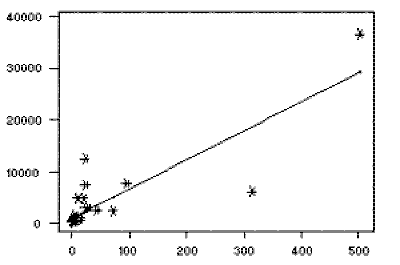
Fig. 1. An example of where a single point is driving a linear regression. Take it away and there is no apparent relationship at all. Figure from http://www.stat.yale.edu/Courses/1997-98/101/linreg.htm
Finally, we need to keep in mind that a significant p-value does not indicate certainty, but probability, i.e., at p=0.05, you would expect to get the same result 19 of 20 times, but that still means that the result could be the result of chance if you only ran the experiment once. (If you run a biological experiment that yields a p-value close to 0.05 a number of times, you would soon discover that it can be difficult to get the same outcome every time). Depending on the context, that may not be all that confidence inspiring. For example, if someone told you that there was only a 5% probability that you would be get seriously sick by eating a particular mushroom, wouldn’t that make you think twice about eating it?? On the other hand many of us will gladly shell out money to buy a 6/49 ticket even though the probability of winning anything at all is very low, let alone winning the jackpot, because in the end we are buying the dream of winning, and a loss is not that taxing (unless you gamble excessively of course). I consider odds of 1:8000 in a lottery really good, which they aren’t of course, evidenced by the fact that I have never won anything of substance! So relatively speaking, 1:20 is astronomically high if you think about it!
Why am I bothering to write this as a self-confessed statistics phobe? I have mainly to emphasize that you (and by « you » I primarily mean students engaged in independent research) need to think of statistics as a valuable tool, but not as the only, or even primary tool for interpreting results. Ultimately, it is the biological information that is important.
CONTACTER LA SOCIÉTÉ
Assistant administratif : info@esc-sec.ca
SEC Président : ESCPresident@esc-sec.ca
This post is also available in: