


Nouvelles
MSc – Role of dung-breeding insects in pasture ecosystems
Applications are invited for an MSc position to begin January or May of 2017. Research will examine the role of dung-breeding insects in pasture ecosystems in southern Alberta. This is a collaborative project between Agriculture & Agri-Food Canada (AAFC) and the University of Lethbridge (U. of L.), both based in Lethbridge, Alberta.
The project will include insect surveys using dung-baited pitfall traps from May through September on native pastures in southern Alberta, Canada. The role of dung insect activity will be assessed for effects on dung degradation, soil nutrients and micro-fauna, and greenhouse gas emissions. Dung beetles will be examined as potential vectors of parasites affecting livestock.
The ideal applicant will have recently completed an undergraduate degree in biology or related program with courses in entomology and ecology. They will be enthusiastic, innovative, and have excellent communication skills (written, oral) in English. They must be able to work independently and as part of a team. They must have a valid driver’s license and meet the scholastic qualifications required for acceptance into Graduate Studies at the U. of L.
The successful applicant will be jointly supervised by Drs. Kevin Floate (AAFC) and Cam Goater (U. of L.). Under the supervision of Dr. Floate, the student will be based at the Lethbridge Research and Development Centre (AAFC), where they will perform the main body of their research. The Floate lab studies diverse aspects of insect community ecology with particular emphasis on prairie ecosystems (https://sites.google.com/site/dungins/homepage). Under the supervision of Dr. Goater, the student will be enrolled in an MSc program in the Department of Biological Sciences at the University of Lethbridge. Research in the dynamic Goater lab focuses on the ecology and evolution of host/parasite interactions, and on prairie biodiversity and conservation (http://scholar.ulethbridge.ca/cpg/home).
Informal communication with Dr. Floate prior to application is encouraged. To apply, please send a cover letter detailing your fit to the position, a CV, a copy of your most recent transcripts, and the names and contact details of three referees to Dr. Kevin Floate (Kevin.Floate@agr.gc.ca). The deadline for application is November 1, 2016.
Postdoctoral Fellow – Functional genomics of insect overwintering
Applications are invited for a funded postdoctoral position in insect functional genomics as part of a collaborative project between labs at Western University and the Canadian Forest Service, both in Ontario, Canada.
The project will involve coordinating work between two laboratories to identify and validate candidate molecular markers associated with diapause and cold tolerance in the Asian Longhorned Beetle, Anoplophora glabripennis using a combination of RNA-Seq, high-throughput metabolomics, and RNAi. The ideal candidate will be creative, and enthusiastic, with an ability to work both independently and as part of a team. We will prefer someone with a background in insect physiology or molecular biology, and with a strong publication record in RNAi (in insects), bioinformatics, transcriptomics and/or metabolomics analyses in non-model systems. Because of the geographic separation of the CFS and Western labs, excellent oral and written communication in English is a must, as is a valid driver’s license.
The successful applicant will be primarily based in London, Ontario, Canada in the Department of Biology, Western University. The Sinclair lab at Western is a diverse, vibrant, and globally-collaborative group of low temperature biologists with broad interests in insect ecology, physiology, and molecular biology. Please visit http://publish.uwo.ca/~bsincla7/ to learn more about the group; informal communication with Dr. Brent Sinclair prior to application is welcomed and encouraged; he will be at the ICE in Orlando, and will be happy to discuss the opportunity in person at the meeting. The project is in collaboration with Drs. Amanda Roe and Daniel Doucet at the Great Lakes Forestry Centre, Sault Ste. Marie (http://www.nrcan.gc.ca/forests/research-centres/glfc/13459), and will make particular use of the insect rearing and quarantine facility.
The initial appointment will be for one year with opportunity for a two-year extension.
To apply, please send a cover letter, detailing your fit to the position, a CV, and the names and contact details of three referees to Dr. Brent Sinclair bsincla7@uwo.ca by Noon (EST) on Monday 3 October.
We are committed to diversity, and encourage application from all qualified candidates.
The Canadian Entomologist (TCE) regularly publishes special issues of manuscripts with a common theme that review or report significant findings of fundamental and (or) general entomological interest.
Submissions currently are being solicited for two upcoming special issues. The first of these will be published in 2017 to celebrate the 40th anniversary of the Biological Survey of Canada (http://biologicalsurvey.ca/). It will be on the theme of “Terrestrial Arthropod Diversity in Canada: Celebrating 40 years of the Biological Survey of Canada”. In this context, “terrestrial” is defined to include upland, wetland and aquatic systems. If you wish to contribute to this special issue, please contact Dr. David Langor (david.langor@canada.ca) by October 1st, 2016.
The second special issue will be published in 2018 to celebrate TCE’s 150th anniversary. It will include manuscripts that each will provide a historical overview on a different aspect of entomological research in Canada. The first six submissions accepted for publication will be given free access on TCE’s website. If you wish to contribute to this second special issue, please contact Dr. Kevin Floate (Kevin.Floate@agr.gc.ca) by December 1st, 2016.
Proposals for special issues can be submitted at any time to TCE’s Editor-in-Chief. Proposals will be reviewed for suitability by the Publications Committee of the Entomological Society of Canada. Manuscripts submitted as part of a special issue are subject to the regular peer review process. There are no page charges.
For more information on The Canadian Entomologist, please visit the journal’s website at:
http://journals.cambridge.org/action/displayJournal?jid=TCE
Kevin Floate, Editor-in-Chief
The Canadian Entomologist

The following is a guest post by Emma DesPland
Last week the CBC contacted me about an “infestation” of caterpillars near a local sports and community centre, citing parents’ concern that these could be dangerous for their children.
I was surprised.
The pine (Thaumetopoea pityocampa) and oak (T. processionea) processionary caterpillars do have a genuine claim to being a public health hazard: the later instars are covered with barbed setae containing an urticating toxin. These setae break off readily on contact and can even become airborne: if they lodge in the skin, they can cause a rash, but if they contact the eyes or throat the allergic response can be more serious.
Both are Mediterranean species that are expanding their range and causing concern in Northern Europe among people without prior experience. Neither has been reported in North America.
There are several species of hairy caterpillars in Quebec: Eastern tent caterpillars, forest tent caterpillars, gypsy moth and woolly bears among the most common. None have the allergenic properties of processionary caterpillars.
So what were these caterpillars invading the community centre? Forest tent caterpillars (Malacosoma disstria) and gypsy moth (Lymantria dispar). Neither has any history of causing allergies or any other health consequences, except for possibly causing abortions in mares who eat large numbers of them.
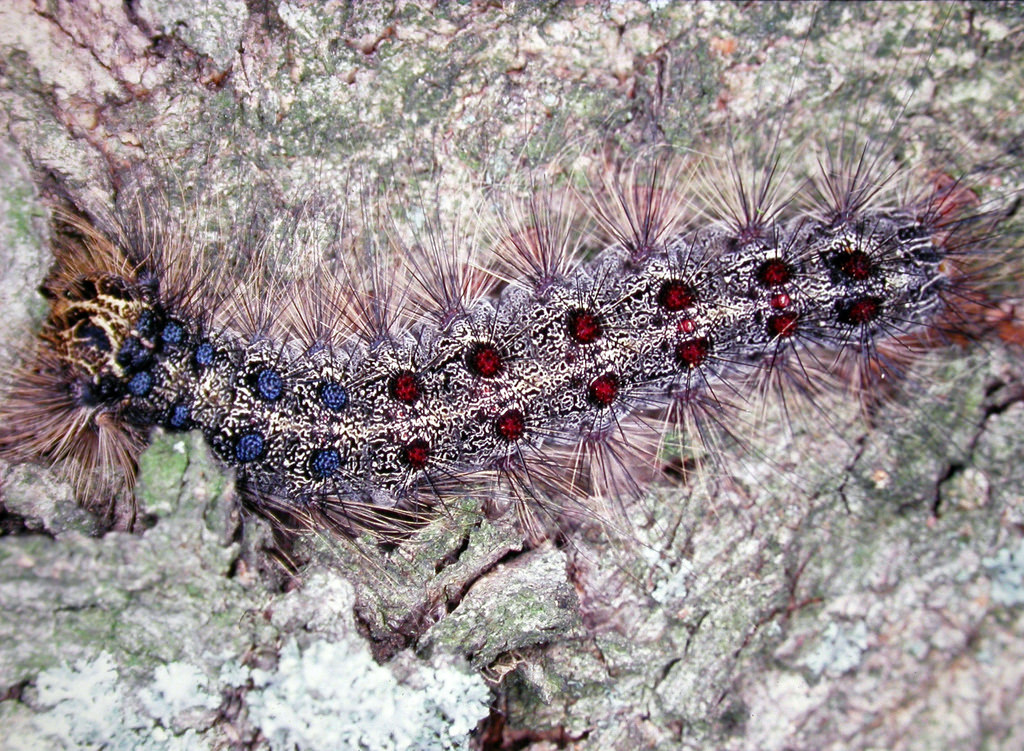
Gypsy moth caterpillar, one of the species found in the community centre. Photo by Brad Smith, used under terms of a Creative Commons BY-NC 2.0 Licence.
I have handled forest tent caterpillars for years, as have many other researchers, the students in my lab as well as my own children. We have also given hands-on science exhibits, in which countless other children have handled them. Fitzgerald’s classic 1995 book The Tent Caterpillars contains a chapter on “Maintaining Colonies and Suggestions for Classroom Activities”. No-one to my knowledge has had an allergic reaction.
Does this mean that it is impossible that someone be allergic to the hairs on these caterpillars? Of course not, allergies are very diverse, widespread, complex and poorly understood. Some people are allergic to laundry detergent, others to strawberries.
Are there any benefits to be gained by children handling caterpillars? First, it’s hard to stop them. Children are curious and intrigued by the world around them, and caterpillars are ideal experimental subjects: they move and do interesting things, but not too fast. They can be herded and driven across bridges, housed in jars and passed from one finger to the next, but never entirely controlled as they generally manage to escape somehow. This kind of non-directed, curiosity-driven play is just the sort that develops scientific thinking. In addition, spending time with nature calms people, children and adults alike, and helps them recover from stress. Finally, conservation ethics – a feeling that the natural word is precious and deserves protection for its own sake – develops in childhood, through non-directed play in nature. A type of play that is becoming less and less accessible for an increasing number of city-dwelling children.
Instilling fear of the natural world – fear of even something as cute, slightly ridiculous and totally innocuous-looking as a fuzzy caterpillar – cannot be a good way to go, in a world that increasingly needs calm, unstressed people with conservation ethics.
As part of a continuing series of Canadian Entomology Research Roundups, here’s what some Canadian entomology grad students have been up to lately:
From the authors:
Finn Hamilton (University of Victoria)
It is now well known that the majority of insects host symbiotic bacteria that have profound consequences for host biology. In some cases, these symbioses can protect hosts against virulent parasites and pathogens, although in most cases it remains unclear how symbionts achieve this defense. In this paper, we show that a strain of the bacterium Spiroplasma that protects its Drosophila host against a virulent nematode parasite encodes a protein toxin. This toxin appears to attack the nematode host during Spiroplasma-mediated defense, representing one of the clearest demonstrations to date of mechanisms underpinning insect defensive symbiosis. Article link

This is a Drosophila falleni fly infected by the nematode, Howardula aoronymphium, which Spiroplasma protects against. Photo credit: Finn Hamilton.
Lucas Roscoe (University of Toronto)
The Emerald Ash Borer (Agrilus planipennis Fairmaire, EAB) is a buprestid pest of ash trees in North America. As part of the development of long-term management plans for EAB, several projects detailing the biology and ecology of poorly-known, yet indigenous parasitoids associated with EAB were initiated. One project concerned the mating sequences of the chalcidid parasitoid, Phasgonophora sulcata Westwood. Many insects undertake repeatable actions prior to mating. These are commonly mediated by pheromones. The results of this research were the description of the mating sequence of P. sulcata, and evidence of female-produced pheromones that initiate these actions. Article link

Phasgonophora sulcata, an important parasitoid of the emerald ash borer. Photo credit: Lucas Roscoe.
Marla Schwarzfeld (University of Alberta)
The parasitic wasp genus Ophion (Hymenoptera: Ichneumonidae) is almost entirely unknown in the Nearctic region, with the vast majority of species undescribed. In this study, we published the first molecular phylogeny of the genus, based on COI, ITS2, and 28S gene regions. While focusing on Nearctic specimens, we also included representatives of most known species from the western Palearctic region and several sequences from other geographical regions. We delimited 13 species groups, most recognized for the first time in this study. This phylogeny will provide an essential framework that will hopefully inspire taxonomists to divide and conquer (and describe!) new species in this morphologically challenging genus. Article link

A parasitoid wasp in the genus Ophion. Photo credit: Andrea Jackson
Seung-Il Lee (University of Alberta)
Seung-Il Lee and his colleagues (University of Alberta) found that large retention patches (> 3.33 ha) minimize negative edge effects on saproxylic beetle assemblages in boreal white spruce stands. Article link Blog post

A saproxylic beetle, Peltis fraterna. Photo credit: Seung-Il Lee.
Paul Abram (Université de Montréal)
The relationship between insect body size and life history traits (e.g. longevity, fecundity) has been extensively studied, but the additional effect of body size on behavioural traits is less well known. Using the egg parasitoid Telenomus podisi Ashmead (Hymenoptera: Platygastridae) and three of its stink bug host species as a model system, we showed that body size differences were associated with a change in a suite of not only life history parameters (longevity, egg load, egg size), but also several behavioural traits (walking speed, oviposition rate, host marking speed). Our results highlight how the entire phenotype (behaviour and life history) has to be considered when assessing associations between body size and fitness. Article link
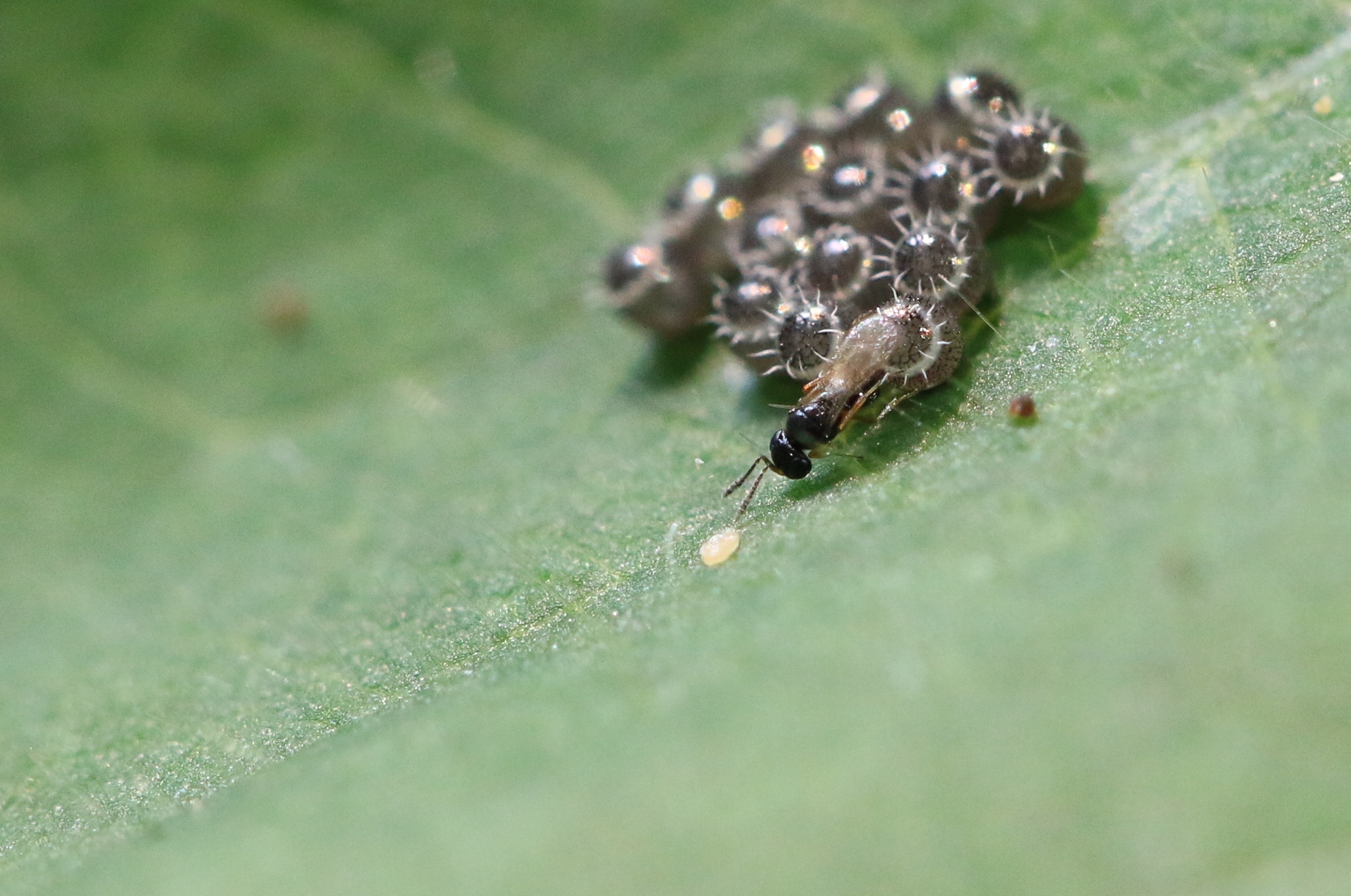
The parasitoid Telenomus podisi parasitizing eggs of the stink bug Podisus maculiventris. Photo credit: Leslie Abram.
Delyle Polet (University of Alberta)
Insect wings often have directional roughness elements- like hairs and scales- that shed water droplets along the grain, but why are these elements not always pointing in the same direction? We proposed that three strategies are at play. Droplets should be (1) shed away from the body, (2) shed as quickly as possible and (3) forced out of “valleys” formed between wing veins. A mathematical model combining these three strategies fits the orientation of hairs on a March fly wing (Penthetria heteroptera) quite well, and could readily be applied to other species or bioinspired materials. Article link
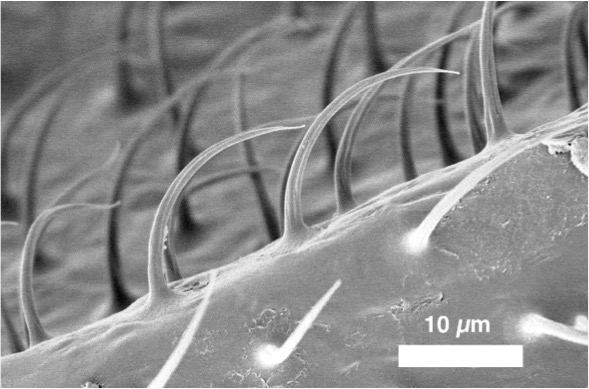
Hairs on a March fly (Penthetria heteroptera) wing. Photo credit: Delyle Polet.
In-brief research summaries
Taxonomy, Systematics, and Morphology
Thomas Onuferko from the Packer Lab at York University and colleagues carried out an extensive survey of bee species in Niagara Region, Ontario. Onuferko et al. collected over 50 000 bees and discovered 30 species previously not recorded in the area. Article link
Christine Barrie and colleague report the Chloropidae flies associated with common reed (Phragmites) in Canada. Article link
Behaviour and Ecology
Blake Anderson (McMaster University) and colleagues investigates the decoupling hypothesis of social behaviour and activity in larval and adult fruit flies. Article link
Susan Anthony from the Sinclair Lab at Western University, along with Chris Buddle (McGill University), determined the Beringian pseudoscorpion can tolerate of both cold temperatures and immersion. Article link
A study by Fanny Maure (Université de Montréal) shows that the nutritional status of a host, the spotted lady beetle (Coleomegilla maculata), influences host fate and parasitoid fitness. Article link
Is connectivity the key? From the Buddle and Bennett Labs at McGill University and the James Lab at (Université de Montréal), Dorothy Maguire (McGill University) and colleagues use landscape connectivity and insect herbivory to propose a framework that examines that tradeoffs associated with ecosystem services. Article link
Alvaro Fuentealba (Université Laval) and colleague discovered that different host tree species show varying natural resistance to spruce budworm. Article link
Insect and Pest Management
Rachel Rix (Dalhousie University) et al. observed that mild insecticide stress can increase reproduction and help aphids better cope with subsequent stress. Article link
Lindsey Goudis (University of Guelph) and others found that the best way to control western bean cutworm is to apply lambda-cyhalothrin and chlorantraniliprole 4 to 18 day after 50 % egg hatch. Article link
Matthew Nunn (Acadia University) and colleague document the diversity and densities of important pest species of wild blueberries in Nova Scotia. Article link
Physiology and Genetics
Does heterozygosity improve symmetry in the Chilean bee, Xeromelissa rozeni? Margarita Miklasevskaja (York University) and colleague tested this hypothesis in their recent paper. Article link

A Chilean male Xeromelissa rozeni. Photo credit: Margarita Miklasevskaja.
Recent University of Alberta graduate Jasmine Janes and others explored the mating systems and fine-scale spatial genetic structure for effective management of mountain pine beetle. Article link
Also from the Sperling Lab at the University of Alberta, Julian Dupuis and Felix Sperling examined the complex interaction of hybridization and speciation. They characterized potential hybridization in a species group of swallowtail butterflies. Article link
Marina Defferrari (University of Toronto) and colleagues identified new insulin-like peptides in Rhodnius prolixus and that these peptides are involved in the metabolic homeostasis of lipids and carbohydrates. Article link
Techniques
Crystal Ernst (McGill University) and colleague sampled beetles and spiders in different northern habitats. They found that the diversity of beetles and spiders are affected by habitat and trap type. Article link
We are continuing to help publicize graduate student publications to the wider entomological community through our Research Roundup. If you published an article recently and would like it featured, e-mail us at entsoccan.students@gmail.com. You can also send us photos and short descriptions of your research, to appear in a later edition of the research roundup.
For regular updates on new Canadian entomological research, you can join the ESC Students Facebook page or follow us on Twitter @esc_students.
CONTACTER LA SOCIÉTÉ
Assistant administratif : info@esc-sec.ca
SEC Président : ESCPresident@esc-sec.ca
This post is also available in: