


Nouvelles

By Rama – Commons file, CC BY-SA 2.0 fr, https://commons.wikimedia.org/w/index.php?curid=53046764
Last winter, I spent a few months working on insect identifications for the BC Conservation Data Centre, mostly collections of insects made at newly-acquired conservation lands in the Okanagan and Kootenay regions of BC.
As I had no laboratory of my own, and no reference collections to work with, I was working out of the ROM, back behind Antonia Guidotti’s office in the entomology workroom. This place, in midwinter, is usually a little lonely, as Antonia has a lot of work to do all around the collection. And so mostly in solitude, I would sit there at my microscope, stumbling through insect IDs, learning what I could about a vast array of taxa, and listening to an inordinate amount of Leonard Cohen’s music.
Somehow, I feel the mood of Leonard Cohen’s later works lends itself so well to solitary entomology pursuits. The consummate outsider, looking closely and inwardly at the human condition, and yet always so aware of a wider world, Leonard’s music has many parallels to sitting at a scope, baffled by Nature’s diversity and wondering how it all fits together.
(As an aside, when I was going through scads of unfortunate, dead, trapped insects, the song « Who by Fire » seemed morbidly appropriate)
Occasionally, from the lab bench, I would reach out to the other folks online, sharing my discoveries through Twitter (the entomology workroom has a modest wireless connection!).
How excited I was, having lived in BC most my life to discover the wonderful piglet bug Bruchomorpha beameri, a wonderful fulgoroid planthopper that I had no idea even existed before taking this contract!
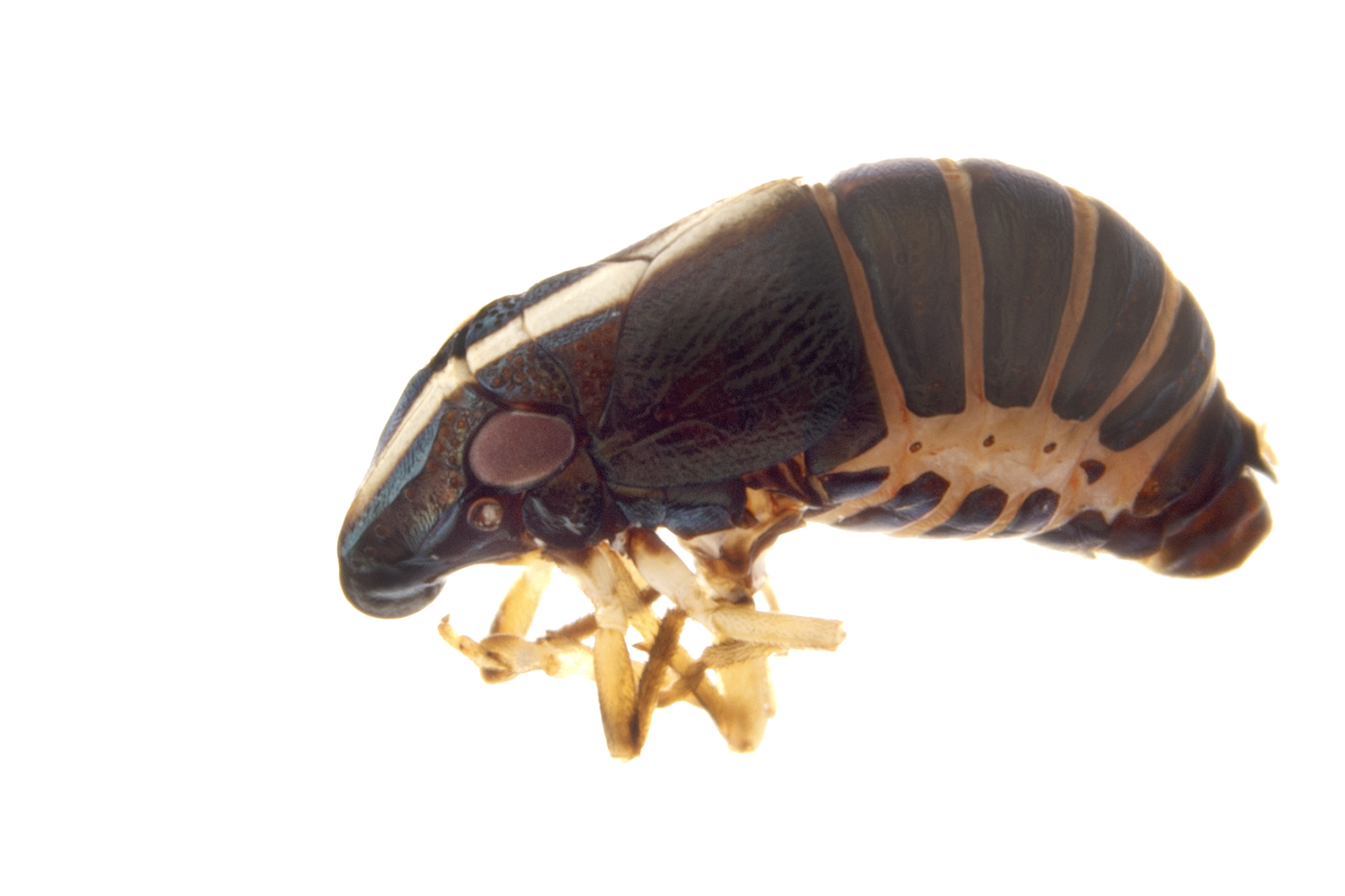
It was heartening, sitting there alone, singing softly along to Leonard Cohen that people out there on Twitter responded so well to my excitement at discovering these treasures, and offering helpful advice. Terry Wheeler was especially helpful when I was stumbling over some puzzling scathophagids from the Peace District.
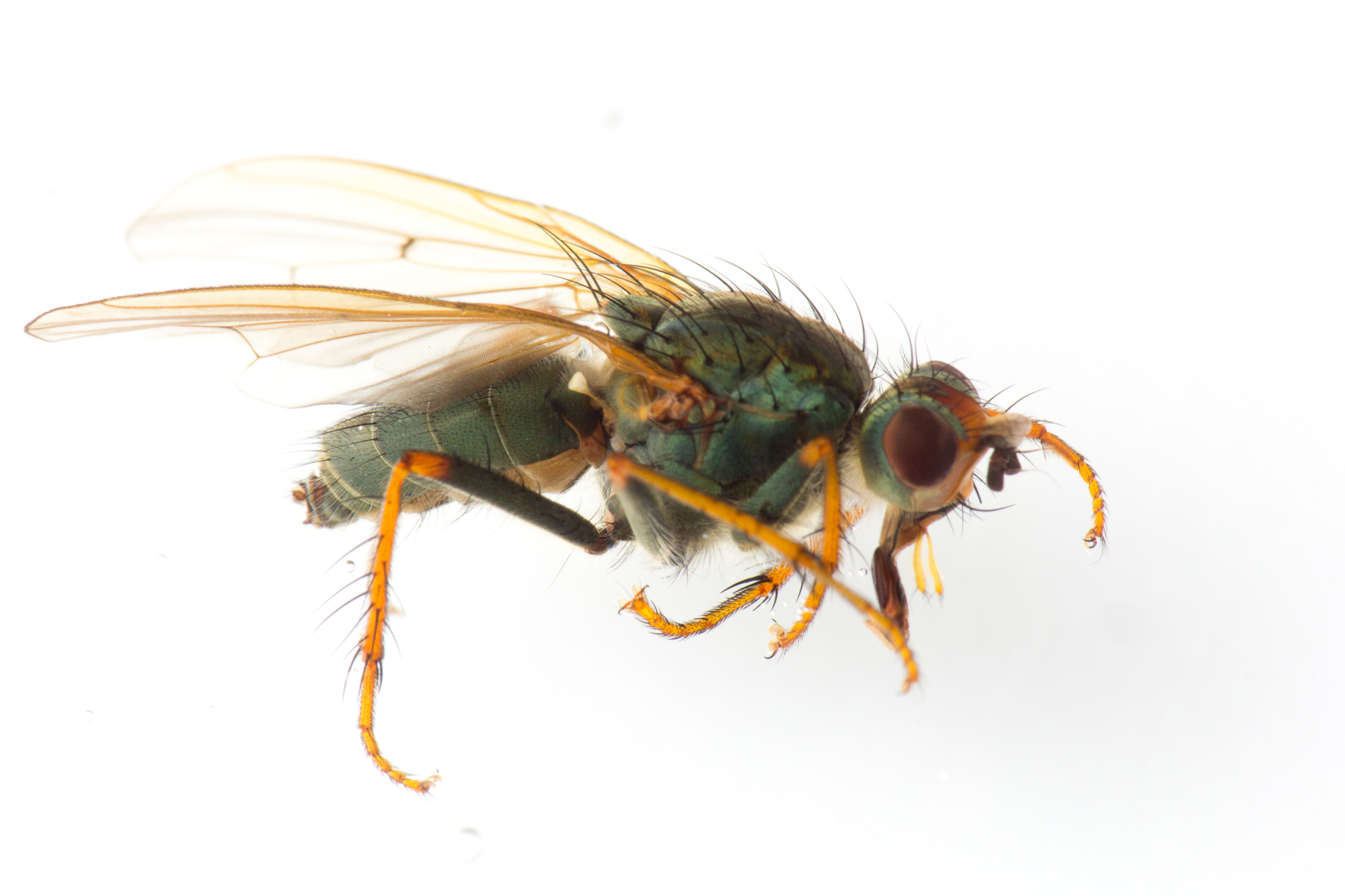
Connecting with people like Terry, who encouraged me through my ID struggles made me feel that despite being on the outer edges of my knowledge and what could reasonably be called paid employment in entomology, people cared about what I was doing and were there if I needed them.
With the help of Terry, Antonia, Laura Timms, Lu Musetti, and the great Leonard Cohen, I struggled my way through my contract, and my first eastern winter. Last week, Leonard Cohen died, leaving a huge hole in Canadian songwriting. We still have his recordings and poems to keep us company, though no matter what we are doing.
On Tuesday, I will head back to the ROM as a volunteer, to help sort out some of the ant collection, to the best of my ability. Perhaps I will listen to some of Leonard Cohen’s music, and tweet out some of what I find to connect me and my entomology work to the wider world.
[youtube https://www.youtube.com/watch?v=NW7oNpzBSGc&w=560&h=480]
The Department of Horticulture at Oregon State University seeks outstanding candidates for a full-time, nine month, tenure track position titled: Extension Specialist—Vegetable and Specialty Seed Crops. The position is based at the North Willamette Research and Extension Center (NWREC) located in Aurora, OR—about 90 minutes north of Corvallis, OR and Oregon State University’s main campus. The position is at the assistant professor rank.
We seek an individual that will develop a regionally and nationally recognized, Extension outreach and research program in support of the fresh and processed vegetable and specialty seed crop industries. Extramural funding generated by the incumbent will help support this position and grow capacity. The appointment is 50% Extension, 30% research, 15% scholarship, and 5% service. Potential areas of emphasis could include, but are not limited to: pest management, irrigation, soil fertility and nutrient management, production science, food safety, marketing, environmental monitoring, technology and automation. The incumbent will be expected publish in peer-reviewed scientific journals and present at professional meetings. Also, the incumbent will be expected to work closely with other OSU faculty—on campus and off-campus who support vegetable and specialty seed crop research, teaching, Extension and outreach.
See flyer for more details & how to apply. Deadline November 20, 2016.
Aziz Sancar delivering his Nobel Lecture for his prize in Chemistry 2015. He said yes.
My early morning wakeup on Wednesday, October 7, 2015 began as usual with a, though admittedly not healthy, quick Twitter check. My internet-induced squint widened when I saw that Aziz Sancar was trending. Dr. Sancar had just been named co-winner of the Nobel prize in chemistry for his work on DNA repair mechanisms. Not at all surprised by the recognition of his career achievements, I was, however, flabbergasted because I actually know Aziz Sancar and in no small way, my career is what it is because of his generosity and kindness.
Twenty years ago, I was an MSc candidate studying the physiological ecology of amphibians at Trent University. At the time I was working with Michael Berrill on replicating and testing the findings of a 1994 PNAS paper by Andrew Blaustein and company. This was important work on declining amphibian populations in the Cascade Mountains. They found that these declining populations were characterised by low levels of a DNA repair enzyme called photolyase. This finding was intriguing because photolyase catalyses the repair of the principal form of damage to DNA from ultraviolet-b radiation. Because emerging ozone holes would result in natural populations experiencing an increased amount of UVB radiation, low levels of photolyase might be a “magic bullet” that explained which populations would be in decline in otherwise “pristine” areas.
Intriguing, but I was actually not ready to test it. With a potent combination of naïve enthusiasm, I figured I could simply contact the authors of the paper and ask them to teach me the methods that I needed to know to further their work. I tried email but could not find an address on the department website. So I phoned the Department of Biochemistry at the University of North Carolina at Chapel Hill. They explained that Dr. Sancar did not want or have an email address. I asked that the call be connected to his office. When he picked up the phone, I leapt immediately into my explanation that I was an MSc student from Trent University in Peterborough, Canada, and that I was hoping to visit his lab to learn methods of photolyase extraction that I would apply to my system. To my now weathered academic amazement, but, at the time, only to my joy, immediately and without hesitation, he said yes. If I could get myself to Chapel Hill, he would teach me what I needed to know.

Alex Smith with hair studying amphibian photolysase induction and concentration in the late 20th century.
So on my spring break of 1997, I rented a car (two cars actually – one died, another story) and drove from snowy Peterpatch to the flowering springtime of Chapel Hill, North Carolina to spend a week in Dr. Sancar’s lab. “Lab” didn’t quite cover it. Dr.’s Sancar (he and his wife, Dr. Gendolyn Sancar) had a floor of the building at UNC. Dr. Sancar met me on that Monday morning and arranged for a postdoc and a PhD student to help me all week and ensure that I could extract and purify the enzyme. He even arranged for another lab to give me some African clawed frog eggs to practice on! He met with me every day to see how I was progressing and answer any questions. I remember him encouraging me to take in a UNC NCAA women’s basketball game while in Chapel Hill (Tar Heels!), and I was very impressed that this academic superman was often watching soccer in his office when I arrived (the knockout phase of the UEFA Champions League, I think). A man of many interests! I left at the end of the week and proceeded to apply these methods successfully in my MSc. Three papers (Smith 2000, Smith et al 2000, and Smith et al 2002), eventually came from this project and one of the principal findings was that this enzymatic system could be induced in individuals from natural populations (previously not considered – and something that dramatically affects ones’ estimation of a populations’ photolyase level).
In my paper I was very critical of previous research – and not surprisingly, the manuscript received quite harsh and negative reviews. I had never written a response to reviewer comments before, and I did not craft them elegantly or with appreciation. Dr. Sancar was the editor at the journal handling the submission. He phoned me to suggest how I might better word my response. Connecting the phone call alone was no easy feat considering I was living in my car at the time, couch-surfing amongst friends on the west coast of North America – I’m still not sure how he managed to find me. But the advice was priceless and likely not something I would have come to on my own (let’s say it was something along the lines of…“I can hear that you’re angry by these comments, and they are not elegant – but you can’t say what you’ve said. What you mean is this……..so try expressing it like this….”). I was so appreciative, and now 20 years later I’m not sure I expressed my gratitude sufficiently.
And so, fast forward 20 years when I wake to read that the world has recognised Aziz Sancar for his pioneering work in the broad field of DNA repair. It made me think about the often unappreciated or unintended effects that saying yes can have on those around you.
At the end of his Nobel Lecture in Sweden in December 2015, Dr. Sancar showed a slide acknowledging his lab and colleagues. In part, these people and their output are the metrics that the Nobel committee evaluated in awarding him the prize. It was an impressive, but I knew not an exhaustive, list, for Dr. Sancar’s direct effect on my career – and indirectly then on all the students I have worked with in the subsequent years – was invisible to the Nobel committee (and perhaps not even remembered by Dr. Sancar). But these effects are significant and they came from a busy scientist saying yes when confronted with a naïve but enthusiastic student. There were many reasons for him to not take my call, not encourage me to come to North Carolina, not host me while I was there nor mentor me through the review process later on. But he did. He did say yes and it had an immeasurable effect.
I now work with insects in the neotropics and Canada on questions of biodiversity. I don’t work with photolyase and I don’t work as a physiological ecologist. However, by saying yes to me 20 years ago, Dr. Sancar’s act of generosity enabled me to follow this path. In the over-scheduled and busy lifestyle that we lead, it is important to consider this ripple that saying yes can have. There are many intended and measurable outcomes of supervision and mentoring – however there are many, perhaps more, unintended and important effects that kindness can have. As Anne Galloway said on Twitter, “We’re all smart – distinguish yourself by being kind”. The Nobel committee judged Dr. Sancar’s academic output worthy of its highest award last year. They were likely unaware of the affect that he has had in other scientific disciplines through his generosity and kindness.
I don’t think I said it clearly enough before. Thank you Dr. Sancar.
Dr. Alex Smith
Department of Integrative Biology,
University of Guelph
Notre but initial, pour mon superviseur Dr. Brent Sinclair et moi, était de voyager au Yukon pour collecter des araignées. Nous avions entendu du Dr. Chris Buddle, que nous allions rencontrer là-bas, que les araignées étaient nombreuses. Et il avait bien raison ! Cependant, nous ne pensions pas être charmé par le minuscule (maximum 3mm), mais fougueux pseudoscorpion Wyochernes asiaticus et qu’il pique autant notre curiosité.

Une femelle W. asiaticus avec une poche pleine d’oeufs. Beaucoup des pseudoscorpions furent trouvé pleins d’oeufs qui ont éclos à notre retour en Ontario. Crédit photo: Brent Sinclair
Notre équipe de recherche a quitté Whitehorse avec tout l’équipement nécessaire (nourriture, réchaud, véhicule à quatre roues motrices et beaucoup de contenants pour l’échantillonage) et nous avons passés les deux prochaines semaines à explorer la tundra, se dirigeant vers le Nord sur la « Dempster Highway ». Cette route est probablement la seule route entretenue au Nord du Yukon et nous permet d’atteindre la région béringienne. Alors que les glaciers recouvraient la plupart de l’Amérique du Nord durant la dernière ère glacière, la Béringie était un des seuls endroits n’ayant pas été ensevelie. Pour cette raison, beaucoup des espècesqui s’y trouvent , telles que W. asiaticus, pré-datent la dernière ère glacière. Bon, cette créature n’est peut-être pas aussi excitante qu’un mammouth ou un castor géant, mais, pour les chercheurs travaillant sur les arthropodes, elle est très spéciale.
C’est Dr. Buddle qui a attiré notre attention sur ces créatures. Il en avait trouvé durant des voyages antérieurs et voulait avoir des échantillons provenant de différentes latitudes (nous avons traversés environ 10 dégrées de latitude durant notre voyage). Il a demandé notre aide pour collecter les échantillons de pseudoscorpions. Ceux-ci vivent sous des roches plates sur les rives des rivières. C’est pendant l’échantillonnage que nous nous sommes demandés ce qu’ils faisaient le reste de l’année. Non seulement ils doivent supporter le froid éprouvant de l’hiver arctique, mais vivent aussi dans une région où il y a des crues périodiques. Nous voulions voir quelle était leur tolérance pour le froid et pour la submersion. Nous allons pris et les avons rapporter vers notre laboratoire à University of Western Ontario, avec aussi environ 600 araignées
De retour dans le laboratoire, j’ai mesuré le point de congélation, les points thermaux critiques minimum et maximum (CTmin et CTmax; les limites de l’activité) des pseudoscorpions. Leur point de congélation, déterminant s’ils survivent ou pas à la congélation, nous a donné une idée de leur habilité à surmonter les hivers glaciaux de l’Arctique. Nous sommes intéressés par le CTmin et CTmax car ils nous permettent d’avoir une bonne idée de leurs limites écologiques, c’est-à-dire s’ils peuvent se déplacer, se nourrir ou se défendre. Nous avons découvert que ces petites bêtes avaient une très mauvaise tolérance au froid. Ils ne survivent pas à la congélation et, aux alentours de -4°C ne peuvent plus bouger. L’Arctique peut atteindre des températures bien plus froides que ça ! Nous pouvons seulement supposer qu’ils recherchent des refuges thermaux très efficaces durant l’hiver ou qu’ils ajustent leur tolérance au froid durant l’année, comme beaucoup d’insectes.
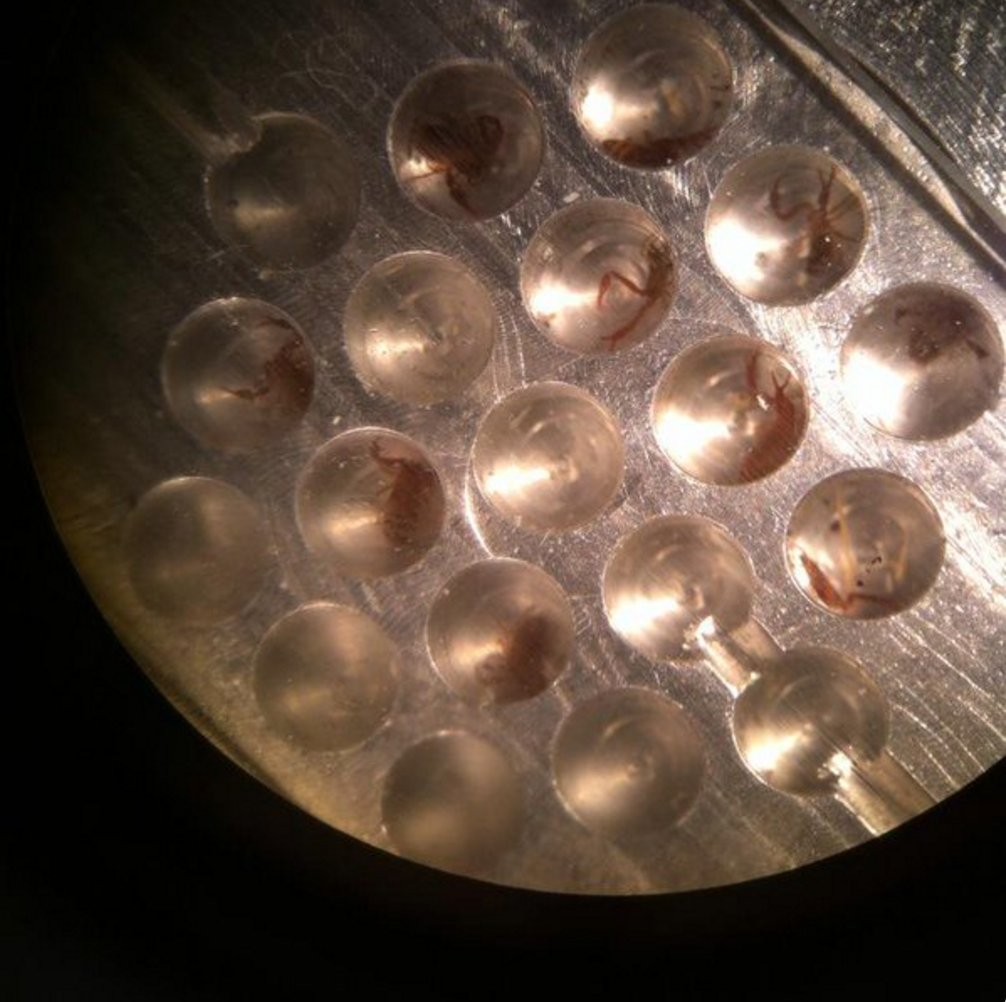
De retour au laboratoire, j’ai utilisé un bloc de métal avec des petits trous pour abriter les pseudoscorpions. Le bloc pouvait être réchauffé ou refroidi et, ainsi, je pouvais observer le moment où les individus arrêtaient de bouger. La photo fut prise à travers un microscope. Crédit photo: Susan Anthony
Parlant de changements de saison, nous assumons que leur habitat est inondé de façon saisonnière vu que nous les avons trouvés sur le bord d’une rivière. Est-ce qu’ils se déplacent en amont de la rivière ? Est-ce qu’ils nagent ? Est-ce qu’ils apportent une bulle d’air avec eux, comme les araignées plongeuses ? Au départ, nous pensions qu’ils tenaient une bulle d’air entre leur abdomen et les roches auxquelles ils s’accrochent. Dans nos expériences, ils ont survécu une semaine submergés dans les eaux hautement oxygénées ayant un taux de survie similaire à ceux qui ne vivaient pas sous l’eau. Cependant, ils avaient aussi le même taux de survie que ceux qui étaient submergés dans des eaux peu oxygénées. Nous concluons donc qu’ils tolèrent le fait d’être sous l’eau, mais qu’ils ne se comptent pas sur l’oxygène provenant de l’eau environnante.

Sheep Creek, la rivière où nous avons collecté Wyochernes asiaticus. Les spécimens étaient plus commun à environ 1m au dessus du niveau de l’eau, sous les roches plates. Crédit photo: Chris Buddle
Notre excursion dans le Nord pour l’échantillonnage nous aura donc donné une belle surprise. Un petit pseudoscorpion sur les rives de la rivière a capté notre attention. Cependant, ce n’est pas la seule chose pouvant provoquer un lot de fascination lorsqu’au Yukon. De l’énorme grizzly au caribou aux centaines d’araignées et aux collemboles dont ils se nourissent, l’Arctique est en effet un endroit unique.
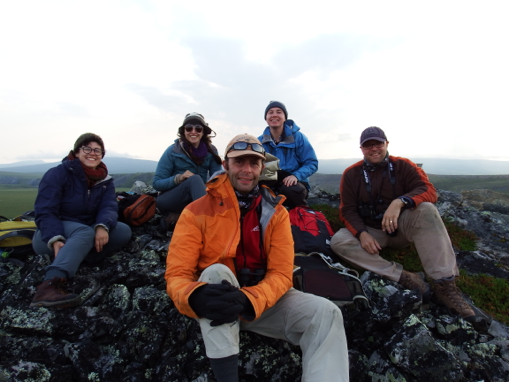
L’équipe de biologie arctique: (g-d) Anne-Sophie Caron (Université McGill), Susan Anthony (Western University), Dr. Brent Sinclair (Western University), Saun Thurney (Université McGill), and Dr. Chris Buddle (Université McGill). Crédit photo: Mhairi McFarlane.
CONTACTER LA SOCIÉTÉ
Assistant administratif : info@esc-sec.ca
SEC Président : ESCPresident@esc-sec.ca
This post is also available in: