As a graduate student, publishing a paper is a big deal. After spending countless hours doing the research, slogging through the writing process, soliciting comments from co-authors, formatting the paper to meet journal guidelines, and dealing with reviewer comments, it’s nice to finally get that acceptance letter and know that your work is getting out there. The ESC Student Affairs Committee is happy to be posting a fourth roundup of papers authored by Canadian graduate students. Stay tuned to the ESC blog for some full length guest posts from some of the students below in the coming weeks!

Have a look at what some entomology grad students in Canada have been up to recently! Articles below were published online from April through June 2015.

Forestry

Seehausen et al. found that parasitism of hemlock looper Lambdina fiscellaria (Guenée) (Lepidoptera: Geometridae) pupae was significantly reduced in plots with high partial cutting intensities (40%). To sustain parasitism rates in forest stands vulnerable to hemlock looper defoliation at naturally high levels, it is recommended to refrain from high intensity partial cutting. Article link

Apechthis Ontario parasitizing a hemlock looper pupa (Photo credit: Lukas Seehausen)

Apechthis ontario parasitizing a hemlock looper pupa (Photo credit: Lukas Seehausen)

During its recent outbreak starting in the early 2000s, the mountain pine beetle destroyed huge areas of lodge pole pine forests in BC and Alberta while also expanding its geographic range east and north. More recently, the beetle has been confirmed to be attacking and reproducing in a novel host, jack pine, which is distributed from Alberta to the Atlantic coast. New research by Taft et al. looks at how specific chemicals in jack pine trees that affect mountain pine beetle vary in jack pine across its range. Article link

Another study from the Erbilgin lab at University of Alberta by Karst et al. revealed that stand mortality caused by prior beetle attacks of mature pines have cascading effects on seedling secondary chemistry, growth and survival, probably mediated through effects on below-ground mutualisms. Article link

Physiology and Genetics

Proshek, Dupuis, et al. found the genetic diversity of Mormon Metalmark species complex are more diverse than traditional morphological characters. Article link

A Lange Metalmark butterfly (Photo: Wikimedia Commons)

Oudin, Bonduriansky, and Rundle at the University of Ottawa found the amount of sexual dimorphism present in antler flies is condition-dependent. Article link

Nearby at Carleton University, Webster et al. studied the edge markings on moths to show they can provide camouflage by breaking up their body outline. Article link

Another study from Carleton University, from Hossie et al., showed that predator-deterring eyespots tend to appear on larger-bodied caterpillars and that smaller species are better off remaining undetected. Check out the detailed blog post about this study on the lead author’s blog, and a great photo gallery of caterpillars with eyespots! And here’s the link to the Article.

Jakobs, Gariepy, and Sinclair established that adult phenotypic plasticity is not sufficient to allow Drosophila suzukii to overwinter in temperate habitats. Article link

Insect Management

Part of the PhD work of Angela Gradish focused on the White Mountain arctic butterfly (WMA), a very rare butterfly occurring only on the alpine zone of Mts. Washington and Jefferson in New Hampshire. Despite its threatened status, little was known of the WMA’s population structure, distribution, and behaviour. So Gradish grabbed a net and headed up Mt. Washington, where she spent part of two summers collecting WMA samples for genetic analyses while performing a mark-release-recapture study on the population. She was the first to use genetic analyses to study the WMA, the results of which are presented here.  Find the results of the mark-release-recapture study here.

Angela Gradish collecting

Collecting butterflies on Mount Washington (photo credit: Angela Gradish).

Marshall and Paiero, from the Marshall lab at University of Guelph, gives a new record of a Palaearctic leaf beetle, Cassida viridis, which has been present in Ontario since 1974. Article link

Maguire et al., from the Buddle lab at McGill University, found destructive insect herbivores can positively or negatively impact ecosystem services depending on outbreak conditions. Article link

Biodiversity

Ernst and Buddle discovered that the diversity and assemblage structure of northern carabid beetles show strong latitudinal gradients due to the mediating effects of climate, particularly temperature. Article link

Behaviour and Ecology

The Luong lab at University of Alberta observed that ectoparasitic mites have deleterious effects on host flight performance of Drosophila species. Article link

Therrien et al. from the Erbilgin lab at the University of Alberta found that bacteria can influence brood development of bark beetles in host tissue. Article link

Desai, Kumar, and Currie from the Currie lab at the University of Manitoba conducted the first major baseline study of viruses in Canadian honey bees to show that deformed wing virus has the highest concentration among worker bees. Article link

Baines, McCauley, and Rowe from the Rowe lab at University of Toronto showed that dispersal is a positive function of body condition in backswimmers, but not interactive with predation risk. Article link

Backswimmers can often be seen swimming just under the surface of the water, ventral side up (Photo credit: Shannon McCauley).

Backswimmers can often be seen swimming just under the surface of the water, ventral side up (Photo credit: Shannon McCauley).

Strepsiptera is a peculiar and enigmatic insect order. All are entomophagous endoparasitoids. Unusually for parasitoids, they possess a very broad host range, encompassing 7 orders and 34 families of insects, in various habitats worldwide. Despite their broad host range, and cosmopolitan distribution, surprisingly little is known about their biology. The gaps in knowledge of this group has led to many generalizations about their biology and behaviour. Only recently are studies beginning to uncover a hitherto unforeseen diversity in reproductive strategies. In this review, Kathirithamby, Hrabar, and colleagues discuss the reproductive biology of Strepsiptera: what is known, and what mysteries remain to be solved. Article link

In the Sargent lab at University of Ottawa, Russell-Mercier and Sargent investigated herbivore-mediated differences in floral display traits and found that they impacted pollinator visitation behaviour, but not in female reproductive success. Article link

Techniques

Can you use gut content DNA analysis of a staphilinid beetle to track predation of spotted wing drosophila? Here’s what Renkema et al. found.

Rosati et al., from the Vanlaerhoven lab at University of Windsor, discuss using ImageJ software to quantify blow fly egg deposition in a non-destructive manner. Article link

We are continuing to help publicize graduate student publications to the wider entomological community through our Research Roundup. Find the previous edition here: http://escsecblog.com/2015/05/04/canadian-entomology-research-roundup-march-2015-april-2015/. If you published an article recently and would like it featured, e-mail us at entsoccan.students@gmail.com. You can also send us photos and short descriptions of your research, to appear in a later edition of the research roundup.

For regular updates on new Canadian entomological research, you can join the ESC Students Facebook page or follow us on Twitter @esc_students

Opinion Piece – M. Alex Smith, Department of Integrative Biology, University of Guelph (salex@uoguelph.ca; @Alex_Smith_Ants; www.malexsmith.weebly.com)

—-

Like many Canadians, I have been hearing more and more about the so-called “Mother Canada” development in Cape Breton Highlands National Park (CBHNP). Proposed by a combination of private funding in partnership with the federal government, this enormous 10-storey memorial is meant to “… be a place for remembrance and gratitude” to Canadians who have “fallen as a result of war and conflict”. Parks Canada has expressed direct support for this monument through actual monetary donations. The erection of such a memorial within a Canadian National Park has garnered much recent interest in the Canadian and international press.

Beyond any aesthetic concerns people may have about the specific plans, in my opinion, there are two critical problems with this monument. The first was pointed out in a Globe and Mail editorial of June 24 2015: it is redundant. Every town and city in Canada already has a memorial to those who have served and sacrificed. My second objection is a combined biological and sociological one. It concerns the location of a private funded monument within a Canadian National Park, where it appears very unclear what the ramifications of that action will be on the fauna in and around the proposed site. The mandate of Parks Canada is elegantly expressed in its charter, “To protect, as a first priority, the natural and cultural heritage of our special places and ensure that they remain healthy and whole” while fostering “public understanding, appreciation and enjoyment in ways that ensure the ecological and commemorative integrity of these places for present and future generations”. Indeed, 26 former senior Parks Canada managers wrote an open letter to the Minister of Environment Leona Aglukkaq detailing their objections and that such a plan, “is in violation of the site’s Wilderness Zone designation as detailed in the Management Plan for the Park”.

Beyond the effects of the actual physical construction on the park environment, the monument will potentially increase tourist traffic to the area. How will these changes affect the biota (both animal and plant) of the immediate area? Exactly how well known is that fauna? How was the effect on the sites and the adjacent park environment determined?

A detailed impact analysis was completed by Stantec Consulting Limited who concluded that the effects of the development are, “generally predicted to be negligible to moderate in magnitude”. Conclusions regarding the effect of the construction and development on the “wildlife” of CBHNP were based on a single terrestrial field survey of the locality and a consultation of a CBHNP sightings database. (Stantec is actually listed as a Partner and Supporter of the development). In the Stantec impact analysis, “wildlife” is exclusively mammals and birds. As an ecologist whose professional and personal life is replete with instances of being overwhelmed and delighted by the diversity of arthropods living coincidentally (and cryptically) with their better-studied vertebrate relatives, this raised some concerns.

So what can I offer? Well in 2009, I spent a wonderful time collecting arthropods in CBHNP as part of the BioBus program out of the Biodiversity Institute of Ontario at the University of Guelph. In fact, four colleagues and I spent a night collecting insects at a site only 3 km away from the proposed development (Black Brook and the nearby Jack Pine Trail). The Jack Pine trail was particularly beautiful! The trail goes through a forest of Jack Pine that is more than 200km away from the rest of its range and has survived fire and spruce budworm infestation. At any rate, since all the data is publicly available online (dx.doi.org/10.5883/DS-ASCBHNP), I thought this would be an opportune time to explore those records in light of the planned “Mother Canada” development.


Figure 1: A high resolution GigaPan panorama taken at the Black Brook collection site (http://gigapan.com/gigapans/29312).

Figure 1: A high resolution GigaPan panorama taken at the Black Brook collection site (http://gigapan.com/gigapans/29312).


Figure 2: The collection team earlier in the trip in Terra Nova National Park Newfoundland.

Figure 2: The collection team earlier in the trip in Terra Nova National Park Newfoundland.

It was a beautiful night in 2009 (Jul-21) at Black Brook where we collected arthropods using two common methods (UV light (which means lots of moths!) and free-hand active search using insect nets). That night, in about four hours of collecting, we came away with 363 specimens from nearly 200 species (191 named and provisional species based on their DNA barcodes). To put this number in context, CBHNP has 200 species of bird – a total nearly matched for arthropods by our single nights work at one location! This diversity is only a small fraction of the diversity of arthropods currently protected by CBHNP. Via these DNA barcodes, (public on BOLD (www.barcodinglife.org, dx.doi.org/10.5883/DS-ASCBHNP) we can compare them to the > 4 million DNA barcode records representing >400,000 species worldwide on this database.

What we find from this comparison is that some of these species may be exceedingly rare. Despite concentrated collections in this and other National Parks before and since this night* there are four species which have been found only once out of these millions of records. While this diversity is currently protected by Parks Canada, it is within 3 km of the proposed “Mother Canada” development. It is unclear how the changes in traffic and construction from the development will affect this protected diversity.

Why bring this up now? What use is a rapid analysis of a single night’s collections? I decided to bring it up to call attention to numerous small and cryptic species in and around the location of the proposed development about which we know very little. Going ahead with an enormous private development within a National Park is a mistake that flies in the face of the mandate of Parks Canada – and does so without good evidence that it would not have negative effects on the diversity of animals that it was created to protect.


Figure 3: This neighbor-joining tree is a graphical representation of the diversity of nearly 200 species of arthropods collected at Black Brook in July 2009. The taxa are colour coded and are followed by the number of specimens we caught.

Figure 3: This neighbor-joining tree is a graphical representation of the diversity of nearly 200 species of arthropods collected at Black Brook in July 2009. The taxa are colour coded and are followed by the number of specimens we caught.

John Barber (a freelance journalist from Toronto) closed his recent article in the Guardian newspaper with a marvelous quote from Valerie Bird, a WWII veteran and resident of Cape Breton, “It is vulgar and ostentatious,” she said. “It certainly doesn’t belong in a national park, and I don’t think its going to do a darn thing for veterans.” “I think the idea of this horrible thing offends veterans,” she added. “I find it difficult to find words. This is a monstrosity.”

Not simply a monstrosity – but one contrary to of the principle mandate of Parks Canada, “to protect, as a first priority, the natural and cultural heritage of our special places and ensure that they remain healthy and whole”. Ultimately, this is the essence of the problem. This issue is more than a simple discussion regarding the aesthetics of a >$25 million, >25-metre tall conglomeration of private and corporate citizens (in apparent partnership with our federal government). If a private group wants to erect a memorial on private grounds and can raise the money for their monument – it is certainly their prerogative. This is a critical discussion about the mandate of Parks Canada and specifically how well they protect the natural heritage resident within that Park.

To place this monument in a National Park is not the right of any private group. To consider placing such a monument in a National Park without careful consideration of the most diverse Park residents (insects, spiders and their kin) is not simply poor planning; it’s poor management and should be stopped.

* -Since that evening in 2009, the BioBus has continued to collaborate with Parks Canada in Cape Breton Highlands National Park and now even more is known about the vast diversity of small and important insects from other areas within this National Park. Collections of arthropods have now been made for 3000 species! For more information about those collections visit the reports section at www.biobus.ca. The author has no current association with the BioBus program. All specimens analysed here are publically available via the public data portal of the Barcode of Life Data System (dx.doi.org/10.5883/DS-ASCBHNP).

Useful websites:

Thanks to Morgan Jackson for helpful thoughts on an earlier draft of this post.
Figure 4 – Shareable infographic outlining information & data presented in this article. Please feel free to circulate.

Figure 4 – Shareable infographic outlining information & data presented in this article. Please feel free to circulate.

Kevin-Floate-image-571x500

My name is Kevin Floate.  Back in 1985, I became a member of the Entomological Society of Canada (ESC) and found it to be a warm and supportive organization.  I’ve since undertaken a number of roles, because I enjoy a challenge, but also because I believe that it is important to give back to the Society and the scientific discipline that has given so much to me during my career.  I have served on the Society’s Governing Board and I have Chaired the Publication Committee and what is now the Marketing and Fund-raising Committee.  I am a past-Editor of theESC Bulletin and have been a Subject Editor for The Canadian Entomologist (TCE) since 2002.  In September of last year, I embarked on my most challenging role thus far, that of Editor-in-Chief (EiC) for TCE.

I didn’t make the decision lightly.  The journal has been continuously published since 1868 under the capable hands of a long-chain of EiCs and I wanted to be sure that I could devote the time to do a credible job.  So for six months prior to saying ‘yes’, I job-shadowed the activities of the previous EiC, Chris Buddle.  It also helps that I ‘inherited’ a strong Editorial Board and a very competent Assistant Editor (Andrew Smith).  With their support, my first six months at the helm have been relatively smooth sailing.

So what exactly does it mean to be the EiC?  I’m coming to realize that it means several things.  First, I’m the gate-keeper.  TCE is an international journal that publishes on all aspects of entomology.  We only ask that submissions meet the journal’s publication policy and that they be written well-enough to permit a thorough scientific review.  I assess each new submission and reject those that don’t meet these criteria.  Second, I represent the Editorial Board, who help shape the journal’s publication policy and ensure that manuscripts are reviewed by qualified individuals in a timely manner.  I note that Board members (myself included) are all volunteers and receive no compensation for our efforts.  Third, and equally important, I represent the authors, who have taken the time to develop and complete a project, write up the results and submit their findings.  If we all do our jobs right, the outcome is a quality publication that enhances the entomological literature.  And finally, I am the public face of the journal… the bull’s eye at which authors can aim their emails.

Being EiC also means keeping up with changes in technology.  Consider that the very first article published in TCE is a report of a luminous larva authored by C.J.S. Bethune.  He would be amazed to learn that his article remains readily available 147 years later to journal subscribers across the world.  He would be even more astounded to learn of downloadable PDFs, the internet, computers, and open-access electronic journals (e-journals).  This latter topic is of particular interest to me, both as an author and as the EiC.  If you haven’t educated yourself on the potential pitfalls associated with some of these journals, I urge you to read Open access, predatory publishers, The Canadian Entomologist, and you (Bulletin of the ESC, vol. 45 (3): 131-137).  I co-authored this article as a way to understand why I was being inundated with spam emails from journals I’d never heard of, promising to quickly publish my next paper for a nominal fee.  As part of my on-going education as an EiC in this brave new world of publishing, I’ve also become a regular reader of Retraction Watch and Beall’s Blog.

With changes in technology, we also have improved our services for authors and subscribers.  In 2012, TCE entered into a partnership with Cambridge University Press (CUP).  CUP is the world’s oldest publishing house and, in keeping with the philosophy of the Society, is a not-for-profit organization.  This new partnership has allowed us to drop the requirement for page charges, and papers now appear online as ‘First View’ articles prior to hardcopy publication.  Last year, TCEadopted a hybrid open-access model to give authors the option of making their papers open-access upon payment of a one-time fee.  These changes have increased the number of manuscript submissions, which has allowed us to expand our published content by ten percent as of this year.  Quite frankly, I’d be swamped if it weren’t for the efforts of the Assistant Editor to ensure a high-quality standard of editing for all accepted manuscripts.

Another feature of the journal that is often overlooked is that we accept proposals for review articles, special issues and supplemental issues.  Special issues are papers with a common theme that appear in a regular issue of the journal.  Supplemental issues are issues that are in addition to the normal six per year.  This year is particularly exciting, because we have one of each.  A special issue on Emerald Ash Borer will appear in the June issue.  A supplemental issue on the history of forest entomology in Canada is being published later in 2015.  Be sure to keep an eye open for these issues, and send me an email if you want to discuss ideas for potential reviews, special issues or supplemental issues.

Other than EiC, what is it that I do as a researcher?  My graduate research encompassed pests of wheat in northern Saskatchewan and gall-forming insects in riparian forests of Utah and Arizona.  In 1993, I was hired by Agriculture and Agri-Food Canada to develop a biocontrol program for insect pests of livestock.  Although I’m still with AAFC, my current research has expanded to include insect-symbiont interactions, insect-parasitoid interactions, the ecology of cow dung communities, the non-target effects of chemical residues, and use of molecular methods to barcode insects or characterize their bacterial associates.  I worry a bit about being a “jack-of-all-trades, master-of-none”, but this breadth of experience has served me well in dealing with the large variety of submissions to the journal.  Away from work and depending upon the season, you’ll find me hiking, curling, playing table tennis, reading, gardening and… of course… looking at bugs.

I’m getting more comfortable in my position as EiC, but I’m not complacent about the job.   It takes time to do it well and I promise to take that time to ensure your submissions are dealt with in a timely and respectful manner.  If I don’t, you know where to aim your emails.

Cheers!

Kevin

Click here to read the first issue of 2015 for free.

This article originally appeared on the Cambridge Journals Blog.

Emerald Ash Borer. Credit Debbie Miller, USDA Forest Service. Bugwood.org

Emerald Ash Borer (Agrilus planipennis). Credit: Debbie Miller USDA Forest Service, Bugwood.org.

To mark the publication of the Emerald Ash Borer special issue from The Canadian Entomologist, guest editors Chris MacQuarrie and Krista Ryall from Natural Resources Canada have co-authored this blog post about the issue.

In 2002, residents of Detroit, Michigan noticed something was killing their ash trees. Ash trees in North America are susceptible to some diseases that can result in decline and mortality, so a forest disease specialist was dispatched to investigate why these trees were dying. It was soon determined that the culprit was not a disease, but an insect: a shiny, metallic-green, buprestid beetle not previously known from Michigan, or anywhere else in North America. Authorities in Michigan notified their Canadian counterparts who soon discovered numerous ash trees dying in Windsor, Ontario from damage caused by the same beetle. Eventually, with the help of a European systematist the insect was determined to be the previously described (and previously rare) Agrilus planipennis. Today, this insect is better known by its common name:  the emerald ash borer.

To commemorate the discovery of emerald ash borer in North America, we organized a symposium and workshop at the 2013 Entomological Society of Canada’s and Ontario’s Joint Meeting in Guelph, Ontario. The timing and location of this workshop seemed appropriate because 2013 marked 10 years of research on the emerald ash borer and Guelph is located only a few 100 kilometres from where emerald ash borer was first found, and is now well within the insect’s Canadian range. Our goal with this symposium was to review the state of knowledge on emerald ash borer after ten years of research, and look ahead to the questions that researchers will be asking as the infestation continues to grow and spread. We were fortunate that many of the researchers who have contributed so much of what we know about emerald ash borer were able to participate.

We were quite pleased with how well the symposium turned out. However, information presented in a symposium is ephemeral and fades away as soon as the last talk is over. To prevent this, we imposed upon our presenters to also prepare written versions of their presentations. It took some time, but now these papers are all complete, and have been put together to form a special issue of The Canadian Entomologist dedicated to the emerald ash borer.

Emerald Ash Borer

Emerald Ash Borer.  Image credit: Chris MacQuarrie

Ten years is a long time in research. We estimated that over 300 papers on emerald ash borer had been produced over that period, with more being produced every month. It is our hope that this special issue can serve as an entry point into this literature for researchers new to the field. We also hope that this issue can be valuable to more established researchers as well, to use as a resource and a touchstone in their own work. This special issue can also serve as a reminder of how much effort is required (in both research and by people) to understand a new pest. What we have learned about emerald ash borer over the past ten years (well, 13 years now) is immense. There is still much to learn though.”

The Emerald Ash Borer special issue is the free sample issue of The Canadian Entomologist for 2015.

Access the special issue for free until 1st January 2016 here.

Main image credit: Debbie Miller, USDA Forest Service, Bugwood.org

—-By Aaron Hall—-

A typical adult dragonfly. Note the spiked legs, which are held in a basket shape to help catch prey while flying.

A typical adult damselfly. Note the spiked legs, which are held in a basket shape to help catch prey while flying.

Dragonflies are charismatic insects, and most of us can probably remember chasing them or watching their acrobatic flights when we were children. But what most of us didn’t realize when we were kids, is that dragonflies spend the majority of their lives as toothy, alien-looking predators living underwater before they become adults. Depending on the species, they can live in the water for several weeks up to several years.

A typical larval dragonfly, which feeds on other aquatic animals - and even other dragonflies!

A typical larval dragonfly, which feeds on other aquatic animals – and even other dragonflies!

By living part of their lives in water, and part on land/in the air, dragonflies represent an interesting conservation challenge. Historically, conservation science has focused on single habitats, such as lakes, streams, forests or grasslands. Little attention has focused on incorporating multiple habitat types, such as those required by dragonflies, into conservation, potentially leaving species like dragonflies in danger.

In the Waubaushene area of Georgian Bay (Lake Huron), recreational boating is very common. These boats create waves that can dislodge both adult and larval dragonflies, affecting their ability to find food and avoid predators. The overall number of boats, the speed of these boats, and how close they are to coastal wetlands are the most important factors that determine how impactful boat-generated waves are on dragonflies. My colleagues and I at the University of Toronto investigated how much influence these recreational boats have, relative to more natural processes, on dragonfly communities in Georgian Bay.

A Google Earth image of an area in Georgian Bay. Note the many waves created by boats as they travel through this region.

A Google Earth image of an area in Georgian Bay. Note the many waves created by boats as they travel through this region.

Taking the lead on this project, I counted dragonflies from 17 islands in Waubaushene. The coastal wetlands around these islands are inhabited by dragonflies. The islands studied in this project were selected to represent a range of influence from boats in the area, determined by their distance and orientation to marked boating channels and area marinas.

Aaron Hall counting adult dragonflies at one of the islands in Waubaushene.

Aaron Hall counting adult dragonflies at one of the islands in Waubaushene.

The results show that boats do have an influence on dragonfly communities, providing a link between recreational boating and dragonfly communities. This research provides important insights that can be applied to the protection and conservation of dragonflies, and suggests that some very simple changes in boater behaviour could have big implications. For example, if boats travel slower or further away from dragonfly habitats, they would have less impact. These two factors might be simple to change. In areas where boats mostly stay within marked boating channels, if these channels were moved or adjusted so they are as far away from dragonfly habitats as possible, impacts would be minimized. Additionally, speed limits could be set in these channels to reduce the size of waves created by boats. These simple measures could have a positive impact on dragonflies, which are a critical component in the aquatic and terrestrial foodwebs of this region.

Want to know more? This research is published in the journal Insect Conservation and Diversity. You can also follow me on Twitter @aarohall.

—- By Gwylim S. Blackburn & Wayne P. Maddison—-

Animals reveal a lot about their lives simply by the way that they behave. When observed in the wild, they also offer insights to the function of behaviours in a natural context. Capturing these insights just requires a little patience, and attention to the right details.

In a recent study printed in the journal Behaviour, we set out to document Habronattus americanus jumping spider behaviors that would shed light on their ‘mating strategies’—the tactics used by females and males to acquire mates. Specifically, we wanted to know if males show off their flashy displays only to females or also compete directly with each other, if they invest heavily in mate search, and if females are choosy when deciding who to mate with.

HamericanusMaleFront_Blackburn&Maddison

An adult male Habronattus americanus jumping spider travels through beach habitat in British Columbia, Canada. The bright coloration on his face and legs is presented to females during elaborate courtship dances. Photo credit: Sean McCann.

To pursue these issues, we followed 41 adults for up to 30 minutes each, and we also staged interactions between an additional 36 male-female pairs, in natural habitat.

Typical Habronattus americanus habitat is fairly flat, well-drained, and sparsely covered with plants, sticks, or pebbles. Photo credit: Maxence Salomon

Typical Habronattus americanus habitat is fairly flat, well-drained, and sparsely covered with plants, sticks, or pebbles. Photo credit: Maxence Salomon

The behaviours of both sexes pointed quite strongly to indirect male competition for choosy females. Males did not display to (or fight with) each other. Instead, they travelled far and wide, eating nothing but displaying to every female they met. Females, on the other hand, focused on hunting rather than travel, and they almost never permitted copulation despite the vigorous courtship efforts of males.

Collectively, these behaviours supply deeper lessons than their individual functions; they also indicate how natural selection might shape several of the traits involved. In particular, our findings suggest that female mate choice may be the key source of selection favouring the evolution of male display traits.

An adult female Habronattus americanus jumping spider in natural beach habitat. Females are avid hunters. Photo credit: Sean McCann

An adult female Habronattus americanus jumping spider in natural beach habitat. Females are avid hunters. Photo credit: Sean McCann

The apparently high investment by males in mate search also represents a potential factor shaping female mate preferences. In a variety of other species, mate search costs have been shown to provide a way for females to judge the quality of prospective mates. This is because males who are able to pay those costs while still producing an impressive display can make better fathers (e.g., by providing better parental care, or by passing along advantageous genes to their offspring). To determine if this is the case in H. americanus, further research will be needed to see how male condition is linked to the quality of their displays and the success of their offspring.

The Habronattus jumping spiders are famous for their stunning array of male displays. It would be fascinating to know how mating strategies, and the natural surroundings in which they unfold, have influenced this diversity. Behavioural observations of different species in the wild will be essential for getting at this question.

—–By Amanda Lindeman, PhD Candidate, Carleton University—–

A male red turpentine beetle over the sound wave of a train of its interrupted chirps.

A male red turpentine beetle over the sound wave of a train of its interrupted chirps.

In April 2015, I coauthored a paper on what bark beetles are trying to say to each other when they interact with potential mates (1). No one knew for sure – since bark beetles, as their name implies, live under the bark, males could simply be announcing their presence as they wander the surface of the bark trying to join a mate in her gallery below, they could be advertising their species identity to make appropriate mate pairings or to say “Hey! I’m not a predator, let me in!” But the thing that always struck me is that many of the 5000+ species of bark beetles produce sounds, and their sounds are complex — they produce more than one kind of sound, and they can be multi-component. For a group of animals that already produces intricate attraction pheromones, why produce sound at all? Is it just for the sake of redundancy?

Image 2 Galleries

An elm bark beetle gallery located along the inner bark of an elm tree. The female digs the central (vertical) gallery and waits at the entrance of the gallery for a male to join her. Eventually, she will lay her eggs along the sides of the gallery and as the larvae hatch they will tunnel out causing the radiating (horizontal) galleries.

Before I go too far, perhaps I should go waayyyy back, and explain why I find insect sounds to be so interesting in the first place. I think that animal communication has always captured human attention and imagination as we consider both the beauty in animal sounds and what they mean. The dawn choir of birds; the roar of a lion; the squeak of a mouse. But, as Frank E. Lutz (1924) said: “probably the first definite sounds made by land-animals on this earth were made by insects. Before ever birds sang or even frogs croaked”. Insects led the way. Indeed, many insects have beautiful songs appreciated by people since antiquity when crickets were kept as domestic pets in ancient China (3) and cicadas were kept in cages in Greece and Rome (4), not unlike how we would keep a pet bird today. Apart from those musically talented insects, however, we need to remember that even in “the lowest insect tribes, many a rough, rasping note, though awakening no particular delight in us, serves as great a purpose as the more pleasant sounds” – F. C. Clark (1875). The trouble in research often comes down to finding out what that purpose is.

No group embodies this sentiment more than the beetles, an order with more ways of producing sound than any other, and yet with a very poor and widely neglected understanding of the purpose of those sounds (5). Bark beetles are an incredibly interesting group of beetles, who likely first caught our interest because of their destructiveness. The members of the genus Dendroctonus in particular have been hailed by forest entomologists as being “the most destructive enemies of the coniferous forests of North America” (6) and “the greatest tree killers known”(7).

One species in the genus that is no stranger to Canadians is the mountain pine beetle, and to put things in perspective, this beetle has impacted over 18 million hectares of forest in BC, and killed about 50% of the total volume of commercial lodgepole pine in only two decades. And, as I mentioned above, I personally find them particularly interesting because of their complex sounds which many of them invariably make as they approach the gallery of a potential mate and try to enter.

A male red turpentine beetle at the entrance to a female’s gallery. Female is visible blocking the gallery entrance.

A male red turpentine beetle at the entrance to a female’s gallery. The female is visible blocking the gallery entrance.

So, getting back on point, what do these sounds mean? In one species of the destructive Dendroctonus genus, the red turpentine beetle, I found that many aspects of a male’s courtship song correlated to his size. Since male size is linked to his ability to produce more offspring, this means that the male might be using his chirping as a way to honestly tell the female how fit he is. One important chirp variable related to size was the number of components per chirp. Chirps with just one component are termed “simple” while chirps with more than one component are termed “interrupted” and sound like a stutter in the chirp to the human ear. It turns out larger males have more components in their chirps. Also, and importantly, females always admitted a male into her gallery if he made interrupted chirps, while if he only made simple chirps, or was experimentally muted to produce no sound at all, he would only be successfully accepted approximately 60% of the time.

Even though I find the question of why an animal produces sound to be inherently interesting, someone who has unfortunately been a bark beetle victim and has seen local communities and businesses devastated by these insects might not care so much about the why and instead wonder what next? Now that we know that sounds may be important to the life history of bark beetles and that their chances of successful mating might depend to some extent on these signals, can this help us manage them? Probably! Acoustic technologies have helped control pest insects by using the sounds the pests rely on against them (8). This can mean anything ranging from detecting their presence to manipulating their behaviour. These kinds of technologies have not yet been applied in bark beetle management because we haven’t known enough about their sounds to develop strategies. Hopefully, as we begin to understand more about the purpose of their sounds, we can use acoustic technology to develop new targeted solutions to this serious problem.

Amanda Lindeman with a funnel trap (baited with pheromones and host tree kairomones to attract bark beetles) – photo credit: Michael Connolly.

Amanda Lindeman with a funnel trap (baited with pheromones and host tree kairomones to attract bark beetles) – photo credit: Michael Connolly.

References

(1) Lindeman, A.L. & Yack, J.E. (2015) What is the password? Female bark beetles (Scolytinae) grant males access to their galleries based on courtship song. Behav. Proc. 115:123-131

(2) Lutz, F.E. (1924) Insect sounds. Am. Mus. Nat. Hist. 50:333-372.

(3) Laufer, B. (1927) Insect Musicians and Cricket Champions of China. Field Museum of Natural History Leaflet

(4) Clark, F.C. (1875) The song of the cicada. Nat. 90(2):70-74.

(5) Wessel, A. (2005) Stridulation in the Coleoptera – An overview. Insect Sounds and Communication. 397-430

(6) Hopkins, A.D. (1909) Practical information on the Scolytid beetles of North American forests. I. Bark beetles of the genus USDA Bur. Entomol. Bull. 83. 169 pp.

(7) Wood, S.L. (1963) A revision of the bark beetle genus Dendroctonus Erichson (Coleoptera: Scolytidae). Great Basin Nat. 23:1-116.

(8) Mankin, R.W. et al. (2011) Perspective and promise: a century of insect acoustic detection and monitoring. Ent. 57(1):30-44.

IMG_1095

Vaseux Lake, a gorgeous body of water in a dry landscape.

Catherine Scott and I recently indulged in an almost unheard-of pleasure…A week long car camping trip to the Okanagan Valley! For those of you who don’t know, this is the area where the vast majority of BC wines originate (and tree fruit crops as well!). The South Okanagan and the Lower Similkameen Valleys, biologically speaking, are very similar to a desert, with many of the flora shared with northern parts of the Great Basin Desert.

The purpose of the trip was to have fun and seek out whatever cool life-forms we could, basically doing undirected fieldwork. With Catherine along, it meant that we sought out a LOT of spiders, but the Okanagan has some spectacular ones, so I was not complaining.

IMG_1098

Catherine under the rocky slopes off McIntyre Rd.

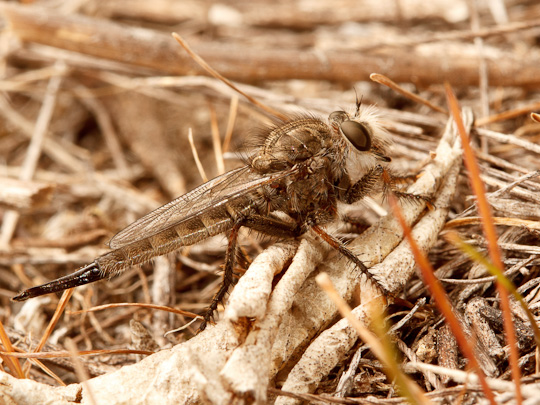
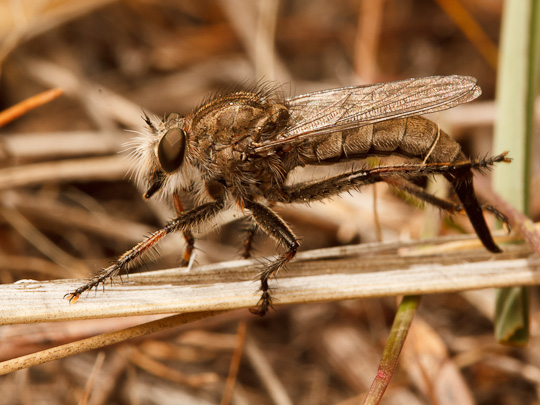
While soliciting info about good spots to check out, one of our Twitter contacts told us to be on the lookout for Efferia okanagana, a robber fly (Asilidae), recently described by Rob Cannings in The Canadian Entomologist.

IMG_1844

The bluffs are spectacular, with abundant scree slopes, which can produce something terrifyingly called a « debris torrent » at times.

On the 5th day of our trip, we were examining the awesome bluffs above the eastern shore of Vaseux Lake (thanks Nature Trust!), when we spotted our first robber. I managed to get a dorsal shot of this female, followed by a couple lateral shots.

IMG_1184

IMG_1192

We took these to a local restaurant with Wi-Fi, and compared them to the pictures of E. okanagana in the paper. They looked mighty similar! We went on Twitter to ask Dr. Cannings if these were indeed the Efferia we were looking for. They were!

This robber is at significant risk of extinction due to its small range in Canada (to date it has not been collected in Washington State). The South Okanagan grassland habitats where this and other iconic wildlife make their living are at risk due to widespread development and increased agricultural land use.  It is one of the earliest-flying robbers in the area, and photographs have documented it feeding on a wide variety of insect taxa. Like other large Efferia, they are not super difficult to approach, flying in bursts when disturbed and often coming to rest only metres away.

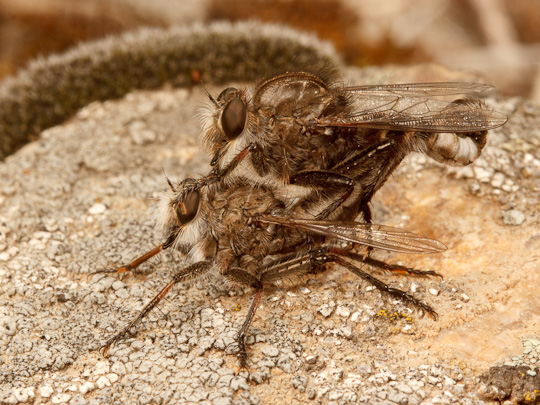
The very next day, coincidentally World Robber Fly Day (thanks to Erica McAlister of the Natural History Museum), we set out for the bluffs once more (they are an awesome habitat). We managed to find E. okanagana several more times, including a female feeding and a pair in copula!

IMG_1766

A female Efferia okanagana chows down on what looks like an ichneumonid.

IMG_1773

Eating requires a leg bath afterward.

IMG_1790

A pair of Efferia okanagana copulating! The male seems to partially cover the female’s eyes with his tarsi.

IMG_1801

Look at the odd position of the male’s abdomen!

IMG_1819

A male, note the bulbous rear end.

IMG_1822

Catherine after an awesome trip to the bluffs above Vaseux Lake.

cows

Eloise Rowland, graduate of the Gries Lab of Simon Fraser University was recently recognized by the Royal Entomological Society for the best paper published in the journal Physiological Entomology in 2013 and 2014. This paper, part of Eloise’s MSc work, examines the role of sound in the sexual communication of the gypsy moth, Lymantria dispar.  It was coauthored by Peter Belton, Paul Schaefer and Gerhard Gries and is really a great contribution! Check it out!

Rowland E, Belton P, Schafer PW, Gries G. 2014. Intraspecific acoustic communication and mechanical sensitivity of the tympanal ear of the gypsy moth Lymantria dispar. Physiological Entomology 39(4): 331 – 340. DOI: 10.1111/phen.12080

elo ill

By Dr. Tom Chapman, Memorial University

—-

I used scissor to cut my pant into short. A jarring opening sentence, I know. It is how I use to feel when someone dropped the “s” in “thrips”; it is a plural noun, don’t you know? If you see a solitary individual of these animals it is still referred to as a “thrips”.  I have been quick to correct people that have made this mistake. But lately on this issue, I have become tired of being the grammar pedant.

Art work done by Michael McLeish and Andrew Chaulk.

Art work done by Michael McLeish and Andrew Chaulk.

I don’t mean to be insulting to the readers of this blog, I am assuming you are knowledgeable and enthusiastic about insects, but just maybe you haven’t heard much of thrips. They are members of the insect Order Thysanoptera, and world wide there are at least 5000 species. They are small; in fact, they are typically the size and colour of the commas in this very sentence. These slithering punctuation marks do not commonly attract the attention of insect enthusiasts. However, for a small number of economically important species there is a large and vibrant community of researchers. These scientists routinely gather together to describe and discuss their research outcomes, with their next big event to be held in California (2015, Xth International Symposium on Thysanoptera & Tospoviruses).  Among the dominant applied work that will be presented at this meeting, and those of the past nine meetings, will also be more curiosity driven research.  This group of non-applied thrips-focused researchers could book a table at most restaurants. No more or less important, just a more private club. A club I joined as a PhD student.

Professor Bernard Crespi, in his early career, did a stint in Australia as a Research Associate. His motivation to travel to the antipodes was to answer the challenge, are there social thrips? The evolution of altruism (sub-fertility in part of a population) in the insects was and remains an outstanding conundrum for evolutionary theory. Theoretical attempts made in the sixties and seventies to explain these incidences of self-sacrificing castes appeared to also predict that somewhere within the diversity of thrips species we should also find sociality. There were no ready examples. Crespi had a hunch that social thrips would be found among the gall-inducing thrips on Australian Acacia.  In brief, he was right! Subsequently (Again, drastically shortening the story. Hey, I am not trying to write Crespi’s biography here.), Crespi took a position at Simon Fraser University where his research began with a focus on Australian social thrips. I was the first graduate student he recruited.

I will admit that the thrips played no part in attracting me to the program. Instead, it was Crespi’s strong scientific reputation and the chance to do field work in Australia that was the lure. However, it was several years of working in Canada with preserved and frozen specimens of thrips before I saw their full charm in their native habitat. I was hosted in Australia by Crespi’s major collaborator with the thrips work, Dr. Michael Schwarz, at Flinders University. In this prominent social insect lab I met three students with the same taxonomic focus as me.  Like Tigger in The Tigger Movie, I had started to fear that I was the only one. We connected quickly, and one of the pivotal bonding events happened during a trip to a Nursery outside the city of Adelaide. We needed native Australian plants for an experiment and the Nursery that could provide them was located inside a national park. On the way in we saw a sign warning visitors that they were not permitted to bring in plants or soil for fear of introducing pests. The list of pests included “thrip”. On our way out of the park, we stopped our truck; one of us jumped out with a permanent marker and added an “s”. Having scored one for thrips, we cheered and drove away.

It has been almost twenty years since we vandalized that sign (I hope that is longer then the crime’s statute of limitation). Since then I have continued research on social thrips, and I have given lectures in undergraduate and graduate classes, job interviews, conferences, public lectures and even dinner parties. Many people have engaged me after these events to express further interest in the work. If they said “thrip”, I corrected them. I thought educating people outweighed the potential risk of embarrassing them. My behaviour has certainly lost me a few acquaintances, some people have skin that is thin, but is there any evidence that I have been successful in educating people? I think the answer is no. A student of mine was interviewed a little while ago on the national radio science show, Quirks and Quarks. She corrected the host when he dropped the “s”. Two students and I submitted a paper to an entomological journal, and one reviewer pointed out to the editor the poor grammar of our presentation. The example they used to illustrate our incompetence was our failure to drop the “s”. I am co-writing a book chapter with a longtime friend and colleague, he edited my part by dropping a few of the “s”s. I give up. Not research or a fascination with thrips, just the “s” thing. It is now my opinion that the thrips research community is better off without this plural noun. To the uninitiated it sounds weird to use “thrips” in the singular, and to insist on its proper use is alienating. I don’t know how to change this. Who is in charge? How do you start a revolution? In the mean time, to those that naturally say “thrip” I am sorry I have offended you, let’s be friends.