By Dr. Chris Buddle, McGill University & Editor of The Canadian Entomologist

———————-

This Issue’s Editor’s pick for The Canadian Entomologist is Staffan Lindgren and Ken Raffa’s paper, titled “Evolution of tree killing in bark beetles: trade-offs between the maddening crowds and a sticky situation”.  This is a key review paper that provides comprehensive and in-depth coverage of a critically important topic, especially for forest entomology in North America.  Bark beetles are often in the news because of the economic consequences of their population increases as we have seen in recent years. Behind this, however, are fascinating life history traits and a story about their tree killing habits. This is where the paper by Staffan and Ken comes into play. These two exceptional scientists have decades of experience on the topic of tree killing in bark beetles, and they bring this expertise forward with this paper.

I asked Staffan and Ken a few questions about their paper, and here are the responses:

Q1:  What inspired this work?

The scientific inspiration came from many years of reading about and studying these amazing insects. Over time, it became clear that « aggressiveness » is a relative term with respect to tree-killing beetles, because they generally appear to be very poor competitors. The same also seemed to be the case with tree-killing root diseases, so a pattern of trade-offs became apparent. Given the potent defensive capability of most conifers, the question naturally arose « why would a beetle risk its life attacking a live tree rather than utilizing a dead or dying tree? » It seemed that the answer had to be linked to trade-offs between the selection pressures exerted by competitors and host tree defenses. The inspiration to write these ideas up evolved through many years of developing a friendship with each other, and we tossed the idea around in a number of discussions we had. The opportunity to act came when the former editor of TCE, Robb Bennett, extended an invitation to submit an article as a CP Alexander Review.

Staffan (R) and Ken (L) (photo by C Raffa)

Staffan (R) and Ken (L) (photo by C Raffa)

Q2:  What do you hope will be the lasting impact of this paper?

The main objective was to put the idea out and to stimulate debate and perhaps generate new research ideas that will contribute to an increased understanding of bark beetle ecology and management. Whether or not we are proven right or wrong is really less important. Based on some feedback we have had already, it seems that the paper has had the desired effect in terms of stimulating thought. I also thought this was a great opportunity to work together on a project: we admire each other as scientist and are friends

Q3:  Where will your next line of research on this topic take you?  

We are working with another great friend of ours, Jean-Claude Grégoire, on two chapters in an upcoming book about bark beetles, so there may be some other ideas emerging from that collaboration.

Q4: Any amusing / interesting anecdotes about this research?

(from Staffan): From my perspective one of the most amusing things is that I can claim the unique experience of having Ken Raffa as a nurse. He is very good at that too, as it happens! The last time I visited him in Madison to work on this paper, I caught a bad cold. So we worked from home that week, with me intermittently resting and writing. It was embarrassing at the time, but now I find it rather amusing.

Cambridge University Press has made Staffan & Ken’s paper freely available worldwide until November 30 for being recognized as the Editor’s Pick. Thanks CUPress!

Citation:

Lindgren B.S. & Raffa K.F. (2013). Evolution of tree killing in bark beetles (Coleoptera: Curculionidae): trade-offs between the maddening crowds and a sticky situation, The Canadian Entomologist, 145 (05) 471-495. DOI:

This year’s Joint Annual Meeting of the Entomological Societies of Canada and Ontario is shaping up to be the event of the century, or perhaps more correctly, a Sesquicentennial Event, as the ESC & the ESO are celebrating their 150th birthday! While all the usual JAM events will be taking place (like Plenary Sessions with exciting invited speakers, student presentations & posters, a whole suite of special symposia, and plenty of social events to unwind in the evenings), this year will also see the expansion of training workshops for not only meeting attendees, but also the public!

This year, the ESC and the ESO will be holding 3 workshops which we invite entomologists and insect-lovers alike to register for, and which will be held before, after and during the ESC-ESO JAM 2013 in Guelph, from October 19 to 24, 2013.

—————–

UP CLOSE: Insect Photography with Alex Wild – Oct. 19, 2013 – University of Guelph Arboretum Centre ($65 registration fee)

Come spend the day learning how to improve your insect macrophotography skills with Alex Wild. This full day workshop (9:30a-4:30p, lunch provided) will help you take better photos of insects, both in the lab and in the field. For more information, and to learn how to register, please visit the workshop website here. Space is limited, so register today!

Alex Wild Guelph Photography Workshop Poster—————–

CFIA Regulated Plant Pests Identification Workshop – Oct. 22, 2013 – University of Guelph, Graham Hall Rm 3309 (Free Registration!)

Come learn about the 69 plant pests whose movement is legally regulated by CFIA. First, a brief introduction to what such regulation means for people who move insects and goods. Then, most of the workshop will be a hands-on session with microscopes (20), specialists (3), and specimens of species of: mites (2), beetles (18), flies (4), Hemiptera (5), Hymenoptera (2), moths (29), and snails (9). This is meant to get participants the information that they most need: we will help you get
to know the regulated pests that are most relevant to your work. Please register with hume.douglas@inspection.gc.ca to secure your space. More information is available on the ESC-ESO JAM website, but space & microscopes are limited so register early.

—————–

Emerald Ash Borer Workshop – Oct. 24, 2013 – University of Guelph Arboretum Centre (Free Registration!)

This workshop is intended for all those interested in the management of emerald ash borer.

The morning session will review current tools and techniques for the management EAB, including a presentation on the risk assessment process in Canada. Other speakers will provide case-studies of their response to EAB in municipalities in Southern Ontario, and on the management of wood from infested trees.

The afternoon session will be round-table discussions among all participants. These discussions will include: what future research is needed to manage emerald ash borer, what questions about the beetle are still unanswered, and what are the challenges to implementing current management techniques. The goal of the afternoon session is for you to provide feedback to the research community on where effort needs to be directed as the emerald ash borer enters its second decade in Canada. There is no charge to attend this workshop, but space is limited. For more information, and to register, please see the workshop flyer on the ESC-ESO JAM Website (PDF).

—————–

Grant Writing: Success in Preparation – October 20, 2013 – University of Guelph Rozanski Hall

This workshop is still in development (check back soon for details), but will be held Sunday, Oct. 20 from 9:30a-11a, before the Opening Ceremonies and Plenary Session. Designed for entomologists at all stages of their careers, from students to post-docs, and early career researchers to tenured professors, we hope this workshop will help get you all set for your next grant writing session. Free & open to all meeting registrants!

—————–

Lunch Workshops

We’ll also be hosting several other workshops over the course of the meeting for registered attendees, including workshops on bringing social media into your lab, teaching in entomology, and how to prepare a CV or Resume. These workshops are for meeting attendees only, and will be held daily over lunch break (your lunch is provided with meeting registration this year).

If you haven’t registered for the ESC-ESO JAM yet, there’s still time to do so online (expires October 6). We hope to see you in a few weeks time at the 2013 ESC-ESO JAM in Guelph!

Earlier this summer, a new key and review of the Ants of Alberta was published in the Canadian Journal of Arthropod Identification. James Glasier, the lead author, was kind enough to answer a few questions about the work, and share some of the species he thought were particularly interesting.

Couplet 3 from Glasier et al. 2013

1. What inspired you to produce this key?

The key was inspired by the difficulty of finding coherent, up to date, and all-encompassing keys for the ant fauna of Alberta. It started as a side project, to help me better understand the differences among ant species I was finding during my thesis research.  As it developed, we realized that a key formatted for the Canadian Journal of Arthropod Identification would greatly benefit anyone who wanted to study ants in the province. So with the help, guidance, and contributions of my co-authors, we developed to identify all known ants from Alberta.

2. Who do you think is most likely to use your key to the Ants of Alberta?

The coauthors and I hope that anyone who is interested in ants uses the key.  We think that in Canada, ants are too often ignored in biological studies and with this key we hope more people will include them in their research.

3. Rather than provide individual accounts for each species, you’ve linked out to the species profiles in AntWeb. Why did you decide to do it this way, and what advantages does AntWeb have over traditional publishing?

We decided to link the key to AntWeb, because AntWeb has fantastic photos of ant specimens and they are always updating their photo catalog.  It is hoped that these photos work in concert with the key we have developed and better aid identification of ant specimens.  Additionally, AntWeb has an online specimen catalog and natural history sections, which is easily accessed and continually updated to provide current information about each ant species.

4. Were there any ants that you were surprised to find in Alberta?

The most surprising was species was the neotropical ant Brachymyrmex obscurior; found in the Olds University Atrium by Dr. Ken Fry.  For better or worse, the colony seems to have died out. Another surprising ant species was found by John Acorn, Dolichoderus taschenbergi. This ant is a rather obvious ant when you are out in the field; workers are black and very shiny, and in the morning will all congregate on their nest to sun themselves.  The effect of hundreds of workers covering a ~30cm2 area is an obvious sparkling mass of black.  Yet, with over 30 years of work by multiple researchers in the Opal Sand Hills, including John, no one recognized that this species was present until our ant project began.

Dolichoderus taschenbergi – Photo by April Nobile, courtesy of AntWeb.org (CC BY 3.0)

Glasier, J.R.N., Acorn, J.H., Nielsen, S., Proctor, H. 2013. Ants (Hymenoptera: Formicidae) of Alberta: A key to species based primarily on the worker caste. Canadian Journal of Arthropod Identification No. 22, 4 July, 2013. Available online at http://www.biology.ualberta.ca/bsc/ejournal/ganp_22/ganp_22.htmlhttp://dx.doi.org/10.3752/cjai.2013.22

By Jeff Skevington, AAFC & President of the Entomological Society of Ontario

——
Today was the first ESO Bug Day. Thanks to Sophie Cardinal for organizing it all and to our many members and other volunteers who came out to help. I think it was an unparalleled success. We had hundreds of participants (my guess is slightly over 1000, but it was hard to track numbers). All of the volunteer leaders came with fabulous stuff – everything from Giant Swallowtails and Tomato Hornworm larvae to huge scarab larvae to hissing cockroaches and a whip scorpion. Andy Bennett did a brilliant job with the cockroach races with his home made Duplo race track. We had a tank of aquatic insects, ran at least 15 public hikes, had a biological control display, face painting, a butterfly exhibit, a craft table. The building was bursting at the seems to thankfully the rain held off and we were able to do a lot of it outdoors.

All in all, it was fabulous exposure for the ESO and the Ottawa Field-Naturalists’ Club (who provided many volunteers as well as their clubhouse and gardens).

Thanks again to all who helped and to the ESC for their help with funding. I hope that we can do it again next year – maybe in more than one city now that we have tried it out!

Caterpillar overlook Craft time

Andy Bennett oversees a cockroach race

Andy Bennett oversees a cockroach race

—–
CBC Radio Ottawa stopped by and took in Bug Day as well. Listen to the segment titled « Bug Day fun at the Fletcher Wildlife Garden » here (scroll down the page a bit to find it).

By Dr. Chris Buddle, McGill University & Editor of The Canadian Entomologist

———-

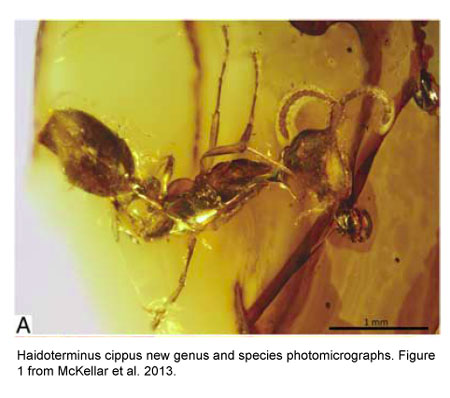
It’s with great pleasure that I announce my pick for the latest issue of The Canadian Entomologist.  Ryan McKellar and colleagues wrote a paper on a new trap-jawed ant from Canadian late Cretaceous amber (freely available during September).  As they write in the Abstract, the new species “….expands the distribution of the bizarre, exclusively Cretaceous, trap-jawed Haidomyrmecini beyond their previous records…”. They truly are bizarre! Facial structures right out of a sci-fi movie!  When reading the paper, I was also surprised that the fossil record for the Formicidae is sparse during the Cretaceous.

Haidoterminus cippus. Figure 1 from McKellar et al. 2013

I asked the lead author a few questions about this work, and am pleased to share the responses with you. It’s truly exciting research, and I am thrilled that the pages of TCE include systematics from amber. This work stirs the imagination, and takes us all back in time.

What inspired this work?

My interest in the Canadian amber assemblage really began when Brian Chatterton (then my M.Sc. supervisor) showed me some of the slides that he had borrowed from the Royal Tyrrell Museum of Paleontology in order to write a book on Canadian palaeontology. The sample set contained insects with bizarre adaptations for life at low Reynolds numbers, and obvious ecological associations, spurring an interest that ultimately led to a research in parasitic microhymenoptera. Michael Engel subsequently introduced me to a much wider array of taxa, and we continue to explore the Canadian assemblage together and with the help of colleagues.

What do you hope will be the lasting impact of this paper?

New records, such as this trap-jawed ant, help to flesh out our picture of the amber-producing forest and its inhabitants. I hope that a comprehensive account of this assemblage will eventually provide insights into terrestrial conditions that are unavailable from other fossil types, and that this will shed some light on changes in diversity and conditions leading up to the end-Cretaceous mass extinction.

Where will your next line of research on this topic take you?  

With any luck, we will be able to complete our coverage of Hymenoptera in Canadian amber soon, and make more of a concerted effort to cover other insect orders and some of the ecological associations found within the deposit. Grassy Lake amber still has a lot to offer, but it is only one of western Canada’s many amber deposits. As a larger-scale project, we are currently part of a team examining the numerous fragile ambers associated with coals in the region. The goal of this research is to create an amber-based record of forest types and inhabitants that spans more than 10 million years within the Late Cretaceous and Paleocene.

Can you share any interesting anecdotes from this research?

Surface-collecting amber can be quite difficult, because unpolished Canadian amber typically has a matte orange-brown colour, and is often covered with a carbon film or weathering crust. If there is no fractured surface visible and the specimen is not translucent, it can be quite difficult to distinguish from the surrounding coal or shale. Furthermore, there is such a range of shapes and sizes that some of the smaller amber droplets are easily confused with modern seeds. One of the quickest ways to see if you are dealing with amber is to wet the specimen and look for amber’s characteristic lustre, or tap the specimen on your teeth (amber feels like plastic compared to most suspect rocks). Naturally, I have licked quite a few samples in the course of my collecting, and have lost a lot of my appreciation for rabbits.

A selection of amber from Grassy Lake. Photo courtesy Brian Chatterton

A selection of amber from Grassy Lake. Photo courtesy Brian Chatterton

Thanks to Cambridge Journals Online for making this month’s Editor’s Pick Freely Available for the month of September!

This post is a regular series highlighting great papers from the pages of the Canadian Entomologist. 
McKellar R.C., Glasier J.R.N. & Engel M.S. (2013). A new trap-jawed ant (Hymenoptera: Formicidae: Haidomyrmecini) from Canadian Late Cretaceous amber, The Canadian Entomologist, 145 (04) 454-465. DOI:

By Gary Umphrey, University of Guelph & President of ESC-ESO 2013 JAM Organizing Committee

———

Greetings Fellow Entomological Enthusiast:

I wish to draw your attention to the following photo, which is of the participants at the Entomological Society of Ontario’s 50th Anniversary meeting, held in Guelph Aug 27-29, 1913. Yes, this meeting was held 100 years ago this past week. And if you peruse the distinguished individuals in the photo you may recognize William Morton Wheeler, the iconic ant man and Ed Wilson’s predecessor in myrmecology at Harvard, sitting on the far left in the front row. Indeed Wheeler was scheduled to present a public lecture, succinctly titled « Ants », at 8:00 pm on August 28, 1913. Wheeler was only one of the distinguished entomologists at the meeting, and I invite you to check out the second file which will attach names to the people you may not recognize.

ESO 50th Anniversary, 1913

ESO 50th Anniversary, 1913 - names

I am not sure how (or if) you celebrated the anniversary of Wheeler’s talk (a Bitburger in my Ants! cup worked for me), but in any case I might suggest that a good way for you to do so would be to register for the special 150th Anniversary entomological extravaganza, the Joint Annual Meeting of the Entomological Society of Canada and Entomological Society of Ontario in Guelph, Oct 20-23, 2013. The deadline for early registration at a deep discount is fast approaching — indeed it is TODAY! The conference website is at:

http://www.uoguelph.ca/debu/esc-eso2013/esc-eso.html

This will be a very full program this year, and it has been necessary to extend it to include Wednesday afternoon. To ensure that you won’t have to miss out on any presentations you might want to attend, we are including lunches with your registration fee for the Monday to Wednesday concurrent sessions at the Delta Hotel. Registration also includes the opening reception and banquet.

An unadvertised attraction of this meeting: you will have opportunities to have your photo taken with Jeremy McNeil, the King of Entomological T-Shirts! You will probably want to be wearing an entomology t-shirt yourself. If you don’t bring a favorite shirt (or even if you do) we will have a limited supply of commemorative 150th JAM t-shirts. If you find the official logo too edgy, are troubled by the raging controversies that have surrounded this logo, or simply don’t like biting flies, we will have t-shirts with an alternative logo as well.

The deadline for submitting a presentation (talk or poster) is September 15. Note that abstracts are not required, we only want your title. Space on the program for talks is limited, so don’t delay if you want to present.

The Delta Hotel is our official conference hotel, and we have a block of rooms available at a special price that includes parking (regularly $12/day). While there are certainly other hotels in Guelph, and some at lower prices, the Delta is a very nice hotel and there is real convenience in staying at the conference hotel, especially if we get some nasty weather. The reserved block is quite limited, and so if you wish to stay in the Delta I would suggest making your reservation as soon as possible.

To our entomological colleagues in the U.S.A., YOUR PRESIDENT WILL BE HERE! Yes, Dr. Rob Wiedenmann, President of the Entomological Society of America, will be speaking on Sunday in the opening session, and we would be delighted if you could attend as well (subject to meeting capacity, we certainly can’t handle the numbers that attend an E.S.A. meeting). Here’s a chance to burnish your international reputation and meet your President at the same time, simply by making a jaunt to Canada to attend our meeting!

I would encourage you to join us in the celebrations of the ESC/ESO Sesquicentennial Anniversary JAM and join William Morton Wheeler and his colleagues in the rich historical legacy of special anniversary entomological meetings in Canada.

ESC-ESO-Logo-Full-Colour400px

By Laura Timms, Chair of the ESC Common Names Committee
——
Hello,
The Common Names Committee of the Entomological Society of Canada, in collaboration with the Canadian Wildlife Service (Environment Canada), is planning a project to develop common names for all beetles in Canada. We are looking for to hire contractors to assist in developing English and French common names.  Since this order contains many families, we are looking for Anglophone and Francophone Coleopterists who specialize in more than one group of Coleoptera species.  Compensation will be based on the number of species assigned to each contractor.  If interested, please send your C.V. to Joanna.James@ec.gc.ca by August 16th, 2013.  Please do not hesitate to contact us if you have any questions.
Thanks!
Bonjour,
Le Comité des noms communs de la Société d’entomologie du Canada, en collaboration avec le Service canadien de la faune (Environnement Canada) prépare un projet pour développer des noms communs pour tous les coléoptères au Canada. Des experts seront engagés pour développer les noms communs en anglais et en français. Puisque cet ordre contient plusieurs familles, nous cherchons des experts anglophones et francophones qui se spécialisent sur plus d’un groupe d’espèces de coléoptères. La rémunération sera basée sur le nombre d’espèces assignées à chaque expert. Si intéressé, svp envoyer votre C.V. à Joanna.James@ec.gc.ca  avant le 16 août, 2013. Svp n’hésitez pas à nous contacter si vous avez des questions.
Merci!

By Chris Buddle, Editor of the Canadian Entomologist

———————–

I am pleased to present the “Editor’s Pick” manuscript for the current issue of The Canadian Entomologist. This pick was a paper by Bob Lamb, Patricia MacKay and Andrei Alyokhin, titled “Seasonal dynamics of three coexisting aphid species: implications for estimating population variability

I had always admired the ongoing work on aphids, spearheaded by Bob and Pat. Their work is always relevant, meticulous, framed in an important and broader ecological context, and they have a ‘model system’ to work with. This is the kind of researcher many more junior entomologists look up to.  The current paper is no exception. In this work, Bob and Pat joined up with Andrei Alyokhin and present a careful study of population variability and effectively use this metric to better understand population dynamics over time.  For me, I see much value in this approach, and can see how this kind of work could effectively be used in teaching students about how to best describe, understand, and quantify population dynamics.  I’m also inspired to see long-term data with arthropods. These kinds of data are so useful, but relatively rare. It’s great to see Bob, Pat and Andrei publish thoughtful and important work using such data.  I may also look around some old filing cabinets at my University…

Bob was kind enough to answer a few questions about this work, with input from his co-authors.

What inspired this work?

When Pat MacKay and I were anticipating eventual retirement from paying jobs as entomologists, we decided to begin a study of an aphid population that could be pursued as long as we could walk trails and count aphids. Our goal was to figure out why aphid populations seem to be so unstable. Eventually we wrote up our findings on the stability of one native species over the first 10 years of a study we hope will go on for at least another 10 years. A few years ago we realized we needed comparative data, but were too old to start on a 20-year study of another aphid species. The solution was to write to colleagues who also had long-term data sets, to see if they were interested in looking at their data from this perspective. So far the colleagues we have contacted have been enthusiastic collaborators. The first was Andrei Alyokhin our coauthor on the current paper. He gave us access to 60 years of data on three aphid species. The first paper on the stability of these aphids was published in the Canadian Entomologist two years ago. The current paper extends that earlier work, looking now at how aphid seasonal biology affects our estimates of stability.

Bob Lamb, sporting "aphid hunting gear"

Bob Lamb, sporting « aphid hunting gear »

What do you hope will be the lasting impact of this paper?

We hope that this paper will help convince other researchers that Joel Heath’s metric, PV, which we use to quantify population variability, is a robust way to quantify one aspect of the stability of populations. If more researchers adopt this metric, ecologists will have a much greater opportunity to apply a comparative approach and identify factors that contribute to stability or instability of populations.

Where will your next line of research on this topic take you?

Pat MacKay and I continue to extend our time series on the abundance of a native aphid, and are now focusing more on the ecological processes that cause our five populations to rise and fall. We also hope to expand our studies of stability to still more aphid species, but also species with very different life histories. At the moment I am working with a colleague, Terry Galloway, University of Manitoba, on several time-series of ectoparasite abundance on birds.

Do you have any interesting anecdotes about this research?

One of the most interesting aspects of the work on aphids from potatoes is the source of the data – 60 years or more of weekly aphid counts. The data for the early years were discovered by Andrei Alyokhin in an abandoned filing cabinet stored in a barn at the University of Maine. Andrei was a new faculty member at the time exploring his research facilities. His predecessors had maintained meticulous records of aphid densities in potato plots since soon after World War II. Andrei was quick to recognize the value of this data, and more importantly recognized the need to go on collecting the data in the same way. The result is an amazing data set, one of the longest continuous records at one location of the dynamics of multi-voltine species.

Lesson 1: newly-hired entomologists should begin their careers by searching old filing cabinets.

Lesson 2: meticulous long-term records can be invaluable, sometime in ways that you might not anticipate.

Andrei discovering data in old filing cabinets

Andrei discovering data in old filing cabinets

Lamb R.J., MacKay P.A. & Alyokhin A. (2013). Seasonal dynamics of three coexisting aphid species: implications for estimating population variability, The Canadian Entomologist, 145 (03) 283-291. DOI: