IMG_6058

Do you have a good taxonomic knowledge of Canadian arthropods? Are you an awesome, champion collector? Do you want an excuse to spend a few days geeking out over lovely terrain and catching lovely wildlife? Well, the Biological Survey of Canada, the Royal BC Museum and the Yellowstone to Yukon Conservation Initiative want you to join them in a BioBlitz of the Peace Region, June 22-26!

If this sounds like your cup of tea, then read the full invitation here. Sign up by June 15!

Who knows? Maybe you will find something completely unexpected (like this ridiculous mite!)!

IMG_6072

prayingmantis_main

PRAYING MANTIS Sterling silver, copper, 14K & 18K gold 18.5″l x 12″w x 9.5″h


We have featured the wonderful metalwork of Canadian artist Elizabeth Goluch before, in this awesome interview by Crystal Ernst. Now Ben Proudfoot of Breakwater Studios has produced this wonderful video featuring Elizabeth, her inspiration and work. If you are fascinated by insects aesthetically, or have a love for metalwork and sculpture, this is a great introduction to the artistic process!
[vimeo 125539638 w=560 h=315]

Lady Bug from Breakwater Studios Ltd. on Vimeo.

bumblebee_main

BUMBLEBEE Sterling silver, 14K & 18K gold 7″l x 7″w x 4″h


IMG_3652

Living in Western Canada is pretty sweet. Especially here on the coast, we have a plethora of awesome insects that only occur in this region. I am trying to savour these insects while I can, as this fall I am moving to Toronto.

The snakeflies (Raphidioptera) are awesome animals, with a delightfully elongate prothorax and long bladelike ovipositors. These insects are fairly common in the early spring in a Garry Oak meadow not far from my mother’s house, so whenever I am in the vicinity at the right time I keep an eye out for them.

IMG_3654

The most common snakeflies in BC are members of the genus Agulla.


IMG_3658-2

What I had not noticed about these insects is how the pronotum wraps around ventrally, like a shield. Also look at the awesome ornamentation on the thorax!

1QJ09QJ0UQRSAQDKSKO0LKA0KKUKQKT06Q2K0K9KGKY05QD0PQEKEQ2K8QUK0KO00KPKKKC06QRS6Q

The larvae of snakeflies are difficult to find, but if you flip over enough rocks or logs, you may just find one!

lift 2

In fact, flipping over logs is exactly how I found this next western treasure…A tiger beetle that may just shatter your image of tiger beetles forever.

IMG_5220

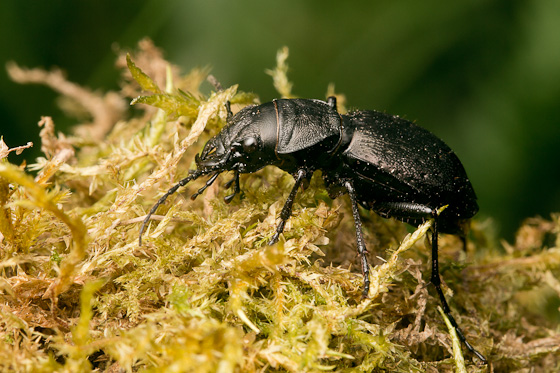
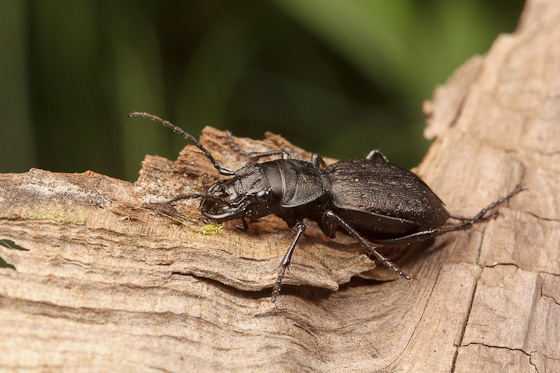
This is Omus dejeani, often referred to by its awesome common name, the greater night-stalking tiger beetle. This is a tiger that could easily be mistaken at a glance for a carabine, if not for the shape of the thorax. This is not a slender, bright, iridescent speedster, but rather a hulking, powerful night terror.


IMG_5243

Yes, make no mistake, this is a tiger through and through. The mandibles tell the tale. Bugguide has this to say about the origin of the generic name Omus: Probably from Greek omos (ωμος)- « raw, crude » or « savage, fierce, cruel »

IMG_5249

Regardless of the name, this beetle is a truly impressive beast, though I rarely encounter it. I wonder if it could be because of the introduction of the two similarly-sized invasive carabines Carabus granulatus and Carabus nemoralis.

Anyhow, regardless of where you live, get out and enjoy what your region has to offer. Insect season is in full swing, and life is short. This summer I will keep flipping logs to savour the western specialties!

IMG_5282

Log flipping also brought me an encounter with another western treasure: the rough skinned newt (Taricha granulosa). Who doesn’t love a newt!


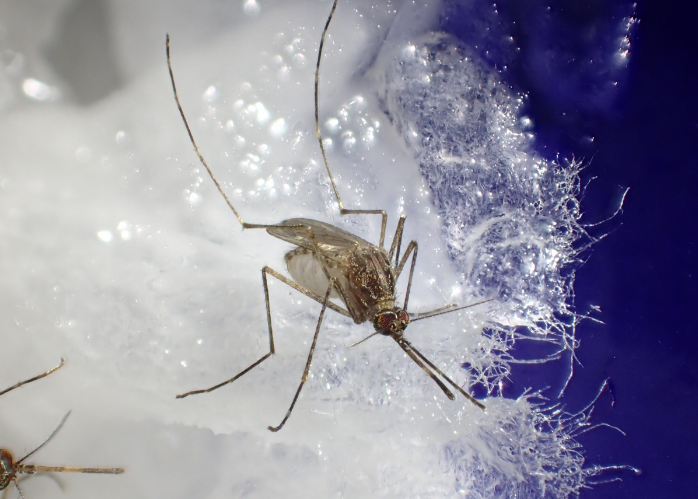
The Editor’s pick from the Feburary issue of The Canadian Entomologist is Crowdsourcing for large-scale mosquito (Diptera: Culicidae) sampling by Elin C. Maki and Lee W. Cohnstaedt. In this blog Lee Cohnstaedt reveals more about the research.

—-

“We were inspired to carry out this study to find out the origin and historical geographic spread of the disease vector mosquito species Culex tarsalis and Aedes vexans. By collecting throughout the entire mosquito habitat range, we generated a snap-shot in time of the distribution of mosquito genes. However, collecting mosquitoes throughout the continental United States was not feasible for one lab. Therefore we used social networking and crowdsourcing to solicit specimens from public health officials, mosquito control experts, and citizen scientists. The response was incredible.

Image courtesy of Sarah Edwards.

Image courtesy of Sarah Edwards.

We hope a lasting impact of this project beyond advancing public health safety for humans and food security for agriculture, is demonstrating the importance and unique capabilities of the public health and mosquito control infrastructure in the United States. These agencies continually face budget cuts because their importance is undervalued. In addition to their public health roles, they contribute substantially to research which is an underappreciated role at improving public safety. This large-scale project would not be possible without the agencies volunteering their time, energy, and expertise. These agencies and individuals contributed to an unprecedented mosquito collection on a continental scale and we feel the North American Mosquito Project will continue to ask big questions with the help of network contributors in the future.

This research will lead to the mosquitos being used for three projects: First, the mosquito samples will be processed for population genetic and phylogenetic analysis to determine mosquito migration currently and historical spread. Second, the movement data from the genetics will be used to parameterize mathematical models to predict the spread of mosquito-borne exotic or emerging pathogens. This will improve public health safety and food security an important role of the agencies that contributed mosquitoes. Third, specific genes unique to certain populations (private alleles) will be examined to understand their role in range expansion.

Entomologists are very friendly people and we were amazed at how kind and helpful people were throughout the project. At least 25% of the network consisted of people we never contacted; other contributors contacted them and asked them to help. Similarly, some individuals collected from huge areas or contacted people to cover entire regions of the country. It makes us proud to be a part of the community and hopefully we can return the generosity with useful information.”

Read the full article here until 22nd May 2015.

—-By Aaron Hall—-

A typical adult dragonfly. Note the spiked legs, which are held in a basket shape to help catch prey while flying.

A typical adult damselfly. Note the spiked legs, which are held in a basket shape to help catch prey while flying.

Dragonflies are charismatic insects, and most of us can probably remember chasing them or watching their acrobatic flights when we were children. But what most of us didn’t realize when we were kids, is that dragonflies spend the majority of their lives as toothy, alien-looking predators living underwater before they become adults. Depending on the species, they can live in the water for several weeks up to several years.

A typical larval dragonfly, which feeds on other aquatic animals - and even other dragonflies!

A typical larval dragonfly, which feeds on other aquatic animals – and even other dragonflies!

By living part of their lives in water, and part on land/in the air, dragonflies represent an interesting conservation challenge. Historically, conservation science has focused on single habitats, such as lakes, streams, forests or grasslands. Little attention has focused on incorporating multiple habitat types, such as those required by dragonflies, into conservation, potentially leaving species like dragonflies in danger.

In the Waubaushene area of Georgian Bay (Lake Huron), recreational boating is very common. These boats create waves that can dislodge both adult and larval dragonflies, affecting their ability to find food and avoid predators. The overall number of boats, the speed of these boats, and how close they are to coastal wetlands are the most important factors that determine how impactful boat-generated waves are on dragonflies. My colleagues and I at the University of Toronto investigated how much influence these recreational boats have, relative to more natural processes, on dragonfly communities in Georgian Bay.

A Google Earth image of an area in Georgian Bay. Note the many waves created by boats as they travel through this region.

A Google Earth image of an area in Georgian Bay. Note the many waves created by boats as they travel through this region.

Taking the lead on this project, I counted dragonflies from 17 islands in Waubaushene. The coastal wetlands around these islands are inhabited by dragonflies. The islands studied in this project were selected to represent a range of influence from boats in the area, determined by their distance and orientation to marked boating channels and area marinas.

Aaron Hall counting adult dragonflies at one of the islands in Waubaushene.

Aaron Hall counting adult dragonflies at one of the islands in Waubaushene.

The results show that boats do have an influence on dragonfly communities, providing a link between recreational boating and dragonfly communities. This research provides important insights that can be applied to the protection and conservation of dragonflies, and suggests that some very simple changes in boater behaviour could have big implications. For example, if boats travel slower or further away from dragonfly habitats, they would have less impact. These two factors might be simple to change. In areas where boats mostly stay within marked boating channels, if these channels were moved or adjusted so they are as far away from dragonfly habitats as possible, impacts would be minimized. Additionally, speed limits could be set in these channels to reduce the size of waves created by boats. These simple measures could have a positive impact on dragonflies, which are a critical component in the aquatic and terrestrial foodwebs of this region.

Want to know more? This research is published in the journal Insect Conservation and Diversity. You can also follow me on Twitter @aarohall.

—- By Gwylim S. Blackburn & Wayne P. Maddison—-

Animals reveal a lot about their lives simply by the way that they behave. When observed in the wild, they also offer insights to the function of behaviours in a natural context. Capturing these insights just requires a little patience, and attention to the right details.

In a recent study printed in the journal Behaviour, we set out to document Habronattus americanus jumping spider behaviors that would shed light on their ‘mating strategies’—the tactics used by females and males to acquire mates. Specifically, we wanted to know if males show off their flashy displays only to females or also compete directly with each other, if they invest heavily in mate search, and if females are choosy when deciding who to mate with.

HamericanusMaleFront_Blackburn&Maddison

An adult male Habronattus americanus jumping spider travels through beach habitat in British Columbia, Canada. The bright coloration on his face and legs is presented to females during elaborate courtship dances. Photo credit: Sean McCann.

To pursue these issues, we followed 41 adults for up to 30 minutes each, and we also staged interactions between an additional 36 male-female pairs, in natural habitat.

Typical Habronattus americanus habitat is fairly flat, well-drained, and sparsely covered with plants, sticks, or pebbles. Photo credit: Maxence Salomon

Typical Habronattus americanus habitat is fairly flat, well-drained, and sparsely covered with plants, sticks, or pebbles. Photo credit: Maxence Salomon

The behaviours of both sexes pointed quite strongly to indirect male competition for choosy females. Males did not display to (or fight with) each other. Instead, they travelled far and wide, eating nothing but displaying to every female they met. Females, on the other hand, focused on hunting rather than travel, and they almost never permitted copulation despite the vigorous courtship efforts of males.

Collectively, these behaviours supply deeper lessons than their individual functions; they also indicate how natural selection might shape several of the traits involved. In particular, our findings suggest that female mate choice may be the key source of selection favouring the evolution of male display traits.

An adult female Habronattus americanus jumping spider in natural beach habitat. Females are avid hunters. Photo credit: Sean McCann

An adult female Habronattus americanus jumping spider in natural beach habitat. Females are avid hunters. Photo credit: Sean McCann

The apparently high investment by males in mate search also represents a potential factor shaping female mate preferences. In a variety of other species, mate search costs have been shown to provide a way for females to judge the quality of prospective mates. This is because males who are able to pay those costs while still producing an impressive display can make better fathers (e.g., by providing better parental care, or by passing along advantageous genes to their offspring). To determine if this is the case in H. americanus, further research will be needed to see how male condition is linked to the quality of their displays and the success of their offspring.

The Habronattus jumping spiders are famous for their stunning array of male displays. It would be fascinating to know how mating strategies, and the natural surroundings in which they unfold, have influenced this diversity. Behavioural observations of different species in the wild will be essential for getting at this question.

—–By Amanda Lindeman, PhD Candidate, Carleton University—–

A male red turpentine beetle over the sound wave of a train of its interrupted chirps.

A male red turpentine beetle over the sound wave of a train of its interrupted chirps.

In April 2015, I coauthored a paper on what bark beetles are trying to say to each other when they interact with potential mates (1). No one knew for sure – since bark beetles, as their name implies, live under the bark, males could simply be announcing their presence as they wander the surface of the bark trying to join a mate in her gallery below, they could be advertising their species identity to make appropriate mate pairings or to say “Hey! I’m not a predator, let me in!” But the thing that always struck me is that many of the 5000+ species of bark beetles produce sounds, and their sounds are complex — they produce more than one kind of sound, and they can be multi-component. For a group of animals that already produces intricate attraction pheromones, why produce sound at all? Is it just for the sake of redundancy?

Image 2 Galleries

An elm bark beetle gallery located along the inner bark of an elm tree. The female digs the central (vertical) gallery and waits at the entrance of the gallery for a male to join her. Eventually, she will lay her eggs along the sides of the gallery and as the larvae hatch they will tunnel out causing the radiating (horizontal) galleries.

Before I go too far, perhaps I should go waayyyy back, and explain why I find insect sounds to be so interesting in the first place. I think that animal communication has always captured human attention and imagination as we consider both the beauty in animal sounds and what they mean. The dawn choir of birds; the roar of a lion; the squeak of a mouse. But, as Frank E. Lutz (1924) said: “probably the first definite sounds made by land-animals on this earth were made by insects. Before ever birds sang or even frogs croaked”. Insects led the way. Indeed, many insects have beautiful songs appreciated by people since antiquity when crickets were kept as domestic pets in ancient China (3) and cicadas were kept in cages in Greece and Rome (4), not unlike how we would keep a pet bird today. Apart from those musically talented insects, however, we need to remember that even in “the lowest insect tribes, many a rough, rasping note, though awakening no particular delight in us, serves as great a purpose as the more pleasant sounds” – F. C. Clark (1875). The trouble in research often comes down to finding out what that purpose is.

No group embodies this sentiment more than the beetles, an order with more ways of producing sound than any other, and yet with a very poor and widely neglected understanding of the purpose of those sounds (5). Bark beetles are an incredibly interesting group of beetles, who likely first caught our interest because of their destructiveness. The members of the genus Dendroctonus in particular have been hailed by forest entomologists as being “the most destructive enemies of the coniferous forests of North America” (6) and “the greatest tree killers known”(7).

One species in the genus that is no stranger to Canadians is the mountain pine beetle, and to put things in perspective, this beetle has impacted over 18 million hectares of forest in BC, and killed about 50% of the total volume of commercial lodgepole pine in only two decades. And, as I mentioned above, I personally find them particularly interesting because of their complex sounds which many of them invariably make as they approach the gallery of a potential mate and try to enter.

A male red turpentine beetle at the entrance to a female’s gallery. Female is visible blocking the gallery entrance.

A male red turpentine beetle at the entrance to a female’s gallery. The female is visible blocking the gallery entrance.

So, getting back on point, what do these sounds mean? In one species of the destructive Dendroctonus genus, the red turpentine beetle, I found that many aspects of a male’s courtship song correlated to his size. Since male size is linked to his ability to produce more offspring, this means that the male might be using his chirping as a way to honestly tell the female how fit he is. One important chirp variable related to size was the number of components per chirp. Chirps with just one component are termed “simple” while chirps with more than one component are termed “interrupted” and sound like a stutter in the chirp to the human ear. It turns out larger males have more components in their chirps. Also, and importantly, females always admitted a male into her gallery if he made interrupted chirps, while if he only made simple chirps, or was experimentally muted to produce no sound at all, he would only be successfully accepted approximately 60% of the time.

Even though I find the question of why an animal produces sound to be inherently interesting, someone who has unfortunately been a bark beetle victim and has seen local communities and businesses devastated by these insects might not care so much about the why and instead wonder what next? Now that we know that sounds may be important to the life history of bark beetles and that their chances of successful mating might depend to some extent on these signals, can this help us manage them? Probably! Acoustic technologies have helped control pest insects by using the sounds the pests rely on against them (8). This can mean anything ranging from detecting their presence to manipulating their behaviour. These kinds of technologies have not yet been applied in bark beetle management because we haven’t known enough about their sounds to develop strategies. Hopefully, as we begin to understand more about the purpose of their sounds, we can use acoustic technology to develop new targeted solutions to this serious problem.

Amanda Lindeman with a funnel trap (baited with pheromones and host tree kairomones to attract bark beetles) – photo credit: Michael Connolly.

Amanda Lindeman with a funnel trap (baited with pheromones and host tree kairomones to attract bark beetles) – photo credit: Michael Connolly.

References

(1) Lindeman, A.L. & Yack, J.E. (2015) What is the password? Female bark beetles (Scolytinae) grant males access to their galleries based on courtship song. Behav. Proc. 115:123-131

(2) Lutz, F.E. (1924) Insect sounds. Am. Mus. Nat. Hist. 50:333-372.

(3) Laufer, B. (1927) Insect Musicians and Cricket Champions of China. Field Museum of Natural History Leaflet

(4) Clark, F.C. (1875) The song of the cicada. Nat. 90(2):70-74.

(5) Wessel, A. (2005) Stridulation in the Coleoptera – An overview. Insect Sounds and Communication. 397-430

(6) Hopkins, A.D. (1909) Practical information on the Scolytid beetles of North American forests. I. Bark beetles of the genus USDA Bur. Entomol. Bull. 83. 169 pp.

(7) Wood, S.L. (1963) A revision of the bark beetle genus Dendroctonus Erichson (Coleoptera: Scolytidae). Great Basin Nat. 23:1-116.

(8) Mankin, R.W. et al. (2011) Perspective and promise: a century of insect acoustic detection and monitoring. Ent. 57(1):30-44.

IMG_1095

Vaseux Lake, a gorgeous body of water in a dry landscape.

Catherine Scott and I recently indulged in an almost unheard-of pleasure…A week long car camping trip to the Okanagan Valley! For those of you who don’t know, this is the area where the vast majority of BC wines originate (and tree fruit crops as well!). The South Okanagan and the Lower Similkameen Valleys, biologically speaking, are very similar to a desert, with many of the flora shared with northern parts of the Great Basin Desert.

The purpose of the trip was to have fun and seek out whatever cool life-forms we could, basically doing undirected fieldwork. With Catherine along, it meant that we sought out a LOT of spiders, but the Okanagan has some spectacular ones, so I was not complaining.

IMG_1098

Catherine under the rocky slopes off McIntyre Rd.

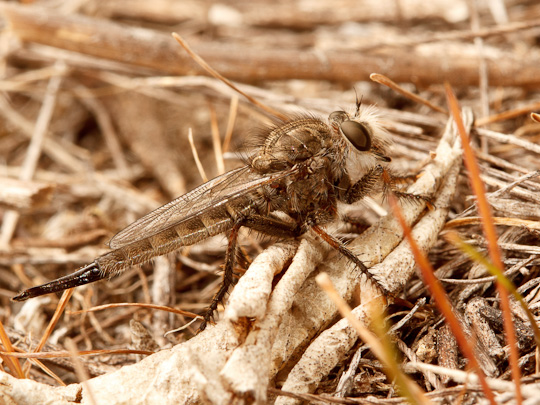
While soliciting info about good spots to check out, one of our Twitter contacts told us to be on the lookout for Efferia okanagana, a robber fly (Asilidae), recently described by Rob Cannings in The Canadian Entomologist.

IMG_1844

The bluffs are spectacular, with abundant scree slopes, which can produce something terrifyingly called a « debris torrent » at times.

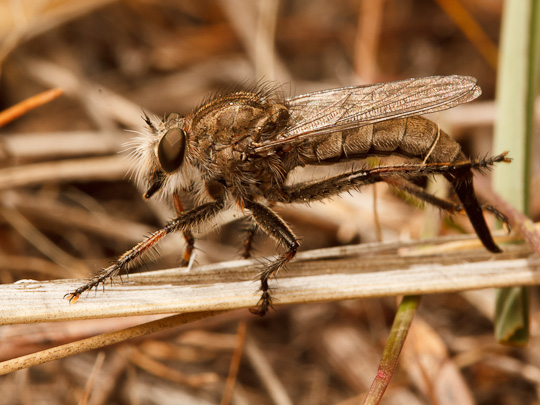
On the 5th day of our trip, we were examining the awesome bluffs above the eastern shore of Vaseux Lake (thanks Nature Trust!), when we spotted our first robber. I managed to get a dorsal shot of this female, followed by a couple lateral shots.

IMG_1184

IMG_1192

We took these to a local restaurant with Wi-Fi, and compared them to the pictures of E. okanagana in the paper. They looked mighty similar! We went on Twitter to ask Dr. Cannings if these were indeed the Efferia we were looking for. They were!

This robber is at significant risk of extinction due to its small range in Canada (to date it has not been collected in Washington State). The South Okanagan grassland habitats where this and other iconic wildlife make their living are at risk due to widespread development and increased agricultural land use.  It is one of the earliest-flying robbers in the area, and photographs have documented it feeding on a wide variety of insect taxa. Like other large Efferia, they are not super difficult to approach, flying in bursts when disturbed and often coming to rest only metres away.

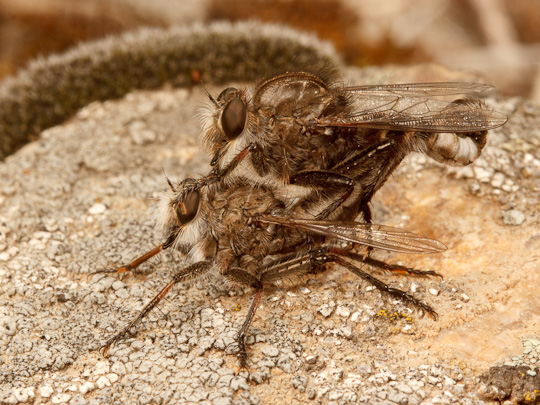
The very next day, coincidentally World Robber Fly Day (thanks to Erica McAlister of the Natural History Museum), we set out for the bluffs once more (they are an awesome habitat). We managed to find E. okanagana several more times, including a female feeding and a pair in copula!

IMG_1766

A female Efferia okanagana chows down on what looks like an ichneumonid.

IMG_1773

Eating requires a leg bath afterward.

IMG_1790

A pair of Efferia okanagana copulating! The male seems to partially cover the female’s eyes with his tarsi.

IMG_1801

Look at the odd position of the male’s abdomen!

IMG_1819

A male, note the bulbous rear end.

IMG_1822

Catherine after an awesome trip to the bluffs above Vaseux Lake.

As a graduate student, publishing a paper is a big deal.  After spending countless hours doing the research, slogging through the writing process, soliciting comments from co-authors, formatting the paper to meet journal guidelines, and dealing with reviewer comments, it’s nice to finally get that acceptance letter and know that your work is getting out there. The ESC Student Affairs Committee is happy to be posting a third roundup of papers authored by Canadian graduate students. Stay tuned to the ESC blog for some full length guest posts from some of the students below in the coming weeks!


Here’s what some entomology grad students in Canada have been up to recently (Articles published online in March and April, 2015):

Ecology and Evolution

All species are variable and are constantly evolving but we simply do not know how ecologically important this is. Nash Turley and colleagues at the University of Toronto Mississauga showed that genetic variation and evolution over the course of a month in a rapidly reproducing insect herbivore (green peach aphid) plays large roles in shaping the growth of plants they feed on. This suggests that genetic and ongoing evolutionary processes are important to consider when trying to understand the ecological effects of interactions among species. Article link

Top: Different genotypes of the green peach aphid; Bottom: A field experiment to test the effect of contemporary aphid evolution on plants

Top: Different genotypes of the green peach aphid; Bottom: A field experiment to test the effect of contemporary aphid evolution on plants (photos provided by Nash Turley)

Emsen Hamiduzzaman (University of Guelph) and colleagues compared viral infection rates between honey bee colonies with high and low rates of parasitic mite population growth. Article link

Many of the 5,000+ bark beetle species produce acoustic signals to communicate with the opposite sex, but the question that has never before been answered is, what are they trying to say? Amanda Lindeman and Jayne Yack (Carleton University) determined that these signals likely communicate the signaller’s fitness and are the proverbial password that encourages a female to step aside and grant a male admittance to her gallery. Article link

A male red turpentine beetle at the entrance to a female’s gallery. Female is visible blocking the gallery entrance

A male red turpentine beetle at the entrance to a female’s gallery. Female is visible blocking the gallery entrance (photo provided by Amanda Lindeman).

Mating experience matters! Joanna Konopka (Western Univeristy) found that Western bean cutworm moth females with more than one mating experience are ready to go again sooner, with a shorter refractory period and earlier onset of calling. Article link

‘Bee hotels’ are nesting habitat analogues of cavity-nesting bees and wasps. These devices are great research and monitoring tools, but more recently, concern for declining bee populations has led to their commercialization and conveyance as a means to ‘save the bees’ and house native pollinators. In a study conducted by Scott MacIvor (University of Toronto), 600 bee hotels were used to sample populations and found that 50% of colonizers were wasps and another 25% were exotic bees. Further, native bees were parasitized significantly more often than exotic bees. Many native bees use bee hotels but communicating the diversity of occupiers is needed to avoid ‘bee-washing’. Article link

Nestbox JSM

A ‘bee hotel’ nest box (photo provided by Scott MacIvor).

A molecular phylogeny of Taeniapterini (Stilt-legged flies, Micropezidae) created by Morgan Jackson and colleagues (University of Guelph) leads to a reclassification of the large genus Taeniaptera and the resurrection two genera. Article link

Aaron Hall (University of Toronto) and colleagues found that recreational boating pressure affects dragonfly/damselfly community composition and can impact conservation planning. Article link

Thomas Onuferko and colleages (Brock University) found that warmer climate leads to earlier nest initiation and lengthening of the flight season, but not to colony social organisation or queen-worker reproductive skew in a eusocial sweat bee. Article link

Gwylim Blackburn and colleagues at the University of British Columbia investigated the mating strategies of Habronattus americanus jumping spiders by documenting the movements, hunting activity, and social interactions of more than 100 individuals in their natural habitat. Males did not display directly to each other to compete for female mates. Instead, they traveled widely, eating nothing and displaying to every female they met. Females traveled significantly less than males and spent more time hunting. They also appeared picky when choosing mates, rejecting nearly every courting male that they encountered. These findings point to female mate choice as a potentially strong source of selection on male sexual displays. Article link

HamericanusMaleFront_Blackburn&Maddison

An adult male Habronattus americanus jumping spider travels through beach habitat in British Columbia, Canada. The bright coloration on his face and legs is presented to females during elaborate courtship dances. Photo credit: Sean McCann.

Agriculture

With no natural enemies in North America, 4-5 generations per year, and early- and late-emerging phenotypes, local swede midge populations can overwhelm established management tactics and cause significant damage to broccoli, cauliflower, and other Brassica crops.  Laboratory experiments by Braden Evans, and his colleagues at the University of Guelph, showed that native (Ontario) strains of the entomopathogenic nematodes Heterorhabditis bacteriophoraSteinernema carpocapsae and Steinernema feltiae,and the entomopathogenic fungus Metarhizium brunneum all infected swede midge larvae, pupae and pre-pupal cocoons and all three nematode species successfully reproduced inside swede midge larval hosts.  Field experiments showed some suppression of adult emergence from the soil, suggesting that entomopathogens may hold some potential as a swede midge management tactic for conventional and organic producers. Article link

Adult swede midge, Contarinia nasturtii. Photo credit: D.K.B. Cheung

Adult swede midge, Contarinia nasturtii. Photo credit: D.K.B. Cheung

Haley Catton (UBC-O and AAFC Lethbridge) and colleagues found out that a controversial biocontrol weevil with low host specificity rarely attacks non-target plants in the field. Article link

Rassol Bahreini (University of Manitoba) found that differential Varroa mite removal of different honey bee stocks was possible under low temperature. Article link

Lygus lineolaris is the dominant mirid species in soy, navy, and pinto bean fields in Manitoba, reports Tharshi Nagalingam at the University of Manitoba. Article link

Ground beetles aren’t just important generalist predators – they eat weed seeds! A new review by Sharavari Kulkami (University of Alberta) and colleagues here: Article link

Physiology and Genetics

Genes encoding the peritrophic matrix of Mamestra configurata (Lepidoptera: Noctuidae) were expressed in the midgut of feeding larvae and the results were used to update a model on the lepidopteran peritriphic membrane. This work was conducted in part by Umut Toprak at the University of Saskatchewan. Article link

Christina Hodson, Phineas Hamilton and colleagues (University of Victoria) co-authored a review article by on the major consequences of uniparental transmission of mitochondria, and an unusual case of extreme sex ratio distortion in a booklouse. Article link

Two genes from the mitochondria genome have potential as genetic markers for examining the population genetics and phylogeography of black legged ticks reports Chantal Krakowetz and colleagues at the University of Saskatchewan. Article link

Harvir Hans and Asad Lone (McMaster Unviersity) found hormetic agents like metformin may derive significant trade-offs with life extension in crickets, whereas health and longevity benefits may be obtained with less cost by agents like aspirin that regulate geroprotective pathways. Article link

Work conducted by Litza Coello Alvarado and colleagues from the Sinclair lab at Western, found that increased tolerance of chilling is associated with improved maintenance of ion and water homeostasis in the cold for Gryllus crickets. Article ink


We are continuing to help publicize graduate student publications to the wider entomological community through our Research Roundup.  Find the first two editions here and here. If you published an article recently and would like it featured, e-mail us at entsoccan.students@gmail.com.  You can also send us photos and short descriptions of your research, to appear in a later edition of the research roundup.

For regular updates on new Canadian entomological research, you can join the ESC Students Facebook page or follow us on Twitter @esc_students

cows

Eloise Rowland, graduate of the Gries Lab of Simon Fraser University was recently recognized by the Royal Entomological Society for the best paper published in the journal Physiological Entomology in 2013 and 2014. This paper, part of Eloise’s MSc work, examines the role of sound in the sexual communication of the gypsy moth, Lymantria dispar.  It was coauthored by Peter Belton, Paul Schaefer and Gerhard Gries and is really a great contribution! Check it out!

Rowland E, Belton P, Schafer PW, Gries G. 2014. Intraspecific acoustic communication and mechanical sensitivity of the tympanal ear of the gypsy moth Lymantria dispar. Physiological Entomology 39(4): 331 – 340. DOI: 10.1111/phen.12080

elo ill