


Nouvelles
Your admins have finally returned from a whirlwind of great entomology conferences! We’re just catching up to the backlog of work here at the ESC Blog and are working on some posts about the excellent JAM in Edmonton (on that note, if you’d like to contribute your thoughts or experiences, we’d love to hear from you!)
In the meantime, Brent Sinclair has asked us to pass on this notice for a Ph.D. scholarship in New Zealand. It looks like a great opportunity, and the deadline to apply is November 30th!
You can read the posting here: PhD ad Bark beetles Allee effects-1. Good luck!
It’s that magical time of year again, when entomologists from across Canada converge to talk about insects, share their science, and make new friends. That’s right, the Entomological Society of Canada Joint Annual Meeting takes place this Sunday and runs until Wednesday afternoon!
This year’s meeting is being held in Edmonton, Alberta in association with the Entomological Society of Alberta, and looks like it’ll be a great time (check out this year’s program and abstracts if you don’t believe me). With a Student Workshop detailing « Perspectives on the Publication Process », an exciting line up of plenary speakers and a live performance by the Lymantria Bug Band plus an Open Mic JAM following the banquet, there’s something for everyone at this year’s meeting.
Because attending conferences should be enlightening AND fun, we here at the ESC Blog have come up with a little conference BINGO to help you get the most out of your ESC 2012 experience. While there aren’t any prizes (other than the thrill of calling out BINGO! in the middle of a plenary session), we hope you’ll give it a try and see how many of the squares you can cross off your card! You can download the PDF here, and we’ll try and have printed copies available at the registration desk so everyone can play along.

Of course, if you can’t make it to the meeting this year, don’t worry, we’ve got you covered! Crystal and I plan on providing updates throughout the conference here at the ESC Blog, and you can follow along on Twitter by using the #ESCJAM2012 hashtag (I have it on good authority there will be a strong cohort of entomological Twitterati at this year’s meeting).
For those of you who will be attending the meeting, don’t be afraid to introduce yourself to Crystal & I and show off your completed BINGO card! We promise we don’t bite, but don’t be surprised if we bug you to submit an article for the blog. Of course, if you want to share your pictures or experiences from ESC 2012, let us know and we’ll be happy to pass them along to the world right here. Until then, safe travels getting to Edmonton, and remember: have fun, meet new people, and continue getting excited about entomology in Canada!
By Matthias Buck, Royal Alberta Museum, Edmonton
——————————————
For many of us who are working as taxonomists, describing new species has become somewhat of a routine. Sometimes it can even become a burdensome chore: I am thinking about those of us who work on hyperdiverse groups of insects in the tropics where almost every species is undescribed (case in point: one of my former lab mates recently described 170 new species of a single genus of Diptera in one paper!). However, the feeling is very different when new species unexpectedly show up in iconic groups that were thought to be well-known. Suddenly, common and familiar creatures turn into an exciting new research frontier, providing a fresh rush of adrenaline!
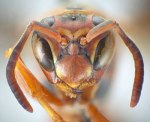
Mug shot of a female of Polistes hirsuticornis Buck. The hairs on the basal articles of the flagellum are longer than in related species (Photo credit D.K.B. Cheung & M. Buck).
This is what happened a few years ago when I started working on the vespids of the northeast. The family Vespidae (which includes mason wasps, paper wasps, yellowjackets and hornets) is most diverse in warmer parts of the World, as is the majority of stinging wasps. Doing a review of the northeastern Nearctic fauna therefore didn’t seem to be a very promising project for taxonomic novelty. Especially considering that the fauna of the eastern half of the continent is significantly less diverse and far better known than that of the west.
To my utmost surprise the study (published 2008 in the Canadian Journal of Arthropod Identification) not only turned up four new species of mason wasps but also two new paper wasps (Polistes). As you know, paper wasps are some of the most iconic species in the world of wasps, almost as much as their odious relatives, the yellowjackets. Further to that, they have received great attention as model organisms for the study of social behaviour and its evolution in insects. Finding not only one, but two new species in a group like this was beyond what I expected in my wildest dreams.
So how did it come to pass? As a novice to paper wasps I expected that reviewing the taxonomy of such a high-profile group would be like a walk in the park. Weren’t there scores of scientists before me who seemingly had no difficulties in identifying these sizeable and handsome insects for their behavioral studies, filling up cabinets of specimens in collections across the continent? Or so I thought! After months of fruitless staring through the microscope my nonchalant attitude gradually turned into frustration. One of the species, the common and widespread Northern Paper Wasp (Polistes fuscatus), was so variable that it blended virtually into almost every other species in the same subgenus. Previously published keys gave me a pretty clear sense of what typical specimens of each species look like, but where were the objective criteria that would allow me to identify the numerous intermediate forms? Truly, I found myself in a taxonomic quagmire!
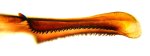
Aedeagus (penis) of Polistes parametricus Buck. The size, shape and position of teeth is diagnostic with regard to P. fuscatus and P. metricus, with which this species was previously confused (Photo credit D.K.B. Cheung & M. Buck).
Grasping for straws I turned to three taxonomic methods that had not been applied to Polistes before: DNA barcoding, detailed study of male genitalic features and morphometric analysis. During the previous months, I had rounded up a number of puzzling specimens which represented the spearhead of my taxonomic headaches, and submitted them for sequencing. The results came back like a thunderclap, turning my anguish into cautious excitement: the DNA barcodes of these troublemakerswere clearly different from any of the described species. With renewed energy I launched into a detailed morphological study which led to the discovery of several new diagnostic characters, confirming the distinctness of these wasps beyond a doubt. A lot of hard work had finally paid off, and I was looking at the first newly discovered species of paper wasps in eastern North America since 1836 when Amédée Louis Michel Lepeletier de Saint-Fargeau described Polistes rubiginosus!
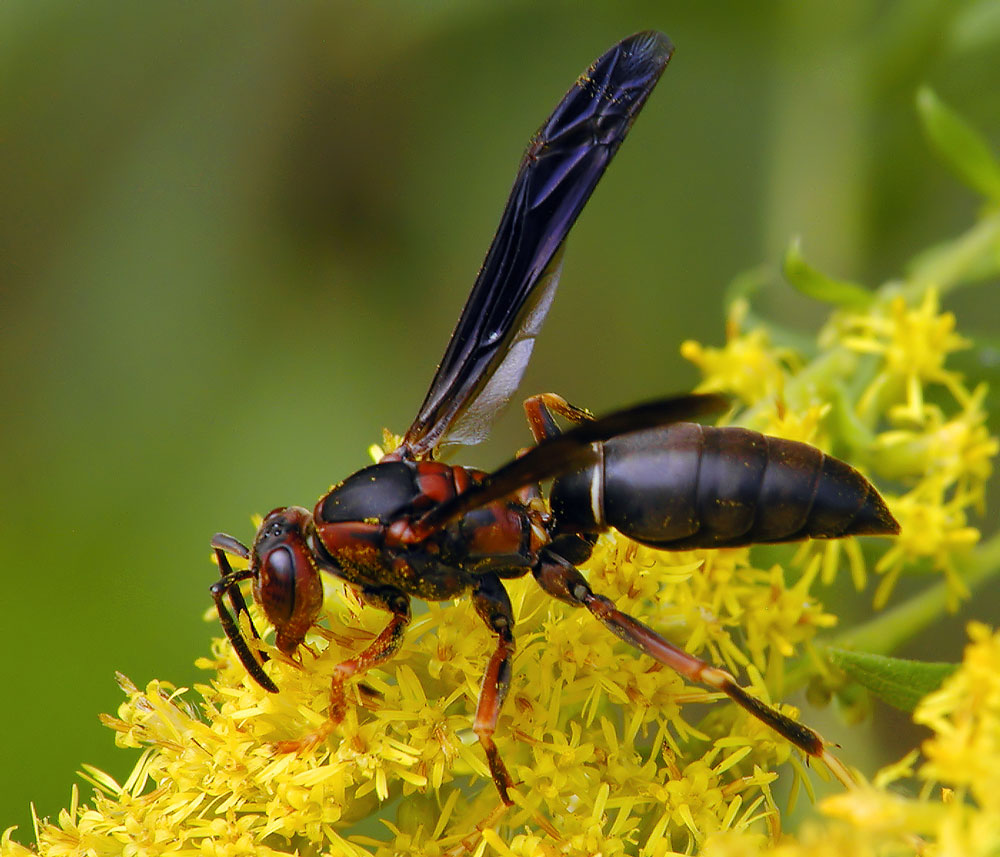
Female of Polistes parametricus Buck nectaring on goldenrod in West Virginia (Photo credit: Donna Race).
Since molecular methods, and in particular DNA barcoding, have received a lot of attention in recent years, it seems opportune to share some of my experiences working on Polistes. Unlike a few other taxa (such as spider wasps, Pompilidae), vespids sequence nicely and easily from pinned specimens, which makes them an ideal group for this kind of study. I found the sequence data extremely helpful but they certainly did not provide the cure of all taxonomic confusion. Barcoding uncovered an unexpected genetic diversity below the species level, which proved to be hard to interpret in the absence of other data. In Polistes there is no hint of a « barcoding gap », which postulates that genetic distances between individuals of the same species are (nearly) always greater than those between conspecific individuals. In fact, some of the species were genetically so similar that they differed by a mere 2 base pairs (out of 658). Nonetheless, the combination of molecular data with fine-scale morphology resulted in a quantum leap forward for Polistes taxonomy. Just days ago, I found out that a group of researchers in Germany and Switzerland are making similar progress on European paper wasps using a nearly identical approach.
My research paper on eastern Nearctic Polistes, including formal descriptions of Polistes hirsuticornis Buck and P. parametricus Buck, was published in the journal Zootaxa on October 1st.
Matthias Buck, Tyler P. Cobb, Julie K. Stahlhut, & Robert H. Hanner (2012). Unravelling cryptic species diversity in eastern Nearctic paper wasps, Polistes (Fuscopolistes), using male genitalia, morphometrics and DNA barcoding, with descriptions of two new species (Hymenoptera: Vespidae) Zootaxa, 3502, 1-48 Other: urn:lsid:zoobank.org:pub:6126D769-A131-49DD-B07F-0386E62FF5B9

Vivez une expérience audio visuelle hors du commun en compagnie du conférencier Étienne Normandin. Musiques, sons et vidéos de la BBC et de « Bugs of the underworld » sont au menu dans le but d’émerveiller vos sens à la beauté et à la fantastique entomofaune aquatique.
Les insectes aquatiques ont été les premiers insectes à apparaître sur la Terre, mais aussi les premiers à utiliser la voie des airs. Dans cette conférence dédiée à un public de tous âges, vous en apprendrez plus sur les particularités des insectes aquatiques ainsi que leurs comportements. Ces insectes peuvent être de fameux architectes, des pêcheurs habiles et d’excellents chasseurs. Ils sont aussi très importants pour l’écologie des plans d’eau et sont de bons outils pour les biologistes.
2 novembre 2012, 19h00
Jardin Botanique, IRBV, Local 354
link: www.aeaq.ca
page facebook: Association des entomologistes amateurs du québec
groupe facebook: Association des entomologistes amateurs du québec

The Entomological Society of Canada is looking for volunteers for the upcoming JAM, November 3-7! 
Volunteering looks great on your CV, is an excellent way to meet new people, and is fun! The Student Affairs Committee worked hard to keep student registration rates low, so we need a very strong showing of student volunteers to help make this meeting a success!
Sign up at http://www.doodle.com/i8znn4z75mtharfw by checking off times you are available. The full program is up now so you can confirm when you are presenting: check it out here!
CONTACTER LA SOCIÉTÉ
Assistant administratif : info@esc-sec.ca
SEC Président : ESCPresident@esc-sec.ca
This post is also available in: