


Nouvelles
Par/by Guillaume Dury
_______________
Chaque année, la Société d’Entomologie du Québec organise un concours photos, afin de trouver les couvertures du bulletin de la société, intitulé Antennae.
Pour aller avec le thème de la conférence de cette année « Entomologie et agriculture biologique; de l’écologie à la pratique », j’ai choisi le thème « formidable prédateurs à l’action ».
17 photos ont été soumises au total, et les trois gagnantes ont été choisies par vote populaire des conférenciers. Puisque j’était en charge du concours, j’ai décidé du système de vote. Chaque conférencier devait donner son choix de trois photos préférées. 3 points ont ensuite été attribués pour un premier choix, 2 pour le deuxième et 1 pour le troisième. Chaque photographe ne pouvait gagner qu’un des trois prix. Je suis heureux de présenter les photos gagnantes.
________________
Every year, the Entomological Society of Quebec organizes a photo contest to find cover photos for its bulletin, called Antennae.
To go along this year’s conference theme « Entomology and organic agriculture; from ecology to application » (my translation), the photo contest theme was « formidable predators in action ».
17 photos were submitted in total, and the three winners were chosen by popular vote of conference attendees. Since I was in charge of the contest, I got to decide the voting scheme. Each attendee was asked to give his first, second and third favourite photos. I then counted 3 points for each first choice, 2 points for second and 1 point for third. Each photographer was only allowed to win one prize. I’m happy to present the winning photos.
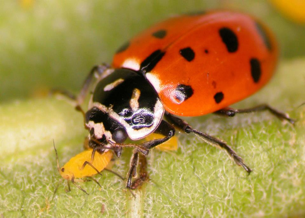
Première position/First Place: Julien Saguez
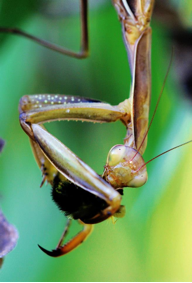
Deuxième position/Second Place: Roxanne Bernard

Troisième position/Third Place: Julie-Éléonore Maisonhaute
Félicitation encore aux gagnants!
Congratulation again to the winners!
A belated Happy New Year to all!
Buggy is back for his first post of the year. This is also my first post in a while; put that down to a combination of conference season, project planning season and too much holiday cheer.
I recently had an exchange on Twitter exchange with a colleague (and yes, before you ask we are allowed to use social media at work) about where scientists could deposit their data on the web at the end of a study. I had a few suggestions (and, as usual, a few opinions) about how, where and why we should be depositing our data.
As science moves towards a more ‘open source’, philosophy making data available as part of the publication process is becoming more common. Of course the taxonomists, systematists and gene-jockies amongst us have been doing that for a while, using systems like NCBI’s GenBank. Where the revolution (if I could be so bold as to use that word) is coming is in the ecological sciences. Expectations amongst publishers and in the broader scientific community are changing twoards expecting that data will be made available online and in an accessible format. To accommodate this, a number of projects have been launched that are meant to be a place for us to publish data sets.
But why publish your data? In theory raw data was always available: you just needed to ask for it. In practice, people can refuse, move on or pass away; data can be lost, formats can change and software can go obsolete which makes the reuse of data difficult. Publishing your data solves this problem.
Publishing your data also makes your work reproducible. With access to your data and your analysis code, anyone can repeat your work – or better yet, extend your work and gain new insight. In fact, in a great many fields your paper will not be published until you deposit the data (see here, for instance). I’d also argue that if your research is publically funded you have an obligation to make your data available. Of course, that is, after you’re done with it!
So why don’t more of us share our data? Well the biggest fear, of course, is that you might get ‘scooped’. That’s reasonable, but I think it’s unfounded, and here’s why: we expect that if someone wants to use our ideas, they will cite us. Otherwise it’s plagiarism (or at least bad manners), and there are ways to deal with that. So, extending that logic, It’s reasonable to expect that if someone wishes to use our data, they will cite us as well (and now you can even track those citations!)
I’d go further and state that the benefits to publishing data outweighs the pitfalls. From an ‘economic’ perspective we can gain professional currency in the form of citations (see here and here), which have value in application, tenure and promotion packages.
Professionally, publishing data can help you attract new collaborators and new research opportunities. Publishing your data is just one more way people can become aware of you and your work and that awareness is important. There is the old saying that data without context is just noise. If your data can be applied elsewhere, only you as the collector can provide that additional insight into the specifics of your system. That insight can help to explain new results, but it can also lead to new hypotheses and collaborations with people you may never have otherwise interacted with (or who would have never read your paper).
Personally, I think that the potential for greater insight resulting from others ‘playing around’ with your data can only result in a deeper understanding of your own system. And really, isn’t that something we’re all after?
Below is a list of some places where you can publish your data. Do you have any other suggestions, or want to share your experiences with publishing data? Let me know in the comments.
Buggy.
(With thanks to Simon Bridge of Natural Resources Canada Canadian Forest Service for suggesting I write this up.)
_____________________
From their about page: “Dryad is both an international repository of data underlying peer-reviewed articles in the basic and applied biosciences, and a membership organization, governed by journals, publishers, scientific societies, and other stakeholders. Dryad welcomes data submissions related to published, or accepted, scholarly publications.”
The Ecological Society of America’s Data Registry
A data repository for articles published in the ESA’s journals)
A repository for phylogentic trees and data
Or find a journal where you can publish the data as a digital appendix like I did here.
By Sean McCann, PhD Canidate in Biological Sciences at Simon Fraser University

9/10 ant-mimicking mantids recommend tropical fieldwork for prevention of insect withdrawal. (Photo: S. McCann)
At this stage of the long dark Canadian winter, thoughts of tropical fieldwork should be going through the heads of all sensible entomologists…If you find yourself longing for the moist and insect-filled paradise of the Neotropics, or even if that is what your research plans call for, let me introduce you to the wonders of French Guiana.

Topography near the Inselberg Camp. (Photo: S. McCann)
French Guiana is situated just north of Brazil on the Atlantic coast of South America, and remains to this day an overseas Department of France. Both French and Creole are spoken, so Canadians should feel right at home.
French Guiana truly shines as a biodiversity and natural areas hotspot because unlike many countries in the Amazonian forest region, it has not experienced extensive deforestation. The immense expanses of unlogged rainforest are truly impressive.

The Inselberg des Nourages on a clear day. View not guaranteed, depends on the season. (Photo: S. McCann)
There is quite active citizen science in Guyane as well, of particular interest is the SEAG, or Société Entomologique Antilles Guyane: http://insectafgseag.myspecies.info/. This society has conducted numerous expeditions focused on collection and identification of many insect taxa, and represents a great resource of local knowledge of the insect fauna.

Finding a cryptic owlfly nymph is always a nice surprise (unless you are a cricket) (Photo: S. McCann)
I have done all my tropical fieldwork at the Nouragues station, supported by an annual grant program that seeks to assist visiting scientists with the travel and logistical expenses involved with a tropical field season. My work has centred on a bird which is a specialist predator of social wasps, the Red-throated Caracara.

Red-throated Caracaras are specialist predators of social wasps, and a common resident of the Nouragues Reserve. (Photo: S. McCann)
The 1000 km 2 Nouragues reserve is located approximately 100 km SSW of Cayenne, and was established in 1995 to be both a refuge free of development and to facilitate research on Neotropical forest dynamics.

Army ants (Eciton spp.) are one of the wonders of the Neotropical raindforests. Go. See. Them. (Photo: S. McCann)
There are two research camps, the Inselberg Camp, situated just beneath a 420 m granite mountain, the Inselberg des Nouragues, and the camp at Saut Pararé, situated just below a series of high rapids on the Arataye River. The camps are accessible by helicopter, or you can take a motorized canoe (pirogue) to the Saut Pararé camp. Both camps are administered by the CNRS (Centre Nationale de Recherche Scientifique) which has an office in Cayenne. Field costs are €20/day for students and postdocs and €35 per day for established researchers. Travel to the station can be expensive, but sharing the cost of helicopters/pirogues with other researchers can bring the costs down considerably.
Access to various parts of the forest is facilitated by an extensive trail system . Data on tree species and flowering/fruiting phenology in two large research plots at the Inselberg Camp are available. At the Pararé camp, there are also many trails, although not as extensive as at the Inselberg camp, as well as access to riverine and palm swamp habitats. Lists of species of birds, bats, fish and trees are available, and there is an impressive list of scientific data already published: http://www.nouragues.cnrs.fr/F-publications.html.

UV lamps attract a nice variety of insects. These are particularly fabulous. Start your collection today! (Photo: S. McCann)
The camps are comfortable, with covered shelters (carbets) for sleeping and eating, and there is electricity and running water at each station (it is the rainforest!). There is also a satellite internet connection which is adequate for email and keeping in touch with labs and colleagues. Food is provided, and is quite good (as one might expect at a French field station!), cooking/cleaning duties are shared.

The kitchen carbet by moonlight. (Photo: S. McCann)
If you are a student or a researcher at the planning or pre-planning stages of a Neotropical research program, there is no better time than now to submit a research proposal to the scientific committee of the station. The recently announced call for proposals will fund projects to a maximum of €9000, which would nicely cover the transportation and field costs for a several-month expedition. The deadline is Feb. 14, 2013. For more information, the details are available here: http://www.nouragues.cnrs.fr/indexenglish.html
By Dr. Staffan Lindgren, University of Northern British Columbia
————————
When teaching Invertebrate zoology, entomology or forest entomology, I am regularly asked by students if they can use common names. Mostly this request is precipitated by the perceived difficulty of memorizing, let alone pronouncing, Latin names. I am fairly relaxed about these things, particularly with forestry students, who are quite unlikely to become entomologists no matter how you define that term. It should be clarified that forest entomology is taught within a Disturbance Ecology and Forest Health course at my institution (UNBC), with diagnostics in half of a separate lab course. My stock answer is thus that they may use common names as long as the name clearly defines the species they are referring to.
Foresters are prone to colloquial terms, whether with respect to insects, trees or other organisms. For example, subalpine fir (Abies lasiocarpa) is called balsam by many, if not most foresters in BC, even though it is a distinct species from balsam fir (Abies balsamea) of eastern North America. Similarly, Pissodes strobi, the white pine weevil, is called spruce weevil (a legacy of the days when this weevil was considered three separate species, two of which primarily infest different spruce species in the west) or simply leader weevil. The reason, supposedly, is that it is the wood quality that matters in terms of trees, and the type of damage with respect to insects. The consequences of being a bit loose with the taxonomy of a particular species may therefore seem fairly inconsequential in forestry.
Incidentally, our forestry students have even more to worry about when it comes to pathology, which they have to learn at the same time, as the same biological organism often has two completely different Latin names (including genera) depending on whether it is the sexual or asexual form (why this remains an accepted practice is beyond me), and they often do not have common names. Add the fact that fungal species seem to change name more often than I change vehicles (I was going to write ‘shirt’, but didn’t want to gross anyone out making you think that I wear the same shirt for years), and it becomes rather a nightmarish proposition for the poor students.
When it comes to entomology in general, however, common names are most commonly used in casual conversation, particularly with members of the public. For entomologists this is usually not a problem, but for non-entomologists it can be very confusing. For example, colloquial use of ‘bug’ is pretty much anything that is small and crawls or flies around. Taxonomically it is quite specific (Hemiptera: Heteroptera). Ladybugs (Coleoptera: Coccinellidae) are perhaps the most recognizable insects to people in general, but they are clearly not bugs. Plant lice (Aphidoidea and Phylloxeroidea), bark lice (Psocoptera) and body lice (Phthiraptera) represent three vastly different taxonomic groups. In addition, if the non-louse groups above were to be correctly written to show that they are not Phthirapterans, there should be no space – however for these common names that principle is never applied as far as I can tell. It is to differentiate dragonflies, damselflies, stoneflies, mayflies, whiteflies etc. from the true flies. For example, a dragon fly, if there were such a thing (and probably there is somewhere – perhaps a decapitating fly (Phoridae) comes close enough to earn that epithet!) would be a dipteran, whereas a dragonfly is not. How is a non-entomologist supposed to know that (assuming that it is important to anyone except us entomophiles)? Then we can go on to more obvious misnomers such as ‘white ants’, which aren’t ants (Hymenoptera: Formicidae) at all, but termites (Isoptera).
Going back to forest entomology, one can have all kinds of fun with some common names, the origin of some could serve as fodder for endless speculation. For example, when discussing the problems with common names, I ask my students what they think a sequoia pitch moth (Synanthedon sequoiae)(Lepidoptera: Sesiidae) would attack. The correct answer is naturally “mostly lodgepole pine, but not sequoia”. Similarly, the Douglas-fir pitch moth (Synanthedon novaroensis) commonly breeds in lodgepole pine, but as far as I know not in Douglas-fir. I then go on to western spruce budworm, which as the name does not imply primarily attacks Douglas-fir.

Myrmica brevispinosa, the short-spined ant
Clearly one cannot expect members of the public to keep track of Latin names of insects, so common names are here to stay. I was interested to find in a book I recently purchased (Ellison et al. 2012) that the authors had invented common names for every species by essentially translating the Latin species epithet. That creates an interesting situation vis-à-vis the attempt of entomological societies to standardize common names (http://www.esc-sec.ca/ee/index.php/cndb; http://www.entsoc.org/common-names). Nevertheless, some ants simply retained their genus name, e.g., Harpagoxenus canadenis became “The Canadian Harpagoxenus” (not sure why, as they named the genus “The robber guest ants”), Formica hewitti became “Hewitt’s ant”, Myrmica brevispinosa (the species in the photo accompanying this article) is called “The short-spined ant”, and perhaps my favourite Lasius subglaber was named “The somewhat hairy fuzzy ant”. Common names aren’t generally that innovative, but Latin names certainly can be.
Many years ago May Berenbaum (1993) wrote a column on this topic. If students would all read Dr. Berenbaum’s eminently humorous take on how insects get named, they would without a doubt get a new appreciation for both Latin names and their creators, and perhaps feel less trepidation about memorizing them. Then not only true blue entomologists would be tempted to buy a bumper sticker that read “Sona si Latine loqueris” (Honk if you speak Latin) (Unverified from http://www.latinsayings.info/).
Berenbaum, M. 1993. “Apis, Apis, Bobapis….”, American Entomologist 39: 133-134.
Ellison, A.M., N.J. Gotelli, E.J. Farnsworth, and G.D. Alpert. 2012. A field guide to the ants of New England. Yale University Press, New Haven and London, 398 pp.
Tonight on CBC (8pm local time across Canada) The Nature of Things with David Suzuki is showing ZAPPED: The Buzz About Mosquitoes, a documentary all about mosquitoes in Canada, the rising potential for mosquito-vectored disease thanks to climate change, and the ways in which Canadian scientists are working hard to stay ahead of them.
Featuring great macrovideography (which you can learn more about with the behind the scences feature on the ZAPPED website), interviews with Canadian entomologists, and highlighting research being done here in Canada, ZAPPED has great potential to spread information and awareness about Canadian mosquitoes.
I’ll be live-tweeting the program tonight @ 8pm EST using the hashtag #CBCZapped (those of you on Twitter can do the same when it airs in your timezone) and I hope that if you live in Canada you’ll join me in learning more about the flies people love to hate!
CONTACTER LA SOCIÉTÉ
Assistant administratif : info@esc-sec.ca
SEC Président : ESCPresident@esc-sec.ca
This post is also available in: