


Nouvelles
One of the fringe benefits of running the ESC/ESAB JAM 2012 photo competition was getting a glimpse into what other people where interested in. One of the most unusual images we received was submitted by Marilyn Light, entitled « Trialeurodes sp. ».
 Trialeurodes sp. with impostor…
The photomicrograph (a focus-stacked image, produced with Zerene Stacker) shows a fourth stage whitefly pupa case. Whitefly are hemipteran herbivores that are often found feeding on the underside of leaves.The species we know most about is the greenhouse whitefly (Trialeurodes vaporariorum), a pest that damages food crops by feeding on them and by spreading viruses. To control whitefly, growers resort to using the wasp Encarsia formosa. In this photograph we see a species of whitefly that was found on a wild orchid, the showy lady’s slipper (Cypripedium reginae Walter). The glassy spines are typical of some whitefly pupa, but what is amazing about this picture is that the creature inside is not a whitefly. Looking closer at the lower left of the image you can see the brownish-orange eyes of the head of a parasitoid wasp, with the thorax and abdomen almost filling the case. Marilyn has included the following information with the image:
from Wikipedia
The showy lady’s slipper orchid, Cypripedium reginae Walter, forms large colonies in fen wetlands. The insect herbivore assemblage of this orchid includes Trialeurodes sp. Cockerell (Hemiptera: Sternorrhyncha: Aleyrodidae) which was first observed by us in 2009 on orchids growing in stressed habitat. Eric Maw, CNC, determined this whitefly to be an undescribed Trialeurodes. Subsequently, we have found isolated infestations in a second orchid population which is less subject to drought stress. The whitefly is parasitized by Encarsia sp. Förster (Hymenoptera: Chalcidoidea: Aphelinidae). During microscopic examination of one 4 th stage nymph (pupa) case that had been removed from a freshly collected orchid leaf on September 22, 2012, I photographed a parasitoid that was soon to emerge. About half of the other cases examined had been parasitized.
Of course, being who I am, I was curious not only about the image, but also about the person who took it. I asked Marilyn to tell me a bit about herself and how the image came to be…
« I am a member of the ESC but do not earn my living through entomology. I am retired from the University of Ottawa Professional Training Service.
My interest in insect population dynamics begins with my experience in 1948-49 during an eastern tent caterpillar outbreak in Montreal: I was 7 years old. My dad showed me the the stages and how to distinguish male and female moths. My first teaching opportunity was with my Grade 2 classmates on the insect and its life history. Ever since I have been learning so I can teach others. In 1951, after the outbreak was subsiding, I observed a large caterpillar walking alone on a twig. It burst when touched, exuding pink fluid. I was to later learn that it had been infected with a virus. I remain fascinated by the delicate balance in nature, between plants and herbivores, and between herbivores, their pests and diseases.
My husband and I have been tracking wild orchid populations since 1985, examining how they are impacted by climatic variables, disturbance, pollinator behaviour, and insect herbivores. The dynamic of insect herbivore populations with their respective biological controls and the orchids is a natural extension of the work.
There is a paucity of information about insect biology except with species of economic importance or conservation value. Our investigations will hopefully serve to fill this gap. We publish regularly in both peer-reviewed and popular media. »
Professional work by dedicated ‘amateurs’! More of Marilyn’s work can be seen in the study, Potential impact of insect herbivores on orchid conservation. (Light, M. H. S. and MacConaill, M., 2011. European Journal of Environmental Sciences: Vol. 1, No. 2, pp. 115–124) and Possible Consequences of Walking off the Trail (Light, M. H. S., and M. MacConaill, 2008. Orchids: 77: pp 128-133). She is well known in the orchid community in Canada and abroad, and is author of the book, Growing Orchids in the Caribbean (Macmillan Caribbean, 1995).
The last issue of the ESC Bulletin for 2012 is now online, and it’s a celebration of the great accomplishments of the society and its members over the past year!

Some highlights include:
- lots of buzz about the great 2012 ESC JAM
- the goals and aspirations of our new President, Rosemary De Clerk-Floate, for the ESC
- student scholarship and award winners
- regular member award winners
- the ESC website is looking for a new webmaster – consider submitting an application!
Enjoy the full articles by clicking here for a pdf.
 The ESC Blog was launched on June 1, 2012. We didn’t entirely know what to expect in terms of the readership, reach and submissions, but it’s clear that we’re off to a great start!
For those who like numbers (we do!), here are some stats. In the past seven months we’ve had:
- about 10,000 page views
- 61 posts by a total of 25 bloggers
- visitors from 141 countries
Wow! While we’re quite pleased to see that our strongest viewership comes from right here in Canada, it’s equally wonderful that our bloggers are writing posts relevant to the rest of the world! We salute our fine authours for all their hard work and excellent contributions this year.
The five most popular posts of the year are quite varied in terms of content, though perhaps we shouldn’t be surprised that our audience appreciates diversity – we’re entomologists, after all!
- Exceptional Canadian Entomologists Recognized with ESC’s Top Honours, by Rose De Clerk-Floate
- An Insect for Canada, by Morgan Jackson
- Insects as Works of Art, by Elizabeth Goluch (as told to Crystal Ernst)
- Stupidity is the Mother of Invention, by Terry Wheeler
- Caption Contest, Cycle 1 Photo 1, by Morgan Jackson
These posts reflect pride in our country and for members of our entomological community, an appreciation for the beauty of our chosen study subjects and, not least of all, a good sense of humour!
Now that you’re all feeling refreshed from a good winter break, why not submit that article you’ve been thinking about writing and join our suite of excellent bloggers? We’d love to hear about your research, a student accomplishment, an outreach activity or workshop, or interesting natural history observations! Send your story and photographs to EntSocCanada@gmail.com.
Happy New Year, and may 2013 bring you many entomological delights and discoveries!
This memorial for Dr. Richard (Dick) Vockeroth is from Dr. Jeff Skevington & Dr. Jeff Cumming of the Diptera Unit at the Canadian National Collection of Insects, Ottawa, Ontario.
—————————

Dick Vockeroth attending the 6th International Congress of Dipterology in Fukuoka, Japan (2006). Photo by Chris Borkent.
The Diptera community has suffered a great loss — Dick Vockeroth passed away on the morning of November 16th 2012, at the age of 84. Almost everyone who studies flies knew Dick, and most of us have some hilarious Vockeroth stories that will undoubtedly continue on for several generations. His breadth of knowledge was unsurpassed and many of us owe him considerably as a mentor. He always amazed us by seeming to know something about virtually every fly species put in front of him. Of course, putting a fly in front of Dick was just the excuse to open the floodgates. For those who could concentrate for long enough, his stories always had a point. They could continue for a long time, but they always wound back to where they started, completing another lesson for those willing to listen. If only we had a way to save all of his immense knowledge.  Fortunately, he was always willing to share. He published 120 papers on 27 families of flies over his career. His unpublished manuscripts and keys also fill many boxes in our collection. Copies of many of these are spread around the world with Dick’s colleagues and will ultimately be incorporated and published as part of new studies. In addition to giving freely of his scientific knowledge, Dick was a true philanthropist. He seemed to donate virtually every penny that he had to anyone who stopped at his door or called. He was incredibly frugal with his own purchases and we all benefited/endured from his purchases of cheap (or free) produce and bread that often had seen better days. His immune system seemed to enjoy these nutritional challenges although ours were perhaps not always up to it. We recall a few years ago when Dick had the first cold that he could remember having since he was a child, as well as the first headache in his life a year or two later. Diabetes was his primary health challenge and it was a significant one in his later life. It was likely a contributing factor to the Alzheimer’s that eroded his mind over the last three years.
The following is excerpted from Cumming et al, 2011. This paper is the introduction to a three volume Festschrift in The Canadian Entomologist honouring Dick and the other coordinators of the Manual of Nearctic Diptera. Picking through these papers, you will find some classic stories about Dick and expand your impression of the impact that he played in the Diptera community over the last 60 plus years.
 Dick was born on May 2nd 1928 in Broderick, Saskatchewan. He received his B.A. and M.A. from the University of Saskatchewan in Saskatoon in 1948 and 1949, respectively, and his D.Phil. on the genera of Scathophagidae from Oxford University in 1954. He officially joined the Canadian National Collection of Insects (CNC) Diptera Unit in 1949. Dick retired in 1991, but contributed broadly to Diptera activities at the CNC as an Honorary Research Associate until 2009. He became a world expert on several families, particularly Mycetophilidae s.l., Dolichopodidae, Syrphidae, Scathophagidae, and Muscidae. He was an avid collector and contributed over 220,000 pinned Diptera to the CNC. Dick authored or co-authored 120 scientific publications, including 12 chapters in the Manual of Nearctic Diptera. He has published 173 new Diptera taxa (1 family group name, 42 genus-group names, and 130 species-group names). Dick was awarded the C.P. Alexander Award in 1997 by the North American Dipterists’ Society. This lifetime award, which can only be held by a single dipterist at a time, publicly acknowledges the most important and influential member of the North American Dipterists’ Society. The Award reads, ‘‘John Richard Vockeroth is recognized as our most knowledgeable dipterist, and for his critical and unique contributions in expanding our knowledge of flies, especially flower flies, educating and encouraging a cadre of world leaders for Systematic Dipterology’’. Sadly, this award is now available to be given to someone else.
Evidence of the respect of Dick’s scientific achievements can be seen in the ninety-one patronyms that have been attributed to him by the entomological community (http://www.canacoll.org/Diptera/Staff/Vockeroth/Vockeroth_Patronyms.pdf). This list will no doubt continue to grow as his collections live on and support new research on the flies that Dick was so passionate about. We have all missed his antics and contributions in the lab since he left in 2009. Let’s hope that we can all leave even a fraction of the lasting legacy and legends that Dick has left behind.
The funeral was held Wednesday 21 November at the Hulse, Playfair & McGarry Chapel at 315 McLeod Street in Ottawa. His obituary appeared in the Ottawa Citizen November 17-19, 2012.
If you wish to make a donation in Dick’s name, he would no doubt be honoured if it went to the Canacoll Foundation (www.canacoll.org), which supports improvements to the CNC by visiting specialists. Cheques made out to the Canacoll Foundation can be sent to the treasurer, Andrew Bennett, at the K.W. Neatby Building, 960 Carling Avenue, Ottawa, ON, K1A 0C6, Canada. Tax receipts will be issued.
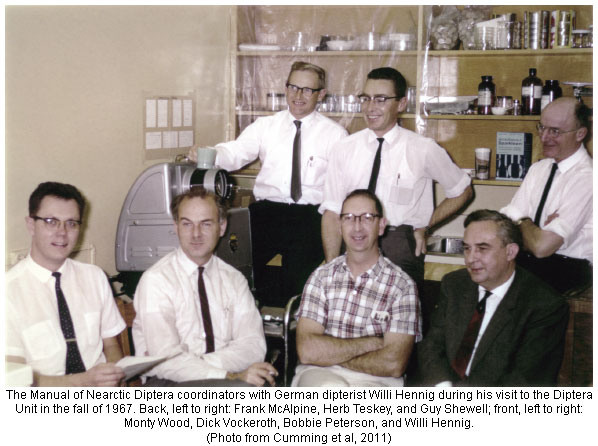
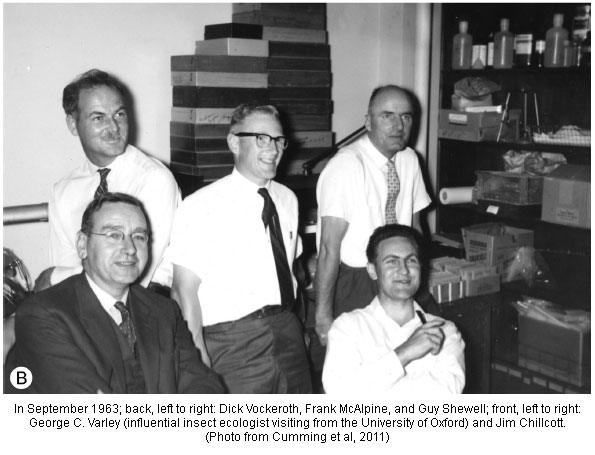

Cumming J.M., Sinclair B.J., Brooks S.E., O’Hara J.E. & Skevington J.H. (2011). The history of dipterology at the Canadian National Collection of Insects, with special reference to the Manual of Nearctic Diptera, The Canadian Entomologist, 143 (6) 539-577. DOI: 10.4039/n11-029
Today’s post is by Dr. Staffan Lindgren, University of Northern British Columbia, and Second Vice-President of the Entomological Society of Canada.
————————————
I have just returned from the Entomological Society of America conference in Knoxville, Tennessee, and thought that this would make a suitable topic for my first ever blog. As I attended the ESC-ESA JAM the week before, it gives me a suitable reference point for evaluating the ESA meeting.
The ESA conference attracted ~3000 or so delegates, and consisted of numerous concurrent submitted sessions, over 100 symposia, and a sizeable poster session, with each set of 300+ posters available for viewing one day. In return for the $400 registration, you received a name tag, a program book, and some items encouraging you to attend the exhibition. If you were savvy and well connected, you could get some free snacks and drinks at one or several of the numerous university or ESA staff-specific mixers held more or less nightly (yes, I am savvy and relatively well connected). As a younger man, armed with enthusiasm, curiosity and at least a modicum of drive, I would identify all the talks relevant to my own research, and then run between sessions to catch them. Now I tend to pick a symposium or session and sit through it, as I find that I am more likely to get exposed to new and different ideas that way. When you have over 100 symposia over four days, however, it is near impossible to catch even a fraction of the sessions you wish to attend. I also like to browse the posters, rather than identify specific ones, but again – during a big meeting like ESA it is sometimes hard to get the time. It is extremely helpful when posters have 8×11 versions that you can take with you to read later, and you could scan QR codes with information on the posters (as well as sessions and exhibitors) into your smart phone/tablet if you were so inclined (I haven’t quite gotten there yet). I would think these approaches are the future when the techies replace us old traditionalists. The meeting also had virtual posters for non-North American students unable to attend the meeting, which was a neat idea (even if I didn’t get around to looking at them either)!

Smoky Mountains photo by Staffan Lindgren
The location of a meeting is obviously important. Knoxville has a lot to offer, not least of which is the “body farm”, or the University of Tennessee Forensic Anthropology Center Research Facility. Tours were offered to the site, but I don’t have the stomach for it, so I went with some colleagues to the Smoky Mountains instead (we did look at hemlock woolly adelgid, so it was an entomological trip!) The layout of the meeting venue is extremely important, I realized. Ideally, the session rooms should be organized around a central area, so that attendees have a chance to interact. The Knoxville meeting was held at the conference center, the layout of which was not conducive to personal interaction, unfortunately. It consisted of a three-storey square building, with the meeting rooms in the middle surrounded by a walkway, and the exhibition hall in the basement. Consequently you could spend the entire meeting there and still not meet up with colleagues. I ran into two colleagues the evening of the last day I was there, and I failed to find one colleague I was actively looking for!
There are positives and negatives with every meeting, but when contrasting the Edmonton ESC meeting with the Knoxville ESA, or any other ESA meeting for that matter, I think ESC takes the prize both in terms of what you get for your registration fee, and ability to network with colleagues. The scientific program at the ESC meeting was of very high caliber as well, particularly the plenary session. Being small isn’t always a good thing, but when it comes to scientific conferences, I think it is a definite advantage. What do you think?
CONTACTER LA SOCIÉTÉ
Assistant administratif : info@esc-sec.ca
SEC Président : ESCPresident@esc-sec.ca
This post is also available in: