


Nouvelles

Eloise Rowland, graduate of the Gries Lab of Simon Fraser University was recently recognized by the Royal Entomological Society for the best paper published in the journal Physiological Entomology in 2013 and 2014. This paper, part of Eloise’s MSc work, examines the role of sound in the sexual communication of the gypsy moth, Lymantria dispar. It was coauthored by Peter Belton, Paul Schaefer and Gerhard Gries and is really a great contribution! Check it out!
Rowland E, Belton P, Schafer PW, Gries G. 2014. Intraspecific acoustic communication and mechanical sensitivity of the tympanal ear of the gypsy moth Lymantria dispar. Physiological Entomology 39(4): 331 – 340. DOI: 10.1111/phen.12080

As part of the Canadian Entomology Research roundup (the first two posts can be found here and here), we will be sharing more detailed posts from the grad students involved in the published research.
Below is a post from Jessica Ethier, sharing her research experience that spanned an undergraduate and PhD degree.
I just published a paper in Entomologia Experimentalis et Applicata. From start to finish, the work only took a decade.
Ten years ago, in the summer of 2005, I had just finished my first year as an undergraduate student at Concordia University. I had no plans yet for what I would do after graduating; really, I was just glad I’d survived that first year. But across the country, unbeknownst to me, traps were being set, insects were being collected, and by the time I was starting my second year of university here in Montreal, a student at the University of Alberta was busy pulling the wings off a bunch of dead moths.

A horrific sight to innocent insect passers-by.
That student was Kevin Lake. He was doing his undergraduate research project on the effects of population density on wing size and colour in the Malacosoma disstria moth with Maya Evenden and Brad Jones. Fast-forward one year to the fall semester of 2006, and I had now transformed (one might say, metamorphosed) into a seasoned third year undergrad dabbling in research for the very first time. In Emma Despland’s lab, I had a freezer-ful of more dead moths just waiting to be de-winged and studied, and (thanks to Maya and Emma) the protocols Kevin used for wing removal and colour scoring. One thing led to another, and before I knew it, it was 2009 and I had just fast-tracked to a PhD from a Master’s for my research on colour polymorphism and wing melanization in the M. disstria moth.
One of the aims of my graduate research as a whole was to try and figure out why there was always so much individual variation in colour within the genetically-based phenotypes. Emma and I developed an experiment for spring of 2010 to see if limiting dietary protein in the larval stage limited the expression of colour in the adult moth. I even had my very own undergraduate student for the project, Michael Gasse, to rear the insects, process the wings, and collect the colour data. But it wasn’t all rainbows and puppies and pulling wings off dead moths. First we had to get the insects from somewhere.
As luck would have it, there was a forest tent caterpillar outbreak about an hour away from the city that year (for some reason, the landowners – maple syrup producers – were not nearly as gleeful about this infestation of their sugar maple forests as all the members of the Despland lab were). So off we trooped in the middle of February, tree clippers, binoculars, and plastic lunchboxes in hand, to go collect as many egg masses as we could get our mitts on.

You thought the lunchboxes were for lunches? Photo by Alison Loader
Then it was back to school, to spend most of April, May, and June in the sub-basement dungeon lab, slaves to the needs of the exponentially-growing, insatiable eating and pooping machines that we called our experimental subjects.

First instar M. disstria colonies in 30mL hatching cups with artificial diet. Those cups are basically the little plastic shot glasses you see at dollar stores. By the time they reach the final instar, the caterpillars are typically longer than those cups are tall. Photo by Alison Loader.
We all survived another research season, and Mike moved on to wing-pulling and colour scoring a few hundred moths. Time flew by, as time will do, but in 2012 I finally finished and submitted my article on nitrogen availability and wing melanization in the Malacosoma disstria moth!
It was rejected.
Undeterred, I chose another journal and submitted again. And again. And again. After the fourth or fifth rejection, I stopped resubmitting. Not because I was giving up, but because I had to write my thesis and graduate. Once that little matter was taken care of, I went back to my pesky paper. Looking at it with fresh eyes, I realized that the two sections I had divided my paper into just did not complement each other, despite being based on the same experiment. Then I had an epiphany. One of the reasons for forest tent caterpillars to suffer nitrogen limitation in real life is high population density.
And the rest, as they say, is history.
By Dr. Tom Chapman, Memorial University
—-
I used scissor to cut my pant into short. A jarring opening sentence, I know. It is how I use to feel when someone dropped the “s” in “thrips”; it is a plural noun, don’t you know? If you see a solitary individual of these animals it is still referred to as a “thrips”. I have been quick to correct people that have made this mistake. But lately on this issue, I have become tired of being the grammar pedant.

Art work done by Michael McLeish and Andrew Chaulk.
I don’t mean to be insulting to the readers of this blog, I am assuming you are knowledgeable and enthusiastic about insects, but just maybe you haven’t heard much of thrips. They are members of the insect Order Thysanoptera, and world wide there are at least 5000 species. They are small; in fact, they are typically the size and colour of the commas in this very sentence. These slithering punctuation marks do not commonly attract the attention of insect enthusiasts. However, for a small number of economically important species there is a large and vibrant community of researchers. These scientists routinely gather together to describe and discuss their research outcomes, with their next big event to be held in California (2015, Xth International Symposium on Thysanoptera & Tospoviruses). Among the dominant applied work that will be presented at this meeting, and those of the past nine meetings, will also be more curiosity driven research. This group of non-applied thrips-focused researchers could book a table at most restaurants. No more or less important, just a more private club. A club I joined as a PhD student.
Professor Bernard Crespi, in his early career, did a stint in Australia as a Research Associate. His motivation to travel to the antipodes was to answer the challenge, are there social thrips? The evolution of altruism (sub-fertility in part of a population) in the insects was and remains an outstanding conundrum for evolutionary theory. Theoretical attempts made in the sixties and seventies to explain these incidences of self-sacrificing castes appeared to also predict that somewhere within the diversity of thrips species we should also find sociality. There were no ready examples. Crespi had a hunch that social thrips would be found among the gall-inducing thrips on Australian Acacia. In brief, he was right! Subsequently (Again, drastically shortening the story. Hey, I am not trying to write Crespi’s biography here.), Crespi took a position at Simon Fraser University where his research began with a focus on Australian social thrips. I was the first graduate student he recruited.
I will admit that the thrips played no part in attracting me to the program. Instead, it was Crespi’s strong scientific reputation and the chance to do field work in Australia that was the lure. However, it was several years of working in Canada with preserved and frozen specimens of thrips before I saw their full charm in their native habitat. I was hosted in Australia by Crespi’s major collaborator with the thrips work, Dr. Michael Schwarz, at Flinders University. In this prominent social insect lab I met three students with the same taxonomic focus as me. Like Tigger in The Tigger Movie, I had started to fear that I was the only one. We connected quickly, and one of the pivotal bonding events happened during a trip to a Nursery outside the city of Adelaide. We needed native Australian plants for an experiment and the Nursery that could provide them was located inside a national park. On the way in we saw a sign warning visitors that they were not permitted to bring in plants or soil for fear of introducing pests. The list of pests included “thrip”. On our way out of the park, we stopped our truck; one of us jumped out with a permanent marker and added an “s”. Having scored one for thrips, we cheered and drove away.
It has been almost twenty years since we vandalized that sign (I hope that is longer then the crime’s statute of limitation). Since then I have continued research on social thrips, and I have given lectures in undergraduate and graduate classes, job interviews, conferences, public lectures and even dinner parties. Many people have engaged me after these events to express further interest in the work. If they said “thrip”, I corrected them. I thought educating people outweighed the potential risk of embarrassing them. My behaviour has certainly lost me a few acquaintances, some people have skin that is thin, but is there any evidence that I have been successful in educating people? I think the answer is no. A student of mine was interviewed a little while ago on the national radio science show, Quirks and Quarks. She corrected the host when he dropped the “s”. Two students and I submitted a paper to an entomological journal, and one reviewer pointed out to the editor the poor grammar of our presentation. The example they used to illustrate our incompetence was our failure to drop the “s”. I am co-writing a book chapter with a longtime friend and colleague, he edited my part by dropping a few of the “s”s. I give up. Not research or a fascination with thrips, just the “s” thing. It is now my opinion that the thrips research community is better off without this plural noun. To the uninitiated it sounds weird to use “thrips” in the singular, and to insist on its proper use is alienating. I don’t know how to change this. Who is in charge? How do you start a revolution? In the mean time, to those that naturally say “thrip” I am sorry I have offended you, let’s be friends.
Two student members of the Entomological Society of Canada have videos entered in the NSERC-CRSNG Science, Action! competition. The contest, open to students across Canada, aims to share NSERC-CRSNG funded research through 60 second videos, and offers a cash prize of $3,000 to the winning entries. The first round of public voting is now open, and both students would appreciate your support by viewing and sharing their entries, helping highlight entomology research in Canada.
Michael Hrabar, MSc Student at Simon Fraser University
Bed bugs have become a global epidemic. Detecting infestations early is the key to successful eradication. Scientists at Simon Fraser University have identified the bed bug aggregation pheromone. They extracted the pheromone from the bugs’ feces and cast cuticle, and analyzed extracts by state-of-the-art technology including gas chromatography-mass spectrometry and nuclear magnetic resonance spectroscopy. In lab and field bioassays, they demonstrated that a 6-component pheromone blend is highly effective in attracting bed bugs to, and retaining them in, cardboard shelter traps. The pheromone technology can now be developed as a tool to help detect, and possibly control, bed bug infestations.
https://youtu.be/xRsh-hInyR0
Morgan Jackson*, PhD Candidate at the University of Guelph
Flies, two-winged insects in the order Diptera, are an important and understudied component of Canada’s biodiversity. With nearly 8,000 species known from Canada, and likely as many more still to be discovered, flies impact our lives every day, either as pests and disease vectors, or as pollinators, decomposers and in many other ways. At the University of Guelph Insect Collection, we’re working to understand the diversity of flies from coast to coast and beyond our borders by studying their natural history and taxonomy using comparative morphology and DNA. By combining fieldwork with museum-based research, we’re helping catalog Canada’s dipteran diversity.
https://youtu.be/BBWC3quX_vk
*Disclaimer: Morgan Jackson is an administrator of the ESC Blog.
As a graduate student, publishing a paper is a big deal. After spending countless hours doing the research, slogging through the writing process, soliciting comments from co-authors, formatting the paper to meet journal guidelines, and dealing with reviewer comments, it’s nice to finally get that acceptance letter and know that your work is getting out there.
We are continuing to help publicize graduate student publications to the wider entomological community through our Research Roundup. The ESC Student Affairs Committee is happy to be posting a second roundup of papers authored by Canadian graduate students. If you published an article recently and would like it featured, e-mail us at entsoccan.students@gmail.com.
For regular updates on new Canadian entomological research, you can join the ESC Students Facebook page or follow us on Twitter @esc_students.
So, what’s hot off the press, you ask? Here’s what some entomology grad students have been up to between 31 January 2015 and 4 March 2015:
Systematics and Morphology
Piophilidae is an important family of flies to forensic entomology: their occurrence on a corpse can help determine post-mortem interval and assist legal investigations. Sabrina Rochefort (McGill University) and colleagues provide an updated key to the forensically pertinent Piophilidae in the Nearctic Region. Article link
Read more in a post on the ESC Blog
Physiology
Enrique Rodriguez (University of Ottawa) and colleagues put the membrane pacemaker hypothesis to the test for the first time in invertebrates. They found that membrane composition of flight muscle in tropical orchid bees varies with body size and flight metabolic rate. Article link
Behaviour and Ecology
How do bumblebees deal with flowers that are blowing in the wind? Hamida Mirwan (University of Guelph) and colleague found that one species of bee showed no preference between mobile and immobile flowers but motion may be a factor in terms of foraging performance. Article link
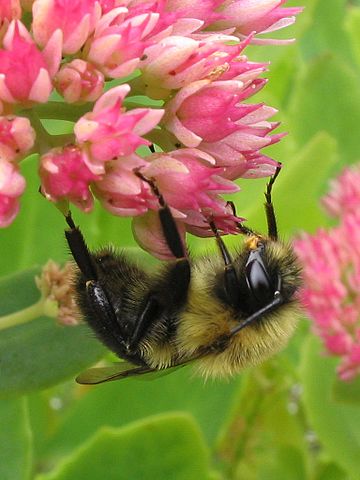
Bombus impatiens – By [1] [CC BY 2.0 (http://creativecommons.org/licenses/by/2.0)], via Wikimedia Commons
“Jumping spiders exposed to low doses of insecticide show changes in their personalities. Insecticides alter behaviours by jamming neural transmission. Most studies on insecticide toxicity compare how behaviours differ in average between insecticide-exposed and control groups, but they don’t take into account how insecticides affect variation in behaviour (aka personality). Bronze Jumping Spiders exposed to the insecticide had lower amount of personality differences in activity and prey capture behaviours and exposed spiders were in general more “unpredictable”. These effect also varied by sex. Activity differences were more strongly affected in males while prey capture capacities were more strongly altered in females.
These results suggest that the effects of insecticides on personality differences may manifest before any effects on the population as a whole are detected, in which case scientists may be frequently underestimating the toxicity of insecticides. Spiders play an important role in agricultural fields as they help regulate pest outbreaks. These personality alterations may affect spiders’ capacity to provide this important ecosystem service.
A more detailed explanation of this research is available here »
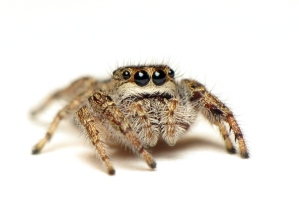
A female jumping spider, Eris militaris (Araneae: Salticidae). Photo by Crystal Ernst; provided by Raphaël Royauté
Matt Yunik (University of Manitoba) and colleagues discovered that unfed American dog ticks have the ability to survive an additional winter. Prior to this research, it was thought that these unfed ticks searching in spring died before the next winter. Article link
Fanny Maure (Université de Montréal) and others found and characterized a new RNA virus of Dinocampus coccinellae, a parasitoid of the ladybird beetle Coleomegilla maculata. The virus appears to be a symbiont of the parasitoid which is stored in the adult wasps’ oviducts and is transmitted by the parasitoid larva to its ladybird host. The virus then moves to the ladybird’s brain and replicates, inducing paralysis and twitching, around the same time that the parasitoid larva emerges and spins a cocoon between the legs of its host. The infected ladybird then acts as a twitchy bodyguard against predators while the parasitoid develops. Then, amazingly, when the adult parasitoid emerges from the cocoon, the viral infection in the ladybird’s brain clears and the host resumes normal behaviour! Article link
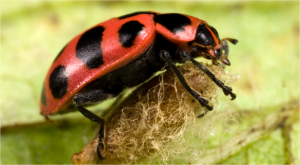
A virally-manipulated ladybird « bodyguard » protecting its ‘puppet master’ from predators. Photo provided by Jacques Brodeur.

Former UdeM student Fanny Maure with her PhD work featured on the cover of National Geographic! Photo provided by Jacques Brodeur.
Megan McAuley (University of Guelph) and colleagues found that repeated conditioning with a floral scent is needed for long-term memory establishment in bumblebees. Article link
Murali-Mohan Ayyanath and colleagues show that sublethal doses of an insect growth regulator stimulate reproduction in the green peach aphid. Article link
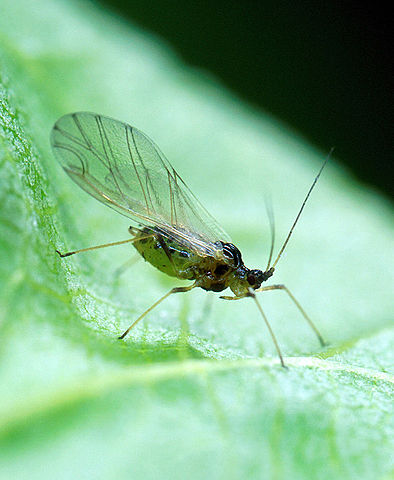
Myzus persicae – By Scott Bauer [Public domain], via Wikimedia Commons
A study by Lorraine Adderly and colleague finds that solitary bees are important for pollination in seablush plants in the Gulf Islands and on Vancouver Island. Article link
Insect Management
Chaminda E. Amal de Silva helped provide evidence for there being high rates of blueberry spanworm parasitism in lowbush blueberry fields in eastern Canada. De Silva and colleagues suggest using augmentative or conservation biological control as a management technique against spanworm. Article link
For a forest moth, colouration is costly—especially under poor conditions (Article link). Coming soon, we will be featuring a post by Jessica Ethier (Concordia University), who took the lead on this long-term project.
CONTACTER LA SOCIÉTÉ
Assistant administratif : info@esc-sec.ca
SEC Président : ESCPresident@esc-sec.ca
This post is also available in: