


Nouvelles

Only half of an estimated 35, 000 insects in BC have been recorded. A curator is urgently needed to address research priorities for BC’s most diverse group of organisms. Photo by Miles Zhang.
The following is a guest post by Professor Felix Sperling
I’m always amazed when I see a well-established natural history museum that doesn’t have entomology curators. What are their administrators thinking? Insects form half of the known species diversity of our planet, a fundamental fact that too many people are unaware of. The ecological and even economic impact of all those species is overwhelming across all terrestrial and freshwater ecosystems, which are of course the habitats that we occupy ourselves. And there is still a shocking amount of insect biodiversity left undocumented or misunderstood, lying in wait to bite us, literally and figuratively, just when we are unprepared to deal with it.

Over 16, 000 RBCM Entomology specimens have been loaned out in the past 5 years alone. Photo: S. McCann.
But that is just the surface. The study of insects is an indispensable portal to understanding life on our planet and therefore to knowing ourselves and our place in this world. An appreciation of the exuberant diversity of insects is an essential foundation from which to build a fully connected and integrated appreciation of our surroundings, and to understanding the diversity and vitality of our interactions. That connectedness is what modern museums strive to capture and present. An entomology curator is the nexus for such connections, serving to do so very much more than just assembling specimens. An entomology curator is responsible for half of all known biological diversity, which also means curation of half of our knowledge about diversity, a human construct that is vulnerable to extinction just like a language is. And more than a purely cultural construct, such a curator maintains the chain that ties the dynamic memory of a human community to the material reality that allows the people of our planet to thrive. So how can a serious museum do without one, especially in a region where biodiversity is important to the self image of a people and insect biodiversity professionals are already so few in number?
So I was seriously puzzled to hear that the CEO of the Royal British Columbia Museum, Professor Jack Lohman, is seriously considering redirecting their entomology curator salary line, which was vacated when Dr. Rob Cannings retired in 2012. But I hear that there is still time for us all to have some input into the process, since Lohman has agreed to discuss the issue one last time on January 22nd, and has asked for a demonstration of support for such a position from outside the museum by that date.

Curatorial oversight leads to enhanced public engagement, fulfilling the core mission of a public museum. Photo by Miles Zhang.
I hope that as many of you as possible can write a short letter to Professor Lohman to point out the importance of entomology in the context of the Royal British Columbia Museum and the broader community that it is part of. Letters from a diversity of backgrounds and institutions would be most helpful. Some of you will have already heard about this via emails that circulated just before the holiday break, and here is an information sheet that may help you to make the case. You can get a better sense of Professor Lohman’s vision and background here.
Letters on institutional letterhead would be best, and can be sent to:
Prof. Jack Lohman, Chief Executive Officer
Royal British Columbia Museum
675 Belleville St,
Victoria, BC V8W 9W2
And send a copy to:
Peter Ord: Vice President, Archives, Collections, and Knowledge
My deepest appreciation to all of you who have read this far, and especially to any of you who can send off a letter, however brief. May you all have a happy, healthy and prosperous year in 2015!

The Royal BC Museum houses over 600,000 entomological specimens. Photo: S. McCann.

The following is by Dr. Staffan Lindgren, ESC President
Christmas has come and gone and it is now closing in on the end of 2014. Most of us are busy with family and friends, and although winter seems to be spotty across the country (it is plus 3 oC in Prince George as I write this), our insect friends are mostly hibernating – at least those that don’t share our homes (like the pesky fruit flies and other small flies from my wife’s indoor worm compost I am constantly batting!) It is much more than just the end of another year for the Entomological Society of Canada, however. Over the past few years, largely in response to an increasingly challenging fiscal environment, the ESC is continuing the transitioning into a new era. Many of our colleagues have put in a lot of their time to make this happen, and I want to highlight a few of them here.
The transition started in 2011 with the move of The Canadian Entomologist from NRC Press to Cambridge University Press. This should restore TCE to its former glory, because we no longer have page charges, and colour plates are also free of charge. The hard work of former Editors-in-Chief Robb Bennett and Chris Buddle, as well as current EiC Kevin Floate and the Publications Committee made this move possible. Another big change has been our transition to the new Canada Not-for-profit Corporations Act. I want to thank Alec McClay, whose diligence alerted us to the requirement for transitioning in a timely manner. Thanks to the invaluable help from the painstaking and detailed work by Gary Gibson and Bill Riel the ESC made a smooth transition and has been operating under this legislation for some time now. As is often the case, there are unforeseen complications with these types of bureaucratic exercises, and one of them is that we have to change the end of our fiscal year to be in compliance with the legislation.
The change that will be most tangible for members happened this fall. At the Annual General Meeting of the ESC on September 30, 2014, in Saskatoon, attending members voted unanimously in favour of contracting office and some other services to Strauss Event & Association Management. After negotiating terms, a contract was signed at the end of October, and as members of the ESC have already noted, communication with members is now handled by Strauss on behalf of the ESC. This means that we are no longer located in Ottawa, but in Winnipeg.
Over the next few months, you will see some tangible evidence of the move. It is important that we get your feedback to refine some of the new features that will be available to us. A major consequence of the change is that the headquarters building in Ottawa will be sold, which will provide some much needed capital to help us get through potential rough patches in the future. It also means that Derna Lisi, ESC’s office manager for the past eight plus years, has moved on to another job, so when you contact the ESC from now on, your first point of contact will be our partners at Strauss. In addition to the executives of the past few years (including Peter Mason, Michel Cusson, Rose DeClerck-Floate, and Rebecca Hallett), Bernie Roitberg, Scott Brooks, and Christopher Dufault among others have been instrumental in moving these issues along, and we owe them all a debt of gratitude for their efforts.
We are looking forward to continuing the traditions of the ESC into the next era, but we also hope that we can strengthen ESC. That can only be done with help from members. You can do your part by remaining a member, encouraging non-member colleagues to join, participating in meetings at the regional and national level, and volunteering for service on one of the many committees or even as a member on the Governing Board. I wish you all a wonderful 2015.

Bedbug feeding on human host. Photo courtesy of Armed Forces Pest Management Board. Used under a CC BY-NC-ND 2.0 licence
Researchers at Simon Fraser University have just published a paper describing a bedbug pheromone blend which includes three new volatiles and a surprising arrestant: histamine!
Regine Gries, along with colleagues from SFU’s Chemistry and Biological Sciences Departments have been working on pheromone chemistry of these pervasive and damaging pests for years. Regine has led the effort, maintaining bedbug colonies and devising many ways of extracting and testing the compounds. By analysing headpace volatiles of bedbug-soiled paper, they were able to identify three new volatile pheromone components: dimethyl disulphide, dimethyl trisulfide and 2-hexanone. These, in addition to the previously-identified alarm pheromone components (E)-2-hexenal and (E)-2-octenal, attract bed bugs to experimental shelter baits placed in study arenas.

Photo by Graham Snodgrass, via Armed Forces Pest Management Board. Used under a CC BY-NC-ND 2.0 licence
The identification of histamine as an arrestant pheromone is quite novel, as this compound is not volatile at all. The free base of this common amine hormone is present in bed bug exuviae, and when applied to paper shelters causes bed bugs to remain in place. Bed bugs seem to use histamine as a signal that the shelter is a safe resting site. This is so effective, that experimental traps with only histamine catch more bedbugs than traps coated with the traditional sticky trap coating. Bed bugs are so reluctant to leave the traps with histamine that they remain in place even when the trap is picked up.
These findings will likely translate into more effective monitoring and control tools for these difficult-to-eradicate pests.

Photo by Graham Snodgrass, via Armed Forces Pest Management Board. Used under a CC BY-NC-ND 2.0 licence
 Invasive ants are generally a phenomenon of warmer climates. Argentine ants, red imported fire ants, and electric ants are all major economic problems in places like Florida, New Caledonia, and Australia. But what is to stop European and Asian ant species from damaging invasions of Canada? It turns out, not much.
Ken Naumann and Rob Higgins, entomologists working on ants in BC, have just published a paper in The Canadian Entomologist on the spread of Myrmica rubra, the so called European fire ant in coastal BC.

In many ways, European fire ants are typical Myrmica, engaged in scavenging, predation and aphid tending. They distinguish themselves in their high colony density and proclivity to sting.
This insect was first detected almost a century ago in Boston, and has since spread to many areas of eastern North America. It has not generally been problematic, but in the past 10-15 years, reports of high colony densities and spread have been increasing. These small red ants are superficially similar to other native Myrmica, but in occupied ground they reach staggeringly high colony densities of up to 4 nests/square metre. They become known to anyone walking on their turf due to their painful stinging attacks in defense of their nests. In areas with large numbers of colonies, activities as innocuous as sitting on the grass can become impossible.

Despite her beautiful wings, this Myrmica rubra queen will not fly, a strange trait that is ubiquitous across the North American range for this species.
One factor limiting the spread of these ants is that the queens do not seem to be able to fly. That trait has been lost in their transition to their new home, although the males still engage in winged dispersal. These ants are instead spreading through nest budding where already established and through movement of infested soil and wood into new areas.
In the paper, Naumann and Higgins report staggeringly high numbers of EFA captures in pitfall trapping in infested areas, compared to moderate numbers of native ants in uninfested habitats. The numbers of Myrmica rubra exceeded the numbers of all native ants by 10 to 1300 times!

In infested areas, Myrmica rubra is the only ant to be found.
More worryingly, Myrmica rubra seems to outcompete and eliminate all other native ants, and in infested areas, very few native ants can be found. In addition, other litter arthropods seem to be reduced in infested areas as well, though the reduction in species richness indices is mostly attributable to the loss of the native ants.
British Columbia, as a biologically diverse and relatively warm province with high levels of oceanic trade, may be the testing ground for biological invasions from ants. A second introduced Myrmica, Myrmica specioides, is also mentioned in the paper. Unlike M. rubra, Myrmica specioides queens retain their flight capabilities, and thus there is no feasible way of stopping their spread.
The ants are marching in BC, and entomologists are well advised to keep up with their movements!

Superficially similar, Myrmica specioides (left) can be distinguished in the field from M. rubra (right) by the sharp bend at the base of the scape. M. rubra has a gently curving scape instead.

Nowhere to go but up: Myrmica specioides queens are quite capable of flight!
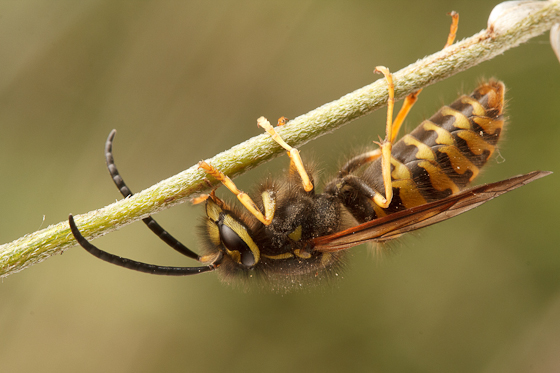
On Friday, while walking to work I found this male wasp, cold and still on the pavement. This was a male western yellowjacket, Vespula pensylvanica, and he was in rough shape. Even here in Vancouver, wintry weather comes this time of year, and we have had freezing nights for almost a week.

Males are easy to recognize, as they have long, 13 segmented antennae, and a long gaster with 7 apparent segments. Females have 6 segments on the gaster, and 12-segmented antennae.

With the freezing weather we have had, this male was not really able to fly, so he was cooperative for some photos.

I have seen male yellowjackets later in the year than this, usually when their nest is within a heated home.

Further south, western yellowjackets have year-round colonies, with multiple queens, but here in Canada they generally conform to the single-foundress colony mode, with a single queen starting a colony in the spring, and dying off in the winter after producing males and new queens.

After this session, I found a nice sunstruck patch of moss, and laid down some honey (which I keep in a vial for ant photography) and let him have a last meal in the sun before the cold of night came to end his life.
CONTACTER LA SOCIÉTÉ
Assistant administratif : info@esc-sec.ca
SEC Président : ESCPresident@esc-sec.ca
This post is also available in: