


Nouvelles

The following is a guest post by Staffan Lindgren
When I started teaching Invertebrate Zoology in the mid-1990’s, students were required to write term papers as one of the tools for evaluation. With a fairly heavy teaching load, this approach became somewhat unmanageable given relatively high enrollment, in particular since I feel that it is important to provide detailed feedback to each student so they can improve on their writing skills. Depending on a student’s skill level, reading, editing and marking a paper can be rather time consuming. After a few years, I therefore reverted to delivering a strictly lecture/lab based course with midterm(s), quizzes and (lab and lecture) finals, essentially the way I had been taught. Two years ago, with considerable trepidation, I decided to step out of my comfort zone and try the blog format. This turned out very successful from a number of perspectives. The students really liked it, and I derived direct benefit by learning about organisms I would likely never have read or heard about. I also enjoyed marking these blogs, because a blog is shorter, less formal, and leaves a lot of room for personal style when compared to a term paper, while still retaining the requirements of coming up with a suitable topic, as well as finding and citing primary literature effectively.
While many of the blogs were about non-arthropods, a fair number of students chose members of this taxon to write about. In this blog, I highlight student blogs that may be of interest to ESC members.
The first blog by Santana Smith is about a group of marine arachnids that I know very little about, the sea spiders. In her blog, “Mating, Reproduction, and Courtship Behaviour of the Pycnogonids” she corrected that shortcoming to some extent. These are odd creatures, to be sure!
The second blog by Alana Garcia is also about arachnids, more specifically Opiliones or harvestmen: “Opiliones and Parenthood: The Rare Exception of Maternal and Paternal Care in Arachnids”. Some of these odd creatures have surprisingly sophisticated and fascinating brood care.
Roscoe Lenardt wrote about hornets “The Genus Vespa: Eusocial societies and vicious stings”. Every time I watch something about Vespa mandarinia I am happy that we only have the baldfaced hornet where I live!

Lena Richter looked at “The Camouflage of Praying Mantids”. Most entomologists are familiar with the orchid mantis, but did you know that Phyllocrania paradoxa nymphs imitate ants?
Favourites for many students (and many arachnologists as well I should imagine) are the jumping spiders. Jessica Leach discusses Portia species in her blog “Jumping spiders: sex among cannibals”. Portia jumping spiders have been described as among the most intelligent of all arthropods.
Danielle New was fascinated by the use of tiny wasps for biological control, which she described in “Trichogramma, a Living Insecticide?” One has to marvel at the ability of these tiny wasps to work for us.
Insects provide inspiration for art, and Nicole Tweddle discusses the use of caddis fly larvae to create jewellery in her blog “Caddisfly (Order Trichoptera) Larval Diversity: The Unlikely Jeweller”. This blog was of particular interest to me, because many years ago at a meeting of the Entomological Society of America, I purchased caddisfly-manufactured earrings for my wife. They were not as exclusive as the ones featured in this article, however.
Madison Wong wrote about the not-so-pleasant effects of centipede venom in “The effect of venom in centipedes.” An arachnophile and former Prince George resident (who described his hobby/business of breeding tarantulas as an interest that went terribly wrong) kindly used to show his animals to UNBC students. One of the few critters he would not handle was his giant centipede!
“Giant Weta” or Wetapunga, the enormous anostostomatid crickets of New Zealand, was the topic for Amandeep Bhatti. Many of these large, flightless insects are threatened and thus of great interest.

Warren Noronha wrote about another species of jumping spider, “Phidippus audax: The Most Daring Spider.” Phidippus species are quite impressive as jumping spiders go. Where I live we have P. johnstoni, a closely related species.
Maeghan Forster provides the first of the 2015 crop of blogs, writing about the fascinating reproductive biology of the emerald cockroach wasp “Eating Your Babysitters: Brooding Behaviors of the Emerald Cockroach Wasp.” I love the way students link behaviours to everyday life, albeit a tad gruesome in this case.
“What in the world is the obelisk posture”, was my first thought when Austin Bartell gave me his proposed blog topic. He explains how dragonfly make use of this posture in “The Obelisk Posture of Dragonflies (Order Odonata)”
Giant Scolopendra centipedes provided the topic for Brittany Fotsch. In “A giant in the under-foliage: Scolopendra gigantea” she ends by referring to centipedes as pets: “A 30 cm, 46-legged, bat-killing, venomous critter is not for everyone, but nevertheless even Amazonian giant centipedes need some TLC.”
T. Callander chose to write about the symbiosis of yucca plants and yucca moths in “Yucca moths and yucca plants: the mailman and the mansion” in his entertaining and informative blog, again with an analogy to human life.

Conrad Taylor’s blog “How I was out-fished by a spider” received a lot of attention when I tweeted the link some time ago. It differs somewhat from most of the other blogs because it is built around a personal experience, and I am sure that is the reason for the attention, at least in part. It certainly makes it an enjoyable read.
The use of transparency in a butterfly caught the interest of Erin Haugland, who wrote about “Greta oto: The Invisible Butterfly.” One of the adaptations to make this approach feasible is the presence of submicroscopic bumps change the refractive index of the wing to match the surrounding air. Who knew?
Arachnophobes in New Zealand probably won’t cry over “Latrodectus katipo: The disappearing cousin of black widow spiders,” written by Finch Ye. It is comforting to know that even a black widow species will have proponents willing to go to bat for them!
Ian Curtis wrote about “The Reindeer Warble Fly (Hypoderma tarandi): An Arctic Parasite,” an insect I knew a little about from my time in Sweden. I also got the opportunity to communicate with my Norwegian colleague Arne C. Nilssen, who gave us permission to use his fabulous photo of an adult fly. Arne did his Ph.D. research on bark beetles, which is how I knew him.

An assignment like this is bound to have at least someone looking at honeybees. Jared Peet wrote his blog “Apis mellifera: Un-bee-lievable Communication” about these important insects, and in a second course I taught, two students wrote honeybee related blogs.

Water striders are incredibly successful hemipterans with some very odd mating behaviours. In her blog “Water striders: Strange Mating Rituals and Adaptations,” Rebecca Lerch describes how females protect themselves against overly amorous males.
Another spider blog that attracted attention was “The diving bell spider: reversed sexual size dimorphism” written by Sunjeet Minhas. To my knowledge, the Eurasian Argyroneta aquatica is the only aquatic spider.
Jennifer Noonan wrote about bioluminescence in lampyrid beetles. In her blog “Fireflies: Bioluminescence” she even included a drawing she made of the chemical reaction.
Angela Tsang’s topic was one that really fascinated me. “Commensalism, Mutualism, or Somewhere on the Borderline: A Relationship between a Frog and a Spider” is about a tiny microhylid frog that lives with a tarantula, normally a predator of frogs! Finding an illustration of this was easier said than done, but the author of one of the source articles, Dr. Francesco Tomasinelli, gave us permission to use a fantastic photo.
Aphids have never been my favourite insects (sorry Simon Leather!) although I could have ended up working with them, early on courtesy of Dr. Jan Pettersson in Sweden. It isn’t an organism I would expect a student to pick, but Grant Usick found an interesting angle in his blog “Acyrthosiphon pisum: The little pea aphid that could.” Perhaps I have to reconsider?
Brooke Wiebe picked Acacia ants for her blog “Pseudomyrmex ferruginea: The ideal tenant.” I still remember a presentation by Dan Janzen about these fascinating little ants and how they have assumed the defense role of Acacia trees.

In my arachnid lecture, I have to highlight the net-casting or ogre-faced spider, of course. This prompted Fiona Raymond to write her blog “The Hunting Techniques of the Net-Casting or Ogre Faced Spider (Araneae: Deinopidae)”. Arachnophobes miss out on so much neat stuff!
For no particular reason, I left out several blogs about horseshoe crabs and Crustaceans. The Crustaceans covered were fiddler crabs, tongue eating isopods, trapeziid guard crabs, pistol shrimp, pom-pom or boxer crabs, tadpole shrimp, Dungeness crabs, and the goose barnacle. And that leaves out all the other interesting invertebrates, of which cephalopods were the most numerous – no surprise there! Anyway, many students exceeded my expectations by a wide margin, and I really believe that it was the format that gave them inspiration to go the extra mile. I am sure Dezene Huber (who will take over after I retire at the end of this year) will improve on the course. Nevertheless, the students deserve credit for a job well done! I hope you will read a few of these blogs, and that you will enjoy them.

Do you have a good taxonomic knowledge of Canadian arthropods? Are you an awesome, champion collector? Do you want an excuse to spend a few days geeking out over lovely terrain and catching lovely wildlife? Well, the Biological Survey of Canada, the Royal BC Museum and the Yellowstone to Yukon Conservation Initiative want you to join them in a BioBlitz of the Peace Region, June 22-26!
If this sounds like your cup of tea, then read the full invitation here. Sign up by June 15!
Who knows? Maybe you will find something completely unexpected (like this ridiculous mite!)!


PRAYING MANTIS Sterling silver, copper, 14K & 18K gold 18.5″l x 12″w x 9.5″h
We have featured the wonderful metalwork of Canadian artist Elizabeth Goluch before, in this awesome interview by Crystal Ernst. Now Ben Proudfoot of Breakwater Studios has produced this wonderful video featuring Elizabeth, her inspiration and work. If you are fascinated by insects aesthetically, or have a love for metalwork and sculpture, this is a great introduction to the artistic process!
[vimeo 125539638 w=560 h=315]
Lady Bug from Breakwater Studios Ltd. on Vimeo.

BUMBLEBEE Sterling silver, 14K & 18K gold 7″l x 7″w x 4″h

Living in Western Canada is pretty sweet. Especially here on the coast, we have a plethora of awesome insects that only occur in this region. I am trying to savour these insects while I can, as this fall I am moving to Toronto.
The snakeflies (Raphidioptera) are awesome animals, with a delightfully elongate prothorax and long bladelike ovipositors. These insects are fairly common in the early spring in a Garry Oak meadow not far from my mother’s house, so whenever I am in the vicinity at the right time I keep an eye out for them.

The most common snakeflies in BC are members of the genus Agulla.

What I had not noticed about these insects is how the pronotum wraps around ventrally, like a shield. Also look at the awesome ornamentation on the thorax!

The larvae of snakeflies are difficult to find, but if you flip over enough rocks or logs, you may just find one!

In fact, flipping over logs is exactly how I found this next western treasure…A tiger beetle that may just shatter your image of tiger beetles forever.
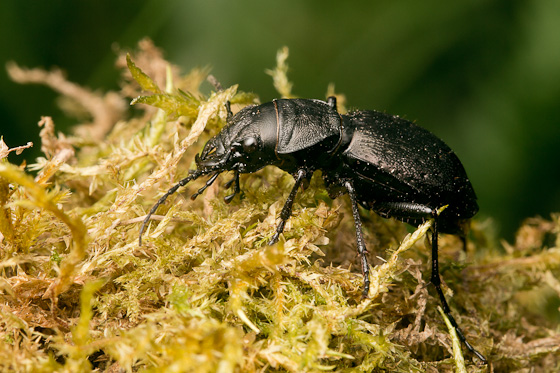
This is Omus dejeani, often referred to by its awesome common name, the greater night-stalking tiger beetle. This is a tiger that could easily be mistaken at a glance for a carabine, if not for the shape of the thorax. This is not a slender, bright, iridescent speedster, but rather a hulking, powerful night terror.

Yes, make no mistake, this is a tiger through and through. The mandibles tell the tale. Bugguide has this to say about the origin of the generic name Omus: Probably from Greek omos (ωμος)- « raw, crude » or « savage, fierce, cruel »
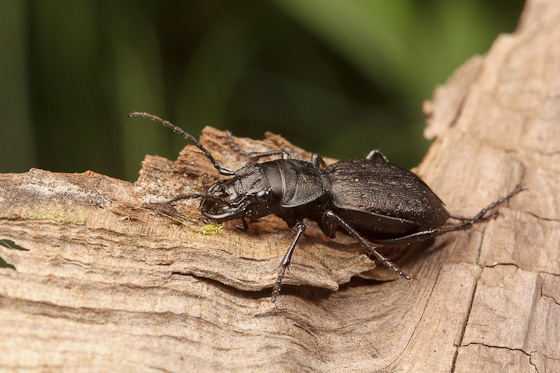
Regardless of the name, this beetle is a truly impressive beast, though I rarely encounter it. I wonder if it could be because of the introduction of the two similarly-sized invasive carabines Carabus granulatus and Carabus nemoralis.
Anyhow, regardless of where you live, get out and enjoy what your region has to offer. Insect season is in full swing, and life is short. This summer I will keep flipping logs to savour the western specialties!

Log flipping also brought me an encounter with another western treasure: the rough skinned newt (Taricha granulosa). Who doesn’t love a newt!
The Editor’s pick from the Feburary issue of The Canadian Entomologist is Crowdsourcing for large-scale mosquito (Diptera: Culicidae) sampling by Elin C. Maki and Lee W. Cohnstaedt. In this blog Lee Cohnstaedt reveals more about the research.
—-
“We were inspired to carry out this study to find out the origin and historical geographic spread of the disease vector mosquito species Culex tarsalis and Aedes vexans. By collecting throughout the entire mosquito habitat range, we generated a snap-shot in time of the distribution of mosquito genes. However, collecting mosquitoes throughout the continental United States was not feasible for one lab. Therefore we used social networking and crowdsourcing to solicit specimens from public health officials, mosquito control experts, and citizen scientists. The response was incredible.
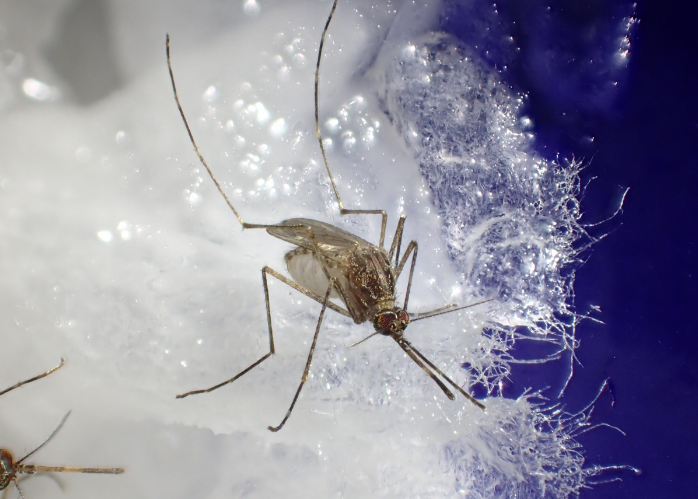
Image courtesy of Sarah Edwards.
We hope a lasting impact of this project beyond advancing public health safety for humans and food security for agriculture, is demonstrating the importance and unique capabilities of the public health and mosquito control infrastructure in the United States. These agencies continually face budget cuts because their importance is undervalued. In addition to their public health roles, they contribute substantially to research which is an underappreciated role at improving public safety. This large-scale project would not be possible without the agencies volunteering their time, energy, and expertise. These agencies and individuals contributed to an unprecedented mosquito collection on a continental scale and we feel the North American Mosquito Project will continue to ask big questions with the help of network contributors in the future.
This research will lead to the mosquitos being used for three projects: First, the mosquito samples will be processed for population genetic and phylogenetic analysis to determine mosquito migration currently and historical spread. Second, the movement data from the genetics will be used to parameterize mathematical models to predict the spread of mosquito-borne exotic or emerging pathogens. This will improve public health safety and food security an important role of the agencies that contributed mosquitoes. Third, specific genes unique to certain populations (private alleles) will be examined to understand their role in range expansion.
Entomologists are very friendly people and we were amazed at how kind and helpful people were throughout the project. At least 25% of the network consisted of people we never contacted; other contributors contacted them and asked them to help. Similarly, some individuals collected from huge areas or contacted people to cover entire regions of the country. It makes us proud to be a part of the community and hopefully we can return the generosity with useful information.”
CONTACTER LA SOCIÉTÉ
Assistant administratif : info@esc-sec.ca
SEC Président : ESCPresident@esc-sec.ca
This post is also available in: