


Nouvelles
After an outpouring of support from the Canadian entomological community, the Royal British Columbia Museum has decided to hire a new Curator of Entomology!
The competition for the Curator of Entomology position at the Royal BC Museum is now posted at http://royalbcmuseum.bc.ca/assets/Posting3.pdf. Deadline for applications has been extended to 24 March.

The Entomological Society of Canada and the Société d’entomologie du Québec are pleased to invite the entomological community to the 2015 Joint Annual Meeting in Montréal, Québec. The conference will take place from 8th to 11th November, and includes a range of symposia and associated events under the meeting’s theme : Entomology in the Anthropocene.
The plenary symposium is designed to provide a provocative overview of the challenges related to entomology in the Anthropocene. Plenary speakers include Dr. May Berenbaum (University of Illinois at Urbana-Champaign), Dr. Jessica Hellmann (University of Notre Dame), and Dr. Marcel Dicke (Wageningen University).
The Entomological Society of Canada and the Société d’Entomologie du Québec invite proposals for symposium sessions at the 2015 Joint Annual Meeting (JAM). We invite timely and well organised submissions from across the breadth of entomological science. We are particularly enthusiastic about symposia that are aligned with our 2015 meeting theme “Insects in the Anthropocene.” Deadline for symposium submission is the 28th February. See the webpage Call for symposia.
Sunday Nov. 8th, 7-10pm; Eat, drink and mingle with new and old friends at the ESC-ESS JAM Opening Reception at the Montréal Insectarium. Entomophagous appetizers will be served.
For more information, please visit our website, join us on Facebook and on Twitter using the hashtag #ESCJAM2015.
As a graduate student, publishing a paper is a big deal. After spending countless hours doing the research, slogging through the writing process, soliciting comments from co-authors, formatting the paper to meet journal guidelines, and dealing with reviewer comments, it’s nice to finally get that acceptance letter and know that your work is getting out there.
We want to help publicize graduate student publications to the wider entomological community. Every month or so, the ESC Student Affairs Committee will post a roundup of papers authored by Canadian graduate students.
We don’t anticipate that these lists will be comprehensive (alas, Google Scholar alerts aren’t perfect), but should give a nice ‘taste’ of student entomological research in Canada. If you want your recently published article featured (or we missed yours last month!), send us an email at entsoccan.students@gmail.com
For regular updates on new Canadian entomological research, you can join the ESC Students Facebook page or follow us on Twitter @esc_students.
Without further delay, here’s what entomology grad students have been up to lately (articles published online between December 1, 2014 and January 18, 2015):
Behaviour and Physiology
Miruna Draguleasa (University of Toronto) and colleagues found that apparently bumblebees love caffeine just like many sleep-deprived grad students.
Two students, Carling Baxter and Rachael Barnett, and their colleagues at McMaster University found that male fruit flies become less choosy when selecting mates as they age.
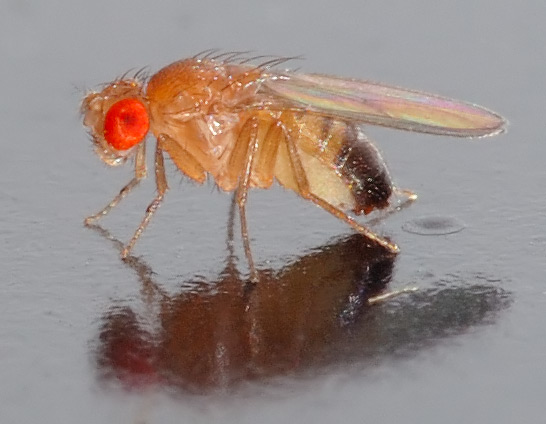
Older male fruit flies (Drosophila melanogaster) are less choosy. Photo by André Karwath aka Aka (Own work) [CC BY-SA 2.5 (http://creativecommons.org/licenses/by-sa/2.5)%5D, via Wikimedia Commons
Laura Ferguson (University of Western Ontario) helped to determine that modifications of ion balance mediate cold tolerance in Drosophila.
The downside of being a sexy male tree cricket? You might not live very long. Kyla Ercit (University of Toronto Mississauga) and colleagues found that male Oecanthus nigricornis individuals with wide heads and small legs were most attractive, but individuals with narrow heads, large legs, and intermediate pronotum length were most likely to survive.
Rosemarie Vallières (Université Laval) and colleagues found that metabolism and winter survival of temperate hemlock looper populations in Québec will be more affected by fall heat waves (compared to boreal populations), which are increasing in frequency due to climate change.

Hemlock looper adult. Photo by D. Gordon E. Robertson (Own work) [CC BY-SA 3.0 (http://creativecommons.org/licenses/by-sa/3.0) or GFDL (http://www.gnu.org/copyleft/fdl.html)%5D, via Wikimedia Commons
New research by Fanny Maure (Université de Montréal) found that ladybirds can survive (and even reproduce!!) after parasitism and behavioural manipulation by a wasp. Featured on the cover of the November 2014 issue of National Geographic Magazine, and discussed in a fantastic accompanying article by Carl Zimmer.
Does the Earth’s magnetic field serve as a reference for alignment of the honeybee waggle dance? Short answer: At least local (ambient) geomagnetic field does not act as the reference for the alignment of waggle-dancing bees. Read more on the research conducted by Veronica Lambient and colleagues at Simon Fraser University here.
Ecology
A recent study by Dorothy Maguire (McGill) and colleagues in a Quebec forest ecosystem finds strong top-down effects of predators on arthropods, but weak effects of fragmentation on predation and herbivory levels.


Students from McGill’s Buddle Lab collecting insects using a beat sheet, sampling bird exclosures, and measuring damage on leaves. Photos courtesy of Dorothy Macguire.
Guillaume Sainte-Marie (Université du Québec à Montréal) and colleagues found that promoting hardwoods does not appear to reduce spruce defoliation during outbreaks of spruce budworm.
Crisia Tabacaru (University of Alberta) and colleagues determined that competitors and natural enemies may help prevent establishment of mountain pine beetle after fires.
Gun Koleoglu and Tatiana Petukhova (University of Guelph) found that Africanized honey bees may have higher viral resistance than European honey bees following parasitism by Varroa mites.
Researchers at the University of Alberta, including Devin Goodsman, found that the interactions between a lepidopteran defoliator and a bark beetle shifted from facilitative to competitive depending on outbreak severity.
Sean McCann and Catherine Scott (Simon Fraser University) discovered that the red-throated caracara rivals the predatory impact of army ants on some populations of Neotropical social wasps.
Genetics
A new molecular marker for phylogeographic and population studies of the black-legged tick has been identified by Chantal Krakowetz (University of Saskatchewan) and colleagues. And in a follow-up study, the mitochondrial gene variation could point to origins of tick populations in the United States and the potential risk for Canada.
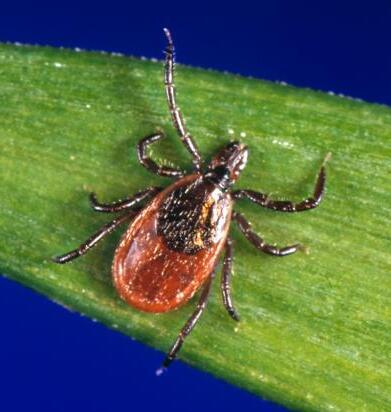
A deer tick, Ixodes scapularis. Photo Credit : Jim Gathany [Public domain], via Wikimedia Commons
Pest Management and Biological control
Two studies conducted at the Université de Montréal by Julie Faucher-Deslile and colleagues found protein content is not the only factor important in selecting diet supplements for predatory mites and that supplementing predatory mite applications with apple pollen may increase the control of thrips in greenhouses.
Insects used in modern weed biological control programs are highly host-specific to their target weed, but can sometimes exhibit ‘spillover’ herbivory on related nontarget plants. Determining where and why spillover occurs can help us predict its potential to negatively affect native plant populations. Here, Haley Catton (UBC Okanagan) and colleagues used two field experiments to show that a controversial biocontrol weevil exhibits spillover when at high density, but does not find or feed on nontarget plants even a few metres from release points. This is good news, as the more localized the spillover, the lower the chance of negative population-level impacts to nontarget plants.

Mogulones crucifer biocontrol weevils painted for a mark-release-recapture experiment involving target and nontarget host finding. Image by Haley Catton.
Christine Miluch (University of Alberta) and colleagues looked at how to maximize the attractiveness of pheromone traps to diamondback moth males in canola.
An interesting study conducted by Simon P. W. Zappia and Amber Gigi Hoi found that regardless of how energy-deprived they are, DEET will keep mosquitos off your stinky socks!
A Canadian research team from Simon Fraser University, including graduate students Michel Holmes and Jason Draper, has identified the bed bug aggregation pheromone! The discovery was featured at several media outlets, including « Wired ».
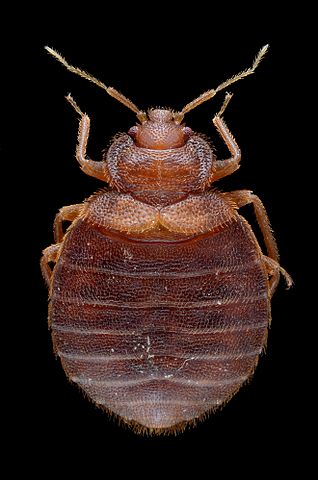
A female bed bug. By Gilles San Martin from Namur, Belgium (Cimex lectularius (bed bug)) [CC BY-SA 2.0 (http://creativecommons.org/licenses/by-sa/2.0)], via Wikimedia Commons
The ESC Student Affairs Committee
By Sabrina Rochefort, MSc student, McGill University.
Early in my undergraduate program at McGill University, I was looking for an opportunity to volunteer in a lab, where I could feed my need to learn and make new discoveries. That led me to Terry Wheeler’s lab; he was the teacher for my evolution class at that time.
I had a strong interest in evolution and paleontology, and was hoping to pursue that field. But Terry informed me that volunteering in his lab did not involve studying fossils, but instead studying tiny insects. Curious and willing to learn about insects, I decided to give it a try! At the Lyman Museum, I quickly discovered that entomology is a field of study with great opportunities and with an infinite number of projects. Besides studying for my degree, and working on weekends at Tim Hortons, I was volunteering up to 12 hours a week, between and after classes, pinning flies and identifying them. I couldn’t lie to myself anymore, I had developed a strong passion for entomology!

Identifying flies at the Lyman Museum. Photo by E. Vajda
Volunteering gradually transformed into a student job. It’s then that Terry introduced me to the fly family Piophilidae, commonly known as the Skipper Flies. I spent numerous hours familiarising myself with piophilids, reading literature, learning to identify them, their ecology, etc. All that knowledge that I acquired in entomology during my undergraduate studies gave me a great opportunity: the chance to pursue graduate studies. I am presently undertaking a Master’s project on the taxonomy and phylogeny of Piophilidae.

Collecting piophilids on decaying mushrooms in the Yukon. Photo by E. Vajda
Now, let’s put a little less attention on my background and a little more on this wonderful family of flies and my project!
Piophilids are small to medium flies (3 to 9mm), which are abundant and diverse, especially in the northern hemisphere. To date, there are 82 described species worldwide. They mainly feed and reproduce on decaying organic matter. This family is of interest in several scientific domains such as forensic entomology (for their presence on carrion), in behavior (for their unique sexual selection strategies) and in biodiversity (for their interesting geographic distribution in the arctic). Several species are also pests in the food industry. The study of their taxonomy and phylogeny is essential for several reasons: to be able to identify specimens found in studies; to document the geographic distribution of species; to establish their phylogenetic relationships; and to learn more about their biology and ecology. The main objectives of my thesis are a taxonomic revision of the Nearctic Piophilidae and phylogenetic analysis of the genera worldwide.

Liopiophila varipes, a piophilid species commonly found on carrion. Photo by S. Rochefort
A statement that is often repeated in our lab is that it is important for taxonomists and ecologists to collaborate, and that the outcomes of our taxonomic projects should be useful not only for taxonomists but also to other entomologists in other fields of expertise. And that is right! For taxonomy to make sense, it is essential that other researchers be able to understand it and use our work. This can be done by providing them with “working tools” such as identification keys which are simple and adapted to a specific need. It is for that reason that, as a side project to my thesis, I decided to collaborate with Marjolaine Giroux, from the Montreal Insectarium, Jade Savage from Bishop’s University and my supervisor Terry Wheeler on a publication and key to the Piophilidae species that may be found in forensic entomology studies in North America. That paper has just been published in the Canadian Journal of Arthropod identification. We reviewed some of the problems associated with identification of piophilids, and the need to develop a user-friendly key to the species. We wanted to create a key with lots of photographs, that was user-friendly and simple for non-specialists, and that would be published on-line and open access. Because of this, CJAI was the ideal journal for our paper.
Seeing this publication completed early in my graduate studies is a great accomplishment for me. It gave me the opportunity to share my knowledge and make taxonomy more accessible to students, amateur entomologists and researchers in the academic and scientific community. Undertaking a project in a less familiar field which is linked to your expertise is a very gratifying experience which I strongly encourage other students to try. From this experience, I acquired new skills and knowledge, I made connections with researchers in other fields of study and I was able to make more connections between my Master’s thesis and other subjects in entomology.
Reference
Rochefort, S., Giroux, M., Savage, J., Wheeler, T.A. 2015. Key to Forensically Important Piophilidae (Diptera) in the Nearctic Region. Canadian Journal of Arthropod Identification No. 27: January 22, 2015. Available online
Call for an ESC symposium at the International Congress of Entomology in Orlando 2016
The ESC Ad Hoc Committee for the International Congress of Entomology, chaired by Murray Isman, is inviting proposals for a Canadian-focussed symposium at ICE. This should be a showcase for an area of entomology in which Canada has a special strength but which would also be of interest to an international audience. Symposium submissions should fit into one of the section topics for ICE, and are due by March 2 2015. Details of the information needed to submit a Symposium proposal can be found at http://ice2016orlando.org/preview-symposium/. Anyone wishing to submit a proposal should contact the Secretary, Alec McClay at secretary@esc-sec.ca, as soon as possible, with details of their proposed topic area and potential speakers. The Executive will review proposals and select one to be developed for submission. Some financial support may be available from ESC for the selected symposium. You can also advise us if you have already submitted a symposium proposal and wish to have it considered as the ESC symposium.
Appel à soumission pour un symposium de la SEC au Congrès international d’entomologie (ICE) 2016 à Orlando
Le comité Ad Hoc de la SEC pour l’ICE, présidé par Murray Isman, invite les soumissions pour un symposium d’intérêt canadien à l’ICE. Il s’agira d’une vitrine pour un domaine de l’entomologie dans lequel le Canada est spécialement fort, mais qui pourrait être d’intérêt pour une audience internationale. Les soumissions de symposium devraient pouvoir être liées à un des thèmes de l’ICE, et sont attendues pour le 2 mars 2015. Les détails sur l’information requise pour soumettre une proposition de symposium se trouvent sur http://ice2016orlando.org/preview-symposium/. Toute personne désirant soumettre une proposition doit contacter le secrétaire, Alec McClay, à secretary@esc-sec.ca, le plus tôt possible, avec les détails du sujet proposé et les conférenciers potentiels. Le conseil exécutif va réviser les propositions et en sélectionner une qui sera développée pour être soumise. Un soutien financier pourrait être disponible de la SEC pour le symposium choisi. Vous pouvez également nous aviser si vous avez déjà soumis une proposition de symposium et que vous voudriez qu’elle soit considérée pour le symposium de la SEC.
Alec McClay, Ph.D.
Secretary, Entomological Society of Canada
CONTACTER LA SOCIÉTÉ
Assistant administratif : info@esc-sec.ca
SEC Président : ESCPresident@esc-sec.ca
This post is also available in: