


Nouvelles
by Amanda Boyd and Kate Pare
The field course in Arctic Ecology (BIOL*4610), offered periodically by the University of Guelph, explores ecological relationships in a sub-arctic environment. Based out of the Northern Studies Research Center, the 2-week course takes place in Churchill Manitoba and the surrounding area. That was what we, the students, knew going into the course. What we didn’t know was that course would be, for many of us, a once in a lifetime experience!

Students in the Arctic Ecology field course learning from hymenopterist extraordinaire Alex Smith. (Photo by Eric Scott)
There are only three ways of travelling to Churchill, Manitoba: by boat, by plane or by train. Since we wouldn’t be taking the boat route, two options were left: an hour and forty-minute flight, or a three-day journey by rail. The latter is where most of our adventures began (particularly when some of us didn’t purchase a sleeper ticket). There is much to be learned from a long northward trek, from changing ecosystems and changing cultural environments to increasing price tags. Eventually though, the journey’s end came with a comfortable bus ride and an incredibly delicious meal at the Northern Studies Centre. From there on out, it was down to business.
The first week of our course was spent roaming the rugged landscape, learning about the diverse ecosystems the region has to offer while simultaneously trying to prevent ourselves from being carried off by the swarms of (seemingly) abnormally-sized horse flies. We visited sphagnum bogs, fens, the coast (which may have involved kayaking with belugas), a cranberry-laden moraine and the northern extent of the boreal forest. We explored Krummholtz and bluffs, learned that sedges have edges and learned to always be on the lookout for polar bears (at least 2 bear guards please!). The second week however, allowed us the liberty of designing and conducting our own studies.
As a real world example of scientific research in action, the first day of week-two was spent sampling in the footsteps of Robert E. Gregg and collecting ants from his original 1969 study sites (Gregg 1972). Armed with basic instructions on the identification of the 1969 sampled ant species and genera, we visited a total three sites: Cape Merry, the Churchill Welcome Sign, and Goose Creek Bog. At each site, we spent approximately three hours actively searching for ants, breaking open woody debris and digging into moss hummocks. This was true for all but the Goose Creek site where our (brand new bus) tire sprung a leak and we had no choice but to wait there (which may have resulted in a thoroughly sampled population of Odonates) until Alex Smith, one of the instructors walked into town to radio the Churchill Northern Studies Centre for Plan-B transportation. From there it was back to the lab for a crash course on identifying ants to morphospecies, and for many of us, a valuable lesson that all individuals of a species do not look the same (due to individual variation and cryptic diversity). The rest of week-two was spent with groups of students at every site chasing a variety of six-legged, sub-arctic mysteries. Of course, as students of the natural world, no curiosity was overlooked and no opportunity for fun either! Many an hour was spent bluff jumping, polar bear sighting, investigating the Ithaca shipwreck, and in the case of some students, completing a partial reconstruction of an arctic fox skeleton. Needless to say, it was a very short two weeks that passed with discovery and awe.

One of the many species collected – an ant in the Leptothorax muscorum complex, collected at Cape Merry (Photo by Chelsie Xavier-Blower)
Going into our field course, I’m not sure any of us thought we would come out of it as published authors. For many of us that participated, the Arctic Ecology field course provided the first real opportunity to actively participate in research outside of the university. The idea that a few days’ worth of collections could be turned into a scientific paper was almost unimaginable. The resulting paper was the first publication that any of us had contributed to. It was exciting to receive the manuscript drafts, and then paper proofs and to know that even aspiring researchers like us could contribute to the knowledge of the scientific community.
During the course, we took high-resolution panoramic GigaPan photographs of the areas we sampled (Smith et al 2013) – you can explore those here. All the DNA barcodes we generated during the course are publicly available for download and exploration. Finally, we wrote about using GigaPans in our Churchill adventures in an article for GigaPan Magazine.
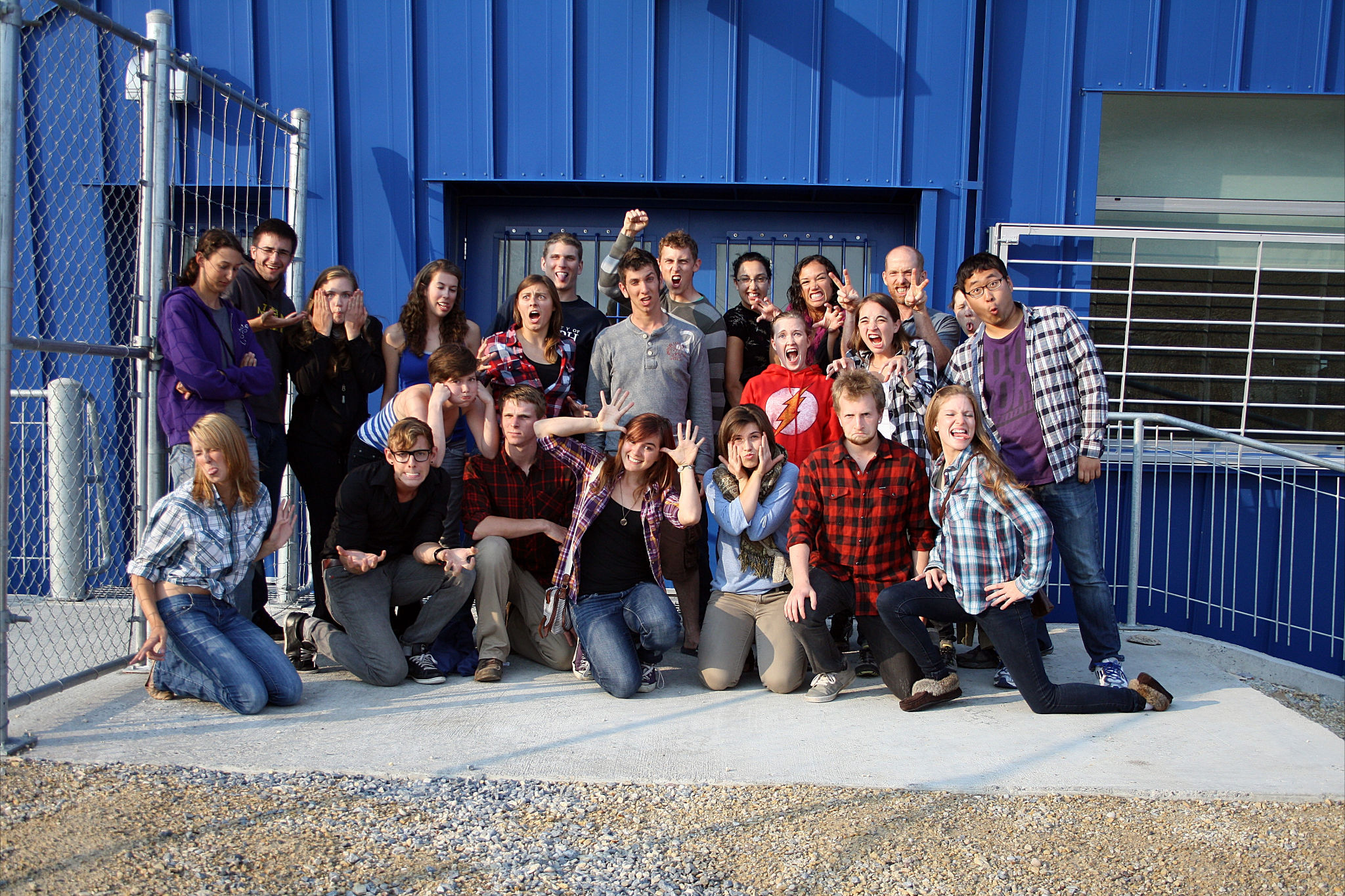
Students of the Arctic Ecology Field course (now published authors!)(Photo by Eric Scott)
Acknowledgements
We would like to thank LeeAnn Fishback and the staff of the Churchill Northern Studies Centre (https://www.churchillscience.ca/) for all their hospitality and help in Churchill. Support from the CREATE Lab Outreach Program at Carnegie Mellon University, the Learning Enhancement Fund of the University of Guelph (http://www.lef.uoguelph.ca/) and the Fine Foundation helped provide funds for GigaPan-ing and DNA barcoding during the course. Support from the Natural Sciences and Engineering Research Council of Canada (NSERC) and the Canada Foundation for Innovation (CFI) to Alex Smith and Sarah Adamowicz provided support and infrastructure.
References
Gregg, R.E. 1972. The northward distribution of ants in North America. The Canadian Entomologist, 104: 1073–1091
Smith, M. Alex, S. Adamowicz, Amanda Boyd, Chris Britton-Foster, Hayley Cahill, Kelsey Desnoyers, Natalie Duitshaever, Dan Gibson, Steve James, Yurak Jeong, Darren Kelly, Eli Levene, Hilary Lyttle, Talia Masse, Kate Pare, Kelsie Paris, Cassie Russell, Eric Scott, Debbie Silva, Megan Sparkes, Kami Valkova (2013) “Arctic Ecology” GigaPan Magazine Vol 5 Issue 1. www.gigapanmagazine.org/vol5/issue1/ (students ordered alphabetically)
Smith, M. Alex, Amanda Boyd, Chris Britton-Foster, Hayley Cahill, Kelsey Desnoyers, Natalie Duitshaever, Dan Gibson, Steve James, Yurak Jeong, Darren Kelly, Eli Levene, Hilary Lyttle, Talia Masse, Kate Pare, Kelsie Paris, Cassie Russell, Eric Scott, Debbie Silva, Megan Sparkes, Kami Valkova S. J. Adamowicz (2015) The northward distribution of ants forty years later: re-visiting Gregg’s 1969 collections in Churchill, Manitoba, Canada. The Canadian Entomologist. http://dx.doi.org/10.4039/tce.2015.53
This is a guest post by Dr. Laurel Haavik, post-doctoral researcher in the Department of Entomology at The Ohio State University.
—-
I am a post-doc. I’ve been one for nearly six years. Like many other post-docs, I have been working for over a decade towards my goal: a tenure-track position at a research-intensive academic institution. I enjoy research and teaching, and so a career including both seemed like a logical pursuit. I must be good enough to succeed in this pursuit, otherwise someone would have told me to opt for a different path by now. After all, only a small percentage of Ph.D.s actually become professors. I must be pretty close to achieving this goal, because lately I’ve had several interviews – no offers yet. By now, most of my peers have secured permanent positions, although some have gone on different paths. It must be my turn soon. I had faith in the system; confidence in myself.
Earlier this summer, I was invited to give a talk at a conference, in a session on women in science. I accepted willingly; the subject seemed challenging and relevant. As I began to prepare, I realized I knew nothing about it. So, I did what any scientist would do: I turned to the primary literature on women in science. What I found changed my whole perspective on academia, my career, and most importantly: my life.
I learned that the tenure system is outdated, and filters out many creative and talented people. It was established ca. 1940, when those entering academic careers were mostly men. Assistant professors were expected to live on campus, and work intensively, around-the-clock, on establishing themselves until achieving tenure. Sounds a lot like graduate school, or a post-doc, doesn’t it? There’s not much room in that scenario for having a life outside of this pursuit. It turns out that not much has changed about this in the intervening 70+ years. To make it worse, there are now few jobs and too many of us with graduate degrees competing to fill them. It turns out that women, more often than men, are willing to forgo their academic dreams because of this ridiculousness, in favor of something better – probably a happier life. It seems that there are two issues. One: is it even possible? Women are confronted with the complications of basic biology at the very same time as they would be embarking on a demanding academic career. Most of us are well into our thirties, near the end of our child-bearing years, by the time we’re on the job search. Two: they’re exhausted, wondering if an academic career is akin to never-ending graduate school. In the academic atmosphere, there is intense pressure to do more; for example, publish or perish, fund or famish. Talent and creativity that science badly needs is undoubtedly lost as women and men continue to opt out of this outdated system, and for very reasonable grounds.
I took a long, hard look at my career so far. I’m on my third post-doc. I’ve had two failed relationships and a third that might not make it if I have to move again. I’m not married. I don’t have children. I’m in my mid-thirties, meaning that if I want to have children, I better get situated and do it soon. Maybe academia isn’t for me after all, even though my interests, teaching and research, are so well-aligned with the academic mission. I realized that my adult life so far, 90% career and 10% life outside of work, is a direct product of what I like to call our broken academic system. We need to better understand and voice our discontent with the broken academic system, or it won’t change.
I wondered if others feel the same way. In my field, had others thought of leaving science? And if so, why? Has the disparity in numbers of women and men graduates vs. those occupying professional positions actually changed in recent decades? Most importantly, what allows people to cope with such a rigorous career? I’ve been lucky to have had some great mentors, support from my family, and support and encouragement from the scientific community in my field. Have others had the same kinds of emotional support systems?
My study pursues these questions among three related fields: Forestry, Entomology, and Forest Entomology. In all three of these fields women are not historically well-represented, but this has changed in recent years, especially in Entomology. There are still few women in Forestry. Forest Entomology is a small field with a very inter-connected community, which I hope will provide an interesting contrast to its two larger, sister fields.
Please follow the link below to participate in my study, by completing my survey.
I invite men and women at all stages in their careers, as well as those who are no longer in science, to participate. Please forward this invitation to anyone you know who is no longer in science, but completed graduate school (M.S. or Ph.D.). The results of this study will be published in the primary literature.
Please follow the link below to complete the brief, 28-question survey by September 30, 2015
https://www.surveymonkey.com/r/forestry-entomology
It may take 10-15 minutes to complete. I apologize for any cross-posting of this survey. No personal identifying information will be collected as part of the survey, and your participation will be completely anonymous. Answering questions in the survey will indicate consent. Participation is voluntary and you may withdraw at any time without penalty, and there are no incentives to participate. Participation will have no effect upon your relationship with the Entomological Society of Canada. This study has been determined Exempt from IRB review.
Please contact me if I can provide any additional information regarding the aims of or your participation in the survey (Laurel Haavik, 479-422-4997, haavik.1@osu.edu). For questions about your rights as a participant in this study or to discuss other study-related concerns or complaints with someone who is not part of the research team, you may contact Ms. Sandra Meadows in the Office of Responsible Research Practices at 1-800-678-6251 or hsconcerns@osu.edu.

Next September, the largest-ever scientific meeting of entomologists will take place at the International Congress of Entomology (ICE) in Orlando, Florida. For graduate students and early-career entomologists, it will be a fantastic opportunity to meet your peers from all over the world, present your research in a high-profile setting, and scout out potential study or career opportunities.
While you might be thinking that it’s an awful long time from now, and that there’s that pesky thesis that you have to get written, there are two important deadlines coming up soon that you should be aware of:
1. Travel Awards for Students and Early-Career Professionals
The international branch of the Entomological Society of America is giving a total of $50,000 worth of awards to students from outside the USA to attend ICE 2016.
Find detailed information about these awards here. Note that you need to be a member of the ESA to apply, that and membership will cost you between $50 and $150. If you plan to apply, you need to act fast – the deadline for application is September 1st, 2015.
Also note that the Entomological Society of Canada will also have a student and early-career professional travel awards program to assist with attendance at ICE. Information about these awards will be available soon!
2. The International Graduate Student Showcase (IGSS)
The Graduate Student Showcase, which has become a staple of ESC annual meetings, is coming to ICE 2016! Don’t miss this opportunity to present your finished research project alongside the top graduate students in entomology from around the world.
To apply, you need to be defending your MSc or PhD thesis between September 30, 2015 and September 30, 2016.
Find more information about the IGSS here.
The deadline for IGSS applications is October 31, 2015.
By Paul Abram
PhD Student, Université de Montréal
When Pink Floyd recorded their epic, psychedelic instrumental “Any Colour You Like” for the classic album Dark Side of the Moon, were they inspired by a predatory stink bug?
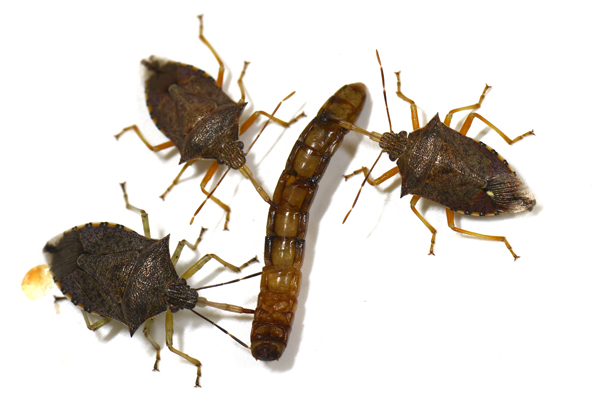
Three spined soldier bugs happily eating a mealworm. Their voracious appetite makes them a widely-used biological control agent of many different insect pests (Photo credit: Andrea Brauner).
Well … probably not.
The spined soldier bug (Podisus maculiventris), can’t actually lay any colour of egg it likes – but the real range of possibilities is pretty impressive.

The range of possible egg colours that can be laid by the spined soldier bug (Photo credit: Paul Abram/Eric Guerra)
Almost three years ago, when I started working with stink bugs and their parasitoid wasps, I noticed this astounding variation in the colour of the eggs of the spined soldier bug. I was surprised to find that nobody had looked into the cause of this variation or its potential functions. In fact, the function of insect egg colouration seems to have been a bit neglected in general. While I was initially hesitant to start on the dangerous path towards a PhD “side-project” (code for “I would like to take much longer to finish my degree, please”), I eventually caved.
In 2013, I was visiting a colleague’s lab where newspapers are used as a laying substrate for these bugs, and I noticed that there seemed to be a loose correspondence between the colour of the egg masses and the darkness of the paper, especially in high-contrast places like crossword puzzles. I wondered – could stink bugs actually adjust the coloration of their eggs to match the darkness of the laying surface? If so, this would be the first case of an animal able to selectively control the colouration of its eggs.
Back in Montreal a few months later, I started working on this question with an undergraduate summer student, Marie-Lyne Desprès-Einspenner. We did the simple experiment of putting individual females in Petri dishes painted white, black, or black on one side and white on the other.

Painted dishes housing spined soldier bug females [right], along with a mate, prey, and some green bean [opened dish shown on the left]. (Photos: Paul Abram)
So, individual stink bugs can lay eggs of a range of colours, depending on where they are laying. Our next question was: how does this capability express itself on natural laying surfaces? We did some experiments using soybean plants, and figured out what seems to be the key to this whole thing: the stink bugs have a very strong tendency to lay darker-coloured egg masses on the tops of leaves (which have a relatively low surface brightness, like our black dishes), and lighter-coloured masses on leaf undersides (which have a high surface brightness due to light passing through from above, similar to the lids of our white dishes).

A light egg mass laid on a leaf underside (upper panel), and a dark egg mass laid on a leaf top (lower panel). Photo credit: Leslie Abram.
Because leaves are excellent filters of ultraviolet (UV) radiation from the sun (protecting most insect eggs, which are usually laid on leaf undersides), and dark pigmentation often acts as a ‘sunscreen’ in nature, we wondered if dark colouration would protect developing stink bug eggs from a lethal sunburn when they are laid on the tops of leaves. Eric Guerra-Grenier (another undergraduate researcher in the lab) and I tested this in the lab by exposing differently coloured eggs to different doses of sun-mimicking UV radiation.
The results were crystal clear – darker eggs are better-protected from UV radiation than light eggs, with a strong dose-dependency with respect to UV radiation intensity and egg colouration.
This was an exciting find, but begged the question: what is the pigment that makes eggs dark, anyway? The clear answer was that it must be melanin, which is responsible for most dark animal pigmentation, including in us humans, and is also really good at protecting against UV radiation damage.
Eric and I did the obvious thing, sending hundreds of (freezer-killed) stink bug eggs to two melanin biochemists in Japan. Our collaborators ran a suite of tests to confirm that the egg pigment was melanin. But…it turned out that the egg pigment wasn’t melanin! Right now, we simply don’t know what this “mystery pigment” is (maybe something totally new to science?).
As is common in research, we are left with more questions than answers. What is the physiological mechanism that allows stink bugs to selectively apply pigment to eggs? In evolutionary terms, why lay eggs on UV-exposed leaf tops in the first place? And why still lay some light eggs on leaf undersides? Could the pigment also have a role in camouflage, thermoregulation, or water retention? Do other, closely related (or why not distantly-related) insect species also have this capacity? We’re currently working on some of these questions, and I hope that we get to try to answer all of them eventually.
If you’d like, you can find a lot more details about our findings, including the answer to “does UV radiation affect the control of egg colour?”, in a newly published paper (remember to listen to the accompanying song while reading) – and stay tuned for more results in the coming months.
In the meantime, fellow entomologists and naturalists, look closely at insect eggs – is there anything interesting about how they’re coloured/patterned?

A spined soldier bug female having a drink and contemplating the future of insect egg colour research (Photo credit: Leslie Abram)
Postscript:
I would like to suggest additional Pink Floyd song/entomology paper pairings (feel free to suggest your own!):
“Breathe” // “Active Regulation of Insect Respiration”
“Run Like Hell” // “Mechanics of a rapid running insect: two-, four- and six-legged locomotion”
“Mother” // “Parental care trade-offs and the role of filial cannibalism in the maritime earwig, Anisolabis maritima«
“Echoes” // “The adaptive significance of host location by vibrational sounding in parasitoid wasps”
“Time” // “Short interval time measurement by a parasitoid wasp”
“Us and Them” // “Boundary disputes in the territorial ant Azteca trigona: effects of asymmetries in colony size”
“Comfortably Numb” // ”Effects of carbon dioxide anaesthesia on Drosophila melanogaster”
By Celina Baines
Have you ever thought about what a pond-dwelling insect might do if it doesn’t like the pond it lives in? People generally assume that these insects are stuck where they are, but actually, many freshwater insects have wings and can fly. This movement between ponds is an example of a process known as dispersal.
Backswimmers, for example, are insects that live in ponds and streams (and sometimes even swimming pools!). Backswimmers have a characteristic way of swimming – on their backs, just under the surface of the water, using their hind legs to propel themselves. It makes them look a little like they are doing the backstroke (hence their common name!). But they also have wings, and can fly between ponds.

A top view of a backswimmer swimming. Backswimmers can often be seen swimming just under the surface of the water, ventral side up. Photo credit: Shannon McCauley.
We know from observing these insects that not all backswimmers make the same decisions about whether to disperse. Some individuals spend their whole lives in the ponds they are born in, and some individuals move to new ponds. So why do some individuals stay and some leave? One factor that could influence dispersal decisions is the quality of the pond. Pond “quality” could depend on many things, including the risk of being eaten by predators like fish. Dispersing can be a great way for organisms to avoid habitats that will be bad for them or their offspring.
Once a backswimmer has decided that it wants to disperse, it then has to decide whether it is strong and healthy enough to fly. This could be another factor that determines whether an individual decides to stay or go.
In the summer of 2013, I conducted a field experiment to learn more about how backswimmers make dispersal decisions. I wanted to test whether dispersal was induced by fish. I also wanted to test whether body condition (basically, the general strength and health of an organism) influences dispersal decisions.
I started by collecting backswimmers from a pond at the Koffler Scientific Reserve. That’s a research site owned by the University of Toronto, where I’m a graduate student.

This is me collecting backswimmers from a pond at the Koffler Scientific Reserve. Photo credit: Chris Thomaidis.
I brought the backswimmers back to a lab at the University of Toronto. Because I wanted to test the effects of body condition on dispersal, I first had to manipulate the backswimmers so that they had different levels of body condition. I did this by carefully controlling how much food each backswimmer got to eat.
Backswimmers are carnivores, and they aren’t very picky. For this experiment, I fed them fruit flies, because it’s really easy to get lots and lots of fruit flies. So, in what turned out to be one of the most back-breakingly tedious jobs I’ve ever performed for science, I (and many uncomplaining assistants) counted out thousands of individual fruit flies to feed to the backswimmers. Each backswimmer was housed in its own little cup, and received a specific (and carefully counted) number of fruit flies to eat every day. Here’s what the hundreds of drink cups looked like, colour coded and full of bugs.

Left: Cups housing backswimmers at the University of Toronto. Right: A backswimmer in its cup.
After a few weeks of controlling the backswimmers’ diets, it was time to bring them outside to see if they would fly. I set up some artificial ponds in a big field. These “ponds” are actually just watering tanks that farmers use for cows and horses, but I added algae and artificial plants to make them more like natural ponds. Since I also wanted to test whether backswimmers are scared away by fish, I added a fish to half of the tanks. I put the fish in cages, and that way, the backswimmers could tell there was a fish in the tank (they could see and smell the fish), but the fish couldn’t actually eat the backswimmers.

This is me, checking the artificial ponds for backswimmers. Photo credit: Betty Dondertman.
Then I put the bugs in the tanks, and waited. After a couple days, I went back to the tanks and checked to see which backswimmers were still in the tanks, and which ones had flown away.
Firstly, I found that backswimmers are scared away by fish; they are more likely to disperse when a fish is in their pond.
I also found that the backswimmers with high body condition are more likely to fly, probably because they are strong fliers and have the best chance of successfully finding a new pond.
Both of these results were really cool and answered some questions for us about how backswimmers make dispersal decisions. But they might also tell us a little about how other organisms move around in natural ecosystems. Dispersers are the only individuals that can find new ponds and start new populations. If dispersers tend to be the strongest and healthiest individuals, that’s great for native species that we want to encourage to start new populations. But having strong, healthy individuals from exotic species start new populations is probably bad news. Dispersal can therefore have important consequences, which is why we need to understand more about how and why organisms disperse.
For more information about my study, check out the recent publication:
CONTACTER LA SOCIÉTÉ
Assistant administratif : info@esc-sec.ca
SEC Président : ESCPresident@esc-sec.ca
This post is also available in: