


Nouvelles
Cette nouvelle page est la culmination d’une année de travail et ne serait pas possible sans la contribution de plusieurs membres de la Société ainsi qu’une forte poussée menée par Neil Holliday. J’aimerais remercier tous les membres qui ont fourni de l’aide sur ce que devrait contenir cette nouvelle page, et ceux qui ont contribué au contenu et aux traductions.
Merci de prendre un moment pour parcourir le nouveau site. Vous remarquerez plusieurs changements en comparaison à l’ancien site, mais j’espère que vous le trouverez suffisamment familier pour naviguer facilement.
Jordan Bannerman (webmestre de la SEC)
MSc Graduate Student Opportunity in the Department of Biology, University of Winnipeg
Project title: Developing a laboratory rearing technique for the endangered Poweshiek skipperling and assessing the feasibility of introduction into tall grass prairie habitats in Manitoba.
Objectives: The Poweshiek skipperling (Oarisma poweshiek) is an Endangered butterfly species that is in critical danger of becoming extinct. Less than 500 individuals remain in the wild and the grasslands of southeastern Manitoba represent one of the species’ last strongholds. The species inhabits remnant patches of tall-grass prairie and in the past 10 years has greatly declined across its historical range. Working at both the Assiniboine Park Zoo in Winnipeg and the University of Winnipeg, the student will help develop laboratory rearing techniques and to determine the feasibility of reintroducing the Poweshiek skipperling into tall grass prairie sites where it has been extirpated or new potential prairie habitat. The student will study life history factors (such as mortality and survivorship of various development stages) and evaluate potential tall grass prairie sites for reintroduction. This study is in coordination with the University of Winnipeg, Assiniboine Park Zoo, and Nature Conservancy of Canada (NCC).

Ever wish you could travel back through time and see a west coast Vancouver Island rainforest before industrial logging? To see huge old trees, intact soils and life in a climax ecosystem? You do not have to invent a time machine, you only need to travel about an hour out of Port Renfrew to the spectacular Walbran Valley.
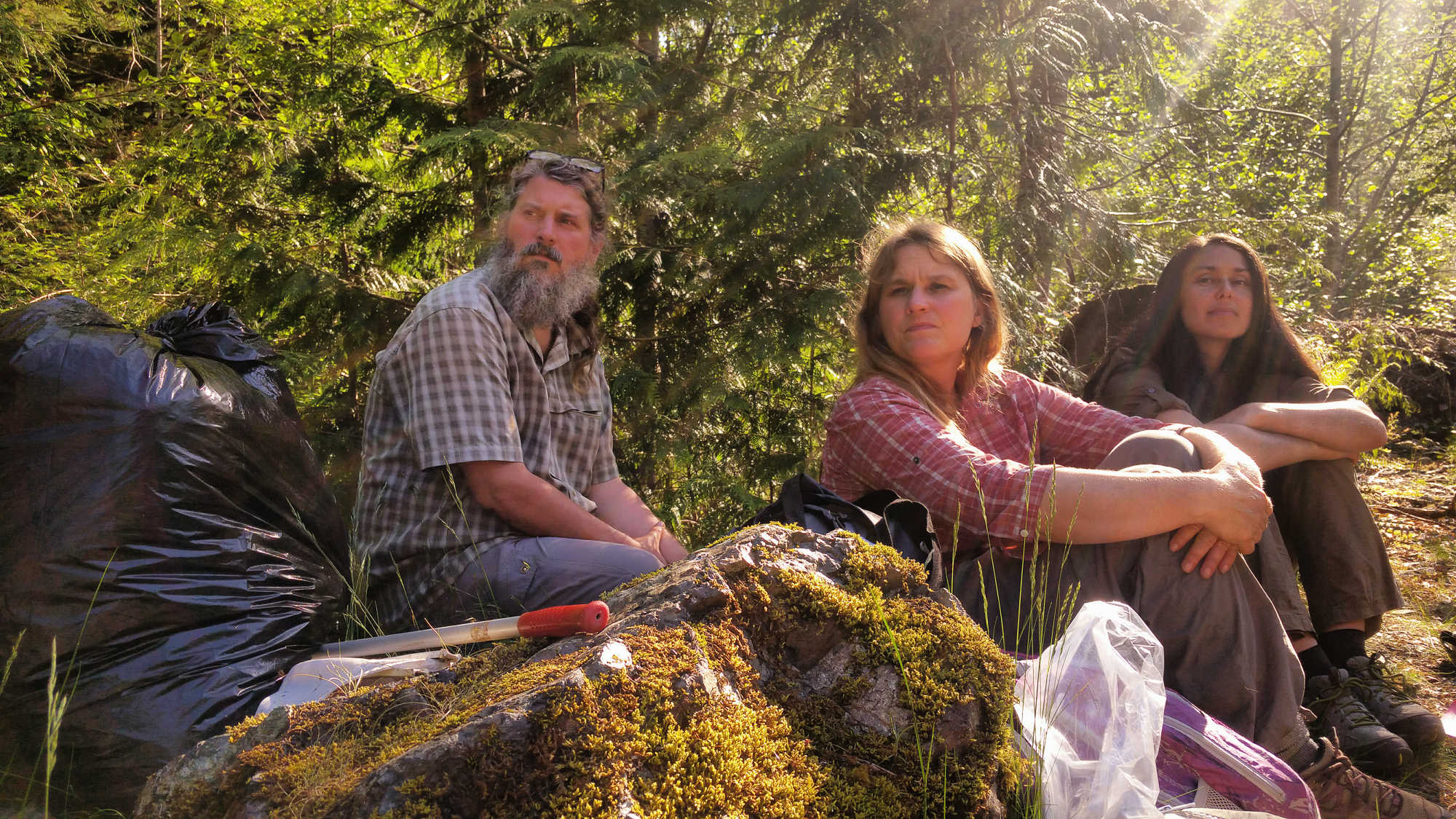
As part of an effort to document the biodiversity of the valley, I traveled with fellow arachnologists Claudia Copley, Darren Copley, Zoe Lindo, and Catherine Scott, along with birders, mycologists, lichenologists and assorted volunteers to spend a day among the giant trees. We were there at the invitation of the Friends of Carmanah-Walbran to lend our expertise to the effort of catloguing the biodiversity of this beautiful, yet still at-risk west coast habitat.
We arrived at the somewhat storied “Bridge to Nowhere”, where in 1991 environmental protesters confronted the logging companies, the RCMP and the government of British Columbia, holding the line against industrial exploitation of a rare ecosystem. What the activists were asking for seems modest: Can’t we have just this one watershed, among all the others on Vancouver Island, be preserved and protected from the clearcutting and degradation that is the fate of every other valley on the Island?
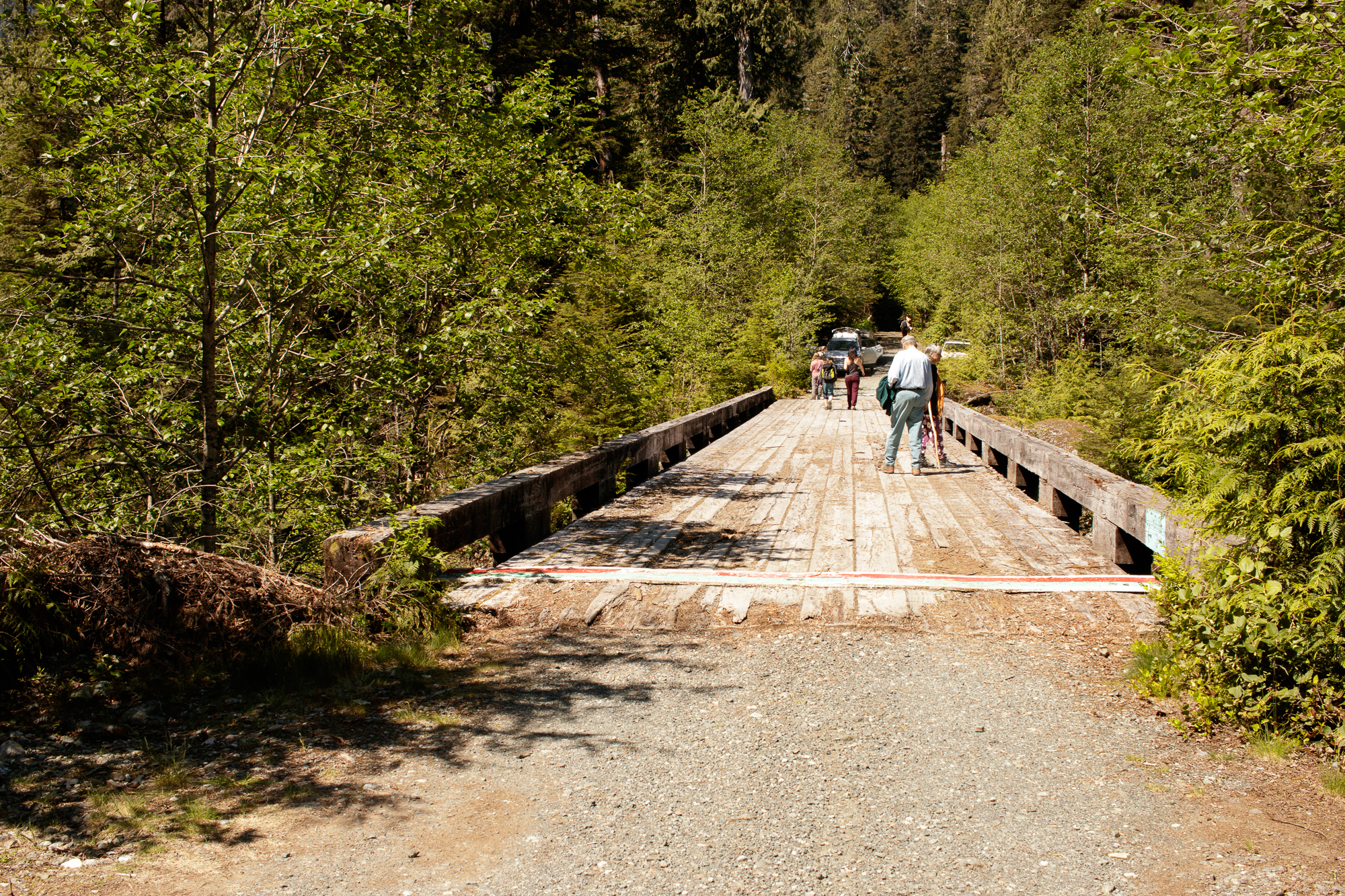 2. Pacheedaht elder Bill Jones walks across the Bridge to Nowhere
While the Friends of Carmanah-Walbran took the other participants deep into the woods on hikes, we arachnologists ventured only short distances into the woods, as our slow and careful sifting through the soil and beating of the bushes is certainly not a thrill ride for everyone. For us, however, it was thrilling, as within 30 minutes of arrival on site, we had found a beautiful and seemingly dense population of Hexura picea, a relative of tarantulas.
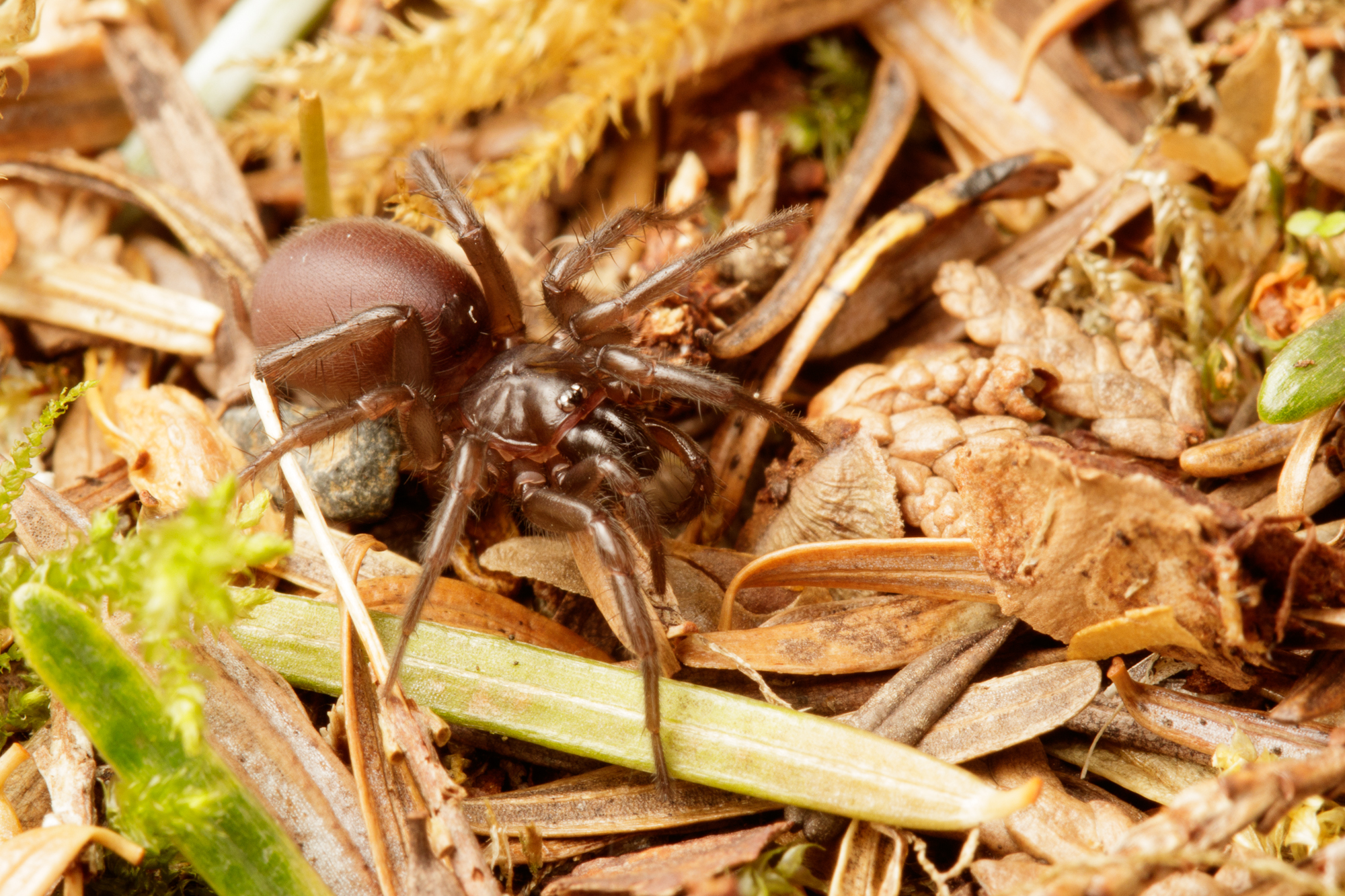 3. Hexura picea, a tarantula relative, brought out of its underground silk tunnel complex for a photo shoot.
These little, pretty, but nondescript spiders live in small silk tunnel complexes among the soil and rocks of the forest floor. Each tunnel has a main entrance lined with silk, and several other openings which may facilitate rapid escape or offer alternate exits at which to snare prey. Being members of the suborder Mygalomorphae, they are indeed tarantula relatives, a group of spiders that closely resemble ancient spiders. Many mygalomorphs retain traces of segmentation on their abdomens, unlike the more modern araneomorph spiders. In the Mecicobothriidae (to which Hexura belongs) the terminal spinneret segments bear “pseudosegmentation”
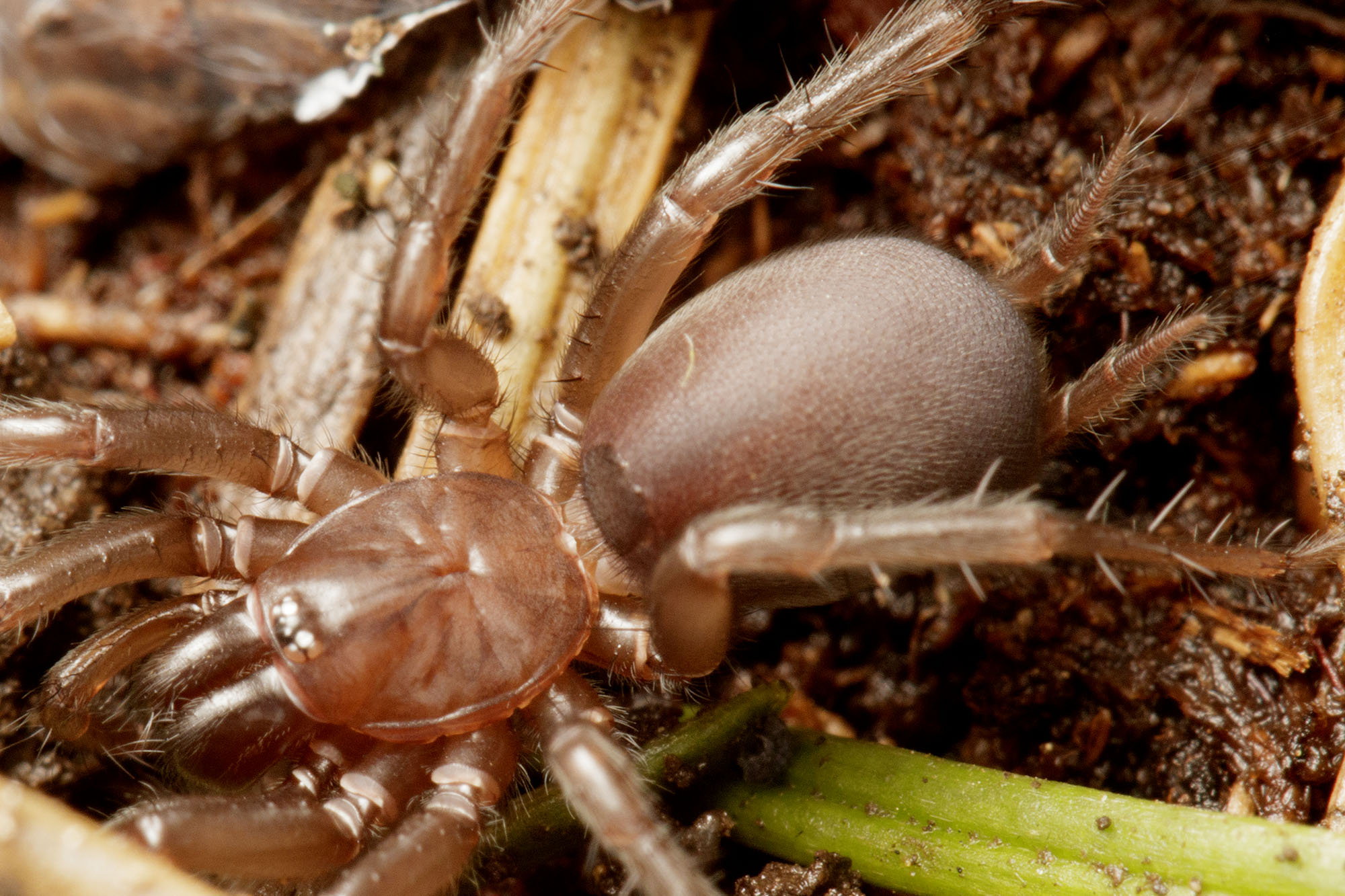
The section of forest we found this spider in was a real “tangled bank”, in fact the scree slope associated with Walbran creek and a small tributary, which has since been covered with a layer of soil and a stand of hardy trees.
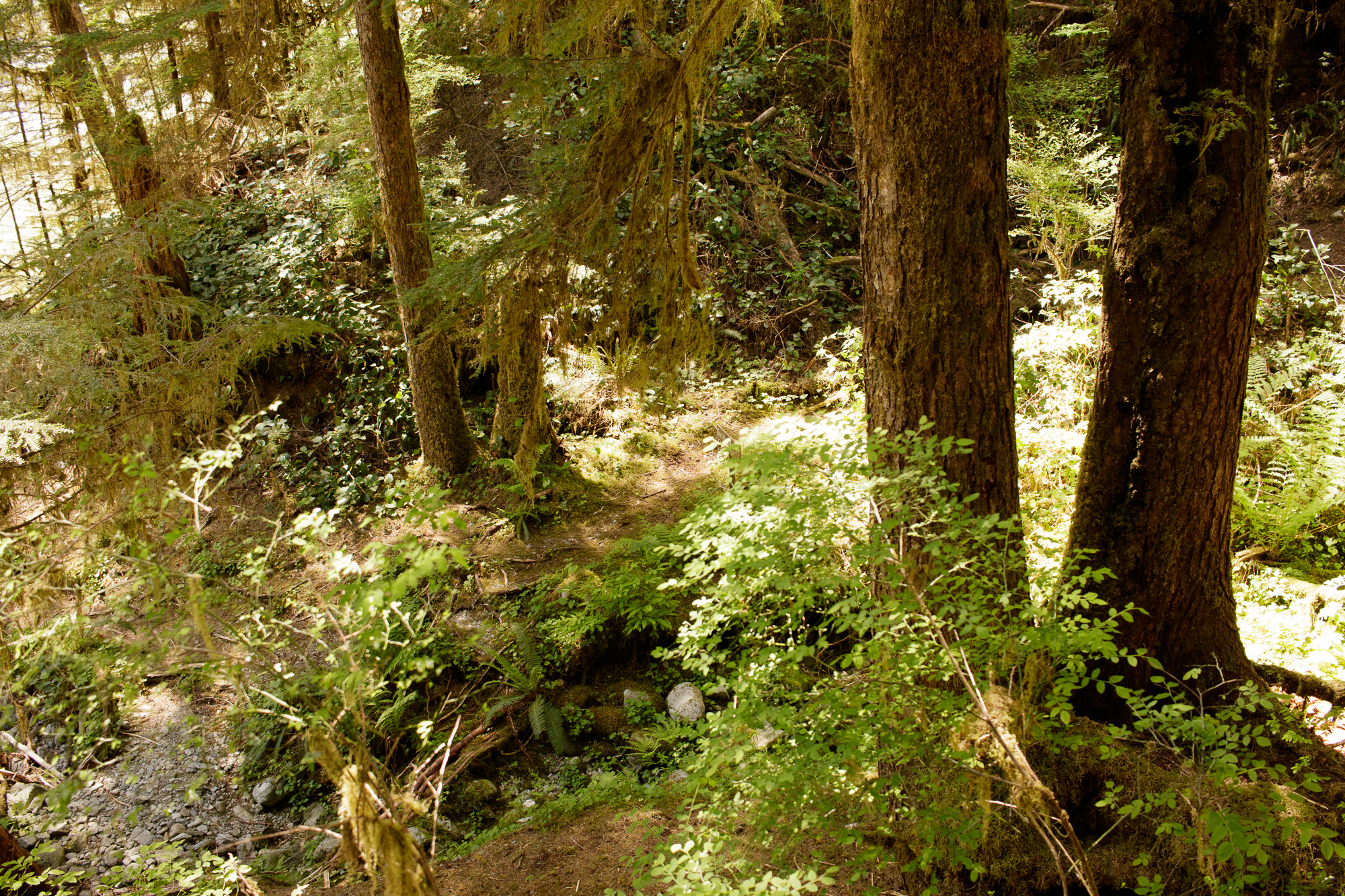 4. Erosion is a gentler process in a forested valley, with trees holding on to what would be a talus slope higher in the mountains. The soils beneath these trees support an extensive food web.
Finding these spiders in the Walbran was not unexpected, as they had previously been found in the Carmanah Valley and at Avatar Grove, but their presence on Vancouver Island is somewhat puzzling, as they represent the only known Canadian population, and are seemingly not present on the BC mainland.
Given the dense population in the Walbran, the valley would be an wonderful place to study their behaviour, which so far is undocumented. We would presume that much of the activity of these spiders takes place at night, although Catherine was able to lure one out of its burrow by tickling the silken doormat with a twig.
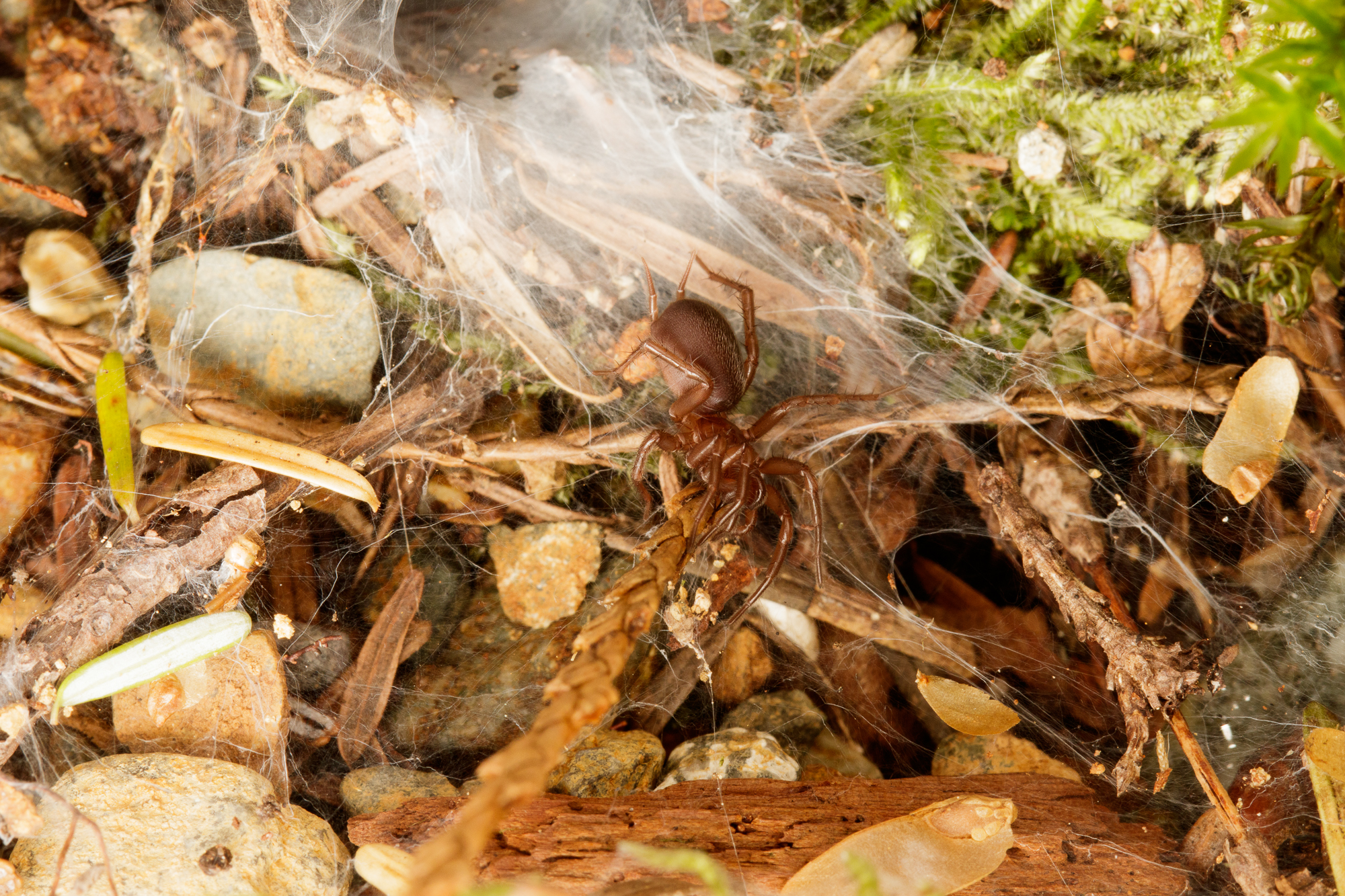 5. Hexura picea emerges from its silken tunnel and onto its “doormat” to “kill” a vibrating cedar twig.
The litter sampling we conducted will surely yield many more species, although we have to wait until the Berlese funnels have extracted all of the arthropods. The work of sampling and cataloguing biodiversity takes time, and is not totally congruent with the rapid “bioblitz” ethos.
If you are ever in BC, and want a trip back in time (never mind our politics), please do not hesitate to come out to the Walbran Valley. You may just discover something amazing.
 6. Darren and Claudia picking up pan traps beside the Malaise flight-intercept trap.
Great Lakes Greenhouses (Leamington, ON) is seeking a full-time entomologist to aid in the development and implementation of rearing protocols for the production of beneficial insects used in the greenhouse industry. Knowledge and experience with experimental design, statistical analysis, beneficial insect propagation and maintenance, and the ability to perform independent research are all necessary to succeed in this position.
Great Lakes Greenhouses has been a family owned and operated hydroponic vegetable grower in Leamington, Ontario since 1983. Our original 2-1/2 acre greenhouse operation has evolved into an environmentally friendly 90 acre state of the art facility that propagates, grows, packages and ships more Long English seedless cucumbers on a year round basis than any other greenhouse operation in North America. Due to our commodity share hold in the market and our Primus Certified Food Safety designation for both our greenhouse and packing operations, our cucumbers have reached most major retailers’ shelves across the USA and Canada.
See full job ad for more details, and send resumes to James Tetreault (james@greatlakesg.com) to apply.
I will admit that the headline was thoroughly and completely “click bait”. That’s because I was worried that “The new ESC Science Policy Committee and its mandate” would have you move along to the next article. And I hope that giving you the goods now on what this article is about doesn’t cause that right… now.
For those of you who are still with me, and I hope that is a majority of our members, I am aware that policy is not generally considered an exciting topic. But in this era of climate change, environmental degradation, increasing population pressure on our agricultural and silvicultural output, emergent and spreading vector-borne diseases, research funding challenges, and rapidly shifting politics in Canada and many of our largest trading partners, we as entomologists cannot merely sit back and let policy happen. We need to engage with policy makers to encourage careful decision making with the long view in mind.

Our diverse Society membership has an equally diverse set of skills and perspectives to offer to Canadians and the rest of the world. But engagement can only happen if we are willing to put fingers on the pulse of various issues, and to collaboratively marshal responses to issues as they begin to emerge. In other words, we can only be effective if we are able to anticipate in time and react with collective care and wisdom.
Over the past many years, the ESC has maintained a Science Policy and Education Committee. That committee has been effective in many areas including over the past several years:
- expressing concern to the federal government about travel restrictions on federal scientists wishing to attend ESC meetings,
- encouraging the continued support of the Experimental Lakes Area,
- responding to NSERC consultations, and
- drafting the ESC Policy Statement on Biodiversity Access and Benefit Sharing which was later adopted by our Society.
However, because the combination of both public education and public policy was a substantial and growing mandate, the ESC Executive Council Committee decided in 2015 to split the committee into two, each part taking care of one of the two former aspects.
In October 2016 I was asked to chair and help to formulate the new ESC Science Policy Committee. Your committee now consists of (in alphabetical order):
- Patrice Bouchard (ESC First VP, Agriculture and Agri-Food Canada)
- Crystal Ernst (appointed member, postdoctoral fellow at Simon Fraser University)
- Neil Holliday, (ESC President, ex officio committee member, University of Manitoba)
- Dezene Huber (appointed member as academic representative, Chair 2016/2017, University of Northern British Columbia)
- Fiona Hunter (ESC Second VP, Brock University)
- Rachel Rix (appointed member and student and early professional representative, Dalhousie University)
- Amanda Roe (appointed member as government representative, Natural Resources Canada – Canadian Forest Service)
Each executive member’s term is specified by their ESC executive term. Each appointed member is a member for up to 3 years. The Chair position is appointed on a yearly basis. The terms of reference specify that the committee should contain members “who (represent) the Student (and Early Professional) Affairs Committee, and preferably one professional entomologist employed in government service and one employed in academia.”
We are officially tasked “(t)o monitor government, industry and NGO science policies, to advise the Society when the science of entomology and our Members are affected, and to undertake tasks assigned by the Board that are designed to interpret, guide, or shift science policy.”
We are now working on putting together an agenda, and have started to work on a few items. For instance, you may recall an eBlast requesting participation in Canada’s Fundamental Science Review that was initiated by Hon. Kirsty Duncan, Minister of Science. We hope that some of you took the opportunity to send your thoughts to the federal government.
As we develop an agenda, we would like to consult with you, the ESC membership. Please tell us:
- What policy-related issues do you see emerging in your area of study, your realm of employment, or in the place that you live?
- How might the ESC Science Policy Committee integrate better with your concerns and those of the rest of the membership?
- How can our Society be more consultative and responsive to the membership and to issues as they arise?
- Who are the people and organizations with which ESC should be working closely on science policy issues?
- How can you be a part of science policy development, particularly as it relates to entomological practice and service in Canada and abroad?
Please email me at huber@unbc.ca with your thoughts, questions, and ideas. We know that many of you are already involved in this type of work, and we hope that we can act as synergists to your efforts and that you can help to further energize ours.
Dr. Dezene Huber
Chair, ESC Science Policy Committee
This article also appears in the March 2017 ESC Bulletin, Vol 48(1).
CONTACTER LA SOCIÉTÉ
Assistant administratif : info@esc-sec.ca
SEC Président : ESCPresident@esc-sec.ca
This post is also available in: