B. Staffan Lindgren is a professor of entomology at the University of Northern British Columbia, and 1st Vice-President of the Entomological Society of Canada. He has been the senior supervisor of 11 M.Sc. students and one Ph.D. student, co-supervisor of two M.Sc. students, and participated on more than 20 supervisory committees.

—————-

Recently I have been approached by several students asking about how to go about applying for graduate school. Furthermore, I and a colleague are doing a brownbag lunch discussion for the local student chapter of The Wildlife Society on this topic this week, and this got me thinking about what considerations a student should have. My conclusion is that you can break down the approach into a consideration of W5 (Why, Where, Who, What, and When) to optimize the chances of being successful.

In this post I will go over my thoughts on these W’s, and relate some of my own experiences, both as student and supervisor. I have not consulted the literature, but base this on personal experience alone, so you have to bear that in mind. For the record, I have not supervised a large number of graduate students, and all but one have been at the Master’s level. On the other hand, I have only “failed” as a supervisor once, which just means that I blame myself for the student’s failure to complete. On the other hand, I have also failed as a graduate student once, so I feel I have some relevant qualifications for writing this.

Why?

This question may seem somewhat redundant, but I believe it is an important first step. It is surprising how many students go into graduate school “to get a better job”. In my opinion, that is not a good reason at all. It is very possible, or in fact likely, that you can land a better job after completing a graduate degree, but there is no guarantee for advanced degrees automatically leading to better jobs. I have two examples. One of my more successful graduate students told me long after she graduated that she went into graduate school for this very reason. Somewhere along the way, she realized that she loved research, and her passion for it grew as a result. She subsequently carried on with a PhD, and now holds a very good research position. So in her case doing a graduate degree led to exactly what she set out to do to begin with, but it wasn’t graduate school per se that lead to her success, but rather her passion for what she was doing, along with some very hard work. My second example relates to my first, and failed attempt at graduate school. I was more worried about funding than topic, and opted to do a PhD in Endocrinology. I had really enjoyed my coursework in zoophysiology, so it seemed like a logical choice at the time. I was in a good lab, had a great colleague (who is now a professor with more than 300 authored or co-authored publications). As it turned out, it was not for me, however. The reasons were many, but a lack of passion for the subject area certainly contributed (see below).

Where?

Different institutions have varying reputations, and particularly if the ultimate goal is an academic position, it may make a difference whether you hold a degree from a major research university or primarily undergraduate teaching institution. However, there may be pros and cons with joining big labs. An obvious benefit is that a large institution is likely to have lots of infrastructure and resources. On the other hand, you may end up in a lab where your supervisor plays only a limited role in your actual supervision, i.e., you may be viewed more as a small cog in a large wheel than as an important individual. To avoid this, you have to ask the next question.

Who?

The supervisor is of critical importance in my opinion. All supervisors are not made equal, and they often have their own agendas and biases! Some may expect you to work things out for yourself, while others like to treat you like an employee. Depending on your personality, you may like one or the other, or somewhere in between. Highly productive, “big name” researchers are not necessarily the best supervisors! Moderately productive scientists at small institutions may provide a much better environment, particularly for graduate students lacking prior experience, e.g., Master’s students. I went into my first two graduate degrees (including the initial failed PhD in Sweden) pretty much blind. The endocrinology attempt was uncomfortable because of an internal schism between my supervisor and the head of the department, but other than that I was fortunate to get a very approachable and helpful supervisor. My supervisor for my Master of Pest Management and PhD degrees at Simon Fraser University was as good as they come; I learned an enormous amount from him, and model my own approach to supervision on that experience.  However, he did not suit everybody. The problem is matching your own needs and preferences with a suitable supervisor. I recommend all prospective graduate students to contact both former and current students of potential supervisors and ask what it is like to be a graduate student. I even recommend students expressing interest in me as a supervisor to do the same – I think of myself as a good supervisor, but I am clearly biased, and in control of the situation, whereas a graduate student would be dependent on my actions. Raise up front issues of support (not just salary, but field assistant, transportation, accommodation in the field, expectations). Ask about how the supervisor deals with authorship – believe it or not, there are supervisors who are prone to self-promotion. A good supervisor promotes his/her students, not themselves. Once you are in a graduate position, it is much more difficult to adjust things, so do your homework up front. I also recommend students to be frank with a potential (or existing) supervisor if there are issues. If you can’t communicate with your prospective supervisor before you are his/her graduate student, it is likely that you won’t be able to later. Sometimes this is just due to personality incompatibility, but it really doesn’t matter what the reason is if you end up in a bad situation. You are never going to go into a graduate position with 100% confidence that it will be perfect, but you can optimize the chances that it will be by doing some basic research.

A successful supervisor-student relationship can turn into a lifetime relationship: Staffan Lindgren (PhD 1982), Lisa Poirier(PhD 1995) and Dezene Huber (PhD 2001), gave back to their supervisor John H. Borden by successfully nominating him for an honorary doctorate at UNBC in 2009 in recognition of his enormous impact on forest insect pest management in British Columbia. Photo by Edna Borden.

A successful supervisor-student relationship can turn into a lifetime relationship: Staffan Lindgren (PhD 1982), Lisa Poirier(PhD 1995) and Dezene Huber (PhD 2001), gave back to their supervisor John H. Borden by successfully nominating him for an honorary doctorate at UNBC in 2009 in recognition of his enormous impact on forest insect pest management in British Columbia. Photo by Edna Borden.

What?

This is perhaps the most important decision you have to make, and it is closely linked to the first W (Why?). In my experience, the most successful students are not those who come in with the highest GPA or with the most funding (although it is easier to get accepted with those qualifications as it relieves the supervisor of some obvious burdens). Rather, they are the students with a burning interest in a specific type of project, or specific organisms. A great way to find your bearings is to get involved in research as an undergraduate student. When I was a PhD student, I had three undergraduate research assistants over the years. All three went on to get a PhD, one is now a research scientist with Forestry Canada, one is a conservation biologist with a consulting company (after Environment Canada was brought to its knees by the current government), and the third is a professor at a large institution in the United States. A number of students I have hired as undergraduate summer research assistants have successfully pursued successful careers. Decisions you make as a young person can profoundly affect your future. I went to the United States as a high school exchange student – without that experience I may have lacked the confidence to come to Canada for graduate school. As an undergraduate student, I participated in annual vole surveys and spider research, which taught me something about what types of activities I enjoy. When I first wanted to pursue graduate school, I failed to use that experience. My primary interest was entomology, but funding was hard to come by, so I opted for endocrinology because that graduate position came with a stipend. This decision turned out to be a huge mistake, and after 1 ½ years I had to give up. Essentially, I selected what to do for the wrong reason. (Thanks to my brilliant graduate student colleagues, I still ended up with five publications, which probably helped me get accepted at Simon Fraser University, so it wasn’t a complete waste of time, however).  At SFU, my MPM supervisor offered me a funded project that would have been applicable to Sweden, and he gave me 8 months to think about it. I eventually made the decision to take that on, and I have never looked back. Thus, once I reset the career compass to my original goals, I ended up where I always wanted to be, which is in forest entomology!

When?

Strangely, this question relates to both “Why” and “What”, although there is considerable variation among students in terms of what is right for each individual. In my experience, however, the most successful graduate students tend to have a little bit of “real world” experience before they pursue a graduate degree. In part, this may be because they have more experience, and therefore are more confident about their abilities, and possibly more aware of their weaknesses than someone fresh out of an undergraduate degree would have. These individuals have also had time to formulate what they are really passionate about, and in my mind, passion is the most important ingredient in a successful graduate degree. Yes, you need some basic skills (communication (written and oral), quantitative skills), a modicum of intelligence, and lots of patience for endless tedium (most research is 90% tedium, 5% frustration, and 5% elation), but you don’t have to be an A+ student. As a graduate student, a passionate B student will do better than a moderately interested A+ student any day. You would be surprised how many professors and successful scientists were relatively average in high school. If the timing is wrong, you may not be happy. For example, when I first tried to pursue graduate school and ended up in the wrong program, I could have waited 2-3 years and I may have had perfect opportunities in Sweden as a huge project on insect pheromones was initiated a year after I went to Canada. I had in fact contacted several of the professors that led that project, but at the time they didn’t have the funds in place.

I mentioned at the beginning that I failed as a supervisor once. This was a combination of not matching the student with an appropriate topic, and personal incompatibility. Both resulted from inexperience, as it was one of my very first graduate students. Even supervisors learn from experience.

I hope these musings are helpful you decide to pursue a graduate degree. Good luck!
By Chris Buddle (McGill University) & Dezene Huber (University of Northern BC)

————–

Last autumn there was quite an interesting discussion on twitter among some entomologists in Canada about the ‘job search’ – more specifically focused on the process of seeking tenure-track academic appointments.  Many of us shared our sob stories, and although the time, place and characters varied, the common element was REJECTION.  Those of us who currently are lucky enough to hold faculty appointments remember the rejection to success ratio, and some of us still have stacks of rejection letters.  While most of us really enjoyed the academic freedom that came with working as a postdoc, the job-search process was more often than not discouraging and deflating, and a really difficult time in our lives.

Towards the end of the PhD program, most of us are riding high – our papers are getting published, we are truly ‘experts’ in our fields of study, we are being congratulated, buoyed by our peers and mentors, and we are ready to take on the world.   We found ways to get a post-doc and perhaps traveled to a different country for additional experience, with a sense of hope, optimism, and enthusiasm for the next stage of our careers.

Then, like the world supply of helium, our hopes were quickly diminished.

« I will easily get a job interview at THAT University ».

Nope.  Not even an interview.

« Perfect – that job advertisement was MADE for me – they will hire me.  It’s a perfect fit ».

Nope. A mass e-mail rejection letter instead.

« I’m the GREATEST in my field of study.  Universities will be asking me to apply »

Nope.  That never happens.

I’m sure that I’ll be seriously considered for this position

Nope. The rejection letter came back saying that there were more than 400 applicants for the position.

Even if I don’t get the job, I’ll be able to get feedback from someone on the committee.”

Nope. It’s highly unlikely that, among the 400 applicants, anyone on the committee even remembers you.

There are really two ways to look at this.  It is possible to get discouraged and frustrated, and give up hope OR it’s possible to see that persistence can pay off and eventually the right job will come along, and you will be competitive.  Sure, the opportunities have to be there, but that kind of timing and ‘luck’ isn’t something you can control.

Here are a few pointers that will hopefully help you think about that tenure-track job search, and give you a sense of optimism:

  • It will take a huge dose of patience and persistence, but there ARE tenure-track jobs out there for people with Entomological interests, even in Canada. Recently, Manitoba hired an entomologist, and University of Ottawa just hired an assistant professor on the evolution of plant-pollinator interactions.
  • University professors do eventually retire! (…Although it needs to be noted that the reality in the current economy is that their positions are not always replaced)
  • You don’t have to restrict your options to only University positions.  We know of faculty members who worked in private companies, or in government, and made a lateral transfer, eventually, to academia.  Your holy grail may be a tenure-track job, but other opportunities are equally rewarding and could eventually get you a tenure-track job. Or you may find that life “beyond the ivory tower” is much to your liking anyhow. In fact, you may be interested in the advice column at Chronicle.com by that very name.
  • Be creative with your CV.  There are relatively few jobs for entomologists, sensu stricto, but there are jobs for evolutionary biologists, ecologists, or other more ‘general’ disciplines (Look: Concordia recently held a competition for a community and ecosystem ecologist!)  Re-work your cover letters and CV to reflect your potential in these jobs, and that you use insects as ‘model organisms’. And always tailor your cover letter and CV to any job for which you apply. Don’t just send in the same material to every search committee. Search committees are looking for that elusive thing that we call “fit.”
  • Keep your eye on the ball:  to get that coveted university position, the peer-reviewed publication remains the MOST IMPORTANT item on your CV.  Publish, publish, publish. During this stage of your career, keep the focus on that part of the research process. In particular, enjoy the fact that, as a postdoc, you are relatively free to conduct research and publish without many of the other responsibilities (e.g., teaching, administration) that will come with a tenure-track post.
  • Be realistic. If a job ad states that the committee is looking for an acarologist specializing in the mites of toucans, and you are an acarologist who studies toucan mites, then you have a good chance of landing an interview. If the job ad asks for a “terrestrial ecologist working at any scale from microbial to landscape” and you fit somewhere in there, chances are so do a few hundred other recent graduates.
  • When you see something that looks potentially appropriate for you, apply. Rejection is painful but costs nothing; not applying to something that might have worked out is doubly painful.  People who have agreed to write you letters of recommendation will be patient with you (if they are not, perhaps they are not the right people to give you a letter…?)
  • Have another postdoc or your mentor read through your application material. Chances are your mentor has been on a few search committees and can give you useful tips.
  • Every time you apply for a job, consider it a chance to improve your application material.
  • When you do land an interview, prepare for it like there’s no tomorrow. You are a researcher, do your best to figure out everything that you possibly can about the department to which you are applying and, even more, the personalities that make up that department.  Once you get an interview, this means your CV is strong enough, and the job interview is about the ‘fit’.
  • OK, to be fair, there are other tricks to success in academia.
  • Landing an academic position is not always going to be in the cards for everyone. It is best to have alternate plans so that you don’t get stuck in the so-called postdoctoral holding pattern for years and years. At least one of us (DH) committed to himself to start to explore alternate options at the five year mark after walking the convocation stage. Have a plan B. Your Plan B might actually turn out better than your Plan A in the end.
  • Rejection in terms of tenure-track jobs is really just a warm-up to the continual sense of rejection you will feel if you do end up working as a Professor.  You might as well get used to it.  This is not a statement to bring on doom and gloom: it’s the reality.  You must develop broad shoulders.

Rejection is a fundamental and core part of the academic life: The publication process is becoming so difficult that you can pretty much assume that your paper will get rejected the first few times around (check out this paper about rejection rates…).  Funding agencies are cash-strapped, and it’s getting harder and harder to find ways to fund research projects.  High caliber graduate students will ‘shop around’ for the best graduate program, and will often reject your laboratory. Be a practitioner of academic kung fu – use the weight of rejection against rejection itself by learning from it and applying it to your next attempt.

Depressed yet?

Don’t be.  A tenure track has so many advantages, and these far outweigh the annoying stream of rejections. And the other options available to a bright, young researcher are often as appealing (and usually pay more) than being on the tenure track anyhow.  ..but that’s a topic for another post.

By Julia Mlynarek, PhD Candidate (Carleton University)

—————

Well it’s a New Year! 2013!

I’m writing a post on behalf of the Student Affairs Committee (SAC). Many people, especially students, don’t really know who we are and what the Student Affairs Committee actually does. So I figured I’d try to clear it up…

Who are we?

The SAC is composed of several graduate students distributed as evenly as possible across Canada. At the moment, there are seven students serving on the Student Affairs Committee. Part of these seven and Chandra Moffat (Fredericton, NB) and Boyd Mori (Edmonton, AB) who are also co-chairs of the SAC this year making sure things run smoothly.

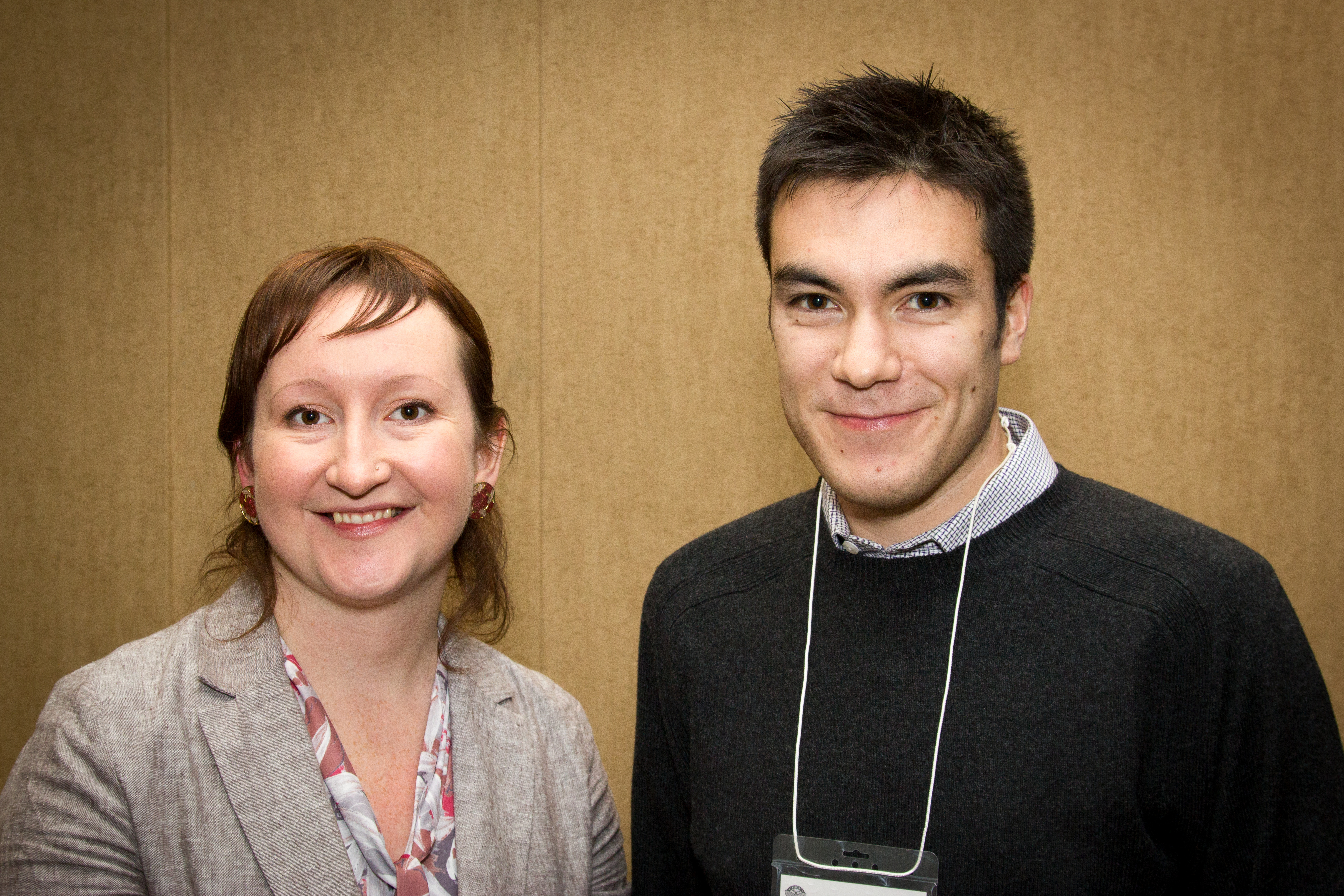
The co-chairs – Chandra Moffat and Boyd Mori. Photo credit: Adrian Thysse

The co-chairs – Chandra Moffat and Boyd Mori. Photo credit: Adrian Thysse

Via e-mail, we consider how improve or maintain student success and visibility in the ESC. Other members include Ikkei Shikano (Burnaby, BC), Brock Harper (Toronto, ON), Paul Abram (Montreal, QC), Léna Durocher-Granger (Quebec/Honduras), Guillaume Dury (Montreal, QC) and me (Julia Mlynarek (Ottawa, ON)).

What do we do?

The mandate of the SAC is two-fold; 1- we advise Student Members, the Governing Board, and the Society on programs of the Society for students and on other matters concerning students and 2- we advise Student Members and the Society on the training of entomologists and on the future job opportunities for entomologists in Canada. This mandate is very broad but throughout the year we try to set specific goals to help students succeed in entomology. This year for example, we will be trying to post more regular updates on the ESC blog to let the Members know what we are up to. We are also working on an updated version of the Directory of Entomology. Of course we continue working hard on letting the Student Members know of Job and Research postings. Additionally, we let the community know if a student has defended their thesis successfully in the thesis round-up (either on the ESC website, or in the Bulletin). So if you’re a student that has just submitted a thesis, let us know! We also help with organization of the annual meeting such as trying to keep the costs for the meeting as low as possible (but still sustainable) for the student, the student mixer during the meeting, the Graduate Student Symposium and the Silent auction. The proceeds of the silent auction actually come back to help the students. So a successful silent auction means extra funds for the students!

Great turn out to the ESC student mixer! Photo credit: Seth McCann

Great turn out to the ESC student mixer! Photo credit: Seth McCann

Student affair committee members (Chandra Moffat and Paul Abram) manning the silent auction at the last ESC annual meeting. Photo credit: Adrian Thysse

Student affair committee members (Chandra Moffat and Paul Abram) manning the silent auction at the last ESC annual meeting. Photo credit: Adrian Thysse

We work hard in our spare (non-thesis) time to encourage students pursue their dreams of working with insects. The actions we take today will influence the future entomology students which could potentially be our students in the future. We want Canadian Entomology to be the best it can be so that is respected in the world as it has been since the inception of the ESC.

If you (as a student) are interested in getting involved please contact us – students@esc-sec.ca or post a message on the ESC student facebook page. We would love to hear from you.

Enjoy the insects.

Till next time,

Julia

The Entomological Society of Canada gives out several financial awards each year to Canadian graduate students studying entomology. The following awards are available for 2013:

Graduate Research Travel Award – Up to a maximum of $2000

  • Normally awarded to one MSc student and one PhD student annually
  • Intent is to help students increase the scope of their research, and will be judged on scientific merit
  • Student must be enrolled as a graduate student at a Canadian university & studying insects or related terrestrial arthropods
  • Details
  • Application & Evaluation Information
  • Deadline: February 16, 2013

Postgraduate Awards – $2000

  • Normally awarded to one MSc student and one PhD student annually
  • Awarded on basis of high scholastic achievement
  • Student must be enrolled as a graduate student at a Canadian university & studying insects or related terrestrial arthropods
  • Application & Evaluation Information
  • Deadline: February 16, 2013

John H. Borden Scholarship – $1000

  • In honour of Dr. John H. Borden, one postgraduate award of $1,000 to assist students in postgraduate programs who are studying Integrated Pest Management (IPM) with an entomological emphasis
  • Awarded on basis of high scholastic achievement & innovative research in IPM
  • Applicant must be a full time postgraduate student at the time of application, studying IPM at a degree granting institution in Canada
  • Application & Evaluation Information
  • Deadline: February 16, 2013

Keith Kevan Award – $1000

  • In memory of Dr. D. Keith McE. Kevan, the Entomological Society of Canada offers one postgraduate award of $1,000 biennally to assist students in postgraduate programs who are studying systematics in entomology
  • Awarded on  basis of high scholastic achievement and excellence in insect systematics
  • Application Procedure
  • Deadline: February 16, 2013

By Sean McCann, PhD Canidate in Biological Sciences at Simon Fraser University

9/10 ant-mimicking mantids recommend tropical fieldwork for prevention of insect withdrawal.  (Photo: S. McCann)

9/10 ant-mimicking mantids recommend tropical fieldwork for prevention of insect withdrawal. (Photo: S. McCann)

At this stage of the long dark Canadian winter, thoughts of tropical fieldwork should be going through the heads of all sensible entomologists…If you find yourself longing for the moist and insect-filled paradise of the Neotropics, or even if that is what your research plans call for, let me introduce you to the wonders of French Guiana.

Topography near the Inselberg Camp.  (Photo: S. McCann)

Topography near the Inselberg Camp. (Photo: S. McCann)

French Guiana is situated just north of Brazil on the Atlantic coast of South America, and remains to this day an overseas Department of France.  Both French and Creole are spoken, so Canadians should feel right at home.

French Guiana truly shines as a biodiversity and natural areas hotspot because unlike many countries in the Amazonian forest region, it has not experienced extensive deforestation. The immense expanses of unlogged rainforest are truly impressive.

The Inselberg des Nourages on a clear day.  View not guaranteed, depends on the season. (Photo: S. McCann)

The Inselberg des Nourages on a clear day. View not guaranteed, depends on the season. (Photo: S. McCann)

There is quite active citizen science in Guyane as well, of particular interest is the SEAG, or Société Entomologique Antilles Guyane: http://insectafgseag.myspecies.info/. This society has conducted numerous expeditions focused on collection and identification of many insect taxa, and represents a great resource of local knowledge of the insect fauna.

Finding a cryptic owlfly nymph is always a nice surprise (unless you are a cricket) (Photo: S. McCann)

Finding a cryptic owlfly nymph is always a nice surprise (unless you are a cricket) (Photo: S. McCann)

I have done all my tropical fieldwork at the Nouragues station, supported by an annual grant program that seeks to assist visiting scientists with the travel and logistical expenses involved with a tropical field season. My work has centred on a bird which is a specialist predator of social wasps, the Red-throated Caracara.

Red-throated Caracaras are specialist predators of social wasps, and a common resident of the Nouragues Reserve. (Photo: S. McCann)

Red-throated Caracaras are specialist predators of social wasps, and a common resident of the Nouragues Reserve. (Photo: S. McCann)

The 1000 km 2 Nouragues reserve is located approximately 100 km SSW of Cayenne, and was established in 1995 to be both a refuge free of development and to facilitate research on Neotropical forest dynamics.

Army ants (Eciton spp.) are one of the wonders of the Neotropical raindforests. Go. See. Them. (Photo: S. McCann)

Army ants (Eciton spp.) are one of the wonders of the Neotropical raindforests. Go. See. Them. (Photo: S. McCann)

There are two research camps, the Inselberg Camp, situated just beneath a 420 m granite mountain, the Inselberg des Nouragues, and the camp at Saut Pararé, situated just below a series of high rapids on the Arataye River. The camps are accessible by helicopter, or you can take a motorized canoe (pirogue) to the Saut Pararé camp.  Both camps are administered by the CNRS (Centre Nationale de Recherche Scientifique) which has an office in Cayenne. Field costs are €20/day for students and postdocs and €35 per day for established researchers. Travel to the station can be expensive, but sharing the cost of helicopters/pirogues with other researchers can bring the costs down considerably.

Access to various parts of the forest is facilitated by an extensive trail system . Data on tree species and flowering/fruiting phenology in two large research plots at the Inselberg Camp are available. At the Pararé camp, there are also many trails, although not as extensive as at the Inselberg camp, as well as access to riverine and palm swamp habitats. Lists of species of birds, bats, fish and trees are available, and there is an impressive list of scientific data already published:  http://www.nouragues.cnrs.fr/F-publications.html.

SM7

UV lamps attract a nice variety of insects. These are particularly fabulous. Start your collection today! (Photo: S. McCann)

The camps are comfortable, with covered shelters (carbets) for sleeping and eating, and there is electricity and running water at each station (it is the rainforest!). There is also a satellite internet connection which is adequate for email and keeping in touch with labs and colleagues. Food is provided, and is quite good (as one might expect at a French field station!), cooking/cleaning duties are shared.

The kitchen carbet by moonlight. (Photo: S. McCann)

The kitchen carbet by moonlight. (Photo: S. McCann)

If you are a student or a researcher at the planning or pre-planning stages of a Neotropical research program, there is no better time than now to submit a research proposal to the scientific committee of the station. The recently announced call for proposals will fund projects to a maximum of €9000, which would nicely cover the transportation and field costs for a several-month expedition. The deadline is Feb. 14, 2013. For more information, the details are available here: http://www.nouragues.cnrs.fr/indexenglish.html

The Entomological Society of Canada is looking for volunteers for the upcoming JAM, November 3-7!

Volunteering looks great on your CV, is an excellent way to meet new people, and is fun! The Student Affairs Committee worked hard to keep student registration rates low, so we need a very strong showing of student volunteers to help make this meeting a success!

Sign up at http://www.doodle.com/i8znn4z75mtharfw by checking off times you are available. The full program is up now so you can confirm when you are presenting: check it out here!

Hi, my name is Holly Caravan and I am a PhD student in Dr. Tom Chapman’s social insect lab at Memorial University of Newfoundland. Currently my work is focused on galling aphids and their potential for antimicrobial activity within the gall. This past summer I visited Dr. Patrick Abbot’s lab at Vanderbilt University (Nashville, TN) where I was able to access three species of galling aphids. But, to address the ultimate goal of my research, I want to include the species Pemphigus spyrothecae which produces spiral galls on Lombardy poplar, Populus nigra. This species has a soldier caste which is morphologically specialized, different from the other three species I have already researched. I am looking for any information on locations of this aphid species in Canada; Newfoundland would be ideal, but my hopes are not high! Attached are links with pictures of the host tree and the spiral galls produced by the aphids. Any information would be greatly appreciated! I can be contacted at holly.caravan@gmail.com or hcaravan@mun.ca!

http://www.naturespot.org.uk/species/pemphigus-spyrothecae

http://www.parkwoodpines.com.au/html/lombardy_Poplar.html

Jacob Coates is an MSc student in the Chapman Entomology Lab at Memorial University of Newfoundland and Labrador.

—————————————

Cockroach – Photo by Jacob Coates

If you’ve never thought of visiting Australia, you’re making a terrible mistake. I just recently returned from a 6 month stint in Sydney based out of a Lab in Macquarie University. I carried out lab and field work on several species of gall-inducing thrips. I owe this great trip to the Australian Endeavour’s Awards, An Australian government run program which takes applications from students all over the world and to those lucky enough to be accepted, ships you to an Australian University with a wage, living allowance and travel cash. On top of getting some serious work done I enjoyed snorkeling around the many beaches, hiking in the Blue Mountains, and took part in the City 2 Surf road race where over 80,000 individuals take to the streets of Sydney to run the largest road race in the world.

Southern Queensland Red Road – Photo by Jacob Coates

In early June I completed a field trip into Southern Queensland to collect insect samples. Tenting through the outback presented some difficulties like torrential downpours, cold nights, and very sloppy road conditions (Nearly sinking a 4×4 in a flooded dirt road). Despite the problems, after nearly 2500 kms and 10 days of driving I returned to Sydney with thrips samples in hand and a very dirty truck to clean. Amazing wildlife, epic landscapes and great people await everyone in the outback, without a doubt the best trip of my life.

Jacob Coates

For those interested about the Endeavour’s award go to http://www.deewr.gov.au/International/EndeavourAwards/Pages/Home.aspx It’s well worth your time.

Today’s post is by Kate Bassett of Memorial University. If you’d like more information about her work, she encourages you to contact her.

——————————-

Hi,

I’m a graduate student at Memorial University (MUN, St. John’s, Newfoundland and Labrador), nearing the end of my masters…hopefully :). My research project is focused on a wildlife issue. Snowshoe hare, Newfoundland’s only Lagomorph, suffer from infection by California serogroup viruses (snowshoe hare virus and Jamestown Canyon virus). Helped by the province’s Chief Veterinarian Officer Dr. Hugh Whitney, I sampled the blood and tested for infection in wild hares and laboratory rabbits used as sentinels.  This work was based in part in the laboratory led by microbiologist Dr. Andrew Lang at MUN, as well as working with the team at the National Microbiology Lab headed by Dr. Michael Drebot in Winnipeg. But, my project also included studying mosquitoes that are thought to transmit these viruses. That part of my project was based in the social insect lab at MUN headed by Dr. Tom Chapman.

I spent two summers catching mosquitoes. Consequently, I can’t miss them. I seem to have permanently altered my hearing and vision such that a mosquito in flight always grabs my attention. Last May while putting in a load of laundry, a specimen alighted on the washer. I dropped everything and ran upstairs for my aspirator, and made it back to collect this girl to identify at work. I froze her and didn’t get around to id’ing until later in the summer, and I was shocked to see that it may be Culex pipiens. This mosquito gains attention on the East Coast of North America because it can transmit West Nile Virus, and when I made this determination the worst West Nile viral outbreak in N.A. was underway and centered in Texas. I was uncertain of my morphological identification, so I added a leg or two of this specimen to my DNA barcoding work, and I waited for the outcome. When the sequence confirmed by identification, I put out a press release, which had me immediately doing live interviews on TV and Radio. I didn’t have a lot of time to think about it, I just went from interview to interview. It was a good experience; I do recommend it. I should add that we don’t have confirmation of West Nile Virus in Newfoundland, but we don’t know what lies ahead. Drs. Lang (aslang@mun.ca), Chapman (tomc@mun.ca) and Whitney (hughwhitney@gov.nl.ca) are looking for students to pick up where I am leaving off.

Culex pipiens photo by Kate Bassett

Here’s a picture of Cx. pipiens I took using a digital camera mounted on a dissecting scope. I used the program Helicon for producing a wide focal plane. It’s not the one that I got in May and fingerprinted, but another one that I got last weekend (September, 2012), also in my house!

Mosquito field trials at the Guelph Turfgrass Institute

Sometimes field work can look a little unconventional, like using large screened tents for a mosquito repellent trial. This original (yet ultimately unsuccessful) idea came from some work I did at the Guelph Turfgrass Institute in 2011.

Another field season has come and gone (mostly, I bet there are some field crop entomologists still out collecting data), and the entomology conference season will soon be upon us. But before you wrap yourself up in a nice warm cocoon of fresh data in preparation for the coming winter, we’d love to hear how your summer went!

The only thing better than obtaining exciting new data is the great story about how you got it! Maybe you traveled to a new location (or had an adventure on the way to your normally-mundane field site), met some interesting new people, took some photos you’re proud of, or did your best MacGyver impression by rigging your equipment together using only duct tape, dental floss and that perfectly shaped twig you found. Being the start of a new semester, maybe you’ve started a new project or joined a new lab and want to introduce yourself, your work, and put out a call for specimens.

Whatever your situation, the ESC Blog is a great place to share your story and earn the adoration of your peers for heroics and valor in the face of p > 0.05! Simply send us an email (entsoccanada@gmail.com) with your story (and a few pictures if you can) and we’ll help bring your story to the masses.

We know you’ll be swapping stories with newfound friends over beer at the ESC meeting in a few weeks, so hopefully you’ll consider sharing them with everyone a little sooner. We promise, we’ll ooh & ahh at all the appropriate moments (and not tell your advisor how the dent in the rental truck really got there)!