By Jeff Skevington, AAFC & President of the Entomological Society of Ontario

——
Today was the first ESO Bug Day. Thanks to Sophie Cardinal for organizing it all and to our many members and other volunteers who came out to help. I think it was an unparalleled success. We had hundreds of participants (my guess is slightly over 1000, but it was hard to track numbers). All of the volunteer leaders came with fabulous stuff – everything from Giant Swallowtails and Tomato Hornworm larvae to huge scarab larvae to hissing cockroaches and a whip scorpion. Andy Bennett did a brilliant job with the cockroach races with his home made Duplo race track. We had a tank of aquatic insects, ran at least 15 public hikes, had a biological control display, face painting, a butterfly exhibit, a craft table. The building was bursting at the seems to thankfully the rain held off and we were able to do a lot of it outdoors.

All in all, it was fabulous exposure for the ESO and the Ottawa Field-Naturalists’ Club (who provided many volunteers as well as their clubhouse and gardens).

Thanks again to all who helped and to the ESC for their help with funding. I hope that we can do it again next year – maybe in more than one city now that we have tried it out!

Caterpillar overlook Craft time

Andy Bennett oversees a cockroach race

Andy Bennett oversees a cockroach race

—–
CBC Radio Ottawa stopped by and took in Bug Day as well. Listen to the segment titled « Bug Day fun at the Fletcher Wildlife Garden » here (scroll down the page a bit to find it).

By Dr. Chris Buddle, McGill University & Editor of The Canadian Entomologist

———-

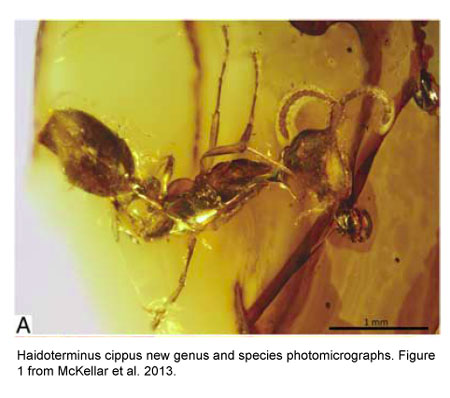
It’s with great pleasure that I announce my pick for the latest issue of The Canadian Entomologist.  Ryan McKellar and colleagues wrote a paper on a new trap-jawed ant from Canadian late Cretaceous amber (freely available during September).  As they write in the Abstract, the new species “….expands the distribution of the bizarre, exclusively Cretaceous, trap-jawed Haidomyrmecini beyond their previous records…”. They truly are bizarre! Facial structures right out of a sci-fi movie!  When reading the paper, I was also surprised that the fossil record for the Formicidae is sparse during the Cretaceous.

Haidoterminus cippus. Figure 1 from McKellar et al. 2013

I asked the lead author a few questions about this work, and am pleased to share the responses with you. It’s truly exciting research, and I am thrilled that the pages of TCE include systematics from amber. This work stirs the imagination, and takes us all back in time.

What inspired this work?

My interest in the Canadian amber assemblage really began when Brian Chatterton (then my M.Sc. supervisor) showed me some of the slides that he had borrowed from the Royal Tyrrell Museum of Paleontology in order to write a book on Canadian palaeontology. The sample set contained insects with bizarre adaptations for life at low Reynolds numbers, and obvious ecological associations, spurring an interest that ultimately led to a research in parasitic microhymenoptera. Michael Engel subsequently introduced me to a much wider array of taxa, and we continue to explore the Canadian assemblage together and with the help of colleagues.

What do you hope will be the lasting impact of this paper?

New records, such as this trap-jawed ant, help to flesh out our picture of the amber-producing forest and its inhabitants. I hope that a comprehensive account of this assemblage will eventually provide insights into terrestrial conditions that are unavailable from other fossil types, and that this will shed some light on changes in diversity and conditions leading up to the end-Cretaceous mass extinction.

Where will your next line of research on this topic take you?  

With any luck, we will be able to complete our coverage of Hymenoptera in Canadian amber soon, and make more of a concerted effort to cover other insect orders and some of the ecological associations found within the deposit. Grassy Lake amber still has a lot to offer, but it is only one of western Canada’s many amber deposits. As a larger-scale project, we are currently part of a team examining the numerous fragile ambers associated with coals in the region. The goal of this research is to create an amber-based record of forest types and inhabitants that spans more than 10 million years within the Late Cretaceous and Paleocene.

Can you share any interesting anecdotes from this research?

Surface-collecting amber can be quite difficult, because unpolished Canadian amber typically has a matte orange-brown colour, and is often covered with a carbon film or weathering crust. If there is no fractured surface visible and the specimen is not translucent, it can be quite difficult to distinguish from the surrounding coal or shale. Furthermore, there is such a range of shapes and sizes that some of the smaller amber droplets are easily confused with modern seeds. One of the quickest ways to see if you are dealing with amber is to wet the specimen and look for amber’s characteristic lustre, or tap the specimen on your teeth (amber feels like plastic compared to most suspect rocks). Naturally, I have licked quite a few samples in the course of my collecting, and have lost a lot of my appreciation for rabbits.

A selection of amber from Grassy Lake. Photo courtesy Brian Chatterton

A selection of amber from Grassy Lake. Photo courtesy Brian Chatterton

Thanks to Cambridge Journals Online for making this month’s Editor’s Pick Freely Available for the month of September!

This post is a regular series highlighting great papers from the pages of the Canadian Entomologist. 
McKellar R.C., Glasier J.R.N. & Engel M.S. (2013). A new trap-jawed ant (Hymenoptera: Formicidae: Haidomyrmecini) from Canadian Late Cretaceous amber, The Canadian Entomologist, 145 (04) 454-465. DOI:

By Gary Umphrey, University of Guelph & President of ESC-ESO 2013 JAM Organizing Committee

———

Greetings Fellow Entomological Enthusiast:

I wish to draw your attention to the following photo, which is of the participants at the Entomological Society of Ontario’s 50th Anniversary meeting, held in Guelph Aug 27-29, 1913. Yes, this meeting was held 100 years ago this past week. And if you peruse the distinguished individuals in the photo you may recognize William Morton Wheeler, the iconic ant man and Ed Wilson’s predecessor in myrmecology at Harvard, sitting on the far left in the front row. Indeed Wheeler was scheduled to present a public lecture, succinctly titled « Ants », at 8:00 pm on August 28, 1913. Wheeler was only one of the distinguished entomologists at the meeting, and I invite you to check out the second file which will attach names to the people you may not recognize.

ESO 50th Anniversary, 1913

ESO 50th Anniversary, 1913 - names

I am not sure how (or if) you celebrated the anniversary of Wheeler’s talk (a Bitburger in my Ants! cup worked for me), but in any case I might suggest that a good way for you to do so would be to register for the special 150th Anniversary entomological extravaganza, the Joint Annual Meeting of the Entomological Society of Canada and Entomological Society of Ontario in Guelph, Oct 20-23, 2013. The deadline for early registration at a deep discount is fast approaching — indeed it is TODAY! The conference website is at:

http://www.uoguelph.ca/debu/esc-eso2013/esc-eso.html

This will be a very full program this year, and it has been necessary to extend it to include Wednesday afternoon. To ensure that you won’t have to miss out on any presentations you might want to attend, we are including lunches with your registration fee for the Monday to Wednesday concurrent sessions at the Delta Hotel. Registration also includes the opening reception and banquet.

An unadvertised attraction of this meeting: you will have opportunities to have your photo taken with Jeremy McNeil, the King of Entomological T-Shirts! You will probably want to be wearing an entomology t-shirt yourself. If you don’t bring a favorite shirt (or even if you do) we will have a limited supply of commemorative 150th JAM t-shirts. If you find the official logo too edgy, are troubled by the raging controversies that have surrounded this logo, or simply don’t like biting flies, we will have t-shirts with an alternative logo as well.

The deadline for submitting a presentation (talk or poster) is September 15. Note that abstracts are not required, we only want your title. Space on the program for talks is limited, so don’t delay if you want to present.

The Delta Hotel is our official conference hotel, and we have a block of rooms available at a special price that includes parking (regularly $12/day). While there are certainly other hotels in Guelph, and some at lower prices, the Delta is a very nice hotel and there is real convenience in staying at the conference hotel, especially if we get some nasty weather. The reserved block is quite limited, and so if you wish to stay in the Delta I would suggest making your reservation as soon as possible.

To our entomological colleagues in the U.S.A., YOUR PRESIDENT WILL BE HERE! Yes, Dr. Rob Wiedenmann, President of the Entomological Society of America, will be speaking on Sunday in the opening session, and we would be delighted if you could attend as well (subject to meeting capacity, we certainly can’t handle the numbers that attend an E.S.A. meeting). Here’s a chance to burnish your international reputation and meet your President at the same time, simply by making a jaunt to Canada to attend our meeting!

I would encourage you to join us in the celebrations of the ESC/ESO Sesquicentennial Anniversary JAM and join William Morton Wheeler and his colleagues in the rich historical legacy of special anniversary entomological meetings in Canada.

ESC-ESO-Logo-Full-Colour400px

By Laura Timms, Chair of the ESC Common Names Committee
——
Hello,
The Common Names Committee of the Entomological Society of Canada, in collaboration with the Canadian Wildlife Service (Environment Canada), is planning a project to develop common names for all beetles in Canada. We are looking for to hire contractors to assist in developing English and French common names.  Since this order contains many families, we are looking for Anglophone and Francophone Coleopterists who specialize in more than one group of Coleoptera species.  Compensation will be based on the number of species assigned to each contractor.  If interested, please send your C.V. to Joanna.James@ec.gc.ca by August 16th, 2013.  Please do not hesitate to contact us if you have any questions.
Thanks!
Bonjour,
Le Comité des noms communs de la Société d’entomologie du Canada, en collaboration avec le Service canadien de la faune (Environnement Canada) prépare un projet pour développer des noms communs pour tous les coléoptères au Canada. Des experts seront engagés pour développer les noms communs en anglais et en français. Puisque cet ordre contient plusieurs familles, nous cherchons des experts anglophones et francophones qui se spécialisent sur plus d’un groupe d’espèces de coléoptères. La rémunération sera basée sur le nombre d’espèces assignées à chaque expert. Si intéressé, svp envoyer votre C.V. à Joanna.James@ec.gc.ca  avant le 16 août, 2013. Svp n’hésitez pas à nous contacter si vous avez des questions.
Merci!

By Staffan Lindgren, University of Northern BC and 2nd Vice President of the ESC

————–

A few weeks ago my most recently graduated Master’s student took a few days off to attend the UNBC convocation ceremony. Knowing her former supervisor’s fondness of red wine (which several of my other graduate students have magically discovered as well – go figure!), and no doubt well mentored in the important aspects of oenology by her entomologist father, she kindly presented me with a bottle of Idaho wine aptly named “Entomology”. The vineyard in question has a series of ‘ology’ wines, and appropriately, the importance of entomology has been recognized in this one. This welcome gift, along with other wines I had purchased solely because they had an insect on the label, caused me to ponder the connection between insects and wine. It should be added that apart from a long-standing preference of certain varieties of red wine, label design and price are pretty much my only criteria for selection of wines to purchase, as my olfactory senses have long been impaired after years of sinus infections.

Insects have had enormous significance in viticulture. Interestingly, pollinators do not appear to play a significant role, as the wine grape, Vitis vinifera L. (Vitaceae) is primarily wind pollinated. The negative impact of one insect on viticulture, on the other hand, provides for a fascinating story of applied interdisciplinarity, long before that concept became a fad. In an entomological detective story, elements of international politics, bureaucratic intrigue, the struggle between Darwinian evolution and creationism, invasive insect ecology, plant resistance, systematics, are interwoven like a movie script leading to the establishment of the fledgling discipline of economic entomology, with several entomologists the heroes (prominent among them Charles V. Riley) saving the damsel in distress (French viticulture) (Sorensen et al. 2008). I speak of course of the impact of the grape phylloxera, Daktulosphaira vitifoliae (Fitch) (Hemiptera: Phylloxeridae), an introduced insect from North America, on the French wine industry. At one point this little insect threatened the very existence of the industry, which at the time supported a sizeable portion of the French economy (Smith 1992, Sorensen et al. 2008). A simple Google Scholar search reveals that phylloxera remains a significant issue and is subject to continuing research worldwide (Granett et al. 2001). Corrie et al. (2002) even noted that phylloxera “is a viticultural pest that in the past has devastated vineyards worldwide, yet little is known about this insect’s biology”.

Apart from the “Entomology” wine, which I haven’t tasted yet, I have four other wines, falling in two categories. Two are organic wines, and have butterflies on the label, while the other two labels are adorned by ants. The descriptions below are from other sources, as my inferior olfactory system cannot do wines justice. Suffice it to say I like them all.

Five wines with labels adorned with insects. In today’s wine market, it seems that eye-catching labels are important competition tools. I wonder if entomophobic customers buy any of these?

Five wines with labels adorned with insects. In today’s wine market, it seems that eye-catching labels are important competition tools. I wonder if entomophobic customers buy any of these?

Nuevo Mundo Reserva Cabernet-Malbec represents the type of wine I enjoy with a “big bouquet of dark cherries and blackberry with hints of sweet spice on the palate” (hint to future students!).  The labels of all their wines have butterflies, no doubt signifying that it is an organic product and certified 100% carbon neutral. This wine is produced in the Maipo Valley, Chile, aged in French oak for a year, and sold for slightly under $16 in BC Liquor stores.

Domino de Punctum Lobetia is an organic Tempranillo wine produced by the Punctum Estate in La Mancha, Spain. It is described as having a “cherry colour with a violet shade indicating its youth. On the nose you’ll find fresh cherries and other red berries, with similar notes on the palate that shows moderate tannins”, and for $12.99 this is a very price-worthy wine.

Fabulous Ant is a Pinot Noir from Tolna, Hungary, which at $12.99 is a great buy. I have not been a fan of Pinot Noir, but I quite enjoy this wine described as having “cherry, strawberry and clove aromas on the nose and a silky, medium-bodied palate”. The label features an ant carrying a cherry, rather than a grape, perhaps indicating the predominance of cherry. This is a wine that I would not have picked as Hungary doesn’t strike me as a primary wine producing country, at least not of the types of wine I enjoy. However, this wine was awarded a Gold Medal at the Berlin Wine Show 2013, reflecting the emergence of yet another interesting wine producing region worth paying attention to.

Formiga de Vellut is a Carignan-Grenache-Syrah blend from the Priorat region in Spain, and is the most expensive of the wines I have chosen. At under $30 it is still worthy of a try by any entomologically inclined wine aficionado, however. I rarely spend that much on wine, but with ants on the label, how can I resist? It is described by Anthony Gismondi (http://www.gismondionwine.com/), who gave it a rating of 91 points, as a “spicy, floral, curry, black peppery, liquorice scented red.” He goes on to write: “Love the dry, supple palate and its smoky, peppery, black cherry jam and meaty, licorice and cedar flavours.” I agree with Mr. Gismondi (at least with respect to what I am able to perceive)!

Finally, the interesting Idaho wine Entomology. Produced by the Cold Springs Winery located halfway between Boise and Twin Falls, Idaho, this is a Cabernet-Syrah blend which according to the vineyards own website is a medium bodied wine with red fruits and dried figs on the nose and blueberry on the palate. The label depicts a Polyphemus moth, which is described as a “pollinator moth”, so the entomology part may be a bit off target, but hey, if the wine is good we can live with some slight miscues.

There are obviously many other wines with an insect connection that I have not seen. I am hoping for suggestions in response to this blog post! Actual samples are welcome as well….

References cited

Corrie, A.M., R.H. Crozier, R. Van Heeswijck, and A.A. Hoffmann. 2002. Clonal reproduction and population genetic structure of grape phylloxera, Daktulosphaira vitifoliae, in Australia. Heredity 88: 203–211.

Granett, J., M.A. Walker, L. Kocsis, and A.D. Omer. 2001. Biology and management of grape Phylloxera. Annual Review of Entomology 46: 387-412.

Smith, E.H. 1992. The grape phylloxera. A celebration of its own. American Entomologist 38(4): 212-221.

Sorensen, W.C., E.H. Smith, J. Smith, and Y. Carton. 2008. Charles V. Riley, France and Phylloxera. American Entomologist 54(3): 134-149.

By Chris Buddle, Editor of the Canadian Entomologist

———————–

I am pleased to present the “Editor’s Pick” manuscript for the current issue of The Canadian Entomologist. This pick was a paper by Bob Lamb, Patricia MacKay and Andrei Alyokhin, titled “Seasonal dynamics of three coexisting aphid species: implications for estimating population variability

I had always admired the ongoing work on aphids, spearheaded by Bob and Pat. Their work is always relevant, meticulous, framed in an important and broader ecological context, and they have a ‘model system’ to work with. This is the kind of researcher many more junior entomologists look up to.  The current paper is no exception. In this work, Bob and Pat joined up with Andrei Alyokhin and present a careful study of population variability and effectively use this metric to better understand population dynamics over time.  For me, I see much value in this approach, and can see how this kind of work could effectively be used in teaching students about how to best describe, understand, and quantify population dynamics.  I’m also inspired to see long-term data with arthropods. These kinds of data are so useful, but relatively rare. It’s great to see Bob, Pat and Andrei publish thoughtful and important work using such data.  I may also look around some old filing cabinets at my University…

Bob was kind enough to answer a few questions about this work, with input from his co-authors.

What inspired this work?

When Pat MacKay and I were anticipating eventual retirement from paying jobs as entomologists, we decided to begin a study of an aphid population that could be pursued as long as we could walk trails and count aphids. Our goal was to figure out why aphid populations seem to be so unstable. Eventually we wrote up our findings on the stability of one native species over the first 10 years of a study we hope will go on for at least another 10 years. A few years ago we realized we needed comparative data, but were too old to start on a 20-year study of another aphid species. The solution was to write to colleagues who also had long-term data sets, to see if they were interested in looking at their data from this perspective. So far the colleagues we have contacted have been enthusiastic collaborators. The first was Andrei Alyokhin our coauthor on the current paper. He gave us access to 60 years of data on three aphid species. The first paper on the stability of these aphids was published in the Canadian Entomologist two years ago. The current paper extends that earlier work, looking now at how aphid seasonal biology affects our estimates of stability.

Bob Lamb, sporting "aphid hunting gear"

Bob Lamb, sporting « aphid hunting gear »

What do you hope will be the lasting impact of this paper?

We hope that this paper will help convince other researchers that Joel Heath’s metric, PV, which we use to quantify population variability, is a robust way to quantify one aspect of the stability of populations. If more researchers adopt this metric, ecologists will have a much greater opportunity to apply a comparative approach and identify factors that contribute to stability or instability of populations.

Where will your next line of research on this topic take you?

Pat MacKay and I continue to extend our time series on the abundance of a native aphid, and are now focusing more on the ecological processes that cause our five populations to rise and fall. We also hope to expand our studies of stability to still more aphid species, but also species with very different life histories. At the moment I am working with a colleague, Terry Galloway, University of Manitoba, on several time-series of ectoparasite abundance on birds.

Do you have any interesting anecdotes about this research?

One of the most interesting aspects of the work on aphids from potatoes is the source of the data – 60 years or more of weekly aphid counts. The data for the early years were discovered by Andrei Alyokhin in an abandoned filing cabinet stored in a barn at the University of Maine. Andrei was a new faculty member at the time exploring his research facilities. His predecessors had maintained meticulous records of aphid densities in potato plots since soon after World War II. Andrei was quick to recognize the value of this data, and more importantly recognized the need to go on collecting the data in the same way. The result is an amazing data set, one of the longest continuous records at one location of the dynamics of multi-voltine species.

Lesson 1: newly-hired entomologists should begin their careers by searching old filing cabinets.

Lesson 2: meticulous long-term records can be invaluable, sometime in ways that you might not anticipate.

Andrei discovering data in old filing cabinets

Andrei discovering data in old filing cabinets

Lamb R.J., MacKay P.A. & Alyokhin A. (2013). Seasonal dynamics of three coexisting aphid species: implications for estimating population variability, The Canadian Entomologist, 145 (03) 283-291. DOI:

By Rebecca Hallett, ESC First Vice-President

—————————

A year ago, an exciting new collaboration was initiated between the ESC and the Royal Canadian Mint. This collaboration grew from a letter sent by then President, Michel Cusson, and myself as chair of the Scientific Policy and Education committee, to the Mint commending them for the inclusion of insects on Canadian coins and offering the services of the ESC as a resource for the development of future insect coins. The response from the Mint was very warm and they immediately invited the ESC to be involved in the Animal Architects coin series.

Bee-coin

The Animal Architects coin series celebrates the “exceptional architects of Canada’s animal world and their unique constructions”. I was thrilled to see that the first coin in this new series has recently been released, depicting an iconic insect architect, the honeybee, with its hive.

View the sale sheet here for the 2012 $3 FINE SILVER COIN – ANIMAL ARCHITECTS: BEE & HIVE

The Mint also decided to recognize the involvement of the ESC in this series and, in 2013, to commemorate the Sesquicentennial of the ESC on the certificates of authenticity that accompany the coins.

The Bee & Hive coin has proven to be extremely popular and is selling rapidly.  The depiction of insects on coins helps to increase appreciation for nature in general, and insects in particular, among the Canadian and coin-collecting public. I hope you will consider supporting this endeavour by treating yourself or a loved one to one or all of the coins in this series.

Coins can be ordered from the Royal Mint website:

http://www.mint.ca/store/coin/14-oz-fine-silver-coin-animal-architects-bee–hive-2013-prod1670011

Or obtained through one of the Mint’s dealers:

http://www.mint.ca/store/mint/customer-service/dealer-locator-1400026

I’ve got my Bee & Hive coin reserved and am rushing off to Toronto tomorrow to collect it!

Keep your eyes open in the fall for the next Animal Architects coin to emerge…

By David McCorquodale, Dean of Science and Technology, Cape Breton University

There is a perception that Nova Scotia and Cape Breton (where I live) may be subject to an invasion of cicadas.  The perception seems to stem from the mass emergence of cicadas in the northeastern USA this spring and summer.  What an opportunity to build suspense and stress!  Consider this headline from Design and Trend on 09 May 2013: CICADAPOCALYPSE: Mass Exodus from the Ground.  A Google search revealed dozens of similar, but admittedly not as sensationalist, headlines from news outlets in the northeastern US and a few in Canada.

In my 35 years as an entomologist in Canada I have seen, heard and collected many cicadas.  The delightful Dog Day Cicada (Tibicen canicularis) sings from the White Birch trees near my house every summer.  It is the species I have seen and heard most frequently.  Cicadas are big (some more than 30 mm long, all at least 20 mm long), loud (at least to those who have not lost their high end hearing) and widely distributed across southern Canada. Sound production is fascinating.  Males have tymbals under their wings.  Tymbals have taut membranes across an echo chamber.  The membranes vibrate to produce the high pitched, incessant, droning calls on hot summer days.

Tibicen canicularis. Photo by Denis Doucet

However I suspect many people have never seen or knowingly heard cicadas. Why?  Probably because most of their life is spent as larvae underground sucking liquids out of roots so they can grow, mature and emerge as adults.  Males sing from tree tops, mate with females who then lay eggs on twigs, when the eggs hatch the larvae fall to the ground and burrow to feed on roots.  The larvae burrow down among the roots, not to be seem until they emerge as adults.

How can we reconcile these disparate pieces of information: i) cicadas are common and widespread where Canadians live, ii) most people have never seen them and iii) WARNING mass invasion of cicadas this summer!

We cannot because there will not be a mass emergence in Nova Scotia or indeed in eastern Canada.  There will be about the same number of adult cicadas in eastern Canada as in any other year.  No one will be able to detect a difference in the number of cicadas in 2013 compared to previous years.  Perhaps there will be more attention on cicadas — that is a good thing.

How can I say this and go against all the headlines?  The first step is to consider what species of cicadas occur in eastern Canada and compare that to which species of cicadas have mass emergences.  In Nova Scotia there are three species of cicadas.  All three are ‘annual’ cicadas.  That is adults emerge each year, mate, lay eggs, larvae develop and then the adults emerge the next year.  There are not dramatic differences in the number of adults from year to year.  Males sing form the treetops every year and most year most people are blissfully ignorant they are there.

However in the eastern USA there are several species of cicadas (Periodical Cicadas, Magicacada spp.) with a different life cycle.  These cicadas also have males who sing, females who mate and then lay eggs on twigs and larvae who feed on roots.  But the next step is different, they keep feeding and do not emerge as adults for 13 or 17 years.  The adults that emerge are ‘teenagers’, not one year olds.  Some periodical cicadas emerge every year, but some years, including 2013 in the eastern USA, there are enormous cohorts of adults that emerge.  The timing, evolution and distribution of these periodical cicadas are fascinating (see Magicicada Mapping Project Homepage http://www.magicicada.org/map_project/maps.php, A National Geographic Project).

Legitimately, these intriguing insects are attracting lots of attention. Because many people have a fear (unrealistic in my opinion) of such a large insects there has been undue media attention to the mass emergence, the sensationalist headlines  and unfounded stress in some people.

In Nova Scotia there are no reasonable ground to be concerned about a mass emergence of cicadas this summer.  The three species of cicadas in Nova Scotia all have an annual life cycle.  Numbers of adults that emerge each year are similar.  We will not be able to see any difference in populations of adults this year compared to other years.

Despite being able to ally the concerns of Nova Scotians, I feel I am missing a spectacular natural phenomenon.  Perhaps this is a reason to relocate from my Cape Breton home?  A good one, but there are lots of good entomological reasons to stay.

For more information on cicadas, check out www.bugguide.org (search for cicada) and a paper published earlier in 2013: Biogeography of the Cicadas (Hemiptera: Cicadidae) of North America, North of Mexico by Allen F. Sanborn and Polly K. Phillips in Diversity 5: 166-239; doi:10.3390/d5020166.