Spiders may not bite, but that doesn’t mean you can’t get them to drink your blood! All you need is a sunset at the beach, hordes of mosquitoes, a spider, and some frustration to take out.
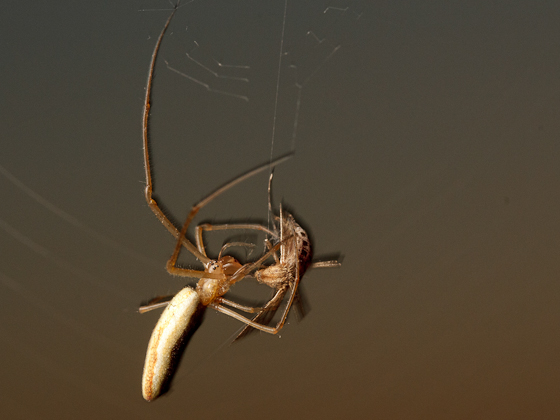
The other night, I was unwinding with an evening of wasp and bee photography at Iona beach, but the flight conditions were great for mosquitoes. They kept interrupting my shots of this lovely Tetragnatha laboriosa, so I decided to share the wealth.
Trapping the mosquito against my skin, I released it in the sweet spot of the web.
You can see the movement of the wrapping action, as I was also dragging the shutter to get some light in the darkening sky.
I was looking forward to a great splash of blood as the spider bit in!
This is about as good as it got however, but I am sure the spider will appreciate the extra protein already in liquid form.
This one is pretty cool too…
The mozzies kept biting, so I kept tossing them into the web.
I kept the spider busy wrapping up her gifts for quite a while.
When we both had had enough, I headed home, feeling itchy, but satisfied that I had at least achieved the fattening up of a cool tetragnathid.
http://esc-sec.ca/wp/wp-content/uploads/2017/01/ESC_logo-300x352.png00Sean McCannhttp://esc-sec.ca/wp/wp-content/uploads/2017/01/ESC_logo-300x352.pngSean McCann2014-07-31 03:45:192019-11-14 21:42:48How to get a spider to drink blood
The Editorial Board of The Canadian Entomologist (TCE) welcomes the comments that we receive from readers and authors. We take these comments seriously and implement appropriate changes when possible. We are pleased to announce three such changes that will further improve the speed, quality and flexibility of the service provided by TCE.
Simplified submission requirement. Authors previously were required to submit papers with abstracts in both French and in English. Although they can still do so, authors now need only submit an abstract in the language of the submitted paper; i.e., French or English. This change eliminates delays associated with having abstracts translated, which will accelerate manuscript publication.
New open access option. Although TCE has no page charges, there has always been a subscription fee. As of 2014, authors now have the option of paying a one-time open access (OA) fee. Payment of the OA fee makes articles freely available as soon as they are published online to anyone with internet access.
More content. Elimination of page charges has increased submissions to the journal, with a consequence increase in the number of papers being accepted for publication. In response, TCE is expanding its content by 10%. This equates to an annual increase of 72 pages, or approximately 1-2 additional papers per issue.
In addition to the above changes, there are several other items that may be of interest. ‘Instructions to Authors’ were revised in March of this year. Revisions include instructions for the submission of ‘Supplementary Material’ and a link to third-party services that specialize in language editing.
You also may wish to read “Open access, predatory publishers, The Canadian Entomologist, and you”. This article appears in the Bulletin of the ESC (Sept. 2013, p. 131), and examines issues that should be interest to anyone publishing in scientific journals.
In closing, we note that Dr. Chris Buddle (McGill University, Montreal, QC) will be completing his tenure as Editor-in-Chief this fall. Dr. Kevin Floate (Agriculture and Agri-Food Canada, Lethbridge, AB) is the incoming Editor-in-Chief.
We thank you, the authors and readers, for making TCE an ongoing success.
http://esc-sec.ca/wp/wp-content/uploads/2017/01/ESC_logo-300x352.png00Bloghttp://esc-sec.ca/wp/wp-content/uploads/2017/01/ESC_logo-300x352.pngBlog2014-06-23 13:12:022019-11-14 21:42:49Update from The Canadian Entomologist Editorial Board
Last night I went for a ramble at Iona Beach in Richmond BC, looking for insects and inspiration in the sand dunes. I knew the sunset would be pretty, as there was a bit of light wispy cloud in the west, so I hurried out to the end of the beach where restoration efforts hadn’t ripped up the ground.
I found my subjects attaching themselves to twigs and vegetation, bedding down for the night.
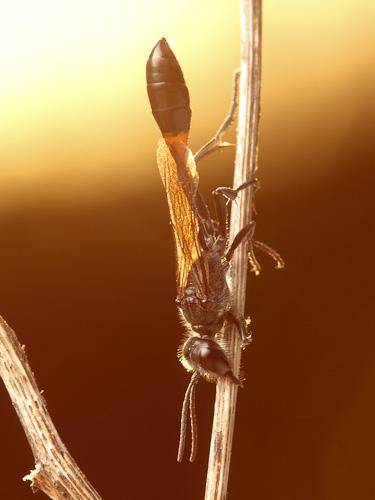
Coelioxys spp. (Megachilidae) preparing to attach to a dead, dried flowerhead. Next time you go for a sunset beach stroll, have a look for these and other sleeping insects!
If you are a photographer, the combination of the setting sun and your flash can do wonderful things to highlight your subjects.
An Ammophila wasp (Sphecidae), shot without flash, is but a silhouette against the darkening sky.
I am not sure, but I think I may have gone overboard with this session! It seems like it could be an ad for a tropical beach vacation for insects.
This slender and elegant caterpillar hunter is fast and nervous in the day, but wonderfully calm in the evening.
As the light was failing, so were my flash batteries, but this unplanned blur of a cluster of male Colletes males is still cool!
There are so many bees on this flower that it sags to the ground!
The Colletes cluster against the darkening sky of night.
Next time you go for an evening stroll on a sandy beach, head up to the dune vegetation, and have a look for these wonderful sleeping wasps and bees!
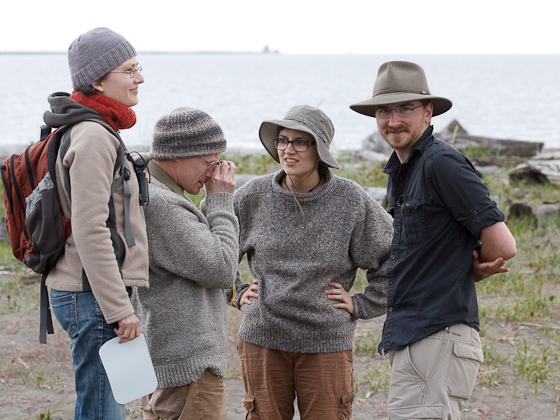
Samantha Vibert, Gwylim Blackburn, Catherine Scott and Sam Evans in the midst of examining an unidentified jumping spider.
Yesterday, I had the pleasure of ferrying four Vancouver-area spider researchers out to Iona Beach in Richmond for a bit of a Friday-evening ramble in search of spiders. Gwylim Blackburn and Samantha Vibert are old hands at spider observations at this site, Gwilym had studied Habronattus americanus and Samantha had studied Hobo Spiders. Catherine Scott (who studies black widows) and Sam Evans (a recent recruit to Wayne Maddison’s lab) came along as well. This was a Toyota Tercel loaded down with spider talent!
Daisy did not ask for this in her old age, but performed admirably nonetheless.
We arrived shortly after 7 pm, and despite the late hour, we found a few jumping spiders, although Habronattus americanus was already in bed. I only managed to sneak in a couple photos of large Phidippus.
Sam searches among moss and Scotch Broom.
A long-jawed orbweaver male (Tetragnathidae) tucked in with a pupating beetle.
A freshly-moulted harvestperson with exuvium still attached!
A large ichneumonid among pine needles.
A 10-lined june beetle larva under a log.
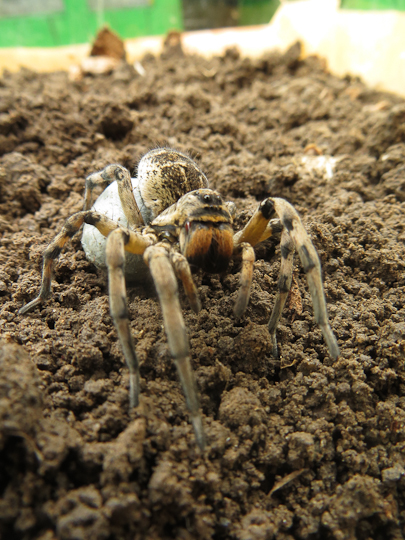
A wolf spider in her burrow with a freshly-laid eggsac.
Gwylim searches the beach.
Just before the gates were due to close at the park, we spotted a couple of snails, seemingly uncaring of our log-flipping sharing a tender moment. We hope they had a fun night!
Sweeping vegetation for terrestrial arthropods as part of the Northern Biodiversity Program survey during 2010. The location is the Skeleton Creek Valley, located just above Lake Hazen on northern Ellesmere Island, and you can see Lake Hazen in the background. Vegetation is particularly lush in these creek valleys, especially compared to surrounding tundra. Students are (from left) Christine Roussel (UPEI), and Sarah Loboda and Meagan Blair (both from McGill). [photo by Donna Giberson]
Unknown dipteran parasitized by mites, taken in the Fortuna cloud forest, Panama, March 20, 2012. [photo by Bernie Roitberg]
This Libellula lydia (Odonata: Libellulidae) was spotted on Mont-St-Hilaire, QC, having just caught a meal. [photo by Christine Barrie]
Acrosternum hilare (Hemiptera: Pentatomidae) holding onto blade of grass in Stoneycroft, Ste-Anne-de-Bellevue, QC. [photo by Christine Barrie]
Larva of Papilio machaon dodi (Lepidoptera: Papilionidae), on Artemesia dracunculus, near Drumheller, AB. [photo by Julian Dupuis]
Two honey bees with full pollen baskets, standing on a pollen trap of goldenrod pollen. Pollen was collected for a honey bee nutrition and pesticide research project. At Five Islands, Nova Scotia, August 18th, 2011. [photo by Megan Colwell]
Leptoglossus occidentalis (the bug, Coreidae) and a male Agapostemon (the bee, Halictidae) hanging out on Aster sp. in the fall (early October) on the UBC Okanagan (Kelowna) campus. Leptoglossus feed on the seed cones of ponderosa pine and Douglas fir. [photo by Bob Lalonde]
A male forked fungus beetle, Bolitotherus cornutus (Tenebrionidae) displays his ornately haired horns as he lumbers over a piece of bark at Bon Echo Provincial Park, Ontario. [photo by Crystal Ernst]
The following is a guest post by Simon Fraser University student Bekka Brodie. Bekka studies blow fly ecology and blogs at www.bekkabrodie.com.
The Romanian tarantula, Lycosa singoriensis (Lexmann 1770), is actually not a tarantula at all! It’s a wolf spider! In Romania, and in most parts of Europe, the members of the family Lycosidae are commonly called tarantulas. This species is the largest spider in Romania.
For the last couple weeks my family and I have been visiting relatives in Romania. While we’ve been here, my son (Tavi) and I have made it our mission to capture the Romanian Tarantula. It all started when we were visiting the Celic-Dere Monastery (black water in Turkish) in northern Dobrogea (or Dobrudja), Romania and found numerous large holes in the ground surrounded by a « spidery » silk. The holes were about the size of a Toonie (about 1 inch in diameter) and approximately 30 cm deep (measured with a stick). So, we just had to investigate.
After talking with the locals, it was explained to us that the best way to capture one of these spiders was to « fish » for it. More specifically, we needed to use a skinny candlestick with the wax removed down to the last centimeter. (So, basically 1 cm of wax and the end of a string.) We immediately set out for our « fishing » trip…
Unfortunately, we had no success. After further questioning the local people, it was suggested we smoke it out… and still no success. (One of those « it seemed like a good idea at the time » plans.) Finally, plan C, to simply dig it out.
And… success at last!
The Romanian “tarantula » is found in central and eastern Europe. In Romania the species appear to be quite common but are classified as critically endangered in the Czech Republic and on the current IUCN Red List other parts of Europe (Frank 2000). The spider spends most of its time in the gallery it digs in the ground. The adult spiders are nocturnal and hunt mainly for insects but have been known to eat small lizards (locals, personal communication).
The species size and lifespan various according to their sex, males are smaller (approximately 19-25 mm) living one year and the females larger (approximately 25-30 mm) but live for two years (Iosob 2009). The spiders have an oval shaped cephalothorax and abdomen that are a brown and black on the dorsal side. Their ventral side is black.
In late summer and early fall males court the females by performing a nuptial dance just outside the gallery entrance. When the male approaches the female he begins to swagger, his leg hair lifts and descends alternately while vibrating (Prisecaru et al. 2010). The nuptial dance varies in time but copulation takes place for up to 1-2 hours (Prisecaru et al. 2010). Shortly after mating the male dies, leaving only juveniles and females to overwinter.
As is common in the spring, we caught an adult female with an egg sac, and as Tavi pointed out, « she is a very good Mama! » When we first dug her out of the ground she was separated from her egg sac, but when we put them together in a jar, she attached herself to them immediately. It has been reported that if the female loses her egg sac she will look for it with perseverance and even accept another spiders egg sac or a sham (Iosob 2009). Once the eggs hatch, females protect their spiderlings by carrying them on her abdomen and cephalothorax (about 4 days) until they deplete their vitelline reserves and complete their first moult (Prisecaru et al. 2010).
The name tarantula is derived from a common wolf spider (genus Lycosa) from Apulia, Italy. The folklore during the 11th century suggests that a person bit by the “tarantula” will undergo a hysterical behavior, called tarantism; that appears like violent convulsions. The only prescribed cure for tarantism was frenzied dancing; now known as the traditional Tarantella.
Romania has without a doubt, some of the last untouched and preserved ecosystems among the European Union countries. (In fact, taxonomists can hardly keep up with identifying new species [Cogãlniceanu 2007].)While in most parts of Europe many plant and animal species are threatened or endangered, they can be found thriving in Romania (species like bears, wolves, tortoises, cormorants)… at least for now. It is crucial that we learn more about these species while they are still common (including the Romanian tarantula), and help them remain common in the face of growing threats such as economic development, overexplotation, or poaching. (You can read about current research and conservation work here and here.)
Tavi and I enjoyed exploring Romania, especially capturing and learning about the Romanian tarantula! We suggest you go and, as Tavi likes to say, “find the Mania in Romania!”
Citations:
Cogãlniceanu, D., Ruşti D., and Manoleli, D. (2007) Romanian taxonomy in crisis-present status and future development. Travaux du Muséum National d’Histoire Naturelle. L:517-526
Frank, V. (2010) Spiders (Araneae) on the red lists of European countries. EkolÓgia (Bratislava) 19: 23-28
Alin, Iosob G. Lycosa singoriensis sau Tarantula romaneasca.” Cunoaste natura si animalele din Romania!Blogspot, October 2010. Web. Accessed 01 May 2014. http://zoologysp.blogspot.ro/2009/05/lycosa-singoriensis-sau-tarantula.html
Prisecaru, M., A. Iosob, O. T. Cristea. 2010. Observations regarding the growth in captivity of the wolf-spider species Lycosa singoriensis (Laxmann, 1770). Studii şi Cercetări: Biologie, Universitatea ”Vasile Alecsandri” din Bacău, 19: 33-38.
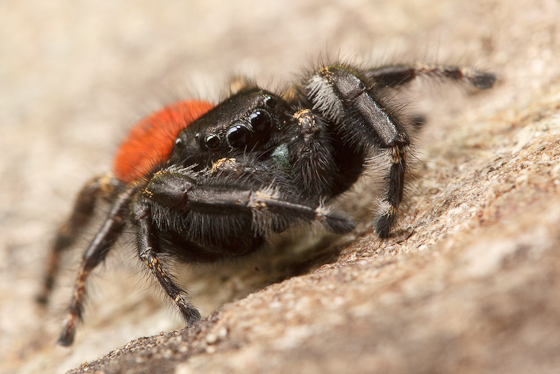
I know this isn’t entomological in the strict sense, but isn’t it just grand when you come upon an arthropod as splendid as this freshly-moulted Phidippus johnsoni? What a beautiful spider! I found this last evening in Mt. Tolmie Park in Victoria, BC, and you can be sure where beauties like this are turning up, a plethora of insects also awaits. I can’t wait to go and explore!
http://esc-sec.ca/wp/wp-content/uploads/2017/01/ESC_logo-300x352.png00Sean McCannhttp://esc-sec.ca/wp/wp-content/uploads/2017/01/ESC_logo-300x352.pngSean McCann2014-04-24 03:00:212019-11-14 21:42:52Happiness is a freshly-moulted Phidippus
The following is a guest post by Memorial University student Andrew Chaulk. Andrew is looking into mosquito ecology an biodiversity . He recently attended a short course offered by the University of Florida’s FMEL in Vero Beach.
Just off a main road running through a small town in Florida, a small group of enthusiastic folks, both local and foreign, sit focused. Eyes trained on minute hairs, scales, and a plethora of other physical traits, we worked diligently; all of us training to identify the 174 species of mosquitoes which call North America home. What brought us all together? The advanced mosquito identification and certification course offered by the Florida Medical Entomology Lab in Vero Beach, Florida.
Toxorhynchites, one of the « good guys ». These mosquitoes won’t bite you, and their larvae are predators on other container-inhabiting mosquito larvae. Photo by Andrew Chaulk.
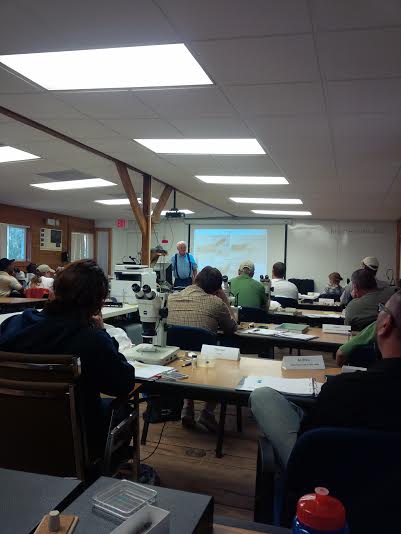
First offered in 2000 as a training course for mosquito control personnel in Florida, the course has since opened its doors, inviting students from across the United States and internationally. This year’s class comprised of 21 students, four of which were Canadian (including myself, Kate Bassett – a fellow Master’s student, and our supervisor, Dr. Tom Chapman), and one student had travelled all the way from Nigeria to receive this internationally recognized accreditation. Led primarily by Dr. Roxanne Connelly, a Louisiana born entomologist who specializes in mosquito biology and mosquito borne diseases, the course is the only one of its kind and covers the principles and skills needed to identify all known mosquito species in North America north of Mexico in a fast-paced and in-depth manner. The taxonomically based course is divided into two sections, with the first week covering adult mosquito keys, and the second, taught by retired entomologist George O’Meara, covers the larval keys.
George O’ Meara leading the class. Photo by Tom Chapman.
Having come all the way from St. John’s Newfoundland, we arrived in Vero Beach to a wonderful break from our typical early spring weather. The course, which ran from March 3rd to 14th, began with some brief introductions and a tour of the FMEL property before getting down to business. Each section of the course comprised of four days of instruction and practice with the keys followed by one morning of exams – one written and practical exam per section. The in class material was often broken up by opportunities to use a wide variety of mosquito collection methods. Demonstrations were also provided concerning methods of specimen preparation and during one such demonstration I was even given the opportunity to show the class how minuten pins are used since this method is not commonly used at the FMEL. Overall, while the learning curve for the course was rather steep and the instruction fast paced, there was an interesting combination of anxiety and comfort brought about by the very friendly and supportive atmosphere which I think created an excellent learning experience.
Greg Ross demonstrates some of the trapping and surveillance equipment, including lard can traps and CDC light traps. Photo by Andrew Chaulk.
Reflecting on my experience after returning to the snowy St. John’s, one unexpected yet valuable aspect of the course I took home with me was learning about the variety of backgrounds my peers had come from and how these all culminated in our taking the course together. From graduate students to naval officers, and mosquito control employees to research and medical scientists, our class was quite an interesting mix. While the foundation for my own interest in mosquitoes stems from my work for a graduate degree in biology at Memorial University of Newfoundland, I now have a much broader perspective on the amount of effort and resources that are invested in mosquito research and control.
Students work with FMEL’s teaching collection, which is extensive. Photo by Tom Chapman.
Taking everything into account, I see this course as being one of the most valuable experiences of my graduate experience to date. Still in the first year of a Master’s degree I am working on a project centered on the mosquitoes of our province. I am concerned with questions surrounding the biodiversity of these insects in our province, their ecology and behaviour, as well as identifying possible introduction pathways of novel species. Being able to see firsthand what the results of research in this area can develop into has provided perspective for my own project and also has given me ideas of where my research can take me in the future. My expectations for this course were well exceeded and I would recommend this course to anyone who is working with these insects in any aspect.
If you would like some more information concerning course content and registration for next year’s class please visit here.
Portrait of a house-killer: The eastern subterranean termite, Reticulitermes flavipes is commonly found in homes. Photo courtesy of USGS Bee Inventory and Monitoring Program/ by Sam Droege.
The following post is by Ben Friedson, an student of Biology at George Washington University
Termites are often thought to infest only tropical or temperate areas. In fact, they thrive in most parts of southern Canada, especially along the coasts. They are commonly found in large cities like Toronto or Ottawa. The most common type of termite to infest Canadian homes is the subterranean termite (in the East, Reticulitermes flavipes, in the West, Reticulitermes hesperus).
A mobile problem: Subterranean termites about to swarm. Photo by Ben Friedson.
Subterranean termites spend most of their lives underground, in colonies with up to 2 million members (depending on the species). In the spring, subterranean termites swarm when groups of reproductive termites go off to start new colonies. They feed on the wood of a home or building, targeting wooden floors, furnishings, window frames, doors, wall paneling and much more. As termites rarely show themselves in the open, infestations can be difficult to detect until damage becomes severe.
When inspecting your home for termite damage, look to identify at least one of the following:
Mud Tubes
If subterranean termites spend too much time above the ground, their bodies begin to dry out and they die. To avoid this, termite workers make mud tubes along the surfaces of walls, fences, tree trunks or steps so they can work and eat in the comfort of moist ground.
Termite mud tubes look as if someone has painted long thin lines on your home with dirt. Dry tubes are old tubes. Old tubes may indicate that the termites are still residing in your home. If you scrape open a moist mud tube, you may see the termites at work.
The most common places to find subterranean termites in a home are basements, garages or any other room on the ground floor.
Hollow Sounding Wood
All termites make tunnels through many types of substances like wood, mulch and drywall. Eventually, the internal structure of the material becomes so riddled with tunnels that it collapses. This is why it is so important to spot termites early, before severe damage occurs.
Unfortunately, you need X-ray vision in order to see the tunnels. However, you can determine the presence of tunnels by knocking on walls, steps or anywhere you suspect termites might be. If you tap a surface and it sounds hollow, this may be an indication of termite tunnels.
Another sign of termite damage is when you see strange spots or stripes on the surface of wooden items throughout the home such as steps, walls, window frames, doorways and furniture. Inspect your home in search of wood surface that appear discolored, warped or bubbling.
If you notice hollow spots on wood surfaces, the termites have eaten just about everything under a thin surface layer. Flakes of paint, wallpaper or plaster on the floor is a big indicator that hollow spots exist. Beware; termites can actually fall out of these spots, at times.
As home owners, you can prevent termite infestations by stopping any sources of moisture that would attract termites. In addition, you must ensure that landscapes are kept clean and neatly trimmed. Be sure that no trees are coming in contact with building walls. Firewood must be stored away from a building and kept dry.
Termite damage is a frustrating problem as it harms valuable property that must be repaired if it is neglected for too long. Contact an experience pest control company, immediately, if you suspect a termite infestation in your home.
Author Bio: Ben Friedson is a junior at George Washington University in Washington, DC, pursuing a BSc in Biology with a concentration in Entomology. He recently spent a semester studying at the University of Alberta, where courses in ecology heightened his interest in pest management and conservation issues.
Subterranean termites ready to swarm. Photo courtesy of Tom Murray.
This wasp has a problem! Three relatively enormous parasitic strepsipterans are occupying her abdomen…Photo by Sean McCann.
Who wouldn’t want to get to know the Strepsiptera? These animals are extremely odd, being obligate endoparasites of other insects, with a free-flying male and an eyeless, wingless female that never leaves the abdomen of her host. Different families of these parasites infect different hosts, ranging from silverfish and cockroaches to solitary and social wasps, leafhoppers, and froghoppers.
Allow me to introduce Xenos peckii, a strepsipteran parasite of Polistes fuscatus, the Northern Paper Wasp. As an entomologist, I have long been interested in these little-studied insects, so I was thrilled to get to help my colleague Mike Hrabar in his investigation their life history and reproduction.
Mike collected a several colonies of infected wasps from Maine and brought them back to the lab to observe their emergence, flight and mating behaviour in a systematic way. We used high speed videography and careful record keeping to document their life history in closer detail than had ever previously been recorded.
Not really bling. This wasp sports a heavy infestation of four developing Xenos, costing vast amounts of resources. Photo by Sean McCann.
From my perspective, one of the coolest things we learned is that the free-flying male opens his puparium by means of blade-like mandibles, which are used to cut along a zone of weakness in the pupal cap, functioning like a tiny can opener!
Head of male Xenos peckii. Note the scissor-like mandibles and the large and unusual compound eyes. Photo by Mike Hrabar. Figure 3G from Hrabar et al. 2014.
Check out the video below to see the male’s little mandibles working the cap open.
These little troopers fly immediately upon emergence, in stark contrast with most other insects, which need time to inflate and harden their wings. In fact, once the males begin beating their wings, they remain in flight continuously except for a brief period during mating.
Before our study, biologists had assumed that female Strepsiptera were completely immobile and passively waited for males to find them, but we observed that they move to adopt a distinct calling posture, elevating their cephalothorax up from the wasp’s abdomen, likely emitting a pheromone plume.
Female Xenos peckii in the abdomen of a Polistes fuscatus. This female is in the calling posture, elevating her cephalothorax. Photo by Mike Hrabar. Figure 4D from Hrabar et al. 2014.
The males smell this pheromone plume and fly toward it rapidly, in a zig-zag fashion reminiscent of pheromone-questing moths. As soon as a male reaches the female-infected host, he lands on her abdomen and walks down to where the female protrudes, using backwards steps with his heavily-modified tarsi.
Mid leg of Xenos peckii male. The tarsi are highly modified for gaining a strong grip on a wasp abdomen while searching for and mating with a female. Figure 8 from Hrabar et al. 2014.
Mating occurs rapidly, with typical copulation time being 3-5 seconds. As soon as mating is finished, the male is once again in flight, presumably in search of another female. After copulation, the female immediately withdraws from the calling posture and ceases calling other males. The following video was taken at 1000 frames/second with a high-speed video camera and shows the sequence from just after landing by the male through the majority of copulation.
This male Polistes fuscatus was weakening, and died while we were watching. Mike pinned the host, and we forgot about it for a while, until glancing at it we realized that one of the males was emerging! This shot was snatched quickly while the male had just popped off his cephalotheca. Photo by Sean McCann, Figure 2E from Hrabar et al. 2014.
We have shown that female Xenos are not just a passive receptacle or bag of eggs, but rather play a physically active role in soliciting mates. The male emergence is facilitated by using sharp mandibles to cut around an ecdysial suture line, and navigating the surface of his prospective mates host is aided by his extremely modified tarsi.
The short-lived males face a great challenge to locate and fly to a host with a calling female in the short amount of time they live (on average 2-2.5 hours). They are in constant flight from emergence until death with only a very short pause for mating. The female, by contrast, remains alive in her host, maturing a brood of eggs which she retains in her body until they hatch and crawl from her brood canal as motile planidial larvae.
These larvae will exit the brood canal at some point, but it is unclear exactly where they manage to find new hosts. It is possible they « deplane » at flowers and wait for a ride on a Polistes to a new nest of victims. Much more research will need to happen to fully understand these fascinating insects, but we have made a start at uncovering some of the mysteries of their emergence, communication and reproduction. Many more questions remain unanswered and provide opportunities for any natural historian to explore.
If you would like to read the whole paper, you can find it on the Canadian Entomologist site here, or if you are not a subscriber, I am hosting a corrected proof here.
The full citation for this paper is:
HRABAR, M., DANCI, A., MCCANN, S., SCHAEFER, P. W., and GRIES, G. 2014. New findings on life history traits of Xenos peckii (Strepsiptera: Xenidae). The Canadian Entomologist doi: http://dx.doi.org/10.4039/tce.2013.85 pp.1–14.
http://esc-sec.ca/wp/wp-content/uploads/2017/01/ESC_logo-300x352.png00Sean McCannhttp://esc-sec.ca/wp/wp-content/uploads/2017/01/ESC_logo-300x352.pngSean McCann2014-03-11 06:00:152019-11-14 21:42:54The brief lives and loves of male strepsipterans
It was written by Philip Careless, Steve Marshall and Bruce Gill.
This link will be active and freely available for the next month, so do not worry about a paywall.
This research focuses on using natural history information to assess creative ways to monitor one of eastern North America’s most important invasive, exotic tree-feeding pests, the emerald ash borer (EAB). The Crabronidae species Cerceris fumipennis is a wasp that is known to provision its nests with metallic wood-boring beetles in the family Buprestidae. Therefore, there is potentially to find out where EAB is located based on whether nests of the wasps contain that particular beetle. It’s a clever approach, and although the basic biology of the system was already known, Philip and colleagues worked to quantify and fully assess this potential biosurveillance tool for the EAB. We need to know where this pest is, and an indicator such as C. fumipennis holds much potential.
I caught up with Philip and he kindly answered a few questions about this work:
What inspired this work?
Almost all graduate work begins as a spark in the advisor’s mind. Certainly this project came from the creative thinking of Dr. Stephen Marshall so he deserves credit for that. I was simply fortunate enough to be the one chosen to run with the idea. Though, more importantly, he and the rest of the advisory committee gave me enormous freedom to transform the question into a journey through the strange world of solitary wasps. As for fueling the fire, I would say it was the writing of entomologists like Howard Evans, a healthy dose of nature documentaries, and correspondence with enthusiastic forest managers like Troy Kimoto who are struggling to address pressing conservation challenges.
What do you hope will be the lasting impact of this paper?
I hope that it will help people think of other novel ways to utilize the often overlooked services that insects all around them provide and in turn care for and conserve biodiversity. In our case an insect that the public instinctively hates, fears, and kills has been transformed into an amazing, useful, and valued colleague.
Where will your next line of research on this topic take you?
We have over 370 nest-provisioning solitary wasps in Canada. Each species is eloquently designed to collect their specific preferred taxa – eg. Stictiella takes adult Lepidoptera, Isodontia takes Orthoptera, Crossocerustakes Psocoptera, etc. The next steps will be to look at our native wasps, identify what they provision with and then determine if they are well-suited to life as a biosurveillance tool – assisting with life science inventories or monitoring pests. As the prey choice of most solitary wasps is unknown, professionals and amateurs alike can assist by photographing provisioning wasps and uploading the images to bugguide.net or the like.
Do you have any interesting anecdotes about this research?
Sitting in the middle of a ball diamond under a beach umbrella with a butterfly net (watching wasps provision their nests) tends to draw a lot of curious looks and questions from passers by. On one such occasion in Windsor, Ontario – while showing a dog walker my prized wasp bringing back a beetle – I observed a novel form of predation. As the prey-laden female wasp diligently droned past us to the nest, the dog – previous quite bored – snapped it out of the air and ate it, prey and all! We humans were both surprised but the dog seemed quite pleased.
Brenna Wells hard at work, waiting to steal beetles from wasps.
For more information on this initiative, or even to get involved yourself, please visit the project website.
http://esc-sec.ca/wp/wp-content/uploads/2017/01/ESC_logo-300x352.png00Bloghttp://esc-sec.ca/wp/wp-content/uploads/2017/01/ESC_logo-300x352.pngBlog2014-02-24 10:37:172019-11-14 21:42:54Basing biosurveillance on good natural history: a case study of Crabronidae wasps and the emerald ash borer. TCE Editor’s Pick for 146(1)