


Nouvelles
By Brent Sinclair, University of Western Ontario
_______________________________
I’m currently on sabbatical in the Department of Zoology, University of Otago in Dunedin New Zealand. This is the department where I did my PhD, so it is an opportunity to come back to familiar territory and re-connect with all sorts of people and places from the past. It’s not a very insect department, but there is a lot of interesting work on ecology, parasites and freshwater biology. A sabbatical is all about recharging scientific and creative batteries, so my main goal here is to write and read and think (and drink coffee and run and hike – but that’s for a different blog), but I felt that I also needed to justify coming all this way by actually gathering some data while I’m here. Respirometry is the perfect answer – once set up, it’s possible to gather data on metabolic rates, breathing patterns and water loss at the expense of only a few minutes at each end of a run, leaving plenty of space for writing and drinking New Zealand’s excellent coffee in between.
What is respirometry?
Respirometry is the science (art?) of measuring the products and substrates of respiration – depending on your strategy, you can measure oxygen consumption and/or carbon dioxide production (to get a handle on metabolic rate) and water loss – among other things. Because I work on generally small insects at generally low temperatures, we mainly measure carbon dioxide production and water loss (the instruments are much more sensitive), and can do some clever calculations to turn this into estimates of metabolic rate.
The equipment itself can look quite intimidating – and certainly like Science – with plenty of tubes and wires (when I calibrate the water channel, there’s even a bubbling flask!), but it’s not that difficult once you figure out what everything is doing, and it looks scary enough that other people generally don’t mess with it. We pass CO2-free, dry air over an insect, and measure the CO2 and water vapour in the excurrent air – all the CO2 and water vapour must have come from the insect, so we can calculate how much it is breathing out. The equipment we use is from a company in Las Vegas called Sable Systems International. Sable Systems’ head honcho, John Lighton, is an insect physiologist who has published in places like Nature and PNAS, which means that when he designs the equipment, he often has insects in mind.

The respirometry system set up in a controlled-temperature room at the University of Otago. CO2-free dry air is supplied by the gas cylinder, and passes through a chamber containing the insect housed in a temperature-controlled chamber (the big grey cooler box), before going on to an infra-red gas analyser (the green box), which uses IR absorbance to measure CO2 and H2O.
What else can we learn from respirometry?
As well as a simple measure of metabolism, it is possible to use respirometry to determine the thermal sensitivity of metabolism (this is important in understanding the effects of climate change), as well as the metabolic costs of various environmental stresses, like freezing or chilling. We can also use respirometry to study how insects breathe (there is much debate surrounding the adaptive significance of the Discontinuous Gas Exchange Cycles observed in some insects), and we can also use respirometry to figure out how much water is being lost across the cuticle of insects – even small ones like individual flies!
What am I …er… respirometing?
After 65 million years of evolution without mammals, New Zealand has an amazing array of endemism and some pretty weird insects. My favourites are the alpine insects, which include impressive radiations of cockroaches, stick insects and weta – large Orthoptera related to the Jerusalem crickets of North America. The mountains are fairly young (<3 million years old), so it’s possible to do all sorts of work comparing alpine species with their lowland relatives .

A group of alpine weta, Hemideina maori found under a stone at 1400 m a.s.l. on the Rock and Pillar Range, Central Otago, New Zealand. The males defend harems of 2-7 females. Female weta can weigh over 5 g, and males over 7 g, making them the heaviest insect known to survive internal ice formation. Photo by B. Sinclair.
Of course, it is the most fun to work on the big, weird insects. So far I’ve been putting alpine weta (Hemideina maori, Orthoptera: Anostostomatidae) and New Zealand’s longest insect, the gloriously-named phasmid Argosarchus horridus through their paces. Male alpine weta can weigh up to 7 g, and are the largest insect species known to withstand internal ice formation. The stick insects can easily reach 4 g, and posed some unique challenges in respirometry – with a body form so long and stick-like, it makes perfect sense to use a converted spaghetti-storage container!

A large female Argosarchus horridus (this one weighs a shade over 3 g) ready to go in her respirometry chamber. Photo by B. Sinclair.
The main questions I will be addressing will be about the evolution of thermal sensitivity and water loss in alpine insects, but the great thing about respirometry is that I never know what I’ll find along the way!
_____________________________________________________________
Brent Sinclair is an Associate Professor at the University of Western Ontario. He is the 2012 recipient of the Entomological Society of Canada’s C. Gordon Hewitt Award.
As mentioned in a previous post, the Entomological Society of BC has been working hard to improve the Society’s impact by enhancing our online presence to reach more people in BC, as well as the rest of Canada and the world. We’ve undertaken a massive project to digitize our entire journal archive, and are in the process of moving all 108 volumes of the Journal of the ESBC online (plus occasional papers, supplementary reports, and the Quarterly Bulletins dating back to 1906!).
This project will provide unprecedented public access to the Society’s publications, and you can help! With scanning and OCR completed, we need to extract the metadata for each article, including the abstracts and references, so that we can import them into our new online journal system (link to http://journal.entsocbc.ca). We are recruiting volunteers to assist with this step, as well as creating cover images from the scanned volumes.
- Flexible and easy;
- Can be done from anywhere (you don’t have to live in BC!);
- Opportunity to explore the history of entomology in BC;
- Work closely with ESBC journal and web editors;
- Contribute directly to the establishment of a permanent, online, open-access repository of entomological knowledge in BC;
- Ideal for students or anyone with an interest in entomology and community service.
Contact Alex Chubaty (webmaster@entsocbc.ca) if you are interested in contributing time towards this project.
As the new web editor of the Entomological Society of British Columbia (ESBC), last fall I began a push toward the digitization of all past issues of the Journal of the ESBC and the implementation of an online journal management system. At the time, only a relatively few issues of JESBC were available online, with only the most recent issues available as PDFs. None of these were easily searchable, nor were these issues indexed on our site, Google Scholar, or other search engines.
Over the years, each editor handled submissions in a slightly different way, via email (or post!), and copies of digital files were not retained by the society, but rather by individual editors. Additionally, we used an annual submission deadline, which resulted in annual “publication push” that resulted in a single “crunch time” leading up to year’s end.
It was with these limitations in mind that I spearheaded an effort to simplify the submission, editorial, and publication processes, and to provide truly open access to our entire journal archive in an effort to increase our journal’s profile, readership, and citations.

Over the past several months (and still ongoing), in conjunction with the SFU library and the Public Knowledge Project, the ESBC began our transition to our new online journal management system and the scanning and uploading of all volumes of the JESBC. Our choice of journal management system was based on several important criteria: cost, features, ease-of-use, robustness, “future-proofing”, and support.
In the interest of brevity, I won’t go into all of the details here, but from our choices of journal management systems, the clear winner was Open Journal Systems, which provides a low-cost, feature-rich, customizable, easy to use, well established, and open-source journal publishing platform. Moving to this new system allows us to easily publish using a continuous submission model, so that articles appear online as they are accepted for publication, as well as provide a streamlined publication work-flow and centralized database.

Screenshot of the new JESBC web site
Our new journal site is now up and running! Check out http://journal.entsocbc.ca for complete open access to all articles, and stay tuned as more back issues of the society’s journal and quarterly bulletin archive are uploaded (going back to 1906!) and as we add DOI support and cross-referencing.
Our journal digitization effort is a huge project, and although we’ve made great headway, we could use your help (more on this soon)! We are looking for volunteers to assist with moving this content online to the new site. Contact Alex Chubaty (webmaster@entsocbc.ca) if you are interested in contributing time towards this project.
Thank you!
Alex M. Chubaty
ESBC Web Editor
ESBC on Facebook: https://www.facebook.com/groups/135038946598013/
ESBC on Twitter: @EntSocBC
Talk about a close vote! The votes from Photo 2 resulted in a tie for first and third places! That means Paul Manning and Colin each get 5 points, while Sam Droege and Greg each get a single point.
Here are the finalists for Photo 3:

Photo by Sean McCann
[polldaddy poll=6522258]
And here’s Photo 4, all quiet and lonely and in need of your caption! (Rules)
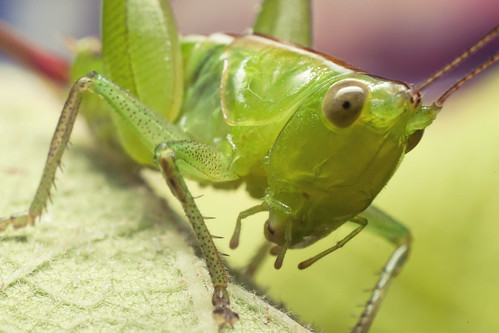
Photo by Lee Jaszlics
Many of us appreciate insects, spiders and other arthropods for more than just their scientific, biological or ecological value: they also have an aesthetic that some of us find irresistible, inspiring us to capture them in photographs or in paintings rather than sweep nets or aspirators.
For this special feature, we interviewed Elizabeth Goluch, a Halifax artist, and asked her about her breathtaking insect sculptures.

PRAYING MANTIS
Sterling silver, copper, 14K & 18K gold
18.5″l x 12″w x 9.5″h
ESCBlog: Please tell us a little bit about your background – where you grew up, when you started doing art, where you did your formal training.
EG: I grew up on a farm in southwestern Ontario. I have been making drawings and objects for as long as I can remember.
I took summer drawing classes at the University of Western Ontario, after which I acquired my BFA in 1976 at the Nova Scotia College of Art & Design. However, my major was in Painting. Much later, around 1997, I learned to solder by taking continuing education classes at NSCAD. I also became a member of the Metal Arts Guild of Nova Scotia which is a Guild in the traditional sense. If you wish to learn a certain skill, you have only to ask and another member will provide the help that you need. Over time, I enrolled in several summer sessions at Haystack Mountain School of Craft thereby acquiring additional metalsmithing skills. So I would have to say that I have had little formal training in working with metal and am, for the most part, self-taught.
ESCBlog: Why insects? Have you always been interested in insects as subjects for your art?
EG: Insects have always attracted me. As a child I collected and examined dead insects, seeing them as objects of beauty. An early memory is one of drawing page after page of spiders which gave me a great sense of satisfaction.

TARANTULA
Sterling silver, 14k & 18k gold, tourmaline
7.25″l x 8″w x 2.25″h
ESCBlog: Most of your sculptures have movable parts; many contain hidden trinkets that can be removed and even worn as jewellery. Tell us about this choice to include interactive components.
EG: When I first began to make metal insect sculptures, I concentrated on the insect form. Over time, I realized that I wanted to add another dimension to each sculpture which resulted in the secret compartments containing hidden treasure.

ESCBlog: Although your pieces are incredibly lifelike, they also include many whimsical elements (a children’s poem enacted in a lady beetle) and often embrace word-play (e.g., the violin beetle). Tell us about your choice to blend the realistic with the fantastical.
EG: As my work has grown I have come to realize that, as much as I enjoy accuracy in building the body parts of each insect, I am also interested in telling the story of the insect. This is accomplished by including information about the insect’s life, lore and environment in the decorative details and secret spaces, increasingly important elements of each work.
ESCBlog: Insects are so often portrayed as something dark and sinister – something to fear. Your work, however turns insects and spiders into precious things made of gold, silver, pearls and gemstones. Can you talk a bit about your choice of materials in your pieces?
EG: Conversely, I have always seen insects as living jewels. However, I enjoy the combination of fear and attraction engendered in the viewer by the juxtaposition of the subject matter (insects) and the richness of the materials used (gold, silver, gemstones) in the making of the object.
ESCBlog: You’ve tackled many different types of insects, and even arachnids, in your work. Is there anything you haven’t attempted to sculpt yet that you’d like to?
EG: There are so many insects in the world that I can’t imagine ever running out of options for the next piece.
(However, I must confess that after repeated requests, I recently completed a commission that was not an insect. I made a Snail which turned out to be one of the most complex pieces that I have made to date. It will appear on my website in the near future.)
ESCBlog: Do you have a favorite piece? If so, why is it your favorite?
EG: I can’t say that I have one favourite piece. What I will say is that I enjoy the increasing complexity of story and detail incorporated in each new piece.

LADYBUG
sterling silver, 18k gold, garnets, enamel, ceramit
4.75″l x 3.75″w x 2″h
ESCBlog: Can people purchase the work your have shown on your website? Do you ever do commissioned pieces?
EG: Much of the work on my website has been sold or was a commissioned piece. I have, on occasion, made a second or third version of one insect (Dragonfly, LadyBug). However, no two pieces are ever the same, each differing in size, details and story.
ESCBlog: Is there anything else we should know about you or your work?
EG: I have won numerous awards including Finalist for the Lieutenant Governor of Nova Scotia Masterworks Arts Award, the Frank Phillips Award for Excellence in Craftsmanship, Best in Show in many Metal Arts Guild of Nova Scotia Competitions/Exhibitions, grants from the Nova Scotia Department of Tourism, Culture and Heritage, and from the Canada Council for the Arts.
My work has been exhibited internationally, including the 2009 Cheongju International Craft Biennale in South Korea where Canada was invited as the guest country, the Cultural Olympiad in the Museum of Vancouver BC to coincide with the 2010 Olympics, Cesky Krumlov in the Wenceslas Cellars of the State Castle of the Czech Republic, SOFA New York and the Mary E. Black Gallery in Halifax NS. One of my works was included in the Metal Arts Guild of Canada Exhibition in Print 2011 curated by Gloria Hickey.
My sculptures can be found in public and private collections in Canada, the USA, Denmark, Australia, Turkey and Hong Kong.
I have given lectures in Halifax at the Joint Annual General Meeting of the Canadian Entomological Society & the Acadian Entomological Society and at NSCAD, in South Korea at the 2009 Cheongju International Biennale, in New York at SOFA, and in Cornwall ON as the keynote speaker at the Artpreneur Conference.
I sit on the Exhibition Review Committee of the Mary E. Black Gallery Halifax NS and on the Standards Committee of the Nova Scotia Designer Crafts Council.
ESCBlog: Where can we go to see some of your work?
EG: My work will be included in upcoming exhibitions at the Mary E. Black Gallery Halifax NS and at The Rooms Provincial Gallery in St. John’s NL, both of which will subsequently travel across Canada.
I am in the Studio Rally Map and will participate in the upcoming Studio Rally Weekend.
Dates: Saturday September 29th and Sunday September 30th
Hours: 10:00 am to 5:00 pm – by chance or appointment
more info: www.StudioRally.ca

BUMBLEBEE
Sterling silver, 14K & 18K gold
7″l x 7″w x 4″h
If you’d like to reach Elizabeth, here is her contact information:
Website: www.elizabethgoluch.com
email: e@elizabethgoluch.com
Representation: Mobilia Gallery,Cambridge/Boston MA.
Availability in Halifax: my Studio – 6913 Tupper Grove, Halifax, NS.
Visitors & commissions welcome.
__________________________________________
Do you know any other incredible Canadian artists who feature insects in their work? We’d love to hear about it?
CONTACTER LA SOCIÉTÉ
Assistant administratif : info@esc-sec.ca
SEC Président : ESCPresident@esc-sec.ca
This post is also available in: