


Nouvelles

Sabrina Rochefort – winner of the President’s Prize for best poster
At the recent ESC/ESS JAM in Saskatoon, not only were we treated to some great science and camaraderie, but the beloved institution of the President’s Prize sessions for student talks and posters provided some of the most stimulating and exciting times. This was my first year not being in the competition, and I would like to offer my views on the subject.
1) The President’s Prize encourages excellence: Students are definitely motivated to deliver polished and professional presentations in the hopes that their efforts will be recognized publicly. This reaches further than the conference, to encourage students to vet their talks and posters within their laboratories and departments in formal and informal settings in order to make the best presentation possible. This can only be a good thing.
2) The recognition is important: this prize, although modest financially, has amazing value as something to put on one’s CV. This enhances the career prospects of the winners and also the recognition that conference travel for students is worth funding within departments. Again, the value of this prize reaches much further than the conference, as students returning with the tangible benefits of a prize winning talk encourages others to make it a priority to attend and give an excellent talk next year.
The President’s Prize and the more recent innovation of the Graduate Student Showcase are thus valuable to the society as a whole. By encouraging and recognizing the efforts of students who attend our conferences to present well-polished research results, we promote excellence in scientific communication. We can all learn from the skill and innovation of these students!
With all of this in mind, I would like to make some recommendations:
1) For every conference, pre-publish the scoring rubric to be used by the judges. This will ensure that students entering a talk or poster know what points they have to hit to make their talk a candidate for the prize. These rubrics should not penalize creativity on the part of the students or discretion on the part of the judges, but should ensure that there is a baseline for what is expected.
2) At every conference, formally recognize runners-up in every session: It costs nothing but a bit of extra time during award presentation, but the chance to bestow recognition on a few more students should not go to waste. Many sessions have many excellent talks, and to send an excellent presenter home with nothing does no one any good. It has been a bit hit and miss in recent years at ESC meetings with regards to runners-up, and I think it should be the case that every conference includes this important recognition.
3) Send all competitors home with the judging sheets. This is a bit more onerous on the part of the judges, but the judges can definitely jot down some notes on their scoring sheet and show the tally for how well the talk lived up to the rubric. This is important to show that the criteria used to score the talks informed the decision. More importantly, it allows students to see how well their talk met the judges’ expectations, and to improve their presentations for the next year. This has been done at a couple of ESC meetings over the last few years and as far as I know, students found the feedback they got very valuable and were able to use it to improve their science communication skills.
Thanks to Mile Zhang for photos of the poster competitors, and to Catherine Scott for helpful suggestions. Congratulations to all this year’s winners, runners-up, and competitors!


 Just a reminder…Summer does not last long here in Canada, so if there are any insects you have missed so far this year, now is the time to get out and find them!


Spiders may not bite, but that doesn’t mean you can’t get them to drink your blood! All you need is a sunset at the beach, hordes of mosquitoes, a spider, and some frustration to take out.

The other night, I was unwinding with an evening of wasp and bee photography at Iona beach, but the flight conditions were great for mosquitoes. They kept interrupting my shots of this lovely Tetragnatha laboriosa, so I decided to share the wealth.

Trapping the mosquito against my skin, I released it in the sweet spot of the web.
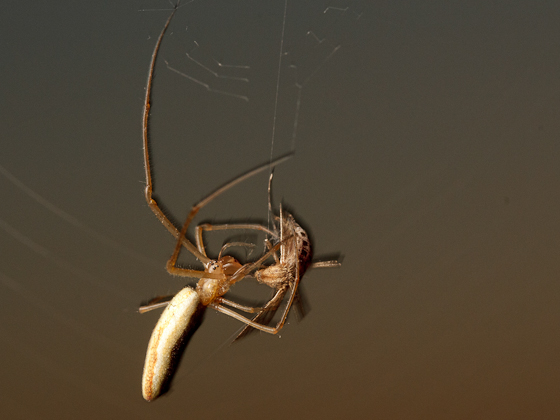
You can see the movement of the wrapping action, as I was also dragging the shutter to get some light in the darkening sky.

I was looking forward to a great splash of blood as the spider bit in!

This is about as good as it got however, but I am sure the spider will appreciate the extra protein already in liquid form.

This one is pretty cool too…

The mozzies kept biting, so I kept tossing them into the web.

I kept the spider busy wrapping up her gifts for quite a while.

When we both had had enough, I headed home, feeling itchy, but satisfied that I had at least achieved the fattening up of a cool tetragnathid.
The Editorial Board of The Canadian Entomologist (TCE) welcomes the comments that we receive from readers and authors. We take these comments seriously and implement appropriate changes when possible. We are pleased to announce three such changes that will further improve the speed, quality and flexibility of the service provided by TCE.
- Simplified submission requirement. Authors previously were required to submit papers with abstracts in both French and in English. Although they can still do so, authors now need only submit an abstract in the language of the submitted paper; i.e., French or English. This change eliminates delays associated with having abstracts translated, which will accelerate manuscript publication.
- New open access option. Although TCE has no page charges, there has always been a subscription fee. As of 2014, authors now have the option of paying a one-time open access (OA) fee. Payment of the OA fee makes articles freely available as soon as they are published online to anyone with internet access.
- More content. Elimination of page charges has increased submissions to the journal, with a consequence increase in the number of papers being accepted for publication. In response, TCE is expanding its content by 10%. This equates to an annual increase of 72 pages, or approximately 1-2 additional papers per issue.
In addition to the above changes, there are several other items that may be of interest. ‘Instructions to Authors’ were revised in March of this year. Revisions include instructions for the submission of ‘Supplementary Material’ and a link to third-party services that specialize in language editing.
You also may wish to read “Open access, predatory publishers, The Canadian Entomologist, and you”. This article appears in the Bulletin of the ESC (Sept. 2013, p. 131), and examines issues that should be interest to anyone publishing in scientific journals.
In closing, we note that Dr. Chris Buddle (McGill University, Montreal, QC) will be completing his tenure as Editor-in-Chief this fall. Dr. Kevin Floate (Agriculture and Agri-Food Canada, Lethbridge, AB) is the incoming Editor-in-Chief.
We thank you, the authors and readers, for making TCE an ongoing success.
Chris Buddle
Kevin Floate
CONTACTER LA SOCIÉTÉ
Assistant administratif : info@esc-sec.ca
SEC Président : ESCPresident@esc-sec.ca
This post is also available in: