By Susan Anthony, PhD Candidate, University of Western Ontario
Our initial aim for me and my supervisor Dr. Brent Sinclair was to travel to the Yukon to collect spiders. We had heard from Dr. Chris Buddle, who would meet us there, that spiders are plentiful. And indeed they were! But what we didn’t expect was to be charmed, and infinitely curious, about the tiny (max. 3mm) but feisty pseudoscorpion Wyochernes asiaticus.

Female W. asiaticus with a brood pouch full of eggs. Many of the pseudoscorpions we found were gravid (full of eggs). When we brought them home, the eggs hatched are we had baby pseudoscorpions. Photo credit: Brent Sinclair
Our research team left Whitehorse with supplies (food, stove, 4WD vehicle, and lots of collecting containers), and spent the next two weeks exploring the tundra heading north on the Dempster Highway. This highway is probably the only maintained road in northern Yukon, and it provided access for us to the Beringian region. As the glaciers swept much of North America during the last ice age, Beringia was the land that was never glaciated. For this reason, many of the species located there pre-date the last ice age, such as W. asiaticus. Now, this creature may not be as exciting as a mammoth or a giant beaver, but to arthropod researchers, it was very special.
It was Dr. Buddle that pointed us to these creatures. He had found them on previous trips, and wanted to collect more from different latitudes (we spanned about 10 degrees of latitude on our trip). He had us help collect the pseudoscorpions: they live on the underside of flat rocks along river banks. It was while collecting them that we wondered what they did for the rest of the year. They would not only have to withstand the grueling cold of an Arctic winter, and they were also in an area that would experience periodic flooding. We wanted to see what their tolerance is for cold and for submergence. We packed them up, and brought them back to our lab at the University of Western Ontario, along with about 600 spiders.
When back in the lab, I measured freezing point, their critical thermal minima and maxima (CTmin and CTmax; the limits of activity) of the pseudoscorpions. Their freezing point, and whether or not they survive freezing, gives us an idea of their ability to survive the frigid winters in the Arctic. We are interested in CTmin and CTmax because they are good ideas of their ecological limits, if they can’t move, they can’t feed or defend themselves. What we discovered is that these little critters have very poor cold tolerance. They don’t survive freezing, and roughly -4°C, they can’t move. The Arctic gets much, much colder than that. Our only guess is that they seek very effective thermal refuges in the winter, or somehow adjust their cold tolerance through the year, much like many insects.
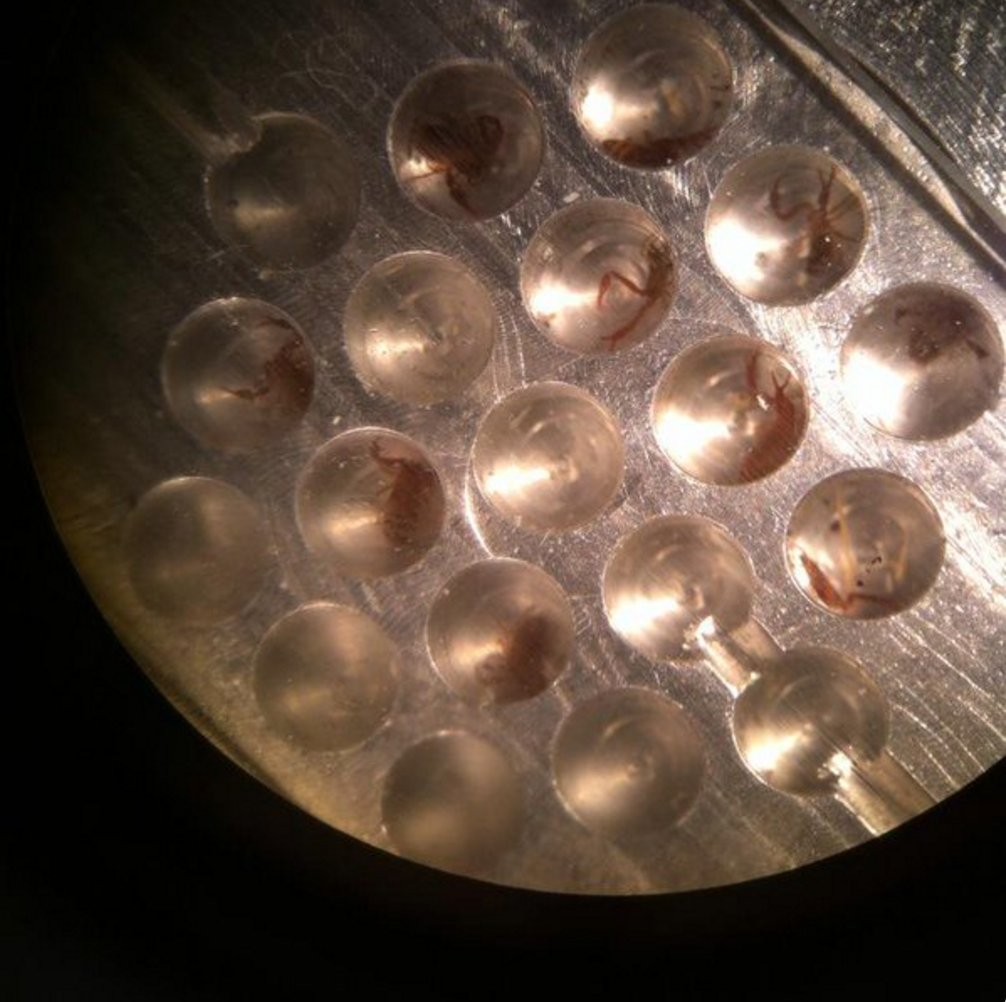
Back in the lab, I used a metal block with small holes drilled into it to house the pseudoscorpions. The block could be heated or cooled, and I could observe the point at which they could no longer move. Photo take through the lens of a microscope. Photo credit: Susan Anthony
Speaking of seasonal change, we found W. asiaticus along the stream. Undoubtedly, their homes will be flooded seasonally. Do they migrate further up from the stream? Do they swim? Or do they bring a bubble of air down with them, like the diving spiders? It seemed at first that they held a bubble of air between their abdomen and the rocks that they latch onto. They survived for a week in highly oxygenated water (same survival as the ones who weren’t underwater). However, it was also the same survival as those submerged in low oxygenated water. Half of them even survived 2 weeks in the low oxygenated water. We concluded that they can tolerate being underwater, but they likely don’t rely on oxygen coming from the water around their air pocket.

Sheep Creek, the stream where we collected Wyochernes asiaticus. The animals were most common approx. 1m above river level, on the underside of flat rocks. Photo credit: Chris Buddle
Our trip up North to collect spiders gave us a great surprise. A small pseudoscorpion on the banks of the streams caught our attention. However, there was so much to capture our fascination up North. From the giant grizzly bear and caribou, to the hundreds of spiders and the collembolans they much upon. The Arctic is indeed an unique place.
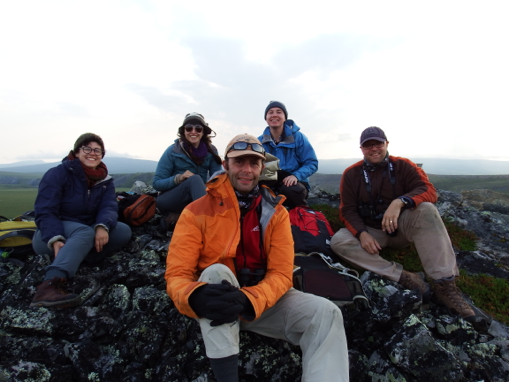
The Arctic biology crew: (l-r) Anne-Sophie Caron (McGill University), me Susan Anthony (Western University), Dr. Brent Sinclair (Western University), Shaun Thurney (McGill University), and Dr. Chris Buddle (McGill University). Photo credit: Mhairi McFarlane.

À la chasse au pseudoscorpion béringien dans l’Arctique
Notre but initial, pour mon superviseur Dr. Brent Sinclair et moi, était de voyager au Yukon pour collecter des araignées. Nous avions entendu du Dr. Chris Buddle, que nous allions rencontrer là-bas, que les araignées étaient nombreuses. Et il avait bien raison ! Cependant, nous ne pensions pas être charmé par le minuscule (maximum 3mm), mais fougueux pseudoscorpion Wyochernes asiaticus et qu’il pique autant notre curiosité.
Une femelle W. asiaticus avec une poche pleine d’oeufs. Beaucoup des pseudoscorpions furent trouvé pleins d’oeufs qui ont éclos à notre retour en Ontario. Crédit photo: Brent Sinclair
Notre équipe de recherche a quitté Whitehorse avec tout l’équipement nécessaire (nourriture, réchaud, véhicule à quatre roues motrices et beaucoup de contenants pour l’échantillonage) et nous avons passés les deux prochaines semaines à explorer la tundra, se dirigeant vers le Nord sur la « Dempster Highway ». Cette route est probablement la seule route entretenue au Nord du Yukon et nous permet d’atteindre la région béringienne. Alors que les glaciers recouvraient la plupart de l’Amérique du Nord durant la dernière ère glacière, la Béringie était un des seuls endroits n’ayant pas été ensevelie. Pour cette raison, beaucoup des espècesqui s’y trouvent , telles que W. asiaticus, pré-datent la dernière ère glacière. Bon, cette créature n’est peut-être pas aussi excitante qu’un mammouth ou un castor géant, mais, pour les chercheurs travaillant sur les arthropodes, elle est très spéciale.
C’est Dr. Buddle qui a attiré notre attention sur ces créatures. Il en avait trouvé durant des voyages antérieurs et voulait avoir des échantillons provenant de différentes latitudes (nous avons traversés environ 10 dégrées de latitude durant notre voyage). Il a demandé notre aide pour collecter les échantillons de pseudoscorpions. Ceux-ci vivent sous des roches plates sur les rives des rivières. C’est pendant l’échantillonnage que nous nous sommes demandés ce qu’ils faisaient le reste de l’année. Non seulement ils doivent supporter le froid éprouvant de l’hiver arctique, mais vivent aussi dans une région où il y a des crues périodiques. Nous voulions voir quelle était leur tolérance pour le froid et pour la submersion. Nous allons pris et les avons rapporter vers notre laboratoire à University of Western Ontario, avec aussi environ 600 araignées
De retour dans le laboratoire, j’ai mesuré le point de congélation, les points thermaux critiques minimum et maximum (CTmin et CTmax; les limites de l’activité) des pseudoscorpions. Leur point de congélation, déterminant s’ils survivent ou pas à la congélation, nous a donné une idée de leur habilité à surmonter les hivers glaciaux de l’Arctique. Nous sommes intéressés par le CTmin et CTmax car ils nous permettent d’avoir une bonne idée de leurs limites écologiques, c’est-à-dire s’ils peuvent se déplacer, se nourrir ou se défendre. Nous avons découvert que ces petites bêtes avaient une très mauvaise tolérance au froid. Ils ne survivent pas à la congélation et, aux alentours de -4°C ne peuvent plus bouger. L’Arctique peut atteindre des températures bien plus froides que ça ! Nous pouvons seulement supposer qu’ils recherchent des refuges thermaux très efficaces durant l’hiver ou qu’ils ajustent leur tolérance au froid durant l’année, comme beaucoup d’insectes.
De retour au laboratoire, j’ai utilisé un bloc de métal avec des petits trous pour abriter les pseudoscorpions. Le bloc pouvait être réchauffé ou refroidi et, ainsi, je pouvais observer le moment où les individus arrêtaient de bouger. La photo fut prise à travers un microscope. Crédit photo: Susan Anthony
Parlant de changements de saison, nous assumons que leur habitat est inondé de façon saisonnière vu que nous les avons trouvés sur le bord d’une rivière. Est-ce qu’ils se déplacent en amont de la rivière ? Est-ce qu’ils nagent ? Est-ce qu’ils apportent une bulle d’air avec eux, comme les araignées plongeuses ? Au départ, nous pensions qu’ils tenaient une bulle d’air entre leur abdomen et les roches auxquelles ils s’accrochent. Dans nos expériences, ils ont survécu une semaine submergés dans les eaux hautement oxygénées ayant un taux de survie similaire à ceux qui ne vivaient pas sous l’eau. Cependant, ils avaient aussi le même taux de survie que ceux qui étaient submergés dans des eaux peu oxygénées. Nous concluons donc qu’ils tolèrent le fait d’être sous l’eau, mais qu’ils ne se comptent pas sur l’oxygène provenant de l’eau environnante.
Sheep Creek, la rivière où nous avons collecté Wyochernes asiaticus. Les spécimens étaient plus commun à environ 1m au dessus du niveau de l’eau, sous les roches plates. Crédit photo: Chris Buddle
Notre excursion dans le Nord pour l’échantillonnage nous aura donc donné une belle surprise. Un petit pseudoscorpion sur les rives de la rivière a capté notre attention. Cependant, ce n’est pas la seule chose pouvant provoquer un lot de fascination lorsqu’au Yukon. De l’énorme grizzly au caribou aux centaines d’araignées et aux collemboles dont ils se nourissent, l’Arctique est en effet un endroit unique.
L’équipe de biologie arctique: (g-d) Anne-Sophie Caron (Université McGill), Susan Anthony (Western University), Dr. Brent Sinclair (Western University), Saun Thurney (Université McGill), and Dr. Chris Buddle (Université McGill). Crédit photo: Mhairi McFarlane.
Hunting for the great Beringian pseudoscorpion in the Arctic
By Susan Anthony, PhD Candidate, University of Western Ontario
Our initial aim for me and my supervisor Dr. Brent Sinclair was to travel to the Yukon to collect spiders. We had heard from Dr. Chris Buddle, who would meet us there, that spiders are plentiful. And indeed they were! But what we didn’t expect was to be charmed, and infinitely curious, about the tiny (max. 3mm) but feisty pseudoscorpion Wyochernes asiaticus.
Female W. asiaticus with a brood pouch full of eggs. Many of the pseudoscorpions we found were gravid (full of eggs). When we brought them home, the eggs hatched are we had baby pseudoscorpions. Photo credit: Brent Sinclair
Our research team left Whitehorse with supplies (food, stove, 4WD vehicle, and lots of collecting containers), and spent the next two weeks exploring the tundra heading north on the Dempster Highway. This highway is probably the only maintained road in northern Yukon, and it provided access for us to the Beringian region. As the glaciers swept much of North America during the last ice age, Beringia was the land that was never glaciated. For this reason, many of the species located there pre-date the last ice age, such as W. asiaticus. Now, this creature may not be as exciting as a mammoth or a giant beaver, but to arthropod researchers, it was very special.
It was Dr. Buddle that pointed us to these creatures. He had found them on previous trips, and wanted to collect more from different latitudes (we spanned about 10 degrees of latitude on our trip). He had us help collect the pseudoscorpions: they live on the underside of flat rocks along river banks. It was while collecting them that we wondered what they did for the rest of the year. They would not only have to withstand the grueling cold of an Arctic winter, and they were also in an area that would experience periodic flooding. We wanted to see what their tolerance is for cold and for submergence. We packed them up, and brought them back to our lab at the University of Western Ontario, along with about 600 spiders.
When back in the lab, I measured freezing point, their critical thermal minima and maxima (CTmin and CTmax; the limits of activity) of the pseudoscorpions. Their freezing point, and whether or not they survive freezing, gives us an idea of their ability to survive the frigid winters in the Arctic. We are interested in CTmin and CTmax because they are good ideas of their ecological limits, if they can’t move, they can’t feed or defend themselves. What we discovered is that these little critters have very poor cold tolerance. They don’t survive freezing, and roughly -4°C, they can’t move. The Arctic gets much, much colder than that. Our only guess is that they seek very effective thermal refuges in the winter, or somehow adjust their cold tolerance through the year, much like many insects.
Back in the lab, I used a metal block with small holes drilled into it to house the pseudoscorpions. The block could be heated or cooled, and I could observe the point at which they could no longer move. Photo take through the lens of a microscope. Photo credit: Susan Anthony
Speaking of seasonal change, we found W. asiaticus along the stream. Undoubtedly, their homes will be flooded seasonally. Do they migrate further up from the stream? Do they swim? Or do they bring a bubble of air down with them, like the diving spiders? It seemed at first that they held a bubble of air between their abdomen and the rocks that they latch onto. They survived for a week in highly oxygenated water (same survival as the ones who weren’t underwater). However, it was also the same survival as those submerged in low oxygenated water. Half of them even survived 2 weeks in the low oxygenated water. We concluded that they can tolerate being underwater, but they likely don’t rely on oxygen coming from the water around their air pocket.
Sheep Creek, the stream where we collected Wyochernes asiaticus. The animals were most common approx. 1m above river level, on the underside of flat rocks. Photo credit: Chris Buddle
Our trip up North to collect spiders gave us a great surprise. A small pseudoscorpion on the banks of the streams caught our attention. However, there was so much to capture our fascination up North. From the giant grizzly bear and caribou, to the hundreds of spiders and the collembolans they much upon. The Arctic is indeed an unique place.
The Arctic biology crew: (l-r) Anne-Sophie Caron (McGill University), me Susan Anthony (Western University), Dr. Brent Sinclair (Western University), Shaun Thurney (McGill University), and Dr. Chris Buddle (McGill University). Photo credit: Mhairi McFarlane.
Joint Annual Meeting ESC-ESM 2017 – Winnipeg, MB
Yes, the International Congress of Entomology, which included the 2016 Entomological Society of Canada meeting contained within it, has just drawn to a close, but it’s never too early to start planning and preparing for the next ESC Annual Meeting!
So, in 2017, please accept the invitation of the Entomological Society of Manitoba to join entomologists from across the country in Winnipeg October 22-25 to share their, and your, entomological research and curiosity!
Official 2017 ESC-ESM Joint Annual Meeting Website
BugsR4Girls – Applied entomology with a twist
By B. Staffan Lindgren (@bslindgren)
I have always thought of myself as extremely fortunate and blessed to have made a career in entomology. The main reason is that 99.9% of all entomologists I have met and come to know over the years have been extremely nice people. Like most entomologists, I was interested in animals (which in my case included insects and spiders) at a young age. Many of my friends probably considered me a bit odd, but that’s as far as it went as far as I recall. Unfortunately, that is not always the case as this story reveals.
The other day I (along with a large number of people on Twitter) got to witness this kindness in action in a way that warms my heart. Nicole Spencer, a concerned mother, sent a request to the Entomological Society of Canada (ESC) regarding her young daughter, Sophia, who happens to love insects and wants to become an entomologist when she grows up. Sophia’s interest has somehow led to teasing and outright bullying in school, however. Fortunately Sophia’s mom understands the importance of nurturing her daughter’s interest, as did my mother even though I kept spiders in jars in my bedroom. Nicole’s and Sophia’s heartfelt letter was passed on to Morgan Jackson (@BioInFocus), who promptly posted a tweet on behalf of the ESC (@CanEntomologist) asking entomologists to help out. This tweet, which displayed the letter, included the hashtag #BugsR4Girls, and it quickly went viral.
I mentioned non-entomologists. Here is an open letter to Sophia (called Beatrix in the letter because the author didn’t know her name at the time) from a science communicator.
On the one hand this is a story about a little girl who has big dreams. On the other hand it is a story about the future of women in STEM. Sophia has dreams about becoming a scientist, but both she and her mother are uncertain of what possibilities are out there. Many other young children are in the same boat, I’m sure. But the journey starts at home with parents encouraging children to believe that they can be or do whatever they set their minds to. Last Friday I listened to a CBC Radio show with Maria Issa, a Canadian scientist who started in life just like Sophia by daydreaming and watching lady bugs. In spite of the odds being stacked high against her success, she made it, but many are discouraged, which later affects their self-confidence. My experience is that there is no gender difference in ability – in fact women mature sooner and are more focused than men IMHO. And the increasing number of brilliant female scientists in entomology is a case in point. Luckily for Sophia, she has an encouraging mother. Whether or not she becomes an entomologist is not the point. The point is that she believes in the possibility.
ESC Blog Classifieds – 2 Post-docs @ University of Alberta (Chemical Ecology & Ecophysiology)
Seeking Two Postdoctoral Fellows in Tree Responses to Insect Herbivores and Drought
Area of Research: Chemical Ecology & Ecophysiology
Location: Department of Renewable Resources, University of Alberta, Edmonton (Alberta, Canada)
Description of positions: The interdisciplinary project goal is to characterize the contributions that metabolomics and genomics-assisted tree breeding can play in comprehensive forest planning. Postdoctoral fellows (PDFs) sought for this project to assess the activities of tree defense and ecophysiological responses to insect herbivory and drought. The PDFs will characterize the secondary compounds, anatomy, and ecophysiology of two conifer species (lodgepole pine and white spruce) in response to insect herbivory and drought treatments in both greenhouse trials and associated progeny field trials in Alberta. The PDFs will be responsible for conducting and coordinating both lab and field investigations that include anatomical and chemical characterization of tree defenses, assessment of 13C, gas exchange, and chlorophyll fluorescence plant drought response, implementation of greenhouse and field experiments, data management, statistical analyses, writing reports and peer-reviewed journal manuscripts, and interact with industrial and government partners. The PDFs will also assist with supervision of full and part-time research assistants and undergraduate students. Even though each PDF will have his/her own research projects, it is expected that they work and collaborate together.
Salary: $50,000+ benefits per year, commensurate with experience.
Required qualifications: PhD in a relevant field is required. The ideal candidate should have background and experience in chemical ecology, ecophysiology, entomology, forest ecology, with strong analytical chemistry of plant secondary compounds (primarily terpenes and phenolics) using GC-MS and LC-MS, and writing skills. Suitable applicants with a primary background in one or more areas, plus interest in other research areas, are encouraged to apply.
Application instructions: All individuals interested in these positions must submit: (1) an updated CV; and (2) a cover letter explaining their qualities, including a list of 3 references along with their contact information (a maximum of 2 pages). Applications should be sent by email to Nadir Erbilgin (erbilgin@aulberta.ca) and Barb Thomas (bthomas@ualberta.ca) by the closing date. Please list “PDF application in Tree Responses to Insect Herbivores and Drought” in the subject heading.
Closing date: November 30, 2016.
Supervisors: Nadir Erbilgin (https://sites.ualberta.ca/~erbilgin/) and Barb Thomas (http://www.rr.ualberta.ca/StaffProfiles/AcademicStaff/Thomas.aspx)
Expected start date: January 2017 (with some flexibility)
Terms: 1-4 years (1st year initial appointment, with additional years subject to satisfactory performance).
Appreciating insects and other arthropods: a lifetime of riches
It is about time I got busy and stared blogging again on this site. Since I am out of practice, I will do what I know best: a photo essay about why I love insects and other arthropods, and how studying them has improved my life!
Ever since I was a young kid, I have loved getting out and seeing the animals nearby. When I was very young, my mom would send me in the backyard with a spoon and a yogurt container, so I could dig up, catch and watch the bugs I found.
In school, virtually all of my research reports and essays would be about insects, spiders, snakes and other animals. My love of insects became my pathway to learning.
In university, I continued to indulge my love of insects and other animals, by taking any and all zoological courses offered.
Even when not studying, almost all the free time I get is spent outdoors, still looking for and watching insects, spiders and other animals. I really enjoy doing photography of what I find.
Taking photos of insects is a great way to explore their beauty, and to try to communicate that to others. In the pursuit of a good photograph, I learn a lot about the habits of local insects.
Now, I make a living studying animal behaviour. At the moment I am working with Catherine Scott studying spider behaviour at a local beach in Victoria BC.
We are studying black widows, one of the most beautiful and intriguing spiders. Of course I bring my camera along, to document the cool things we are learning about their behaviour!
Studying insects and spiders is not only my job, it is what I most love to do. There is just so much to learn and explore. I think that getting out and experiencing the natural world this way is one of the most rewarding things someone of any age can do!
Organizations like the Entomological Society of Canada, as well as the Entomological Society of Ontario, and the Toronto Entomologist’s Association form a community of people I can talk to and share my discoveries with. I highly recommend getting together with other insect lovers! Trading ideas and anecdotes and learning more together are some ways we can improve knowledge of insects and other arthropods.
OK! I have said my piece. I would welcome any other ESC members, or other entomologists out there to do likewise! What have you been doing this summer? What are some of the cool things you have seen? Share them with us here at the ESC blog!
ESC Blog Classifieds – MSc opportunity for prairie ecosystem research
MSc – Role of dung-breeding insects in pasture ecosystems
Applications are invited for an MSc position to begin January or May of 2017. Research will examine the role of dung-breeding insects in pasture ecosystems in southern Alberta. This is a collaborative project between Agriculture & Agri-Food Canada (AAFC) and the University of Lethbridge (U. of L.), both based in Lethbridge, Alberta.
The project will include insect surveys using dung-baited pitfall traps from May through September on native pastures in southern Alberta, Canada. The role of dung insect activity will be assessed for effects on dung degradation, soil nutrients and micro-fauna, and greenhouse gas emissions. Dung beetles will be examined as potential vectors of parasites affecting livestock.
The ideal applicant will have recently completed an undergraduate degree in biology or related program with courses in entomology and ecology. They will be enthusiastic, innovative, and have excellent communication skills (written, oral) in English. They must be able to work independently and as part of a team. They must have a valid driver’s license and meet the scholastic qualifications required for acceptance into Graduate Studies at the U. of L.
The successful applicant will be jointly supervised by Drs. Kevin Floate (AAFC) and Cam Goater (U. of L.). Under the supervision of Dr. Floate, the student will be based at the Lethbridge Research and Development Centre (AAFC), where they will perform the main body of their research. The Floate lab studies diverse aspects of insect community ecology with particular emphasis on prairie ecosystems (https://sites.google.com/site/dungins/homepage). Under the supervision of Dr. Goater, the student will be enrolled in an MSc program in the Department of Biological Sciences at the University of Lethbridge. Research in the dynamic Goater lab focuses on the ecology and evolution of host/parasite interactions, and on prairie biodiversity and conservation (http://scholar.ulethbridge.ca/cpg/home).
Informal communication with Dr. Floate prior to application is encouraged. To apply, please send a cover letter detailing your fit to the position, a CV, a copy of your most recent transcripts, and the names and contact details of three referees to Dr. Kevin Floate (Kevin.Floate@agr.gc.ca). The deadline for application is November 1, 2016.
ESC Blog Classifieds – Postdoc opportunity with Dr. Brent Sinclair
Postdoctoral Fellow – Functional genomics of insect overwintering
Applications are invited for a funded postdoctoral position in insect functional genomics as part of a collaborative project between labs at Western University and the Canadian Forest Service, both in Ontario, Canada.
The project will involve coordinating work between two laboratories to identify and validate candidate molecular markers associated with diapause and cold tolerance in the Asian Longhorned Beetle, Anoplophora glabripennis using a combination of RNA-Seq, high-throughput metabolomics, and RNAi. The ideal candidate will be creative, and enthusiastic, with an ability to work both independently and as part of a team. We will prefer someone with a background in insect physiology or molecular biology, and with a strong publication record in RNAi (in insects), bioinformatics, transcriptomics and/or metabolomics analyses in non-model systems. Because of the geographic separation of the CFS and Western labs, excellent oral and written communication in English is a must, as is a valid driver’s license.
The successful applicant will be primarily based in London, Ontario, Canada in the Department of Biology, Western University. The Sinclair lab at Western is a diverse, vibrant, and globally-collaborative group of low temperature biologists with broad interests in insect ecology, physiology, and molecular biology. Please visit http://publish.uwo.ca/~bsincla7/ to learn more about the group; informal communication with Dr. Brent Sinclair prior to application is welcomed and encouraged; he will be at the ICE in Orlando, and will be happy to discuss the opportunity in person at the meeting. The project is in collaboration with Drs. Amanda Roe and Daniel Doucet at the Great Lakes Forestry Centre, Sault Ste. Marie (http://www.nrcan.gc.ca/forests/research-centres/glfc/13459), and will make particular use of the insect rearing and quarantine facility.
The initial appointment will be for one year with opportunity for a two-year extension.
To apply, please send a cover letter, detailing your fit to the position, a CV, and the names and contact details of three referees to Dr. Brent Sinclair bsincla7@uwo.ca by Noon (EST) on Monday 3 October.
We are committed to diversity, and encourage application from all qualified candidates.
The Canadian Entomologist — Call for Special Issues
The Canadian Entomologist (TCE) regularly publishes special issues of manuscripts with a common theme that review or report significant findings of fundamental and (or) general entomological interest.
Submissions currently are being solicited for two upcoming special issues. The first of these will be published in 2017 to celebrate the 40th anniversary of the Biological Survey of Canada (http://biologicalsurvey.ca/). It will be on the theme of “Terrestrial Arthropod Diversity in Canada: Celebrating 40 years of the Biological Survey of Canada”. In this context, “terrestrial” is defined to include upland, wetland and aquatic systems. If you wish to contribute to this special issue, please contact Dr. David Langor (david.langor@canada.ca) by October 1st, 2016.
The second special issue will be published in 2018 to celebrate TCE’s 150th anniversary. It will include manuscripts that each will provide a historical overview on a different aspect of entomological research in Canada. The first six submissions accepted for publication will be given free access on TCE’s website. If you wish to contribute to this second special issue, please contact Dr. Kevin Floate (Kevin.Floate@agr.gc.ca) by December 1st, 2016.
Proposals for special issues can be submitted at any time to TCE’s Editor-in-Chief. Proposals will be reviewed for suitability by the Publications Committee of the Entomological Society of Canada. Manuscripts submitted as part of a special issue are subject to the regular peer review process. There are no page charges.
For more information on The Canadian Entomologist, please visit the journal’s website at:
http://journals.cambridge.org/action/displayJournal?jid=TCE
Kevin Floate, Editor-in-Chief
The Canadian Entomologist
Dangerous caterpillars
The following is a guest post by Emma DesPland
Last week the CBC contacted me about an “infestation” of caterpillars near a local sports and community centre, citing parents’ concern that these could be dangerous for their children.
I was surprised.
The pine (Thaumetopoea pityocampa) and oak (T. processionea) processionary caterpillars do have a genuine claim to being a public health hazard: the later instars are covered with barbed setae containing an urticating toxin. These setae break off readily on contact and can even become airborne: if they lodge in the skin, they can cause a rash, but if they contact the eyes or throat the allergic response can be more serious.
Both are Mediterranean species that are expanding their range and causing concern in Northern Europe among people without prior experience. Neither has been reported in North America.
There are several species of hairy caterpillars in Quebec: Eastern tent caterpillars, forest tent caterpillars, gypsy moth and woolly bears among the most common. None have the allergenic properties of processionary caterpillars.
So what were these caterpillars invading the community centre? Forest tent caterpillars (Malacosoma disstria) and gypsy moth (Lymantria dispar). Neither has any history of causing allergies or any other health consequences, except for possibly causing abortions in mares who eat large numbers of them.
Gypsy moth caterpillar, one of the species found in the community centre. Photo by Brad Smith, used under terms of a Creative Commons BY-NC 2.0 Licence.
I have handled forest tent caterpillars for years, as have many other researchers, the students in my lab as well as my own children. We have also given hands-on science exhibits, in which countless other children have handled them. Fitzgerald’s classic 1995 book The Tent Caterpillars contains a chapter on “Maintaining Colonies and Suggestions for Classroom Activities”. No-one to my knowledge has had an allergic reaction.
Does this mean that it is impossible that someone be allergic to the hairs on these caterpillars? Of course not, allergies are very diverse, widespread, complex and poorly understood. Some people are allergic to laundry detergent, others to strawberries.
Are there any benefits to be gained by children handling caterpillars? First, it’s hard to stop them. Children are curious and intrigued by the world around them, and caterpillars are ideal experimental subjects: they move and do interesting things, but not too fast. They can be herded and driven across bridges, housed in jars and passed from one finger to the next, but never entirely controlled as they generally manage to escape somehow. This kind of non-directed, curiosity-driven play is just the sort that develops scientific thinking. In addition, spending time with nature calms people, children and adults alike, and helps them recover from stress. Finally, conservation ethics – a feeling that the natural word is precious and deserves protection for its own sake – develops in childhood, through non-directed play in nature. A type of play that is becoming less and less accessible for an increasing number of city-dwelling children.
Instilling fear of the natural world – fear of even something as cute, slightly ridiculous and totally innocuous-looking as a fuzzy caterpillar – cannot be a good way to go, in a world that increasingly needs calm, unstressed people with conservation ethics.