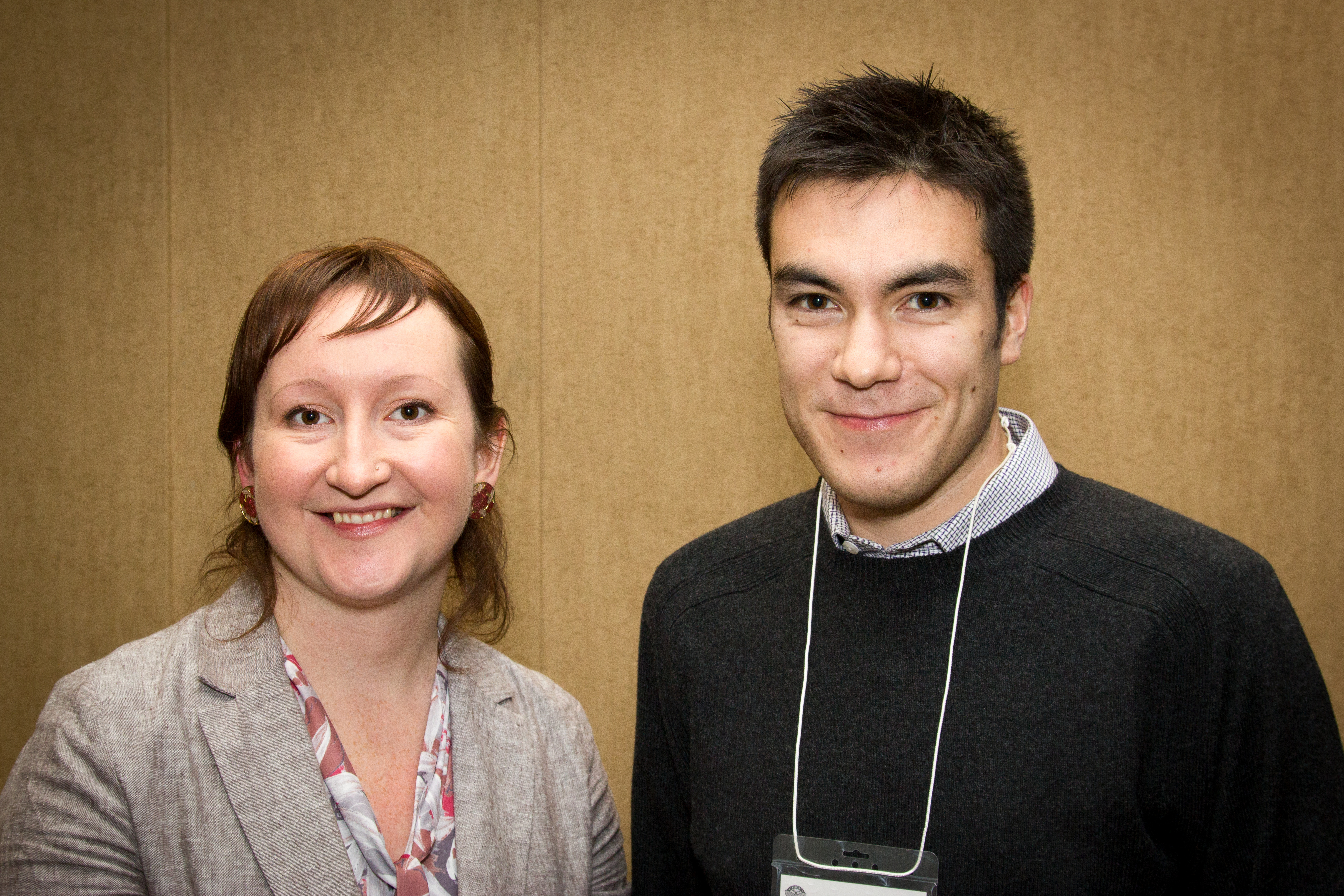
By ESC President Rosemarie DeClerck-Floate

—————————

I’m new to blogging, so when asked by our Blog Administrators to provide a first installment as President, I was at a bit of a loss on how to proceed with this. Do I simply distill what I have already shared more formally in the Up-front article from the December 2012, ESC Bulletin?  After some thought, I have decided to try something a bit different, but still related to my article.

One of my personal goals as President is to increase not only membership in the ESC, but the level of “active membership”. To my understanding, an active member is in action and contributing to our Society in any of a myriad of manners; e.g. serving on one of our many committees as either member or Chair, letting their name stand for executive office as Second Vice President or the next Director-at-large, applying to be a Society Trustee (e.g., Secretary, Treasurer, Bulletin Editor, Webmaster) as positions become vacant, collaborating to nominate a deserving fellow member for one of our achievement awards, helping organize a symposium or workshop for the next JAM, giving requested expert advice on issues that crop up within the society, etc. Without the mostly volunteer service of our active members, we cease to exist.

In thinking about what must be a perennial issue for every volunteer group out there…how to get new blood pumped into an organization to sustain it and also allow it to grow, and then how to encourage new involvement in the running of the organization, it occurred to me that one way to do so is to pull back the veil on what active service means, thereby allowing people to envision themselves in a particular active role. Do most of our members really know what projects our 17 regular committees are up to? Do they have a grasp of what is entailed in serving within any of the positions of the society.  Although any one of us can get onto the membership pages of our website and read our By-laws, Standing Rules and Committee Guidelines to find out the nuts and bolts of how our society runs, how many actually do so unless they are serving on a committee?  Honestly, that has been the case for me.  However, by sharing what we do and why, it gives a more human face to the intermeshed components of our organization, and may even inspire someone to step forth to serve.

So to get the ball rolling, let’s start with my experience so far and what is currently keeping me preoccupied on behalf of the society.  I have been in my role as President now for nearly 21 weeks and quickly am getting my legs in the job. Initially the position presented a somewhat daunting view of what lay ahead for me in terms of work load and challenges, and my legs were shaky. I was wondering how in heck I was going to juggle this major responsibility along with my research program and other activities. However, the experience has recently morphed into one of enjoyment that has actually given me energy overall and an eagerness to meet the challenges head-on with the help of others.  A large part of the enjoyment is coming from working with some excellent active members from across the country that are very dedicated and brimming with their own visions of us and how to move our society in new directions. There is such vibrancy to the ESC!

As President, I am ex officio on each of the regular committees, plus two newly-struck ad hoc committees, which means I get a bird’s eye view of what is happening within each as Committee Chairs cc me on their activity and discussions. Not all of them are active at the same time, but it is kind of like watching fireworks go off in different sectors of the sky, and then gauging how it all fits into the progression and synchronization of the whole show. Sometimes I may participate in the activity (either by invitation or when I clearly see where I need to get into action), but more often I find myself just watching, learning, or deciding where to nudge if needed. I also am encouraging new projects by either planting ideas with others, or enabling someone else’s idea by getting the appropriate people together. I must say that it is very gratifying watching projects take hold and grow to potential Board presentation stage, even without any involvement from me at all. Some of the projects that are in the early stages of discussion involve our student membership; for instance, we are sussing out new opportunities for career and leadership development. Overall, the role is a great way to develop improved management/people and leadership skills…..and even some French language skills because of the patience and encouragement of our francophone members.

But to present the full picture, it isn’t rosy all the time, as there are some serious matters to deal with which could have an impact on the future of our society. That’s where I have to screw up some courage and jump into the thick of things. A current example is making sure the ESC makes a successful legal transition according to the new Canadian Not-for-profit Corporations Act, which will mean the re-writing of our by-laws this year among other paperwork. Right now, I’m just so thankful to have the help and experience of our active membership as we navigate these new waters.

Regardless of how serious the challenge though, I have faith that we will survive as a society. We have existed for 150 years, so no time to give up now! So for anyone interested, we will be looking for new people to fill the Chairs of the Annual Meeting, Finance and Publications Committees beginning at our next JAM in Guelph, October 2013, and of course, welcome anyone who wishes to serve as members on any of our 17 committees. Think of it as an opportunity for personal and/or career growth and adventure.

By Chris Buddle (McGill University) & Dezene Huber (University of Northern BC)

————–

Last autumn there was quite an interesting discussion on twitter among some entomologists in Canada about the ‘job search’ – more specifically focused on the process of seeking tenure-track academic appointments.  Many of us shared our sob stories, and although the time, place and characters varied, the common element was REJECTION.  Those of us who currently are lucky enough to hold faculty appointments remember the rejection to success ratio, and some of us still have stacks of rejection letters.  While most of us really enjoyed the academic freedom that came with working as a postdoc, the job-search process was more often than not discouraging and deflating, and a really difficult time in our lives.

Towards the end of the PhD program, most of us are riding high – our papers are getting published, we are truly ‘experts’ in our fields of study, we are being congratulated, buoyed by our peers and mentors, and we are ready to take on the world.   We found ways to get a post-doc and perhaps traveled to a different country for additional experience, with a sense of hope, optimism, and enthusiasm for the next stage of our careers.

Then, like the world supply of helium, our hopes were quickly diminished.

« I will easily get a job interview at THAT University ».

Nope.  Not even an interview.

« Perfect – that job advertisement was MADE for me – they will hire me.  It’s a perfect fit ».

Nope. A mass e-mail rejection letter instead.

« I’m the GREATEST in my field of study.  Universities will be asking me to apply »

Nope.  That never happens.

I’m sure that I’ll be seriously considered for this position

Nope. The rejection letter came back saying that there were more than 400 applicants for the position.

Even if I don’t get the job, I’ll be able to get feedback from someone on the committee.”

Nope. It’s highly unlikely that, among the 400 applicants, anyone on the committee even remembers you.

There are really two ways to look at this.  It is possible to get discouraged and frustrated, and give up hope OR it’s possible to see that persistence can pay off and eventually the right job will come along, and you will be competitive.  Sure, the opportunities have to be there, but that kind of timing and ‘luck’ isn’t something you can control.

Here are a few pointers that will hopefully help you think about that tenure-track job search, and give you a sense of optimism:

  • It will take a huge dose of patience and persistence, but there ARE tenure-track jobs out there for people with Entomological interests, even in Canada. Recently, Manitoba hired an entomologist, and University of Ottawa just hired an assistant professor on the evolution of plant-pollinator interactions.
  • University professors do eventually retire! (…Although it needs to be noted that the reality in the current economy is that their positions are not always replaced)
  • You don’t have to restrict your options to only University positions.  We know of faculty members who worked in private companies, or in government, and made a lateral transfer, eventually, to academia.  Your holy grail may be a tenure-track job, but other opportunities are equally rewarding and could eventually get you a tenure-track job. Or you may find that life “beyond the ivory tower” is much to your liking anyhow. In fact, you may be interested in the advice column at Chronicle.com by that very name.
  • Be creative with your CV.  There are relatively few jobs for entomologists, sensu stricto, but there are jobs for evolutionary biologists, ecologists, or other more ‘general’ disciplines (Look: Concordia recently held a competition for a community and ecosystem ecologist!)  Re-work your cover letters and CV to reflect your potential in these jobs, and that you use insects as ‘model organisms’. And always tailor your cover letter and CV to any job for which you apply. Don’t just send in the same material to every search committee. Search committees are looking for that elusive thing that we call “fit.”
  • Keep your eye on the ball:  to get that coveted university position, the peer-reviewed publication remains the MOST IMPORTANT item on your CV.  Publish, publish, publish. During this stage of your career, keep the focus on that part of the research process. In particular, enjoy the fact that, as a postdoc, you are relatively free to conduct research and publish without many of the other responsibilities (e.g., teaching, administration) that will come with a tenure-track post.
  • Be realistic. If a job ad states that the committee is looking for an acarologist specializing in the mites of toucans, and you are an acarologist who studies toucan mites, then you have a good chance of landing an interview. If the job ad asks for a “terrestrial ecologist working at any scale from microbial to landscape” and you fit somewhere in there, chances are so do a few hundred other recent graduates.
  • When you see something that looks potentially appropriate for you, apply. Rejection is painful but costs nothing; not applying to something that might have worked out is doubly painful.  People who have agreed to write you letters of recommendation will be patient with you (if they are not, perhaps they are not the right people to give you a letter…?)
  • Have another postdoc or your mentor read through your application material. Chances are your mentor has been on a few search committees and can give you useful tips.
  • Every time you apply for a job, consider it a chance to improve your application material.
  • When you do land an interview, prepare for it like there’s no tomorrow. You are a researcher, do your best to figure out everything that you possibly can about the department to which you are applying and, even more, the personalities that make up that department.  Once you get an interview, this means your CV is strong enough, and the job interview is about the ‘fit’.
  • OK, to be fair, there are other tricks to success in academia.
  • Landing an academic position is not always going to be in the cards for everyone. It is best to have alternate plans so that you don’t get stuck in the so-called postdoctoral holding pattern for years and years. At least one of us (DH) committed to himself to start to explore alternate options at the five year mark after walking the convocation stage. Have a plan B. Your Plan B might actually turn out better than your Plan A in the end.
  • Rejection in terms of tenure-track jobs is really just a warm-up to the continual sense of rejection you will feel if you do end up working as a Professor.  You might as well get used to it.  This is not a statement to bring on doom and gloom: it’s the reality.  You must develop broad shoulders.

Rejection is a fundamental and core part of the academic life: The publication process is becoming so difficult that you can pretty much assume that your paper will get rejected the first few times around (check out this paper about rejection rates…).  Funding agencies are cash-strapped, and it’s getting harder and harder to find ways to fund research projects.  High caliber graduate students will ‘shop around’ for the best graduate program, and will often reject your laboratory. Be a practitioner of academic kung fu – use the weight of rejection against rejection itself by learning from it and applying it to your next attempt.

Depressed yet?

Don’t be.  A tenure track has so many advantages, and these far outweigh the annoying stream of rejections. And the other options available to a bright, young researcher are often as appealing (and usually pay more) than being on the tenure track anyhow.  ..but that’s a topic for another post.

by Christopher Buddle, McGill University

————–

As the Editor-in-Chief of The Canadian Entomologist, I have the pleasure of seeing all papers move through the publication process, from first submission to approval of the final proof.  This places me in a position to fully appreciate the incredible entomological research occurring around the world.  As one way to promote some of the great papers within TCE, I have decided to start a series of blog posts titled « Editor’s Pick » – these are papers that stand out as being high quality research, and research that has broad interest to the entomological community.  I will pick one paper from each issue, and write a short piece to profile the paper.

For the first issue of the current volume (145), I’ve picked the paper by Kathleen Ryan and colleagues, titled « Seasonal occurrence and spatial distribution of resinosis, a symptom of Sirex noctilio (Hymenoptera: Siricidae) injury, on boles of Pinus sylvestris (Pinaceae)« .   Sirex noctilio is a recently introduced species in Canada, and is a woodwasp that we need to pay attention to.   As Kathleen writes, « unlike our native species of woodwasps, it attacks and kills living pines » and because of this, we must strive to find effective ways to monitor the species.  One potential approach is to look for signs of resinosis, or ‘excessive’ outflow of tree sap and resins from conifers.  The goal of this work was to specifically assess « the spatial and temporal distribution of resin symptoms of attack to optimise sampling« .  The work involved Kathleen spending a LOT of time in the field, observing evidence of damage to trees, and assessing timing of resinosis relative to other damage to pine trees as related to woodwasps.  In the end, Kathleen was able to confirm that in most infested trees, the appearance of resin was a meaningful detection method.  This is a very practical paper, and very useful towards finding the best methods to detect this exotic species.

Sirex noctilio female - Photo by K. Ryan

Sirex noctilio female – Photo by K. Ryan

I asked Kathleen a few questions about this paper and the context of the work.

Q: Kathleen, what first got you interested in this area of research?

A: I became interested in studying Sirex’s interaction with other subcortical insects. Sirex was recently detected in North America at the time and we didn’t know much about it here including how, where and when to find it  – all of which were essential in planning research about insect interactions. So this study was my starting point – my “getting to know Sirex” study.

Q:  What do you hope will be the lasting impact of this paper?

A: This paper is the result of the many hours of field observations that helped me to become more familiar with Sirex. Since its really basic research, I hope that this paper might be a useful starting point for other people beginning to work with Sirex.

Q:  Where will your next line of research on this topic take you?  

A: Currently, I’m studying another invasive wood-borer, but I’d like to work with Sirex again – it’s a really interesting and unique insect biologically and ecologically. I’m especially interested in studying Sirex community ecology in its native, European, range to see how it compares to North America.

This is truly an important area of study, and I do look forward to seeing more of Kathleen’s papers in TCE.

Finally, I asked Kathleen about any amusing anecdotes about the research, and she shared this wonderful story with me:

The first day we worked together, my PhD advisor Peter de Groot, dropped me off at a forest site with instructions to only observe and collect absolutely no data. I had been in the forest for only a few moments, when a female Sirex landed right in front of me. So being an entomologist, naturally I caught her. A couple of hours later, still holding her, I met back up with Peter and sheepishly admitted that I had caught some “data”. Thinking it fantastic, from that point forward he told everyone that Sirex had picked me as her project.

Looking for wood wasps - Photo by K. Ryan

Looking for woodwasps – Photo by K. Ryan

I believe that these kinds of stories behind the research make Entomology more accessible and real, and help us appreciate the human element of scientific research.

As a final note, the entomological community was very saddened by Peter de Groot’s death in 2010.  His legacy to Canadian Entomology is still very strong.

A special thanks to Kathleen for answering a few questions, and sharing insights into the first ‘Editor’s pick’ for The Canadian Entomologist

———-

Reference:  Ryan, K, P. de Groot, S.M. Smith and J. J. Turgeon.  Seasonal occurrence and spatial distribution of resinosis, a symptom of Sirex noctilio (Hymenoptera: Siricidae) injury on boles of Pinus sylvestris (Pinaceae). The Canadian Entomologist 145: 117-122. Link.

By Chris MacQuarrie, Natural Resources Canada Canadian Forest Service (Sault Ste. Marie, ON)

——————-

Opa Opa Citation Style! *

I recently switched over to the Mendeley citation manager after many years of being a loyal EndNote user. I’m liking Mendeley, but one thing I lost in the switch was the collection of custom citation styles I had put together during my MSc, PhD and Post-doc.

Mendeley Desktop

Mendeley Desktop

This wasn’t a problem until this week when I was preparing final edits on a manuscript for The Canadian Entomologist. Mendeley didn’t have a style for TCE, but what it does have is the ability to modify existing styles and create new ones.

I started with the existing style for the Canadian Journal of Fisheries and Aquatic Sciences because it’s an old stable-mate of TCE from the NRC press days and has a very similar citation style.

I used Mendeley’s Visual CSL Editor:

csl editor
to modify the CJFAS style to output what TCE requires in it’s reference section.The only ‘big’ difference I could find between is that TCE uses a comma after the journal name where CJFAS does not.

I also made a few changes. For instance, the CJFAS style didn’t have a output for theses so I created one for that reference class. I also modified a few of the settings to delete information that CJFAS needs but TCE doesn’t.

Reference Output from Mendeley using the custom citation style

Reference Output from Mendeley using the custom citation style

You can download the finished product from this link:

http://csl.mendeley.com/styles/18621721/TheCanadianEntomologist

Now, what’s neat, is that Mendeley’s citation styles are based on the open-source Citation Style Language so you can use this style in any citation management program that also uses CSL (e.g., Zotero and Papers).

A disclaimer. I hacked this together in a few hours and didn’t check all reference classes, so your milage may vary! As always, check your references section carefully before submission!

If you do spot an error or have a suggestion let me know here, on Twitter (@cmacquar) or at cjkmacquarrie@gmail.com.

*if you don’t get this reference, see here

By Julia Mlynarek, PhD Candidate (Carleton University)

—————

Well it’s a New Year! 2013!

I’m writing a post on behalf of the Student Affairs Committee (SAC). Many people, especially students, don’t really know who we are and what the Student Affairs Committee actually does. So I figured I’d try to clear it up…

Who are we?

The SAC is composed of several graduate students distributed as evenly as possible across Canada. At the moment, there are seven students serving on the Student Affairs Committee. Part of these seven and Chandra Moffat (Fredericton, NB) and Boyd Mori (Edmonton, AB) who are also co-chairs of the SAC this year making sure things run smoothly.

The co-chairs – Chandra Moffat and Boyd Mori. Photo credit: Adrian Thysse

The co-chairs – Chandra Moffat and Boyd Mori. Photo credit: Adrian Thysse

Via e-mail, we consider how improve or maintain student success and visibility in the ESC. Other members include Ikkei Shikano (Burnaby, BC), Brock Harper (Toronto, ON), Paul Abram (Montreal, QC), Léna Durocher-Granger (Quebec/Honduras), Guillaume Dury (Montreal, QC) and me (Julia Mlynarek (Ottawa, ON)).

What do we do?

The mandate of the SAC is two-fold; 1- we advise Student Members, the Governing Board, and the Society on programs of the Society for students and on other matters concerning students and 2- we advise Student Members and the Society on the training of entomologists and on the future job opportunities for entomologists in Canada. This mandate is very broad but throughout the year we try to set specific goals to help students succeed in entomology. This year for example, we will be trying to post more regular updates on the ESC blog to let the Members know what we are up to. We are also working on an updated version of the Directory of Entomology. Of course we continue working hard on letting the Student Members know of Job and Research postings. Additionally, we let the community know if a student has defended their thesis successfully in the thesis round-up (either on the ESC website, or in the Bulletin). So if you’re a student that has just submitted a thesis, let us know! We also help with organization of the annual meeting such as trying to keep the costs for the meeting as low as possible (but still sustainable) for the student, the student mixer during the meeting, the Graduate Student Symposium and the Silent auction. The proceeds of the silent auction actually come back to help the students. So a successful silent auction means extra funds for the students!

Great turn out to the ESC student mixer! Photo credit: Seth McCann

Great turn out to the ESC student mixer! Photo credit: Seth McCann

Student affair committee members (Chandra Moffat and Paul Abram) manning the silent auction at the last ESC annual meeting. Photo credit: Adrian Thysse

Student affair committee members (Chandra Moffat and Paul Abram) manning the silent auction at the last ESC annual meeting. Photo credit: Adrian Thysse

We work hard in our spare (non-thesis) time to encourage students pursue their dreams of working with insects. The actions we take today will influence the future entomology students which could potentially be our students in the future. We want Canadian Entomology to be the best it can be so that is respected in the world as it has been since the inception of the ESC.

If you (as a student) are interested in getting involved please contact us – students@esc-sec.ca or post a message on the ESC student facebook page. We would love to hear from you.

Enjoy the insects.

Till next time,

Julia

The Entomological Society of Canada gives out several financial awards each year to Canadian graduate students studying entomology. The following awards are available for 2013:

Graduate Research Travel Award – Up to a maximum of $2000

  • Normally awarded to one MSc student and one PhD student annually
  • Intent is to help students increase the scope of their research, and will be judged on scientific merit
  • Student must be enrolled as a graduate student at a Canadian university & studying insects or related terrestrial arthropods
  • Details
  • Application & Evaluation Information
  • Deadline: February 16, 2013

Postgraduate Awards – $2000

  • Normally awarded to one MSc student and one PhD student annually
  • Awarded on basis of high scholastic achievement
  • Student must be enrolled as a graduate student at a Canadian university & studying insects or related terrestrial arthropods
  • Application & Evaluation Information
  • Deadline: February 16, 2013

John H. Borden Scholarship – $1000

  • In honour of Dr. John H. Borden, one postgraduate award of $1,000 to assist students in postgraduate programs who are studying Integrated Pest Management (IPM) with an entomological emphasis
  • Awarded on basis of high scholastic achievement & innovative research in IPM
  • Applicant must be a full time postgraduate student at the time of application, studying IPM at a degree granting institution in Canada
  • Application & Evaluation Information
  • Deadline: February 16, 2013

Keith Kevan Award – $1000

  • In memory of Dr. D. Keith McE. Kevan, the Entomological Society of Canada offers one postgraduate award of $1,000 biennally to assist students in postgraduate programs who are studying systematics in entomology
  • Awarded on  basis of high scholastic achievement and excellence in insect systematics
  • Application Procedure
  • Deadline: February 16, 2013

By Mark P. Nelder, Public Health Ontario

——————

William R Maples’ Dead Men Do Tell Tales: The Strange and Fascinating Cases of a Forensic Anthropologist, created a lasting memory for me. Aside from the fascinating science, Dead Men Do Tell Tales underscored that passion and resourcefulness is the key to learning.

With an interest in blowfly ecology and ectoparasites, I set out to study these two fields as side projects during my graduate research at University of South Alabama (MSc) and Clemson University (PhD). Yes, “side projects” is a phrase that can send any supervisor running in fear, but I was lucky.

During my research on black fly larvae and their gut fungi in Alabama, I initially thought that the undersides of bridges (easiest place to look for streams and black flies; #overlyhonestmethods) are where headless white-tailed deer went to die. These morbid scenes of poaching were both a source of amazement and one of convenience – easily accessed streams with black fly larvae accompanied by robust populations of blowflies and louse flies (my first sight of the very cool Lipoptena mazamae). These deer were just a gateway carcass, leading to a downward spiral of seeking out additional species of dead wildlife and their ectoparasites. I was now a roadkill prospector.

Realizing that I needed experience with ectoparasites, prior to starting research on biting flies and ectoparasites of South Carolina zoos, I turned to the sometimes flattened, bloated, and unrecognizable critters I saw on my daily drive to campus. Equipped with latest intelligence on a fresh carcass, all I needed was a garbage bag, latex gloves, and a vehicle.

Roads pose a real threat to animal populations. The numbers are staggering, as reported by @TetZoo or Darren Naish in Dead Animals at the Roadside. In Belgium, an estimated 230,000 and 350,000 hedgehogs fall victim to vehicles per year. Not exploring this biodiversity source would constitute a wasted opportunity.

Insects and roads do not mix either. In Japan, a study of two routes resulted in 5000 dead insects per kilometer, collections dominated by Coleoptera, Lepidoptera, and Diptera (Yamada et al. 2010).

Roadkill are ideal subjects for biodiversity studies (the vertebrate hosts, along with their ectoparasites and internal parasites). As One Health opens the doors to collaboration between the fields of human medicine, veterinary medicine, and the environment, scientists often remain confined in their respective silos. Roadkill offers a potentially important source of data on zoonoses and generate collaboration between veterinarians, entomologists, microbiologists, ecologists, and others.

Interest in roadkill science is about as old as the automobile, albeit slower wildlife succumbed to horse drawn carriages of the 1800s. AW Schorger had more than a passing interest in roadkill, identifying 64 species of birds from 1932 to 1950, on the same roads between Madison, Wisconsin and Freeport, Illinois. Avian roadkill was dominated by English (House) Sparrows (N = 2784), Red-headed Woodpeckers (389), American Robins (310), Ring-necked Pheasants (271), Screech Owls (235), and Northern Flickers (230). Imagine the possible research if Schorger had a curious entomologist to tag along on these trips and to inspect each bird.

Transportation ecology is a relatively new field that looks to study how wildlife interacts with our roads and how road design can minimize wildlife impact. The University of California Davis and partners have established a citizen-science project that allows the public to report roadkill on California highways, California Roadkill Observation System (see Maine and Idaho). Championed by the Toronto Zoo, the Ontario Road Ecology Group looks to combat the impact of roads on biodiversity in southern Ontario. Yet another is the South African initiative Wildlife Road Traffic Accidents – A Biodiversity Research Project. These programs offer an existing infrastructure that provides the basis for longitudinal studies of ectoparasites and their hosts.

Aside from the basic understanding of host-ectoparasite relationships, roadkill are increasingly becoming a tool for hypothesis testing. A few examples are worth mentioning here. The Cardiff University Otter Project provided road-killed otters to test hypotheses surrounding otters, ticks, and climate. The prevalence, but not intensity, of the tick Ixodes hexagonus infestation on otters was associated with higher Central England temperatures, while both prevalence and intensity were associated with positive phases of the North Atlantic Oscillation.

Without roadkill, we would not know that as lice burden increases in barn owls, the number of pectinate claw teeth decreases and bill hook length increases (Bush et al. 2012). Bush and colleagues also noted rodent ectoparasites on barn owls; e.g., the louse Hoplopleura acanthopus (normally found on rats) and the flea Malaraeus telchinus (from mice and voles). Is this a potential example of incipient evolution through host switching?

Roadkill prospecting excited me (and still does)….not unlike an unexplored stream has excited many a black fly expert, as an illuminated cloth at night for the moth lover, and as CDC light trap the mosquito ecologist. As Dr. Diane Kelly said in her excellent Story Collider tale Confronting Death on the Road

When you open up an animal, there is all kinds of awesome in there.

Article by Dr. Chris Buddle, Professor at the McGill University.

————————

The Entomological Society of Canada's home of operations in Ottawa, Ontario.

The Entomological Society of Canada’s home of operations in Ottawa, Ontario.

I was in Ottawa back in December, and found a bit of time to visit the Entomological Society of Canada’s headquarters, on Winston Avenue.  It was a real treat – our office manager (Derna Lisi) is always thrilled to have visitors, and will make you a lovely cup of coffee!  The office is where memberships get processed, general queries from members get answered, and where printing, mailing and processing paperwork gets done.  It’s also a place where you can browse through ALL the volumes of The Canadian Entomologist.  The office has seven copies of all TCE issues, well-organized, and fully accessible.  Although the journal is electronic now, it sure is nice to hold the Volume 1, Issue 1, in your hands.  That is a lot of history!   It is also somewhat comforting to know that hard copies exist, and that they are well cared for.

The Canadian Entomologist 1(1) - 1868

The Canadian Entomologist 1(1) – 1868

Although I visit Ottawa with some frequency, I always seemed to find reasons not to visit the ESC headquarters.  That was a mistake.  It was a real pleasure to meet Derna, see the operations, and realize that our society has a brick-and-mortar face to it. We are all busy and overworked, but I do encourage you to stop by 393 Winston Ave next time you are in Ottawa.  As a further incentive, there are some lovely shops nearby, including Mountain Equipment Coop.  Go grab your field clothes and stop in to say hi to Derna!  You’ll be glad you did.

[googlemaps https://maps.google.ca/maps?q=393+Winston+Avenue,+Ottawa,+ON&layer=c&sll=45.391733,-75.756668&cbp=13,34.84,,0,1.72&cbll=45.391568,-75.756585&hl=en&ie=UTF8&hq=&hnear=393+Winston+Ave,+Ottawa,+Ontario+K2A+1Y5&ll=45.391733,-75.756668&spn=0.004408,0.009645&t=h&z=14&panoid=z4yTx0-6DuB1ViiOT7x3Fw&source=embed&output=svembed&w=425&h=350]

By Christopher Cloutier, Naturalist (Morgan Arboretum, McGill University) and Teacher (Vanier College)

As a kid, growing up in the big city, wildlife was a rarity to say the least. Gray squirrels, starlings and house sparrows made up the “wild” critters around my childhood stomping grounds, but one group of organisms that never seemed to disappoint were the arthropods. Insects and spiders could be found virtually anywhere and it seemed that back then there were too many to ever count or name. It was from these early beginnings that I began to appreciate nature for both the big and the small. Cementing my interest in this amazing world of creepy critters were my early excursions to provincial parks and tagging along with naturalists who taught me more about these amazing creatures. Today, as an interpretive naturalist and teacher with a love of insects, it has become a passion and a joy to pass on the wonderment which is the “world of the little things” to people of all ages.

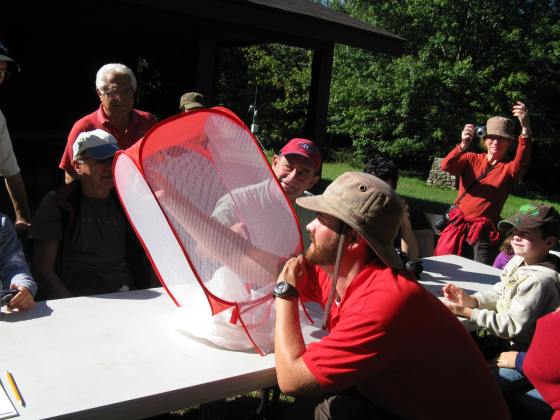
Reaching for the next pre-caught monarch to tag, Monarch Melee, 2011, Morgan Arboretum.  Credit: Chris Cloutier

Reaching for the next pre-caught monarch to tag, Monarch Melee, 2011, Morgan Arboretum. Credit: Chris Cloutier

It is shown that insects generate a certain degree of interest from the layperson. Whether it be raising Painted Ladies in the classroom in elementary school, or counting the number of Plecoptera naiads during a stream survey; the fascinating life histories of insects have touched the lives of many people and have been used as a tool to emphasize the underlying principles of conservation, not only for the insects themselves but for the multitude of habitats which they occupy.

For years now I have led many insect-themed interpretive walks and have noticed a very strong showing from the general public. Children and parents alike seem to get the same level of enjoyment from spending an hour or two searching out and discovering something new about the world beneath their feet. With a fondness for Dragonflies, Butterflies and Spiders, these themed walks have become somewhat of a specialty and seem to attract more and more people every year.

Photo: Tom Kingsbury

Photo: Tom Kingsbury

One of the most enjoyable walks which has been held for three consecutive years now is entitled “Monarch Melee”. The activity is in association with the Monarch Watch program offered at the University of Kansas. The idea here, for those of you unfamiliar with the project, is similar to bird banding, except that the bands are stickers and the birds are, you guessed it, monarchs. I begin the workshop with a 30min presentation on the life history of the monarch butterfly, what it eats, metamorphosis, defense, and of course migration. It is amazing how a single insect, although quite charismatic for something other than a Panda or Beluga can make people so aware of the adaptability, perseverance and just general “wow factor” of insects as a whole. The presentation is followed by a tagging session for some pre-caught monarchs. Once the demo is over, we grab our nets and head out to several milkweed patches in search of more.

Photo: Tom Kingsbury

Photo: Tom Kingsbury

So, how does this sort of activity work to inspire people to do their part for conservation? Well, since those activities have been hosted, I know of several families that have since set up some very elaborate butterfly gardens at the homes, including puddling areas, butterfly shelters, hummingbird feeders, mason bee boxes, bat houses and more. People bring me photos of things that they are seeing around their homes, and not just Leptoglossus occidentalis photos anymore, but photos of butterflies and neat birds, spiders, and more. I have even seen kids walking around the Arboretum with binoculars and butterfly nets, yes, butterfly nets!

Photo: Tom Kingsbury

Photo: Tom Kingsbury

I feel that I have been able to open a door, or bridge a gap if you will, for some of these people to become enthralled in nature again, something which our current younger generation is having some difficulty doing. Although my personal role in this “nature revolution” is minor in the big picture, it is enormous in the lives of those inspired to learn more and to do more, just as it was for me when I was a kid. It never hurts to share your passion and of course a little knowledge. It might go a really long way (yes, Monarch migration pun intended!).

Photo: Reaching for the next pre-caught monarch to tag, Monarch Melee, 2011, Morgan Arboretum: credit: Chris Cloutier

Par/by Guillaume Dury
_______________

Chaque année, la Société d’Entomologie du Québec organise un concours photos, afin de trouver les couvertures du bulletin de la société, intitulé Antennae.

Pour aller avec le thème de la conférence de cette année « Entomologie et agriculture biologique; de l’écologie à la pratique », j’ai choisi le thème « formidable prédateurs à l’action ».

17 photos ont été soumises au total, et les trois gagnantes ont été choisies par vote populaire des conférenciers. Puisque j’était en charge du concours, j’ai décidé du système de vote. Chaque conférencier devait donner son choix de trois photos préférées. 3 points ont ensuite été attribués pour un premier choix, 2 pour le deuxième et 1 pour le troisième. Chaque photographe ne pouvait gagner qu’un des trois prix. Je suis heureux de présenter les photos gagnantes.
________________

Every year, the Entomological Society of Quebec organizes a photo contest to find cover photos for its bulletin, called Antennae.

To go along this year’s conference theme « Entomology and organic agriculture; from ecology to application » (my translation), the photo contest theme was « formidable predators in action ».

17 photos were submitted in total, and the three winners were chosen by popular vote of conference attendees. Since I was in charge of the contest, I got to decide the voting scheme. Each attendee was asked to give his first, second and third favourite photos. I then counted 3 points for each first choice, 2 points for second and 1 point for third. Each photographer was only allowed to win one prize. I’m happy to present the winning photos.

First

Première position/First Place: Julien Saguez

Second

Deuxième position/Second Place: Roxanne Bernard

Troisième position/Third Place: Julie-Éléonore Maisonhaute

Troisième position/Third Place: Julie-Éléonore Maisonhaute

Félicitation encore aux gagnants!

Congratulation again to the winners!