IMG_7110b

This wasp has a problem! Three relatively enormous parasitic strepsipterans are occupying her abdomen…Photo by Sean McCann.

Who wouldn’t want to get to know the Strepsiptera? These animals are extremely odd, being obligate endoparasites of other insects, with a free-flying male and an eyeless, wingless female that never leaves the abdomen of her host. Different families of these parasites infect different hosts, ranging from silverfish and cockroaches to solitary and social wasps, leafhoppers, and froghoppers.

Allow me to introduce Xenos peckii, a strepsipteran parasite of Polistes fuscatus, the Northern Paper Wasp.  As an entomologist, I have long been interested in these little-studied insects, so I was thrilled to get to help my colleague Mike Hrabar in his investigation their life history and reproduction.

Mike collected a several colonies of infected wasps from Maine and brought them back to the lab to observe their emergence, flight and mating behaviour in a systematic way. We used high speed videography and careful record keeping to document their life history in closer detail than had ever previously been recorded.

IMG_7137

Not really bling. This wasp sports a heavy infestation of four developing Xenos, costing vast amounts of resources.  Photo by Sean McCann.

From my perspective, one of the coolest things we learned is that the free-flying male opens his puparium by means of blade-like mandibles, which are used to cut along a zone of weakness in the pupal cap, functioning like a tiny can opener!

new head

Head of male Xenos peckii. Note the scissor-like mandibles and the large and unusual compound eyes. Photo by Mike Hrabar. Figure 3G from Hrabar et al. 2014.

Check out the video below to see the male’s little mandibles working the cap open.

[youtube http://www.youtube.com/watch?v=aCeEsXVNiOY?rel=0&w=560&h=315]

These little troopers fly immediately upon emergence, in stark contrast with most other insects, which need time to inflate and harden their wings. In fact, once the males begin beating their wings, they remain in flight continuously except for a brief period during mating.

Before our study, biologists had assumed that female Strepsiptera were completely immobile and passively waited for males to find them, but we observed that they move to adopt a distinct calling posture, elevating their cephalothorax up from the wasp’s abdomen, likely emitting a pheromone plume.

new calling

Female Xenos peckii in the abdomen of a Polistes fuscatus. This female is in the calling posture, elevating her cephalothorax. Photo by Mike Hrabar. Figure 4D from Hrabar et al. 2014.

The males smell this pheromone plume and fly toward it rapidly, in a zig-zag fashion reminiscent of pheromone-questing moths. As soon as a male reaches the female-infected host, he lands on her abdomen and walks down to where the female protrudes, using backwards steps with his heavily-modified tarsi.

new leg

Mid leg of Xenos peckii male. The tarsi are highly modified for gaining a strong grip on a wasp abdomen while searching for and mating with a female.  Figure 8 from Hrabar et al. 2014.

Mating occurs rapidly, with typical copulation time being 3-5 seconds. As soon as mating is finished, the male is once again in flight, presumably in search of another female. After copulation, the female immediately withdraws from the calling posture and ceases calling other males. The following video was taken at 1000 frames/second with a high-speed video camera and shows the sequence from just after landing by the male through the majority of copulation.

[youtube http://www.youtube.com/watch?v=QPiG8AV0XWY?rel=0&w=560&h=420]

S. McCann Polistes and Strepsipteran sm

This male Polistes fuscatus was weakening, and died while we were watching. Mike pinned the host, and we forgot about it for a while, until glancing at it we realized that one of the males was emerging! This shot was snatched quickly while the male had just popped off his cephalotheca. Photo by Sean McCann, Figure 2E from Hrabar et al. 2014.

We have shown that female Xenos are not just a passive receptacle or bag of eggs, but rather play a physically active role in soliciting mates. The male emergence is facilitated by using sharp mandibles to cut around an ecdysial suture line, and navigating the surface of his prospective mates host is aided by his extremely modified tarsi.

The short-lived males face a great challenge to locate and fly to a host with a calling female in the short amount of time they live (on average 2-2.5 hours). They are in constant flight from emergence until death with only a very short pause for mating. The female, by contrast, remains alive in her host, maturing a brood of eggs which she retains in her body until they hatch and crawl from her brood canal as motile planidial larvae.

These larvae will exit the brood canal at some point, but it is unclear exactly where they manage to find new hosts. It is possible they « deplane » at flowers and wait for a ride on a Polistes to a new nest of victims. Much more research will need to happen to fully understand these fascinating insects, but we have made a start at uncovering some of the mysteries of their emergence, communication and reproduction. Many more questions remain unanswered and provide opportunities for any natural historian to explore.

If you would like to read the whole paper, you can find it on the Canadian Entomologist site here, or if you are not a subscriber, I am hosting a corrected proof here.

The full citation for this paper is:

HRABAR, M., DANCI, A., MCCANN, S., SCHAEFER, P. W., and GRIES, G. 2014. New findings on life history traits of Xenos peckii (Strepsiptera: Xenidae). The Canadian Entomologist doi: http://dx.doi.org/10.4039/tce.2013.85 pp.1–14.

Cerceris 560

New « field assistant », getting its unique identifying paint job.

I’m pleased to announce the following Canadian Entomologist paper as this issue’s Editor’s Pick: The use of Cerceris fumipennis (Hymenoptera: Crabronidae) for surveying and monitoring emerald ash borer (Coleoptera: Buprestidae) infestations in eastern North America.

It was written by Philip Careless, Steve Marshall and Bruce Gill.

This link will be active and freely available for the next month, so do not worry about a paywall.

This research focuses on using natural history information to assess creative ways to monitor one of eastern North America’s most important invasive, exotic tree-feeding pests, the emerald ash borer (EAB).  The Crabronidae species Cerceris fumipennis is a wasp that is known to provision its nests with metallic wood-boring beetles in the family Buprestidae. Therefore, there is potentially to find out where EAB is located based on whether nests of the wasps contain that particular beetle. It’s a clever approach, and although the basic biology of the system was already known, Philip and colleagues worked to quantify and fully assess this potential biosurveillance tool for the EAB. We need to know where this pest is, and an indicator such as C. fumipennis holds much potential.

I caught up with Philip and he kindly answered a few questions about this work:

What inspired this work?

Almost all graduate work begins as a spark in the advisor’s mind.  Certainly this project came from the creative thinking of Dr. Stephen Marshall so he deserves credit for that.  I was simply fortunate enough to be the one chosen to run with the idea.  Though, more importantly, he and the rest of the advisory committee gave me enormous freedom to transform the question into a journey through the strange world of solitary wasps.  As for fueling the fire, I would say it was the writing of entomologists like Howard Evans, a healthy dose of nature documentaries, and correspondence with enthusiastic forest managers like Troy Kimoto who are struggling to address pressing conservation challenges.

What do you hope will be the lasting impact of this paper?

I hope that it will help people think of other novel ways to utilize the often overlooked services that insects all around them provide and in turn care for and conserve biodiversity.  In our case an insect that the public instinctively hates, fears, and kills has been transformed into an amazing, useful, and valued colleague.

Where will your next line of research on this topic take you?

We have over 370 nest-provisioning solitary wasps in Canada. Each species is eloquently designed to collect their specific preferred taxa – eg. Stictiella takes adult Lepidoptera, Isodontia takes Orthoptera, Crossocerus takes Psocoptera, etc.  The next steps will be to look at our native wasps, identify what they provision with and then determine if they are well-suited to life as a biosurveillance tool – assisting with life science inventories or monitoring pests.  As the prey choice of most solitary wasps is unknown, professionals and amateurs alike can assist by photographing provisioning wasps and uploading the images to bugguide.net or the like.

Do you have any interesting anecdotes about this research?

Sitting in the middle of a ball diamond under a beach umbrella with a butterfly net (watching wasps provision their nests) tends to draw a lot of curious looks and questions from passers by.  On one such occasion in Windsor, Ontario – while showing a dog walker my prized wasp bringing back a beetle – I observed a novel form of predation.  As the prey-laden female wasp diligently droned past us to the nest, the dog – previous quite bored – snapped it out of the air and ate it, prey and all!  We humans were both surprised but the dog seemed quite pleased.

Brenna 560

Brenna Wells hard at work, waiting to steal beetles from wasps.

For more information on this initiative, or even to get involved yourself, please visit the project website.

Dr. Christopher Buddle

Editor, the Canadian Entomologist

@CMBuddle

By Justin Renkema, Post-Doc, University of Guelph

—–

It was an early morning after a long drive from Guelph to a small fruit farm in Chatham-Kent where my undergraduate student, Caitlyn, and I were conducting a small-plot spray trial to test the effect s of repellents against Drosophila suzukii (Spotted Wing Drosophila), a recent invasive and serious fruit pest.  I knew the raspberry patch was heavily infested with D. suzukii so before getting to work, to amuse ourselves at the start of the day, I started gently shaking canes, and we watched the swarms of fruit flies disperse and hover over the fresh fruit.  However, as I went to grab a branch low to the ground, I noticed something different about one of the fruit flies sitting on a leaf.  It had characteristic white “racing stripes” along its thorax, unlike any other fruit fly I had seen.  This was it!  This was very likely Zaprionus indianus or African fig fly, another invasive and potential fruit pest that we knew was moving northwards from the southeastern USA.  Caitlyn grabbed a vial and we successfully had, on 10 September 2013, what we thought was the first capture of this fly in Ontario and Canada.

Zaprionis indianus photographed by Dr. Stephen Marshall in Africa. (Photo C Stephen A. Marshall, used with permission)

Zaprionis indianus photographed by Dr. Stephen Marshall in Africa. (Photo © Stephen A. Marshall, used with permission)

 Indeed the fly was Z. indianus, as determined by Meredith Miller, a M.Sc. student at the University of Guelph working on taxonomy of Drosophila spp. in Ontario.  Through contact with Hannah Fraser at Ontario Ministry of Agriculture Food and Rural Affairs, we learned that their Ontario-wide monitoring program for D. suzukii had also picked up some African fig flies in apple-cider vinegar traps, and a few at an earlier date than our find in Chatham-Kent.  Colleagues in Quebec (Jean-Phillipe Légaré and others at MAPAQ) had also found what they believed were Z. indianus.  Once all the material was collected and examined by Meredith, we submitted a scientific note documenting our Z. indianus discovery in Canada that was published by the Journal of the Entomological Society of Ontario.

Zaprionus indianus is native to the Afrotropical region.  It was found in Brazil in 1998 where it was given its common name because it became a significant pest of figs.  In 2005, Z. indianus was discovered in Florida and has since been found successively further north and west in the USA (see a map of its distribution here).  It is likely that the North American infestation did not come from the Brazilian population.  Zaprionus indianus is the only member of Zaprionus present in Canada, and therefore the reddish-brown head and thorax and particularly the silvery stripes that extend from the antennae to the tip of scutellum can be used as distinguishing features.

Zaprionis indianus dorsum showing characteristic white stripes

Unlike D. suzukii (thankfully!), female Z. indianus do not possess heavily sclerotized and serrated ovipositors and are not currently seen as a serious threat to temperate fruit crops.  They have been reared from a number of tropical, tree-ripened fruits in Florida and there is concern in vineyards in the eastern USA, where sometimes they outnumber D. suzukii in traps. It is possible that Z. indianus can use fruit that has been oviposited in by D. suzukii, thus increasing damage and possibly complicating control measures.  In Canada, particularly Ontario and Quebec, winter temperatures may preclude establishment of African fig fly, and yearly re-infestation from the south would be necessary for it to show up in future years.  At all but one site, we found just 1-4 flies during late summer and early fall per site, so it will be interesting to see what happens to numbers this coming growing season.  In tropical and sub-tropical locations much larger populations have been detected the year following first detection.

For the past 1.5 years I have been working as a post-doctoral fellow at the University of Guelph with Rebecca Hallett on D. suzukii.  We are developing a push-pull management strategy using volatile plant compounds to repel and attract this pest.  With the occurrence of Z. indianus and possible reoccurrence  in larger numbers in the future, we may have a unique opportunity to study how two recent invaders using similar resources interact, and also, perhaps, a more significant challenge ahead of us  in developing management strategies.  If you are interested in this topic or have current or future experiences with Z. indianus, I and co-authors on the scientific note would appreciate hearing from you.  You can contact me at renkemaj@uoguelph.ca.

—-

Renkema J.M., Miller M., Fraser H., Légaré J.P. & Hallett R.H. (2013). First records of Zaprionus indianus Gupta (Diptera: Drosophilidae) from commercial fruit fields in Ontario and Quebec, Canada, Journal of the Entomological Society of Ontario, 144 125-130. OPEN ACCESS [PDF]

IMG_4452

Catherine Scott and I continue on our Honduran odyssey, finally making it out into the field to begin our work on Red-throated Caracaras. We are working in a medium-elevation pine forest, consisting of mainly Pinus oocarpa and a couple oak species. This makes the surroundings seem very much like the foothills of the Rockies, except the species composition is way off!

IMG_4442

In these pine forests, one of the main defoliating species are fungus-rearing leafcutter ants!

IMG_4170

On some of the flowering plants, mantids lie in wait of unwary pollinators.

IMG_4180

IMG_4197

Catherine Scott and Isidro Zuniga, our main Honduran collaborator, check out the cryptic mantid.

Being weird gringos, and something of a novelty, we get great opportunities to chat with curious kids. Some of them are really enthusiastic about birds and insects, and some can be persuaded to show us where to find the cool bugs. 

IMG_4471

We will keep searching out these cool bugs, as our Honduras fieldwork continues. Please stay tuned for more updates from the field, when and where we can fit them in.

IMG_4225

IMG_3384

While out visiting our friend Rafael’s ranchito yesterday, we were surrounded by a herd of curious cattle. These were a mix of both Brahmas and Holsteins, with some crosses as well. One animal in particular caught my eye; it appeared to have bot emergence holes on its sides.

IMG_3389

I asked Rafael what these were, and sure enough, he told me that these were « torsalo », basically the same New World bot that scientists are always getting in the Neotropics. I was not aware that Dermatobia hominis parasitizes cattle, but apparently it quite commonly does so. It makes sense, as emergence sites of Cattle Grubs would be higher up on the back of the animal.

I love it how my entomological training really gets awakened when travelling in new areas.


IMG_3305

I am sure many folks out there know what it is like to rent their very first apartment, only to find that the place has a major infestation of some noxious pest. Well, fellow ESC member Catherine Scott and I have just rented our first apartment in Gualaco, Honduras, and boy does it ever have an infestation!

These are the dreaded household casebearer, Phereoeca uterella (Tineidae)and there are tons of the wandering larvae all over the walls! Luckily we have other familiar allies, the Pholcids, which are in great abundance. This infestation will be easy to manage provided we take care of the moths’ food sources. This is definitely not the worst infestation I have experienced.

IMG_3310

Allies in the fight against clothes moths!

Anyway, these are the most obvious insects in our new home. Please share below about any experiences with first-apartment infestations you may have had!

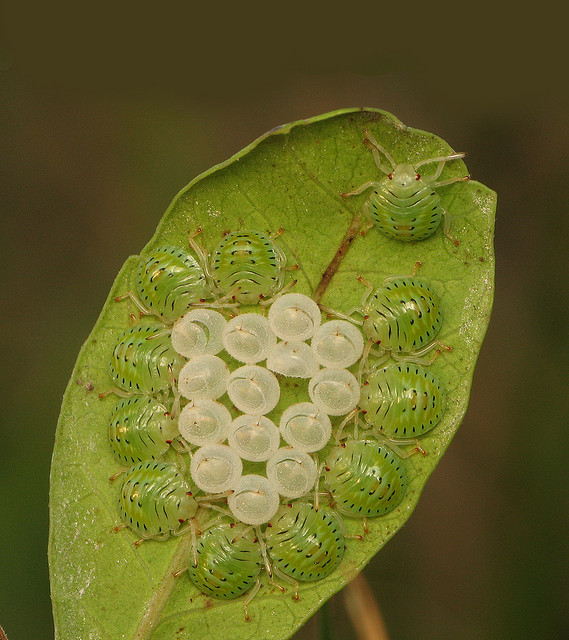
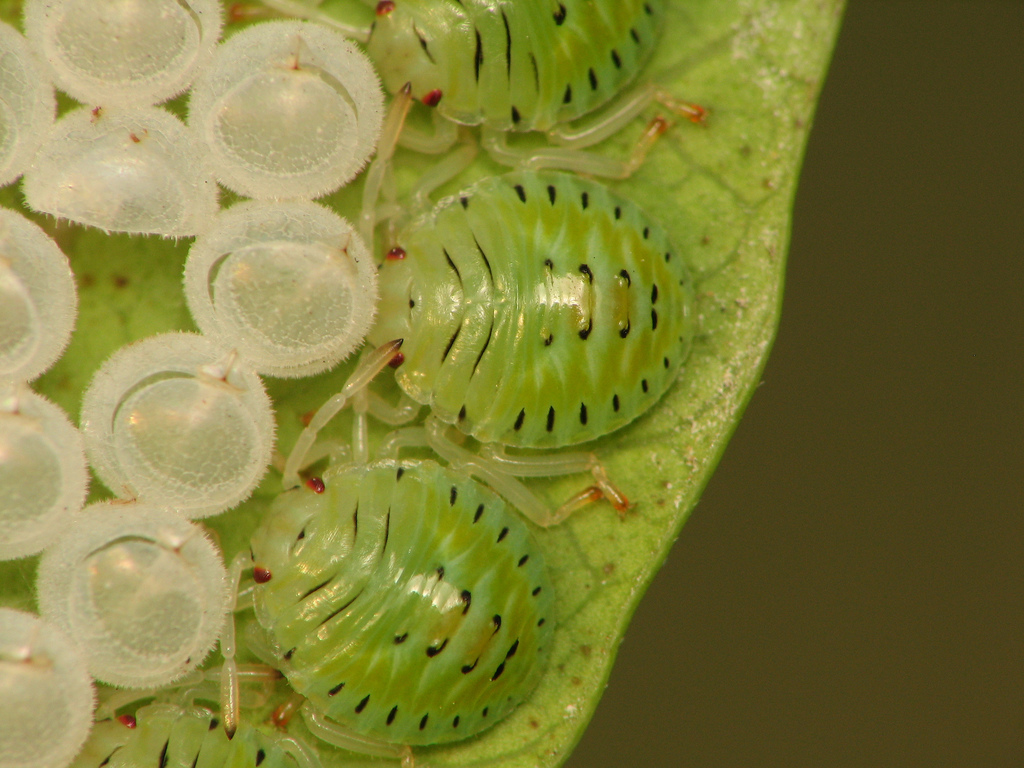
pentatomidae 1

This season is full of green and red decorations, and exhortations about family, so I thought I would share this lovely family portrait of some 1st instar stink bugs exemplifying the togetherness of the holiday season. I found this family group in Fort Pierce, Florida on the underside of a Brazilian Peppertree leaf. Schinus terebinthefolius is an invasive plant brought in as an ornamental for its beautiful red berries and evergreen leaves (and used in Christmas decorations!). Not surprisingly, entomologists are on the lookout for a insect-based solution for peppertree control!

pentatomidae 2

By Sean McCann, ESC/SEC blog coordinator and PhD student at Simon Fraser University —— © 2011 S. McCann, all rights reserved It seems that a popular pastime for Canadian entomologists in winter is to reminisce about warmer times and abundant insects. Edmonton bug photographer Adrian Thysse just posted a video of his National Moth Week experience at Devonian Gardens in Edmonton over the summer, and it looks like an entomological wonderland compared to the insect famine that is the Canadian winter. That video reminded me of my own light trapping experiences in much warmer times, namely in the rainforest of French Guiana. I was not actually doing the trapping, but I had the good fortune to do some observation. Guelph’s own Alex Smith and Rodolphe Rougerie were using UV lamps and white sheets to do their sampling, but of course all kinds of amazing insects were coming to the sheets. If you have never experienced tropical light trapping, the video below provides a taste of the sheer biomass of insects coming to a single sheet. [flickr video=11200757316 secret=7ec05d78b3 w=560 h=315] Here is a small gallery of images of insects that caught my eye (bonus points if you can ID them in the comments!).

Human hangers-on were not the only beneficiaries of this insect bonanza. Under the sheet, toads gathered to feast, while bats swooped in from above. The next morning, the diurnal predators took over, with scores of birds waiting above to snatch the tasty morsels from the  air as they tried to fly back to their homes in the trees. Here a Black Nunbird (Monasa atra) shows up on a perch with a gift. [flickr video=11200587055 secret=bdf1a44633 w=560 h=315] This gift-giving was a bit of a theme, with a Black-bellied Cuckoo offering a large katydid to an associate. mag (10 of 19) For an entomologist who studies birds such as myself, the light traps were a wonderful thing to see. Waking up at dawn to see a concentrated slice of bird-insect interaction in the warmth of the tropical rainforest is something I will never forget. As the winter tightens its grip on Canada, its insects, and those who study them, I hope this post helps warm you up!

B. Staffan Lindgren is a professor of entomology at the University of Northern British Columbia, and 1st Vice-President of the Entomological Society of Canada. He has been the senior supervisor of 11 M.Sc. students and one Ph.D. student, co-supervisor of two M.Sc. students, and participated on more than 20 supervisory committees.

—————-

Recently I have been approached by several students asking about how to go about applying for graduate school. Furthermore, I and a colleague are doing a brownbag lunch discussion for the local student chapter of The Wildlife Society on this topic this week, and this got me thinking about what considerations a student should have. My conclusion is that you can break down the approach into a consideration of W5 (Why, Where, Who, What, and When) to optimize the chances of being successful.

In this post I will go over my thoughts on these W’s, and relate some of my own experiences, both as student and supervisor. I have not consulted the literature, but base this on personal experience alone, so you have to bear that in mind. For the record, I have not supervised a large number of graduate students, and all but one have been at the Master’s level. On the other hand, I have only “failed” as a supervisor once, which just means that I blame myself for the student’s failure to complete. On the other hand, I have also failed as a graduate student once, so I feel I have some relevant qualifications for writing this.

Why?

This question may seem somewhat redundant, but I believe it is an important first step. It is surprising how many students go into graduate school “to get a better job”. In my opinion, that is not a good reason at all. It is very possible, or in fact likely, that you can land a better job after completing a graduate degree, but there is no guarantee for advanced degrees automatically leading to better jobs. I have two examples. One of my more successful graduate students told me long after she graduated that she went into graduate school for this very reason. Somewhere along the way, she realized that she loved research, and her passion for it grew as a result. She subsequently carried on with a PhD, and now holds a very good research position. So in her case doing a graduate degree led to exactly what she set out to do to begin with, but it wasn’t graduate school per se that lead to her success, but rather her passion for what she was doing, along with some very hard work. My second example relates to my first, and failed attempt at graduate school. I was more worried about funding than topic, and opted to do a PhD in Endocrinology. I had really enjoyed my coursework in zoophysiology, so it seemed like a logical choice at the time. I was in a good lab, had a great colleague (who is now a professor with more than 300 authored or co-authored publications). As it turned out, it was not for me, however. The reasons were many, but a lack of passion for the subject area certainly contributed (see below).

Where?

Different institutions have varying reputations, and particularly if the ultimate goal is an academic position, it may make a difference whether you hold a degree from a major research university or primarily undergraduate teaching institution. However, there may be pros and cons with joining big labs. An obvious benefit is that a large institution is likely to have lots of infrastructure and resources. On the other hand, you may end up in a lab where your supervisor plays only a limited role in your actual supervision, i.e., you may be viewed more as a small cog in a large wheel than as an important individual. To avoid this, you have to ask the next question.

Who?

The supervisor is of critical importance in my opinion. All supervisors are not made equal, and they often have their own agendas and biases! Some may expect you to work things out for yourself, while others like to treat you like an employee. Depending on your personality, you may like one or the other, or somewhere in between. Highly productive, “big name” researchers are not necessarily the best supervisors! Moderately productive scientists at small institutions may provide a much better environment, particularly for graduate students lacking prior experience, e.g., Master’s students. I went into my first two graduate degrees (including the initial failed PhD in Sweden) pretty much blind. The endocrinology attempt was uncomfortable because of an internal schism between my supervisor and the head of the department, but other than that I was fortunate to get a very approachable and helpful supervisor. My supervisor for my Master of Pest Management and PhD degrees at Simon Fraser University was as good as they come; I learned an enormous amount from him, and model my own approach to supervision on that experience.  However, he did not suit everybody. The problem is matching your own needs and preferences with a suitable supervisor. I recommend all prospective graduate students to contact both former and current students of potential supervisors and ask what it is like to be a graduate student. I even recommend students expressing interest in me as a supervisor to do the same – I think of myself as a good supervisor, but I am clearly biased, and in control of the situation, whereas a graduate student would be dependent on my actions. Raise up front issues of support (not just salary, but field assistant, transportation, accommodation in the field, expectations). Ask about how the supervisor deals with authorship – believe it or not, there are supervisors who are prone to self-promotion. A good supervisor promotes his/her students, not themselves. Once you are in a graduate position, it is much more difficult to adjust things, so do your homework up front. I also recommend students to be frank with a potential (or existing) supervisor if there are issues. If you can’t communicate with your prospective supervisor before you are his/her graduate student, it is likely that you won’t be able to later. Sometimes this is just due to personality incompatibility, but it really doesn’t matter what the reason is if you end up in a bad situation. You are never going to go into a graduate position with 100% confidence that it will be perfect, but you can optimize the chances that it will be by doing some basic research.

A successful supervisor-student relationship can turn into a lifetime relationship: Staffan Lindgren (PhD 1982), Lisa Poirier(PhD 1995) and Dezene Huber (PhD 2001), gave back to their supervisor John H. Borden by successfully nominating him for an honorary doctorate at UNBC in 2009 in recognition of his enormous impact on forest insect pest management in British Columbia. Photo by Edna Borden.

A successful supervisor-student relationship can turn into a lifetime relationship: Staffan Lindgren (PhD 1982), Lisa Poirier(PhD 1995) and Dezene Huber (PhD 2001), gave back to their supervisor John H. Borden by successfully nominating him for an honorary doctorate at UNBC in 2009 in recognition of his enormous impact on forest insect pest management in British Columbia. Photo by Edna Borden.

What?

This is perhaps the most important decision you have to make, and it is closely linked to the first W (Why?). In my experience, the most successful students are not those who come in with the highest GPA or with the most funding (although it is easier to get accepted with those qualifications as it relieves the supervisor of some obvious burdens). Rather, they are the students with a burning interest in a specific type of project, or specific organisms. A great way to find your bearings is to get involved in research as an undergraduate student. When I was a PhD student, I had three undergraduate research assistants over the years. All three went on to get a PhD, one is now a research scientist with Forestry Canada, one is a conservation biologist with a consulting company (after Environment Canada was brought to its knees by the current government), and the third is a professor at a large institution in the United States. A number of students I have hired as undergraduate summer research assistants have successfully pursued successful careers. Decisions you make as a young person can profoundly affect your future. I went to the United States as a high school exchange student – without that experience I may have lacked the confidence to come to Canada for graduate school. As an undergraduate student, I participated in annual vole surveys and spider research, which taught me something about what types of activities I enjoy. When I first wanted to pursue graduate school, I failed to use that experience. My primary interest was entomology, but funding was hard to come by, so I opted for endocrinology because that graduate position came with a stipend. This decision turned out to be a huge mistake, and after 1 ½ years I had to give up. Essentially, I selected what to do for the wrong reason. (Thanks to my brilliant graduate student colleagues, I still ended up with five publications, which probably helped me get accepted at Simon Fraser University, so it wasn’t a complete waste of time, however).  At SFU, my MPM supervisor offered me a funded project that would have been applicable to Sweden, and he gave me 8 months to think about it. I eventually made the decision to take that on, and I have never looked back. Thus, once I reset the career compass to my original goals, I ended up where I always wanted to be, which is in forest entomology!

When?

Strangely, this question relates to both “Why” and “What”, although there is considerable variation among students in terms of what is right for each individual. In my experience, however, the most successful graduate students tend to have a little bit of “real world” experience before they pursue a graduate degree. In part, this may be because they have more experience, and therefore are more confident about their abilities, and possibly more aware of their weaknesses than someone fresh out of an undergraduate degree would have. These individuals have also had time to formulate what they are really passionate about, and in my mind, passion is the most important ingredient in a successful graduate degree. Yes, you need some basic skills (communication (written and oral), quantitative skills), a modicum of intelligence, and lots of patience for endless tedium (most research is 90% tedium, 5% frustration, and 5% elation), but you don’t have to be an A+ student. As a graduate student, a passionate B student will do better than a moderately interested A+ student any day. You would be surprised how many professors and successful scientists were relatively average in high school. If the timing is wrong, you may not be happy. For example, when I first tried to pursue graduate school and ended up in the wrong program, I could have waited 2-3 years and I may have had perfect opportunities in Sweden as a huge project on insect pheromones was initiated a year after I went to Canada. I had in fact contacted several of the professors that led that project, but at the time they didn’t have the funds in place.

I mentioned at the beginning that I failed as a supervisor once. This was a combination of not matching the student with an appropriate topic, and personal incompatibility. Both resulted from inexperience, as it was one of my very first graduate students. Even supervisors learn from experience.

I hope these musings are helpful you decide to pursue a graduate degree. Good luck!

By Dr. Chris Buddle, McGill University & Editor of The Canadian Entomologist

———————-

This Issue’s Editor’s pick for The Canadian Entomologist is Staffan Lindgren and Ken Raffa’s paper, titled “Evolution of tree killing in bark beetles: trade-offs between the maddening crowds and a sticky situation”.  This is a key review paper that provides comprehensive and in-depth coverage of a critically important topic, especially for forest entomology in North America.  Bark beetles are often in the news because of the economic consequences of their population increases as we have seen in recent years. Behind this, however, are fascinating life history traits and a story about their tree killing habits. This is where the paper by Staffan and Ken comes into play. These two exceptional scientists have decades of experience on the topic of tree killing in bark beetles, and they bring this expertise forward with this paper.

I asked Staffan and Ken a few questions about their paper, and here are the responses:

Q1:  What inspired this work?

The scientific inspiration came from many years of reading about and studying these amazing insects. Over time, it became clear that « aggressiveness » is a relative term with respect to tree-killing beetles, because they generally appear to be very poor competitors. The same also seemed to be the case with tree-killing root diseases, so a pattern of trade-offs became apparent. Given the potent defensive capability of most conifers, the question naturally arose « why would a beetle risk its life attacking a live tree rather than utilizing a dead or dying tree? » It seemed that the answer had to be linked to trade-offs between the selection pressures exerted by competitors and host tree defenses. The inspiration to write these ideas up evolved through many years of developing a friendship with each other, and we tossed the idea around in a number of discussions we had. The opportunity to act came when the former editor of TCE, Robb Bennett, extended an invitation to submit an article as a CP Alexander Review.

Staffan (R) and Ken (L) (photo by C Raffa)

Staffan (R) and Ken (L) (photo by C Raffa)

Q2:  What do you hope will be the lasting impact of this paper?

The main objective was to put the idea out and to stimulate debate and perhaps generate new research ideas that will contribute to an increased understanding of bark beetle ecology and management. Whether or not we are proven right or wrong is really less important. Based on some feedback we have had already, it seems that the paper has had the desired effect in terms of stimulating thought. I also thought this was a great opportunity to work together on a project: we admire each other as scientist and are friends

Q3:  Where will your next line of research on this topic take you?  

We are working with another great friend of ours, Jean-Claude Grégoire, on two chapters in an upcoming book about bark beetles, so there may be some other ideas emerging from that collaboration.

Q4: Any amusing / interesting anecdotes about this research?

(from Staffan): From my perspective one of the most amusing things is that I can claim the unique experience of having Ken Raffa as a nurse. He is very good at that too, as it happens! The last time I visited him in Madison to work on this paper, I caught a bad cold. So we worked from home that week, with me intermittently resting and writing. It was embarrassing at the time, but now I find it rather amusing.

Cambridge University Press has made Staffan & Ken’s paper freely available worldwide until November 30 for being recognized as the Editor’s Pick. Thanks CUPress!

Citation:

Lindgren B.S. & Raffa K.F. (2013). Evolution of tree killing in bark beetles (Coleoptera: Curculionidae): trade-offs between the maddening crowds and a sticky situation, The Canadian Entomologist, 145 (05) 471-495. DOI: