The following is a guest post by Simon Fraser University student Bekka Brodie. Bekka studies blow fly ecology and blogs at www.bekkabrodie.com.
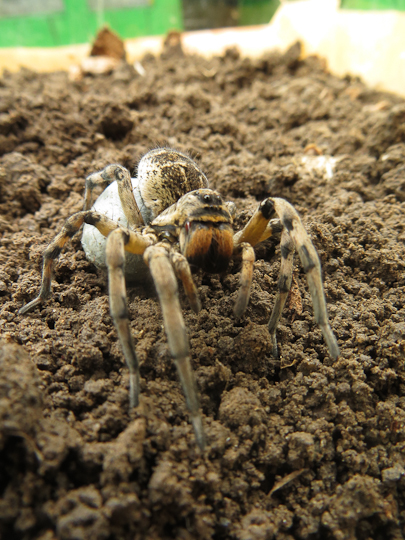
The Romanian tarantula, Lycosa singoriensis (Lexmann 1770), is actually not a tarantula at all! It’s a wolf spider! In Romania, and in most parts of Europe, the members of the family Lycosidae are commonly called tarantulas. This species is the largest spider in Romania.
For the last couple weeks my family and I have been visiting relatives in Romania. While we’ve been here, my son (Tavi) and I have made it our mission to capture the Romanian Tarantula. It all started when we were visiting the Celic-Dere Monastery (black water in Turkish) in northern Dobrogea (or Dobrudja), Romania and found numerous large holes in the ground surrounded by a “spidery” silk. The holes were about the size of a Toonie (about 1 inch in diameter) and approximately 30 cm deep (measured with a stick). So, we just had to investigate.

After talking with the locals, it was explained to us that the best way to capture one of these spiders was to “fish” for it. More specifically, we needed to use a skinny candlestick with the wax removed down to the last centimeter. (So, basically 1 cm of wax and the end of a string.) We immediately set out for our “fishing” trip…
[youtube http://www.youtube.com/watch?v=22Z5VmDh_28?rel=0&w=540&h=304]
Unfortunately, we had no success. After further questioning the local people, it was suggested we smoke it out… and still no success. (One of those “it seemed like a good idea at the time” plans.) Finally, plan C, to simply dig it out.

And… success at last!

The Romanian “tarantula” is found in central and eastern Europe. In Romania the species appear to be quite common but are classified as critically endangered in the Czech Republic and on the current IUCN Red List other parts of Europe (Frank 2000). The spider spends most of its time in the gallery it digs in the ground. The adult spiders are nocturnal and hunt mainly for insects but have been known to eat small lizards (locals, personal communication).
The species size and lifespan various according to their sex, males are smaller (approximately 19-25 mm) living one year and the females larger (approximately 25-30 mm) but live for two years (Iosob 2009). The spiders have an oval shaped cephalothorax and abdomen that are a brown and black on the dorsal side. Their ventral side is black.

In late summer and early fall males court the females by performing a nuptial dance just outside the gallery entrance. When the male approaches the female he begins to swagger, his leg hair lifts and descends alternately while vibrating (Prisecaru et al. 2010). The nuptial dance varies in time but copulation takes place for up to 1-2 hours (Prisecaru et al. 2010). Shortly after mating the male dies, leaving only juveniles and females to overwinter.
As is common in the spring, we caught an adult female with an egg sac, and as Tavi pointed out, “she is a very good Mama!” When we first dug her out of the ground she was separated from her egg sac, but when we put them together in a jar, she attached herself to them immediately. It has been reported that if the female loses her egg sac she will look for it with perseverance and even accept another spiders egg sac or a sham (Iosob 2009). Once the eggs hatch, females protect their spiderlings by carrying them on her abdomen and cephalothorax (about 4 days) until they deplete their vitelline reserves and complete their first moult (Prisecaru et al. 2010).
The name tarantula is derived from a common wolf spider (genus Lycosa) from Apulia, Italy. The folklore during the 11th century suggests that a person bit by the “tarantula” will undergo a hysterical behavior, called tarantism; that appears like violent convulsions. The only prescribed cure for tarantism was frenzied dancing; now known as the traditional Tarantella.
[youtube http://www.youtube.com/watch?v=BoWjMK93Lv8?rel=0&w=540&h=405]
Romania has without a doubt, some of the last untouched and preserved ecosystems among the European Union countries. (In fact, taxonomists can hardly keep up with identifying new species [Cogãlniceanu 2007].)While in most parts of Europe many plant and animal species are threatened or endangered, they can be found thriving in Romania (species like bears, wolves, tortoises, cormorants)… at least for now. It is crucial that we learn more about these species while they are still common (including the Romanian tarantula), and help them remain common in the face of growing threats such as economic development, overexplotation, or poaching. (You can read about current research and conservation work here and here.)
Tavi and I enjoyed exploring Romania, especially capturing and learning about the Romanian tarantula! We suggest you go and, as Tavi likes to say, “find the Mania in Romania!”

Citations:
Cogãlniceanu, D., Ruşti D., and Manoleli, D. (2007) Romanian taxonomy in crisis-present status and future development. Travaux du Muséum National d’Histoire Naturelle. L:517-526
Frank, V. (2010) Spiders (Araneae) on the red lists of European countries. EkolÓgia (Bratislava) 19: 23-28
Alin, Iosob G. Lycosa singoriensis sau Tarantula romaneasca.” Cunoaste natura si animalele din Romania!Blogspot, October 2010. Web. Accessed 01 May 2014. http://zoologysp.blogspot.ro/2009/05/lycosa-singoriensis-sau-tarantula.html
Prisecaru, M., A. Iosob, O. T. Cristea. 2010. Observations regarding the growth in captivity of the wolf-spider species Lycosa singoriensis (Laxmann, 1770). Studii şi Cercetări: Biologie, Universitatea ”Vasile Alecsandri” din Bacău, 19: 33-38.

President’s Prize winners and runners-up
Sarah Loboda of McGill University, a double runner-up! Photo by Miles Zhang.
In my last post, I shared some thoughts about the value of the President’s Prize at Annual Meetings of the Entomological Society of Canada. This time, with the help of Tyler Wist, I present the names and categories for each of the winners and runners-up.
I would like to congratulate all of these fine scientists, and invite each of them to share a bit about their work here on the ESC blog.
Oral Presentations
Bees and Pollination
Winner:
Veronika Lambinet (Simon Fraser University), with M. Bieri, M. Hayden, and G. Gries.
Bee talk – Do honeybees use the earth’s magnetic field as a reference to align their waggle dance?
Honourable mention:
Danae Frier (University of Regina), with C. Sheffield.
Bumblebees do it better: the importance of native bees to the pollination of haskap crops.
Biodiversity and Conservation
Winner:
Sebastian Ibarra (Simon Fraser University), with S. McCann, R. Gries, H. Zhai, and G. Gries.
The wrath of the bald-faced hornet – pheromone-mediated nest defence.
Honourable mention:
Seung-Il Lee (University of Alberta), with J. Spence and D. Langor.
Variable retention harvesting and saproxylic beetle conservation in white spruce stands of the boreal ecosystem.
Sarah Loboda (McGill University), with J. Savage, T. Hoye, and C. Buddle.
Ecological and evolutionary responses of Arctic flies to recent climate change in Zackenberg, Greenland.
Arthropod Biology
Winner:
Sharleen Balogh (University of Northern British Columbia), with D. Huber and S. Lindgren.
Host selection of lodgepole pine (Pinus contorta) by the Warren root collar weevil (Hylobius warreni).
Honourable mention:
Aldo Rios (University of Manitoba), with A. Costamagna.
Contribution of soybean aphid alates to colony fitness under predation.
Pest Management
Winner:
Tina Dancau (CABI, Switzerland), with T. Haye, P. Mason, and D. Gillespie.
Mortality factors affecting the diamondback moth (Plutella xylostella) in continental Europe: a preliminary life table analysis.
Honourable mention:
Jon Williams (University of Guelph), with H. Earl and R. Hallett.
Laboratory investigations of swede midge, Contarinia nasturtii, oviposition and damage symptoms to canola.
Posters
Winner:
Sabrina Rochefort (McGill University), with T. Wheeler.
Taxonomy and diversity of Parapiophila (Diptera: Piophilidae).
Honourable mention:
Sarah Loboda (McGill University), with C. Ernst and C. Buddle.
Yellow pan traps versus pitfall traps: best monitoring tool for ground-dwelling arthropods in the Arctic.
What is a President’s Prize worth?
Sabrina Rochefort – winner of the President’s Prize for best poster
At the recent ESC/ESS JAM in Saskatoon, not only were we treated to some great science and camaraderie, but the beloved institution of the President’s Prize sessions for student talks and posters provided some of the most stimulating and exciting times. This was my first year not being in the competition, and I would like to offer my views on the subject.
1) The President’s Prize encourages excellence: Students are definitely motivated to deliver polished and professional presentations in the hopes that their efforts will be recognized publicly. This reaches further than the conference, to encourage students to vet their talks and posters within their laboratories and departments in formal and informal settings in order to make the best presentation possible. This can only be a good thing.
2) The recognition is important: this prize, although modest financially, has amazing value as something to put on one’s CV. This enhances the career prospects of the winners and also the recognition that conference travel for students is worth funding within departments. Again, the value of this prize reaches much further than the conference, as students returning with the tangible benefits of a prize winning talk encourages others to make it a priority to attend and give an excellent talk next year.
The President’s Prize and the more recent innovation of the Graduate Student Showcase are thus valuable to the society as a whole. By encouraging and recognizing the efforts of students who attend our conferences to present well-polished research results, we promote excellence in scientific communication. We can all learn from the skill and innovation of these students!
With all of this in mind, I would like to make some recommendations:
1) For every conference, pre-publish the scoring rubric to be used by the judges. This will ensure that students entering a talk or poster know what points they have to hit to make their talk a candidate for the prize. These rubrics should not penalize creativity on the part of the students or discretion on the part of the judges, but should ensure that there is a baseline for what is expected.
2) At every conference, formally recognize runners-up in every session: It costs nothing but a bit of extra time during award presentation, but the chance to bestow recognition on a few more students should not go to waste. Many sessions have many excellent talks, and to send an excellent presenter home with nothing does no one any good. It has been a bit hit and miss in recent years at ESC meetings with regards to runners-up, and I think it should be the case that every conference includes this important recognition.
3) Send all competitors home with the judging sheets. This is a bit more onerous on the part of the judges, but the judges can definitely jot down some notes on their scoring sheet and show the tally for how well the talk lived up to the rubric. This is important to show that the criteria used to score the talks informed the decision. More importantly, it allows students to see how well their talk met the judges’ expectations, and to improve their presentations for the next year. This has been done at a couple of ESC meetings over the last few years and as far as I know, students found the feedback they got very valuable and were able to use it to improve their science communication skills.
Thanks to Mile Zhang for photos of the poster competitors, and to Catherine Scott for helpful suggestions. Congratulations to all this year’s winners, runners-up, and competitors!
ESC/ESS JAM 2014 Day 1 photos
Drop in on your friends…Before it’s too late!
How to get a spider to drink blood
Spiders may not bite, but that doesn’t mean you can’t get them to drink your blood! All you need is a sunset at the beach, hordes of mosquitoes, a spider, and some frustration to take out.
The other night, I was unwinding with an evening of wasp and bee photography at Iona beach, but the flight conditions were great for mosquitoes. They kept interrupting my shots of this lovely Tetragnatha laboriosa, so I decided to share the wealth.
Trapping the mosquito against my skin, I released it in the sweet spot of the web.
You can see the movement of the wrapping action, as I was also dragging the shutter to get some light in the darkening sky.
I was looking forward to a great splash of blood as the spider bit in!
This is about as good as it got however, but I am sure the spider will appreciate the extra protein already in liquid form.
This one is pretty cool too…
The mozzies kept biting, so I kept tossing them into the web.
I kept the spider busy wrapping up her gifts for quite a while.
When we both had had enough, I headed home, feeling itchy, but satisfied that I had at least achieved the fattening up of a cool tetragnathid.
Update from The Canadian Entomologist Editorial Board
The Editorial Board of The Canadian Entomologist (TCE) welcomes the comments that we receive from readers and authors. We take these comments seriously and implement appropriate changes when possible. We are pleased to announce three such changes that will further improve the speed, quality and flexibility of the service provided by TCE.
In addition to the above changes, there are several other items that may be of interest. ‘Instructions to Authors’ were revised in March of this year. Revisions include instructions for the submission of ‘Supplementary Material’ and a link to third-party services that specialize in language editing.
You also may wish to read “Open access, predatory publishers, The Canadian Entomologist, and you”. This article appears in the Bulletin of the ESC (Sept. 2013, p. 131), and examines issues that should be interest to anyone publishing in scientific journals.
In closing, we note that Dr. Chris Buddle (McGill University, Montreal, QC) will be completing his tenure as Editor-in-Chief this fall. Dr. Kevin Floate (Agriculture and Agri-Food Canada, Lethbridge, AB) is the incoming Editor-in-Chief.
We thank you, the authors and readers, for making TCE an ongoing success.
Chris Buddle
Kevin Floate
Hymenoptera at Sunset
Last night I went for a ramble at Iona Beach in Richmond BC, looking for insects and inspiration in the sand dunes. I knew the sunset would be pretty, as there was a bit of light wispy cloud in the west, so I hurried out to the end of the beach where restoration efforts hadn’t ripped up the ground.
I found my subjects attaching themselves to twigs and vegetation, bedding down for the night.
Coelioxys spp. (Megachilidae) preparing to attach to a dead, dried flowerhead. Next time you go for a sunset beach stroll, have a look for these and other sleeping insects!
If you are a photographer, the combination of the setting sun and your flash can do wonderful things to highlight your subjects.
An Ammophila wasp (Sphecidae), shot without flash, is but a silhouette against the darkening sky.
I am not sure, but I think I may have gone overboard with this session! It seems like it could be an ad for a tropical beach vacation for insects.
This slender and elegant caterpillar hunter is fast and nervous in the day, but wonderfully calm in the evening.
As the light was failing, so were my flash batteries, but this unplanned blur of a cluster of male Colletes males is still cool!
There are so many bees on this flower that it sags to the ground!
The Colletes cluster against the darkening sky of night.
Next time you go for an evening stroll on a sandy beach, head up to the dune vegetation, and have a look for these wonderful sleeping wasps and bees!
Friday night fun: spiders at Iona Beach
Samantha Vibert, Gwylim Blackburn, Catherine Scott and Sam Evans in the midst of examining an unidentified jumping spider.
Yesterday, I had the pleasure of ferrying four Vancouver-area spider researchers out to Iona Beach in Richmond for a bit of a Friday-evening ramble in search of spiders. Gwylim Blackburn and Samantha Vibert are old hands at spider observations at this site, Gwilym had studied Habronattus americanus and Samantha had studied Hobo Spiders. Catherine Scott (who studies black widows) and Sam Evans (a recent recruit to Wayne Maddison’s lab) came along as well. This was a Toyota Tercel loaded down with spider talent!
Daisy did not ask for this in her old age, but performed admirably nonetheless.
We arrived shortly after 7 pm, and despite the late hour, we found a few jumping spiders, although Habronattus americanus was already in bed. I only managed to sneak in a couple photos of large Phidippus.
Sam searches among moss and Scotch Broom.
A long-jawed orbweaver male (Tetragnathidae) tucked in with a pupating beetle.
A freshly-moulted harvestperson with exuvium still attached!
A large ichneumonid among pine needles.
A 10-lined june beetle larva under a log.
A wolf spider in her burrow with a freshly-laid eggsac.
Gwylim searches the beach.
Just before the gates were due to close at the park, we spotted a couple of snails, seemingly uncaring of our log-flipping sharing a tender moment. We hope they had a fun night!
The Romanian Tarantula
The following is a guest post by Simon Fraser University student Bekka Brodie. Bekka studies blow fly ecology and blogs at www.bekkabrodie.com.
The Romanian tarantula, Lycosa singoriensis (Lexmann 1770), is actually not a tarantula at all! It’s a wolf spider! In Romania, and in most parts of Europe, the members of the family Lycosidae are commonly called tarantulas. This species is the largest spider in Romania.
For the last couple weeks my family and I have been visiting relatives in Romania. While we’ve been here, my son (Tavi) and I have made it our mission to capture the Romanian Tarantula. It all started when we were visiting the Celic-Dere Monastery (black water in Turkish) in northern Dobrogea (or Dobrudja), Romania and found numerous large holes in the ground surrounded by a “spidery” silk. The holes were about the size of a Toonie (about 1 inch in diameter) and approximately 30 cm deep (measured with a stick). So, we just had to investigate.
After talking with the locals, it was explained to us that the best way to capture one of these spiders was to “fish” for it. More specifically, we needed to use a skinny candlestick with the wax removed down to the last centimeter. (So, basically 1 cm of wax and the end of a string.) We immediately set out for our “fishing” trip…
[youtube http://www.youtube.com/watch?v=22Z5VmDh_28?rel=0&w=540&h=304]
Unfortunately, we had no success. After further questioning the local people, it was suggested we smoke it out… and still no success. (One of those “it seemed like a good idea at the time” plans.) Finally, plan C, to simply dig it out.
And… success at last!
The Romanian “tarantula” is found in central and eastern Europe. In Romania the species appear to be quite common but are classified as critically endangered in the Czech Republic and on the current IUCN Red List other parts of Europe (Frank 2000). The spider spends most of its time in the gallery it digs in the ground. The adult spiders are nocturnal and hunt mainly for insects but have been known to eat small lizards (locals, personal communication).
The species size and lifespan various according to their sex, males are smaller (approximately 19-25 mm) living one year and the females larger (approximately 25-30 mm) but live for two years (Iosob 2009). The spiders have an oval shaped cephalothorax and abdomen that are a brown and black on the dorsal side. Their ventral side is black.
In late summer and early fall males court the females by performing a nuptial dance just outside the gallery entrance. When the male approaches the female he begins to swagger, his leg hair lifts and descends alternately while vibrating (Prisecaru et al. 2010). The nuptial dance varies in time but copulation takes place for up to 1-2 hours (Prisecaru et al. 2010). Shortly after mating the male dies, leaving only juveniles and females to overwinter.
As is common in the spring, we caught an adult female with an egg sac, and as Tavi pointed out, “she is a very good Mama!” When we first dug her out of the ground she was separated from her egg sac, but when we put them together in a jar, she attached herself to them immediately. It has been reported that if the female loses her egg sac she will look for it with perseverance and even accept another spiders egg sac or a sham (Iosob 2009). Once the eggs hatch, females protect their spiderlings by carrying them on her abdomen and cephalothorax (about 4 days) until they deplete their vitelline reserves and complete their first moult (Prisecaru et al. 2010).
The name tarantula is derived from a common wolf spider (genus Lycosa) from Apulia, Italy. The folklore during the 11th century suggests that a person bit by the “tarantula” will undergo a hysterical behavior, called tarantism; that appears like violent convulsions. The only prescribed cure for tarantism was frenzied dancing; now known as the traditional Tarantella.
[youtube http://www.youtube.com/watch?v=BoWjMK93Lv8?rel=0&w=540&h=405]
Romania has without a doubt, some of the last untouched and preserved ecosystems among the European Union countries. (In fact, taxonomists can hardly keep up with identifying new species [Cogãlniceanu 2007].)While in most parts of Europe many plant and animal species are threatened or endangered, they can be found thriving in Romania (species like bears, wolves, tortoises, cormorants)… at least for now. It is crucial that we learn more about these species while they are still common (including the Romanian tarantula), and help them remain common in the face of growing threats such as economic development, overexplotation, or poaching. (You can read about current research and conservation work here and here.)
Tavi and I enjoyed exploring Romania, especially capturing and learning about the Romanian tarantula! We suggest you go and, as Tavi likes to say, “find the Mania in Romania!”
Citations:
Cogãlniceanu, D., Ruşti D., and Manoleli, D. (2007) Romanian taxonomy in crisis-present status and future development. Travaux du Muséum National d’Histoire Naturelle. L:517-526
Frank, V. (2010) Spiders (Araneae) on the red lists of European countries. EkolÓgia (Bratislava) 19: 23-28
Alin, Iosob G. Lycosa singoriensis sau Tarantula romaneasca.” Cunoaste natura si animalele din Romania!Blogspot, October 2010. Web. Accessed 01 May 2014. http://zoologysp.blogspot.ro/2009/05/lycosa-singoriensis-sau-tarantula.html
Prisecaru, M., A. Iosob, O. T. Cristea. 2010. Observations regarding the growth in captivity of the wolf-spider species Lycosa singoriensis (Laxmann, 1770). Studii şi Cercetări: Biologie, Universitatea ”Vasile Alecsandri” din Bacău, 19: 33-38.
Happiness is a freshly-moulted Phidippus
I know this isn’t entomological in the strict sense, but isn’t it just grand when you come upon an arthropod as splendid as this freshly-moulted Phidippus johnsoni? What a beautiful spider! I found this last evening in Mt. Tolmie Park in Victoria, BC, and you can be sure where beauties like this are turning up, a plethora of insects also awaits. I can’t wait to go and explore!