


Nouvelles
Chercheurs en lutte antiparasitaire intégrée,
Le Centre de la lutte antiparasitaire élabore le Rapport de recherches sur la lutte dirigée (RRLD) pour la Société canadienne de phytopathologie (SCP), avec le concours de la Société d’entomologie du Canada. Le RRLD facilite l’échange de renseignements sur la lutte antiparasitaire intégrée entre les personnes participant à la recherche et aux services-conseils sur la lutte antiparasitaire intégrée contre les insectes nuisibles et les phytopathologies d’importance pour l’industrie agroalimentaire canadienne.
Le RRLD est publié annuellement sous forme d’une compilation de rapports de recherche effectuée par le personnel des gouvernements fédéral et provinciaux, d’universités, de l’industrie et de services‑conseils. Ces rapports aident à formuler des recommandations pour les programmes de lutte contre les insectes et les maladies au Canada. Ils traitent de tous les aspects de la lutte antiparasitaire, dont les cultivars et les modes de lutte et ils sont disponibles afin d’appuyer l’homologation de produits antiparasitaires. Le RRLD est publié uniquement en version électronique. Les éditions 1995 à 2017 sont disponibles pour consultation et téléchargement sur le site de la SCP à http://phytopath.ca/publication/pmrr/.
Vous trouverez l’invitation à soumettre des rapports de recherche pour l’édition 2018 du RRLD. Veuillez encourager aussi vos collègues effectuant des recherches sur la lutte antiparasitaire intégrée à soumettre des rapports de recherche.
Salutations,
Stefan Bussmann

Le quatorzième concours annuel de photographie visant à sélectionner des images pour les couvertures de The Canadian Entomologist et du Bulletin de la Société d’entomologie du Canada pour 2019 est en cours. Les images sur la couverture doivent représenter l’étendue entomologique couverte par les publications de la Société. Des photos représentant des insectes ou autres arthropodes forestiers, urbains ou agricoles, des paysages, du travail de terrain ou de laboratoire, des gros plans, ainsi que montrant des activités associées à la physiologie, au comportement, à la taxonomie ou à la lutte intégrée seraient souhaitées. Deux « insectes vedettes » (pour le dos et sous le titre) sont également recherchés. Si elle est sélectionnée, votre photo ornera la couverture des deux publications pour l’année entière. De plus, vos photos gagnantes et une sélection de photos soumises seront montrées sur le site Internet de la SEC.
Règlements du concours :
Les photos d’insectes et autres arthropodes à n’importe quel stade, effectuant n’importe quelle activité et dans n’importe quel habitat sont acceptées. Afin de représenter les sujets de la recherche entomologique, nous encourageons également les photos de parcelles de terrain, expériences de laboratoire, impacts des insectes, activités de recherche, équipement d’échantillonnage, etc. Les photos doivent, cependant, avoir un intérêt entomologique clair.
Les images numériques doivent être soumises sans bordure, en format JPG de haute qualité, avec le plus grand côté (largeur ou hauteur) d’un minimum de 1500 pixels.
Chaque participant peut soumettre jusqu’à cinq photographies. Une légende doit être fournie pour chaque photo soumise : les photos sans légendes ne seront pas acceptées. La légende doit inclure la localisation, l’identification du sujet le plus précisément possible, la description de l’activité si le sujet n’est pas un insecte, et toute information intéressante ou pertinente. Les légendes doivent avoir une longueur maximale de 40 mots.
Les participants doivent être membres en bonne et due forme de la Société d’entomologie du Canada. Les photos doivent avoir été prises par le participant, et le participant doit en posséder les droits d’auteur.
Le participant conserve les droits d’auteur de la photo, mais l’utilisation libre de droits doit être accordée à la SEC afin de l’inclure sur la couverture d’un volume (6 numéros) de The Canadian Entomologist, un volume (4 numéros) du Bulletin, et sur le site Internet de la SEC.
Le comité d’évaluation sera choisi par le président du comité des publications de la SEC et inclura un membre du comité du contenu du site Internet.
Les gagnants du concours de photographie seront annoncés sur le site Internet de la SEC et pourront être annoncés à la réunion annuelle de la SEC ou dans le Bulletin. Il n’y a pas de prix en argent pour les gagnants, mais les photographes seront remerciés dans chaque numéro où les photos seront imprimées.
La date limite de soumission est le 31 août 2018. Les soumissions doivent être faites en pièces jointes d’un courrier électronique. L’objet du message doit débuter par « Soumission pour le concours de photographie de la SEC ». Envoyez vos courriels à : photocontest@esc-sec.ca.
Les inscriptions et l’hébergement sont maintenant ouverts pour Vancouver!
Faites vos plans dès maintenant pour être à Vancouver pour la réunion annuelle conjointe 2018 de la ESA, SEC et SECB du 11 au 14 novembre. Inscrivez-vous et réservez votre hôtel pour dormir près du centre des congrès de Vancouver ou réservez au plus bas tarif. Consultez notre liste excitante d’excursions et d’ateliers que vous pouvez ajouter à votre inscription et tirez parti de votre temps en Colombie-Britannique! Avec plus de 120 symposiums et ateliers, 1300+ présentations et 575 affiche, vous ne voulez pas manquer cette réunion au Canada!
Vous ne pouvez pas vous rendre à Vancouver? Soumettez une affiche virtuelle afin de faire partie de la réunion, incluant la compétition étudiante! Consultez les exigences et tarifs.
This post is the first in a series featuring ‘cool’ and ‘cruel’ (pest) insects in Canada. If there’s an insect that you’d like to write a post about, please get in touch with us!
by John Acorn

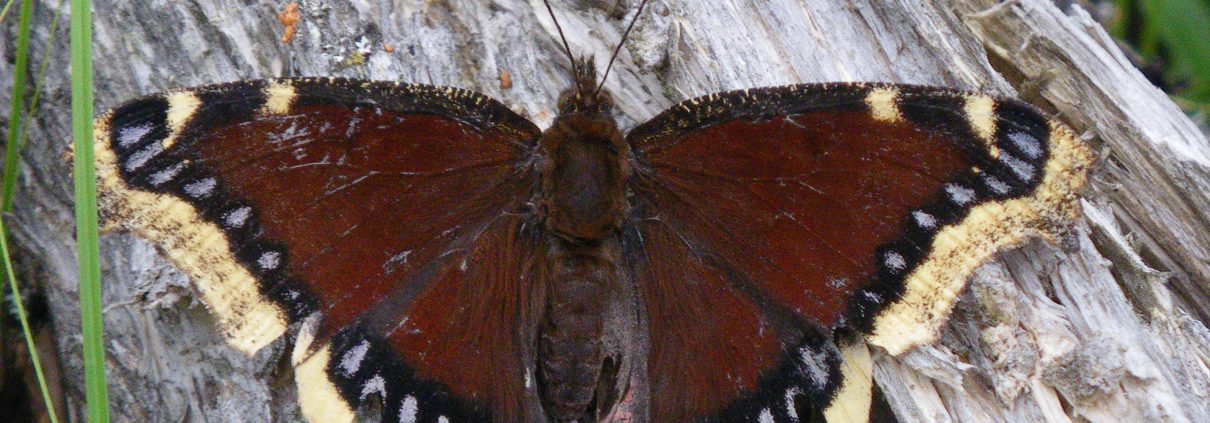
The beautifully camouflaged under surface of a Mourning Cloak butterfly.
How long do butterflies live? For most, the answer is « not very long, » after what may have been many months as an egg, caterpillar, and chrysalis. For the Mourning Cloak (Nymphalis antiopa), however, life as a butterfly can stretch over an entire year. Mourning Cloaks spend the winter in hibernation, under bark for example, and they are often the « first butterfly of spring, » along with their close relatives, the tortoiseshells and commas. Since Mourning Cloaks are widespread in North America and Eurasia, they are probably the most oft-encountered spring butterflies in the north temperate world. After feeding on various trees (elm, willow, and poplar are all acceptable fare) as caterpillars, Mourning Cloak butterflies emerge from their pupae in mid to late summer. They sometimes live as long as twelve months as adults. In springtime, they typically emerge from hibernation before the first flowers are in bloom, and they feed on everything from sap flows to dung to mud, in order to obtain the nutrients necessary for such a long life.
On an older Mourning Cloak, the bright yellow wing edges have faded to pale white, and the maroon of the wings becomes a more generic shade of brown. The wing pattern of Mourning Cloaks has been the inspiration for speculation among entomologists. Most agree that the underside of the wings is camouflaged, looking like a dried leaf, or tree bark. But the upper side has been interpreted as a depiction of a yellow, black, and blue-spotted caterpillar, walking along a brown-maroon surface. Birds might peck at the fake caterpillar, thereby missing the delicate body of the butterfly, and indeed we do find Mourning Cloaks with bird bill marks along the edges of their wings (« cloak and dagger, » one might ask?). On the other hand, Mourning Cloaks are agile fliers, and at least one other insect, the Carolina Locust grasshopper (Dissosteira carolina), appears to mimic the Mourning Cloak, perhaps to convince birds that it is difficult to capture in flight.

A freshly emerged Mourning Cloak with bird bill marks along its wing margin. Wingspan approximately 7 cm.
In any event, the wings of Mourning Cloaks are similar to a traditional style of clothing worn when in mourning, but maroon or purplish mourning dresses with dull yellow trim were a matter of « half mourning » in Victorian England, whereas full mourning clothing was all black. In the UK, this species is known as the Camberwell Beauty, in remembrance of two migrant individuals (yes, this species will sometimes undergo « irruptive » migrations, in years when they are especially common) that made their way from the European mainland to Camberwell, a part of London. In French, the name is Morio, a word that also refers to starlings, birds that share a dark ground colour with yellow accents. As for the scientific name, Nymphalis means « nymph, » and refers to the forest nymphs of Greek mythology, while Antiope was the name of one of the mythical Amazons. You will find, however, that if you Google the word « antiopa, » almost all of the hits will refer to the butterfly, which has now eclipsed its namesake.
Links:
http://www.cbif.gc.ca/eng/species-bank/butterflies-of-canada/mourning-cloak/?id=1370403265696
http://entomology.museums.ualberta.ca/searching_species_details.php?fsn=nymphalis+antiopa&sb=1&r=2&o=1&c=2&s=2652&sn=Nymphalis+antiopa
Photos supplied by John Acorn
The Mourning Cloak Butterfly
CONTACTER LA SOCIÉTÉ
Assistant administratif : info@esc-sec.ca
SEC Président : ESCPresident@esc-sec.ca
This post is also available in: