By Crystal Ernst, PhD Candidate (McGill University)
Since I finally submitted my manuscript to a journal (YAY!), I’ve been tying up the little loose ends remaining at the end of the project. You know: organizing the useful data and image files, tossing the files marked “MESSING_AROUND_WITH_DATA_v.29), tidying up my R code, and, perhaps most importantly, curating my specimens.
I’m not going to go into too much detail about the project here (I’m saving that for another post). I will say, though, that the work I just completed includes just over 2,600 beetles from a single location in Nunavut (Kugluktuk, where I spent my entire first field season).
Two major aspects of the physical work (as opposed to the thinking, reading and writing) involved in an ecological/entomological project such as this one are the pinning and the identifications. Some of the tasks are a bit tedious (cutting labels; entering data; gluing over 800 specimens of the same tiny, plain black ground beetle to paper points), and some of them are thrilling (finally getting over the “hump” of the morphological learning curve and feeling good and confident when working with your keys; having experts tell you “Yep, you got those all right”; discovering rare species or new regional species records). In the end, in addition to the published (*knocks on wood*) paper, you have boxes or drawers full of specimens.
The specimens are gold. (Read this post by Dr. Terry Wheeler to understand why.)
Unfortunately, they don’t always get treated as such.
In the two-ish years that I’ve been working in my lab, we’ve had two major “lab clean-up days”. The first managed to get rid of a lot of clutter (old papers, broken apparatus, random crap). The second involved going through the “stuff” that was eating up all the most valuable storage space: specimens. Years and years worth of graduate and undergraduate projects’ specimens, stashed in freezers, boxes, bags and vials of all shapes and sizes.
Some things were in good shape (pinned well, or in clear ethanol). Other things were, well, downright nasty: gooey beetles in sludgy brown ethanol, dried up bits of moth wings in plastic containers, and a little bit of “what in the name of pearl is growing on that agar plate???” in the fridge.
None of these items were kept – their value as useful specimens was nil. So, the physical representation of some student’s work – probably months or years worth of work – was tossed in the trash.
Others, happily, were tucked back into drawers and cupboards, because someone had taken the time to ensure the specimens were well-preserved.
However, even many of these were suffering from a serious issue: bad labels.
Allow me to illustrate the point. This is a bad label:
 This is also a bad label:
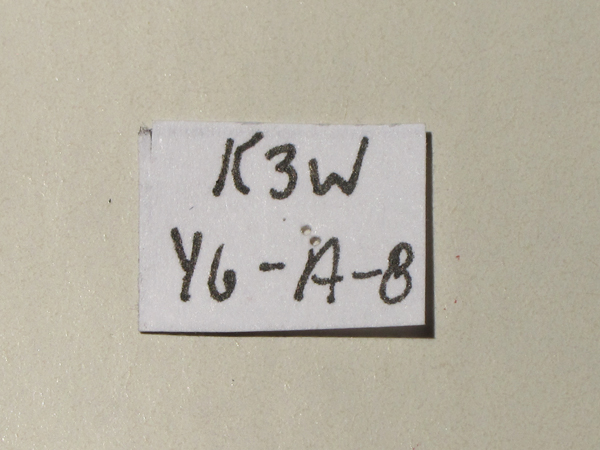
The first, you’ll note, is written in ballpoint pen (which fades) on a torn piece of notebook paper and contains almost no information. The second, although it looks fancier and perhaps more sciencey, is just as bad: it contains a cryptic code that is useful only to the bearer of the lab notebook in which said code has been written down. Or, perhaps the code is completely intelligible to the researcher who developed it, but the key to it exists only in his or her head.
To everyone else, it is meaningless. Neither of these labels indicate who collected the specimen, where, when, or how. And we all know what happens in labs: upon completion of their degrees, students move on, email addresses change, notebooks are misplaced, data files are not backed up. The labels’ codes can never be broken, and the scientific value of the specimens – *poof*.
While there’s nothing wrong, in theory, with using labels like these temporarily (although there is always a risk that they will be misinterpreted or misunderstood after a little while, even by the person who wrote them), they are absolutely useless as permanent records.
These are good labels:

These labels, properly affixed to a specimen, provide clear and universally understood information. One provides the location, including GPS coordinates, a method of collection, a date, the name of the collector(s). The information that goes on this label can vary a bit (it may include information about the habitat or host plant, for example), but those are the basic requirements. The smaller label is typically affixed on the pin below the first, and contains the specimen’s scientific name and the name of the person who identified it (it is the “det. label”, i.e., “determined by”). These labels, and therefore the specimen with which they are associated, will remain useful for decades, even centuries.
I am totally guilty of both of the offenses I just explained (the gooky vials of nastiness and the bad labels). For my undergraduate honors project, I identified close to 8000 spiders, mites and insects to the Family level – it was hundreds of hours of microscope work. Then I stuffed all those specimens back into vials with cryptic little codes, like V-1-F(!), hand-written on STICKERS(!), which I placed on the LIDS(!) and not even in the vials themselves(!). Oh, and I’ve long since lost the notebook that contained my decoder key(!). THIS IS ALL SO BAD. I have no doubt that those boxes of vials, which I once prized so highly and felt such pride for, have been unceremoniously tossed in the trash by my former advisor.
Well, I’ve learned from my mistakes, and from working with museum and other collection specimens. I now understand that each specimen is deserving of respect – it’s the original data after all – and that means it should be properly preserved, and labelled.
So.
Last week I spent a great deal of time, as I said, tying up my loose ends. The last thing I needed to do was remove my cryptic labels (the second in the series up there is an actual example of one of my own “secret code” labels) and replace them with proper ones, sorting and tidying up the collection in the process. The end result?
This:

Frankly, it’s a thing of beauty. It’s also enormously scientifically valuable. These specimens will be deposited in various nationally-important collections and museums, like the CNC.

As a matter of fact, just last week I was at the CNC, and I saw specimens bearing the name of the last person to do a comprehensive survey of the insects in Kugluktuk, back in 1955. That tiny but so-important label suddenly made me feel connected to the man who, almost 60 years earlier, had stood on the same stretch of tundra as me, holding and perhaps delighting in the very specimen that I held in my own hand.

Giving my specimens the respect they deserve is worth it, not only for the scientific value, but also because perhaps, 60 years from now, another grad student will discover my name on a specimen’s det. label. Perhaps she, too, will feel that same wondrous sense of connection to the the greater scheme of scientific discovery…

____________________________
Original post at: http://thebuggeek.com/2012/06/25/respect-your-specimens/

Fellows of the Entomological Society of Canada, 2012
A few weeks ago, Rose De Clerke-Floate wrote a post about her experiences as the Chair of the ESC Achievement Awards Committee and announced the recipients of the Gold Medal and the C. Gordon Hewitt Award. Today, she announces additional honours bestowed upon more of our valued members.
_________________________________________
We applaud the following worthy members of the Entomological Society of Canada (ESC) whom are to be made Fellows of our Society in recognition of their major contributions to entomology.
Dr. Robb Bennett
Dr. Gary Gibson
Dr Gibson also is being recognized for his long-time dedicated service to entomology within AAFC and the ESC. He has served in various capacities to enhance the CNC and the CanaColl Foundation, a non-profit organization that supports visits by experts to curate portions of the CNC. In his 30+ years as an active member of the ESC, he has also served in a number of societal roles, including as Associate Editor of TCE (1990-95), Chair of the Finance Committee (1992-95), and Treasurer (1996-2004).
Dr. Neil Holliday
Luminous impressions of nocturnal pollinator research
By Paul Manning, B.Sc. student at Nova Scotia Agricultural College
_______________
As an undergraduate student, I’ve been working diligently on the final hurrah of my four year career; the undergraduate thesis. I’ve been fortunate to work under the supervision of Dr. Chris Cutler for the past two summers, learning about the ecology and roles of insects within wild blueberry production. Though I’ve worked on a wide variety of projects within the lab, I’ve realized quickly that pollination was the aspect of entomology that I found to be particularly intriguing.
Blossoms of wild blueberry May, 23rd, 2012 (Photo by P. Manning)
One of the projects that caught my eye was as a continuation of a trial that our lab did in the summer of 2011. By sanctioning off areas of wild blueberries with cages that prevented pollinators from accessing the flowers, the team discovered that approximately a third of pollination events may be attributed to nocturnal insect activity, as well as weight of ripe berries being insignificant between nocturnal, and diurnal pollinated treatments. Though a number of insects were collected using Malaise traps in this study, it was not possible to conclude captured insects were responsible for vectoring the pollen.
Lo and behold, there was a great opportunity for my thesis; to discover the identities of nocturnal pollinators within wild blueberry production. Armed with a sweep net, kill jars, a mercury-vapour lamp, tissue and enough ethyl-acetate to open my own nail salon we began to hit the field. Our sampling periods happened at two different times during the night; an early shift that started as soon as the sun went down, and a shift that started at 12:00 AM. Each sampling session lasted for two hours in length.
We implemented an interesting capture method, which worked extremely effectively. Under the glow of the mercury-vapor lamp, we placed a large 8×4 plywood board against the fence, making an 80° angle with the ground. When the insect landed upon the board, a quick capture could be made by placing the kill-jar against the board, and giving the board a small tap. This caused the insect to fly up into the kill-jar.
Screen illuminated by the mercury-vapour lamp (Photo by P. Manning)
June beetle captured with light trapping (Photo by P. Manning)
As the mercury vapor lamp began to buzz, insects began to make their way out of the dark and against our screen. The diversity was stunningly interesting, quite surprising. Tiny midges, large scarab beetles, hawk moths, and nocturnal icheumonids were included amongst our varied group of visitors.
[youtube=http://www.youtube.com/watch?v=OJNKIzoC-yE]
Sweep samples were also taken in an area of darkness within the field. We used ethyl-acetate fumigated from a ventilated jar, within a larger Tupperware container to effectively kill the insects without struggle. The diversity from these samples was very different; being attributed mostly to beetles and small flies.
Insects were analyzed to find whether or not they carried pollen using methods. By swabbing the eyes, head, and mouthparts with a small cube of fuchsin gel. By sealing these slides with the aid of a Bunsen burner, blueberry pollen was easily detected through its distinctive tetrad shape using a light microscope.
As the samples have been analyzed, the diversity of insects that may represent the nocturnal pollinators of wild blueberry is staggering. Though the work has been challenging and sometimes very tedious (have you ever attempted removing pollen off the head of a thrips?). I’ve learned a great diversity of things, including: an incredibly simple way to differentiate between icheumonids and brachonids; that there are an incredible number of fly families that vaguely-resemble a typical housefly; and that iced-cappuccinos do contain caffeine (after finally drifting off to sleep at 4:30 AM on a Sunday morning).
A small moth visits the light screen after sampling finishes (Photo by P. Manning)
This project has been a great way to open my eyes to the diversity of insects responsible for ecological functions. When prompted with the cue ‘pollination’ – my mind has been switched over from the typical image of a honey-bee – to a myriad of insect visitors among flowers. This is a vision of pollination which to me is something more; diverse, representative, and inclusive of this invaluable ecological service.
_____
References:
Beattie, A. J. 1971. A technique for the study of insect-borne pollen. Pan-Pacific Entomologist 47:82.
Cutler, C. G., Reeh, K. W., Sproule, J. M., & Ramanaidu, K. (July 01, 2012). Berry unexpected: Nocturnal pollination of lowbush blueberry. Canadian Journal of Plant Science, 92, 4, 707-711.
Stupidity is the mother of invention
By Dr. Terry Wheeler, Director of the Lyman Entomological Museum, McGill University
_________________________________
Warning: the following post contains content that makes a university professor and museum director look a bit ridiculous. Readers who wish to cling to the fiction that University Professors are smart, infallible and wise may find this post unsettling.
“Do you have everything?” A logical and reasonable question from The Students as The Professor exits his hotel room in the morning, several bags in hand. Some Students may consider such a question presumptuous, but it’s good to run through these little mental checklists.
Lesson #1 (for Students and Assistants): “Do you have everything?” may be a little too broad a question. A series of questions identifying particular individual items of necessary field equipment might be better. In this case, for example, a question along the lines of “Do you have the sweep net handles?” might have saved much subsequent humiliation and hilarity.
Lesson #2 (for Professors): Pack the gear the night before AND get enough sleep!
We jumped in The Vehicle and headed south for a long day of collecting in the dry prairies of southeastern Alberta. We had our sights set on a few promising collecting spots and it was a sunny day. After an hour or so of driving we arrived at the first site and The Professor disgorged the contents of the several bags as The Students waited to begin doing science. “Where are the net handles?” asked both Students, almost simultaneously. “Well,” replied The Professor “obviously they’re in the $#%#$ hotel in my &#@% red duffel bag.”
Lesson #3 (for Students and Assistants): Do not be afraid to laugh at a Professor, especially when they deserve it.
Lesson #4 (for Professors and Aspiring Professors): You can’t afford to take yourself too seriously. Things happen and people will laugh at you. Pretend you’ve just told a wickedly funny joke. I find that helps.
So, not relishing a long drive back to the hotel in the prairie heat, The Professor was forced to improvise, which he did in a rather unspectacular way, and the Short-Handled Shortgrass-Prairie Sweep Net (SHSPSN) was born.
The short-handled shortgrass-prairie sweep-net, ready for deployment. (Photo by T. Wheeler)
Some readers will recognize the SHSPSN as reminiscent of a short-handled folding insect net commonly referred to as a “National Park Special”, a net that folds up compactly and is easily concealed in a pocket for . . . well . . . ummm . . . inclement weather and increased mobility and the like. In our case (we were not in a National Park or other similarly protected area), the short handle worked quite well to keep us low and out of the high wind blowing across the site. Of course, the actual process of sweeping required a slightly modified stance compared to regular sweeping.
Anna demonstrating excellent SHSPSN technique. Her back will be fine. (Photo by T. Wheeler)
In the end, we collected (very successfully!) at four good sites that day with our lightweight, compact SHSPSN’s. Fortunately, we encountered no other Entomologists (especially Lepidopterists, with their penchant for freakishly long-handled nets) who could have taken advantage of our predicament and heaped ridicule upon us, especially The Professor.
And the next morning, when The Professor emerged from his room, well-rested and laden with several bags, The Students greeted him with a hearty “Do you have the net handles?” and it didn’t sound sarcastic AT ALL.
Lesson #5 (for Students and Assistants): Sooner or later, every Professor is going to do something dumb. Take joy in such magical moments. They are the times that make The Professor appear slightly less than superhuman. It helps to have a camera handy for the more spectacular times. Such photos make great content for retirement celebrations or department Christmas parties.
Lesson #6 (for Professors): The great thing about tenure is that you can actually get away with a lot of really dumb stuff. Just don’t lose any Students in the field – there’s a lot of paperwork involved. I find keeping the numbers low and giving each of them a distinct name helps. Take attendance a lot. Especially at airports.
And if anyone would like plans for making their very own SHSPSN, please contact The Professor.
_________________________
The original post can be found on Dr. Wheeler’s blog, here: http://lymanmuseum.wordpress.com/2012/07/23/stupidity-is-the-mother-of-invention/
We’d love to hear about other people’s (mis-)adventures in the field! Please feel free to send your stories and pictures to EntSocCanada@gmail.com
CJAI #20 – Dufourea (Apoidea: Halictidae) of Canada
By Sheila Dumesh, entomology research assistant at York University.
——————————–
My interest in bees was ignited in 2007, when I took a biodiversity course in my last year as an undergraduate student at York University in Toronto. The course instructor was the well-known melittologist, Laurence Packer, and, although I had not met him before, I had heard many good things. Laurence’s affection for bees was inspiring, not only to me, but to others in the past and many more to come. He was so fascinated by these cute and fuzzy insects (at the time, I did not see myself describing them as such). Even though he had been studying bees for decades, the look of excitement on his face never faded when collected and examined them. Back then, my knowledge of bees was very limited. I was unaware of their diversity, importance, and great beauty!
I began with an Honours thesis under Laurence’s supervision in the “bee lab” at York University. I was keen on taxonomy and began a systematic study on a Central American bee genus, Mexalictus. For my Master’s thesis, I chose to continue that work and complete a revision of Mexalictus, which included descriptions for 20 new species, an illustrated key, and a phylogenetic analysis. I conducted my field work in Costa Rica, Guatemala, and Mexico, where I sampled in high elevation cloud forests (the known habitat of Mexalictus). As these species are quite rare, I did not always have the pleasure of finding them; although this was somewhat upsetting, I was amazed by the bee (and general insect) diversity in that part of the world. I was aware of it, but being out in the field in those countries was a truly amazing experience. Just the change in habitat and species make-up along a small sector of the elevation gradient was incredible to witness!
Dufourea sp. – Photo by Sheila Dumesh
Throughout my time as a Master’s student, I studied other groups of bees and collaborated with others in our lab. One such project is the revision of the Canadian species in the genus Dufourea (Apoidea: Halictidae), which I undertook with Cory Sheffield and recently published in the Canadian Journal of Arthropod Identification. There are eight species in Canada, but some were described from only one sex, the descriptions were written by several authors in different publications, and a key to identify these species was previously unavailable! These bees are also floral specialists, meaning they visit specific flowers (usually a genus or family). Cory and I set out to revise this group and provide all of this information in one paper. The identification key is user-friendly and illustrates the characters mentioned in the key couplets to aid the user. We also constructed species pages, which include full descriptions, important features, distribution maps, and images of each species.
We are striving towards creating many more illustrated (and web-based) keys to facilitate bee identification. I am very excited to have this work freely available and hope that it is found useful by others in the community!
———–
Dumesh, S. & Sheffield, C.S. (2012). Bees of the Genus Dufourea Lepeletier (Hymenoptera: Halictidae: Rophitinae) of Canada, Canadian Journal of Arthropod Identification, 20 DOI: 10.3752/cjai.2012.20
Physiology Fridays: From boozy breath to colony control: ethyl oleate production in honeybees
Honey bee flying with pollen – Photo by Alex Wild, used with permission
Honeybee colonies are famous for their orderly divisions of labour. As worker bees grow up, they transition from housekeepers (cleaning the colony) to nurse bees (feeding young bees), to finally switching to foragers who go out and collect nectar and pollen for the rest of the colony. To maintain a healthy colony, bees need to decide how many foragers and how many nurse bees are needed, and control of these numbers is accomplished by pheromone levels within the colony.
In honeybee colonies, there are pheromones like the alarm pheromone that cause immediate behavioural responses (called releaser pheromones) and others that trigger physiological changes like hormones do (called primer pheromone). From previous work, it seemed that ethyl oleate functions as a primer pheromone, produced by foragers, that delays the maturation of nurse bees into foragers.
“Ethyl oleate does not elicit any noticeable behavourial responses in recipient workers,” says Dr. Erika Plettner, who supervised a recent study on the synthesis of ethyl oleate at Simon Fraser University in British Columbia. “Yet it has a profound physiological effect”.
To understand how this chemical is produced in the individual bee and then distributed in the colony, Carlos Castillo and colleagues from Simon Fraser University in British Columbia and the Laboratoire Biologie et protection de L’Abeillie in France looked at several ways to identify the source and synthesis of ethyl oleate. This chemical can be produced by a reaction between oleic acid (a common fatty acid in insects) and ethanol. While you might not think of honeybees as heavy drinkers, it turns out that yeasts in flower nectar ferment the sugars present into ethanol, and so the forager bees have much higher exposure to ethanol than nurse bees.
To figure out if ethanol and oleic acid can be made into ethyl oleate by honeybees, the researchers incubated different honeybee body parts from forager and nurse bees with these precursors. They found highest production of ethyl oleate in the head tissues, and that both nurses and foragers could produce ethyl oleate when given ethanol. In addition, in whole bees, they found that the ethyl oleate migrated from the gut to the exoskeleton of the bees where it would exude into the colony.
Taken together, these results suggest that making ethyl oleate, while it is useful for colony control, might also be a way to deal with the occupational hazard of consuming toxic ethanol. “Foragers have much higher occupational exposure to ethanol than nurses do,” says Dr. Plettner. “This is why they make ethyl oleate in nature”.
Ethyl oleate
To track down where exactly the ethyl oleate was synthesized, they coupled oleic acid to a chemical that would produce fluorescence when the oleic acid was combined with ethanol to produce ethyl oleate. Under the microscope, areas that fluoresced showed where ethyl oleate was being made. They found that ethyl oleate was made in the esophagus, honey crop and stomach.
The authors were also able to identify the genes responsible for the synthesis of ethyl oleate in the honeybee and the resulting enzymes that catalyze the reaction between oleic acid and ethanol. These enzymes are then secreted into the gut fluid, where they produce ethyl oleate, which is then transported to the cuticle.
The biosynthesis of ethyl oleate then can be thought of a way of providing updates to the colony about the availability of flower nectar in nature. “EO might be some kind of ‘resource meter’ that tells the nurses in the colony how many nectar and pollen resources are coming in,” says Dr. Plettner. “If lots of food is coming in, then it makes sense to inhibit nurse to forager transition, as the nurses would be more needed in the brood chamber than as foragers. Conversely, if few resources and/or foragers are coming in, then it makes sense to speed up development of nurses so that they can forage and fill the need.”
Castillo, C., Chen, H., Graves, C., Maisonnasse, A., Le Conte, Y. & Plettner, E. (2012). Biosynthesis of ethyl oleate, a primer pheromone, in the honey bee (Apis mellifera L.), Insect Biochemistry and Molecular Biology, 42 (6) 416. DOI: 10.1016/j.ibmb.2012.02.002
Corresponding author: Erika Plettner (plettner@sfu.ca)
Further reading:
Castillo, C., Maisonnasse, A., Conte, Y.L. & Plettner, E. (2012). Seasonal variation in the titers and biosynthesis of the primer pheromone ethyl oleate in honey bees, Journal of Insect Physiology, 58 (8) 1121. DOI: 10.1016/j.jinsphys.2012.05.010
CJAI #19 – Cluster flies of North America
Pollenia rudis
By Adam Jewiss-Gaines, a research assistant at Brock University.
———————
When people ask me what the heck a calliphorid is (often after I have mentioned the family name and am being gawked at as if I’m crazy), I usually remark “You know those shiny flies you often see flying around in the spring and summer?” This isn’t technically 100% accurate since the genus Pollenia, one of the most commonly encountered genera of the family, is in fact non-reflective and grey. Upon closer inspection, a keen eye can also observe varying amounts of wrinkled, yellow hairs on the thorax. These two qualities distinguish Pollenia from other blow flies throughout North America. Despite being a little dull when compared to their more eye-catching iridescent relatives, Pollenia are ecologically important insects as they aid in plant pollination and the processing of various biomaterials.
Pollenia often become particularly active during the spring and summer months once the temperature warms up, although they can occasionally be spotted indoors in the wintertime on a warmer day. With a sudden onslaught of large, grey insects flying around when the snow begins to melt, it comes as no surprise that people tend to get irritated with them and consider them pests. Oftentimes they are mistaken as houseflies (Family Muscidae) causing Pollenia species to be labeled as potential food contaminators, but this is not the case. These insects are also particularly well-known for their clustering behaviour on walls, earning them their common name: cluster flies.
Even though Pollenia are extremely common, their general biology is largely unknown with a few exceptional details. It is known that larval Pollenia are parasites on various other organisms, such as maggots and worms. For example, Rognes (1991) noted that Pollenia pediculata, one of the most common species found throughout the continent, is a parasite of the earthworm species Eisenia rosea. Aside from this little tidbit however, specific information regarding the life cycles of Pollenia species is relatively scarce and further studies in this particular field would greatly improve our knowledge of the genus.
Pollenia griseotomentosa
Until very recently it has been thought that all Pollenia found in North America were the same species (Pollenia rudis), but after examining various collections throughout the world, Knut Rognes found that six members of the genus occur throughout the region. Terry Whitworth adapted much of Rognes’ work shortly thereafter into a nice, clean, simple identification key for North America. With accurate images and photography, however, characters could be even easier to distinguish and observe when one is able to compare a photograph to the creature they have under their microscope.
Therefore, to further expand on Terry’s key and clarify important visual characters, I collaborated with him and Dr. Steve Marshall to create a fully-illustrated digital key for distinguishing the six North American Pollenia species from one another. Now published in the Canadian Journal of Arthropod Identification, Cluster Flies of North America couples high-resolution images of important traits with a clean and simple interface to create a handy tool to be used by entomologists and non-entomologists alike. If you are relying on this key for identification, it is recommended to use physical specimens of Pollenia rather than images or photos, since even the best of hand-photographs have difficulty capturing key features. In addition, distribution maps are provided for each species, constructed from locality data of specimens from the University of Guelph Insect Collection and Terry Whitworth’s personal collection of Pollenia.
Creating this key has been a great opportunity, and I hope the entomological community is able to make good use of it. My sincere thanks go out to Steve Marshall, Terry Whitworth, the editors, and my labmates and friends for all of their support.
——————————
Jewiss-Gaines, A., Marshall, S.A. & Whitworth, T.L. (2012). Cluster flies (Calliphoridae: Polleniinae: Pollenia) of North America, Canadian Journal of Arthropod Identification, 19 DOI: 10.3752/cjai.2012.19
Rognes, K. 1991. Blowflies (Diptera, Calliphoridae) of Fennoscandia and Denmark. Fauna Entomologica Scandinavica Vol. 24.
ESC Caption Contest – Cycle 1, Photo 2
We had a great response to last week’s photo, so thank you to everyone who played along. We’ve got an all new photo for you to caption today, but first we need you to vote for your favourite Photo 1 caption.
ESC Caption Contest C1 P1
[polldaddy poll=6409189]
We’ll post the results and award some points next week.
Now, onto this week’s photo (here are the rules if this is your first time):
ESC Caption Contest C1 P2 – Photo by Morgan Jackson
Have fun!
3rd Annual ESO BugEye Photo Contest
Got a great insect photo? Submit it to the 3rd Annual BugEye Photo Contest presented by the Entomological Society of Ontario!
2011 Winning Photo, Open Category: Acorn Weevil by Crystal Ernst
Prizes for:
– Best photo (open category): $50
– Best photo by an Ontario resident: $50
– Best photo of an Ontario insect: $50
– Best photo by a kid under 13: $50
Open to everyone, no entry fee!
(Ontario resident includes anyone who currently makes their primary residence in Ontario, international students welcome!).
Submission deadline: Sept. 6th, 2012
Submit photos to: esophotos@gmail.com
Winners announced: September 30th, 2012
Copyright for the photo remains with the photographer, use must be granted for ESO promotional material. Winning photos will be displayed on the ESO website, and all entries will be displayed at the 149th Annual General Meeting of the ESO.
Interested in meeting other entomologists and learning more about Ontario insects? Join ESO! It’s free for students and amateurs, and only $30 for others. Get more information at http://www.entsocont.ca.
Rules:
1. Photos must be of insects or closely-related arthropods (e.g. mites, spiders).
2. Submissions must be as digital files
3. Photographic enhancement is allowed as long as it is something that could be achieved in a real darkroom (i.e. adjustment of contrast, color enhancement, cropping, etc.). However very obvious enhancements will be negatively scored.
4. You may submit up to 3 unique images per category.
5. Submit photos as 7.5 x 10 inches in size at 300 dpi (2250 x 3000 pixels), in .jpg format, with filename as title_lastname_firstinitial.jpg (e.g. dragonfly_smith_j.jpg).
6. Photos may be landscape or portrait in orientation.
7. Print photos must be scanned and submitted as digital files.
Please include a short description of your photo:
1. Where they were taken
2. Why you like them
3. What insect is pictured
4. What category is being entered
5. Your complete address
Judging criteria:
1. Image composition
2. Visual impact
3. Subject interest
4. Sharpness of subject
5. Difficulty of image acquisition
6. Depth of field within image
Dear Buggy: Where Do Research Ideas Come From?
Dear Buggy is the the alter-ego of Dr. Chris MacQuarrie, a research entomologist with the Canadian Forest Service. You can ask Buggy questions of your own on Twitter @CMacQuar.
—————————-
Hello!
Dear Buggy has lept out of the pages of the ESC Bulletin and landed in the new and exciting wilderness of the ESC blog. My loyal readers shouldn’t worry, I’ll still be writing my column, but between editions of the Bulletin I’ll be posting here.
I’m very excited to be contributing to the ESC blog, but I’ll admit I am a tad nervous. When Crystal and Morgan invited me to contribute I was worried that it would be hard to come up with interesting topics. Thankfully the ideas began to flow after a glass of good scotch and I think I’ve come up with a few ideas that should keep me busy. After that? Well I’m always open to suggestions.
While thinking about this first blog post for ‘Dear Buggy’ I recalled how I felt when I first signed on to write Dear Buggy for the Bulletin. Where was I going to get these ideas!? Fortunately, a lot of the suggestions for my early columns come from the then-editor, Kevin Floate. Kevin had the original idea for Dear Buggy and shared with me his collection of questions and ideas. Later on, the ideas began to flow and inspiration came from others around me. Although, when I’m stuck for an topic I still go back to the original list that Kevin gave me. Good ideas can be hard to come by when you’ve got writer’s block and a deadline is fast approaching
As I planned this blog post I began to muse over the source of all my ideas, in particular “Where do I get my research ideas?”.
For example, when I was a new MSc student many of my research questions were influenced by the ideas of my supervisors. This isn’t all that unusual. I suspect that when most of us started in research we were given, or at the least influenced, by ideas of others. As we mature scientifically we eventually start to come up with our own ideas. In fact, a good part of becoming a successful, independent researcher is tied to coming up with good ideas (which we might also call hypotheses). So where do these ideas come from? And perhaps more importantly, what do we do with these ideas once we have them?
I find inspiration hits at the oddest times and in the oddest places . I think Jorge Cham at PhD comics captured it best in this series of comics. Like most, I’ve been inspired in the ‘usual’ places: reading papers, attending seminars, talking with colleagues, etc… But inspiration can happen in other places as well. My mind tends to wander on my bike-ride home, when I’m pushing my daughter in her stroller, and quite often when I’m sharing a glass of scotch with my wife (who, lucky for me, is also an entomologist). As it turns out, this ‘mind wandering’ actually helps you have those ‘eureka’ moments, especially if you have been banging your head against the wall for awhile. I wrote recently about figuring out when you are best at writing. I think that advice can be extended to figuring out when and where you are inspired and to make sure you go there often.
But what about capturing ideas? My mind is like the proverbial sieve, but with one annoying quirk. I often can remember that I had an idea, I just can’t remember what it was.
To combat this selective memory I try to capture my ideas in my work journal as soon as possible. I’m a bit old fashioned so my journal is still kept in a notebook. Since my journal is also where I keep track my current projects, I make sure I highlight any new ideas so they are easy to find later on. There are many, many web-tools out there that can do the same job. The trick, though is to find something that works for you and to use it. My wife, for example, is also an artist and long-ago got in the habit of carrying a sketchbook with her. That sketchbook now contains just as many ideas for research projects as it does ideas for art projects.
Finally, I must make a confession. Most of my ideas are bad. Some are half baked, others were thought of by someone else and rejected 30 years ago, a lot are impractical, infeasible, or near-impossible to execute or fit into the research that I’m doing. These over time get filtered out. Those that survive this process of natural selection, I keep. I then draw from this storehouse when the right moment comes along. Not all of these ideas will pan out of course, but by hanging on to the good ones I always have the right idea at hand when opportunity presents itself.
I’d be curious to hear about where you find your inspiration and how you track your ideas. Leave them in the comments section and I’ll summarize the best ones in a later post.
Cheers and see you next month,
Buggy.
Respect your specimens
By Crystal Ernst, PhD Candidate (McGill University)
Since I finally submitted my manuscript to a journal (YAY!), I’ve been tying up the little loose ends remaining at the end of the project. You know: organizing the useful data and image files, tossing the files marked “MESSING_AROUND_WITH_DATA_v.29), tidying up my R code, and, perhaps most importantly, curating my specimens.
I’m not going to go into too much detail about the project here (I’m saving that for another post). I will say, though, that the work I just completed includes just over 2,600 beetles from a single location in Nunavut (Kugluktuk, where I spent my entire first field season).
Two major aspects of the physical work (as opposed to the thinking, reading and writing) involved in an ecological/entomological project such as this one are the pinning and the identifications. Some of the tasks are a bit tedious (cutting labels; entering data; gluing over 800 specimens of the same tiny, plain black ground beetle to paper points), and some of them are thrilling (finally getting over the “hump” of the morphological learning curve and feeling good and confident when working with your keys; having experts tell you “Yep, you got those all right”; discovering rare species or new regional species records). In the end, in addition to the published (*knocks on wood*) paper, you have boxes or drawers full of specimens.
The specimens are gold. (Read this post by Dr. Terry Wheeler to understand why.)
Unfortunately, they don’t always get treated as such.
In the two-ish years that I’ve been working in my lab, we’ve had two major “lab clean-up days”. The first managed to get rid of a lot of clutter (old papers, broken apparatus, random crap). The second involved going through the “stuff” that was eating up all the most valuable storage space: specimens. Years and years worth of graduate and undergraduate projects’ specimens, stashed in freezers, boxes, bags and vials of all shapes and sizes.
Some things were in good shape (pinned well, or in clear ethanol). Other things were, well, downright nasty: gooey beetles in sludgy brown ethanol, dried up bits of moth wings in plastic containers, and a little bit of “what in the name of pearl is growing on that agar plate???” in the fridge.
None of these items were kept – their value as useful specimens was nil. So, the physical representation of some student’s work – probably months or years worth of work – was tossed in the trash.
Others, happily, were tucked back into drawers and cupboards, because someone had taken the time to ensure the specimens were well-preserved.
However, even many of these were suffering from a serious issue: bad labels.
Allow me to illustrate the point. This is a bad label:
The first, you’ll note, is written in ballpoint pen (which fades) on a torn piece of notebook paper and contains almost no information. The second, although it looks fancier and perhaps more sciencey, is just as bad: it contains a cryptic code that is useful only to the bearer of the lab notebook in which said code has been written down. Or, perhaps the code is completely intelligible to the researcher who developed it, but the key to it exists only in his or her head.
To everyone else, it is meaningless. Neither of these labels indicate who collected the specimen, where, when, or how. And we all know what happens in labs: upon completion of their degrees, students move on, email addresses change, notebooks are misplaced, data files are not backed up. The labels’ codes can never be broken, and the scientific value of the specimens – *poof*.
While there’s nothing wrong, in theory, with using labels like these temporarily (although there is always a risk that they will be misinterpreted or misunderstood after a little while, even by the person who wrote them), they are absolutely useless as permanent records.
These are good labels:
These labels, properly affixed to a specimen, provide clear and universally understood information. One provides the location, including GPS coordinates, a method of collection, a date, the name of the collector(s). The information that goes on this label can vary a bit (it may include information about the habitat or host plant, for example), but those are the basic requirements. The smaller label is typically affixed on the pin below the first, and contains the specimen’s scientific name and the name of the person who identified it (it is the “det. label”, i.e., “determined by”). These labels, and therefore the specimen with which they are associated, will remain useful for decades, even centuries.
I am totally guilty of both of the offenses I just explained (the gooky vials of nastiness and the bad labels). For my undergraduate honors project, I identified close to 8000 spiders, mites and insects to the Family level – it was hundreds of hours of microscope work. Then I stuffed all those specimens back into vials with cryptic little codes, like V-1-F(!), hand-written on STICKERS(!), which I placed on the LIDS(!) and not even in the vials themselves(!). Oh, and I’ve long since lost the notebook that contained my decoder key(!). THIS IS ALL SO BAD. I have no doubt that those boxes of vials, which I once prized so highly and felt such pride for, have been unceremoniously tossed in the trash by my former advisor.
Well, I’ve learned from my mistakes, and from working with museum and other collection specimens. I now understand that each specimen is deserving of respect – it’s the original data after all – and that means it should be properly preserved, and labelled.
So.
Last week I spent a great deal of time, as I said, tying up my loose ends. The last thing I needed to do was remove my cryptic labels (the second in the series up there is an actual example of one of my own “secret code” labels) and replace them with proper ones, sorting and tidying up the collection in the process. The end result?
This:
Frankly, it’s a thing of beauty. It’s also enormously scientifically valuable. These specimens will be deposited in various nationally-important collections and museums, like the CNC.
As a matter of fact, just last week I was at the CNC, and I saw specimens bearing the name of the last person to do a comprehensive survey of the insects in Kugluktuk, back in 1955. That tiny but so-important label suddenly made me feel connected to the man who, almost 60 years earlier, had stood on the same stretch of tundra as me, holding and perhaps delighting in the very specimen that I held in my own hand.

Giving my specimens the respect they deserve is worth it, not only for the scientific value, but also because perhaps, 60 years from now, another grad student will discover my name on a specimen’s det. label. Perhaps she, too, will feel that same wondrous sense of connection to the the greater scheme of scientific discovery…
____________________________
Original post at: http://thebuggeek.com/2012/06/25/respect-your-specimens/