By Crystal Ernst, PhD Candidate (McGill University)

Since I finally submitted my manuscript to a journal (YAY!), I’ve been tying up the little loose ends remaining at the end of the project. You know: organizing the useful data and image files, tossing the files marked “MESSING_AROUND_WITH_DATA_v.29), tidying up my R code, and, perhaps most importantly, curating my specimens.

I’m not going to go into too much detail about the project here (I’m saving that for another post). I will say, though, that the work I just completed includes just over 2,600 beetles from a single location in Nunavut (Kugluktuk, where I spent my entire first field season).

Two major aspects of the physical work (as opposed to the thinking, reading and writing) involved in an ecological/entomological project such as this one are the pinning and the identifications. Some of the tasks are a bit tedious (cutting labels; entering data; gluing over 800 specimens of the same tiny, plain black ground beetle to paper points), and some of them are thrilling (finally getting over the “hump” of the morphological learning curve and feeling good and confident when working with your keys; having experts tell you “Yep, you got those all right”; discovering rare species or new regional species records). In the end, in addition to the published (*knocks on wood*) paper, you have boxes or drawers full of specimens.

The specimens are gold. (Read this post by Dr. Terry Wheeler to understand why.)

Unfortunately, they don’t always get treated as such.

In the two-ish years that I’ve been working in my lab, we’ve had two major “lab clean-up days”. The first managed to get rid of a lot of clutter (old papers, broken apparatus, random crap). The second involved going through the “stuff” that was eating up all the most valuable storage space: specimens. Years and years worth of graduate and undergraduate projects’ specimens, stashed in freezers, boxes, bags and vials of all shapes and sizes.

Some things were in good shape (pinned well, or in clear ethanol). Other things were, well, downright nasty: gooey beetles in sludgy brown ethanol, dried up bits of moth wings in plastic containers, and a little bit of “what in the name of pearl is growing on that agar plate???” in the fridge.

None of these items were kept – their value as useful specimens was nil. So, the physical representation of some student’s work – probably months or years worth of work – was tossed in the trash.

Others, happily, were tucked back into drawers and cupboards, because someone had taken the time to ensure the specimens were well-preserved.

However, even many of these were suffering from a serious issue: bad labels.

Allow me to illustrate the point. This is a bad label:

This is also a bad label:
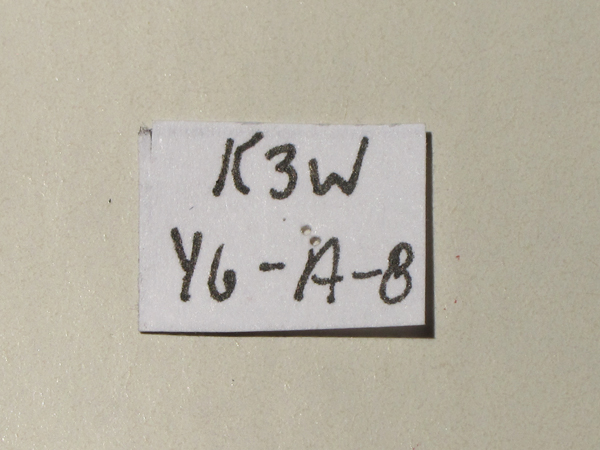
The first, you’ll note, is written in ballpoint pen (which fades) on a torn piece of notebook paper and contains almost no information. The second, although it looks fancier and perhaps more sciencey, is just as bad: it contains a cryptic code that is useful only to the bearer of the lab notebook in which said code has been written down. Or, perhaps the code is completely intelligible to the researcher who developed it, but the key to it exists only in his or her head.

To everyone else, it is meaningless. Neither of these labels indicate who collected the specimen, where, when, or how. And we all know what happens in labs: upon completion of their degrees, students move on, email addresses change, notebooks are misplaced, data files are not backed up. The labels’ codes can never be broken, and the scientific value of the specimens – *poof*.

While there’s nothing wrong, in theory, with using labels like these temporarily (although there is always a risk that they will be misinterpreted or misunderstood after a little while, even by the person who wrote them), they are absolutely useless as permanent records.

These are good labels:

These labels, properly affixed to a specimen, provide clear and universally understood information. One provides the location, including GPS coordinates, a method of collection, a date, the name of the collector(s). The information that goes on this label can vary a bit (it may include information about the habitat or host plant, for example), but those are the basic requirements. The smaller label is typically affixed on the pin below the first, and contains the specimen’s scientific name and the name of the person who identified it (it is the “det. label”, i.e., “determined by”). These labels, and therefore the specimen with which they are associated, will remain useful for decades, even centuries.

I am totally guilty of both of the offenses I just explained (the gooky vials of nastiness and the bad labels). For my undergraduate honors project, I identified close to 8000 spiders, mites and insects to the Family level – it was hundreds of hours of microscope work. Then I stuffed all those specimens back into vials with cryptic little codes, like V-1-F(!), hand-written on STICKERS(!), which I placed on the LIDS(!) and not even in the vials themselves(!). Oh, and I’ve long since lost the notebook that contained my decoder key(!). THIS IS ALL SO BAD. I have no doubt that those boxes of vials, which I once prized so highly and felt such pride for, have been unceremoniously tossed in the trash by my former advisor.

Well, I’ve learned from my mistakes, and from working with museum and other collection specimens. I now understand that each specimen is deserving of respect – it’s the original data after all – and that means it should be properly preserved, and labelled.

So.

Last week I spent a great deal of time, as I said, tying up my loose ends. The last thing I needed to do was remove my cryptic labels (the second in the series up there is an actual example of one of my own “secret code” labels) and replace them with proper ones, sorting and tidying up the collection in the process. The end result?

This:

Frankly, it’s a thing of beauty. It’s also enormously scientifically valuable. These specimens will be deposited in various nationally-important collections and museums, like the CNC.

As a matter of fact, just last week I was at the CNC, and I saw specimens bearing the name of the last person to do a comprehensive survey of the insects in Kugluktuk, back in 1955. That tiny but so-important label suddenly made me feel connected to the man who, almost 60 years earlier, had stood on the same stretch of tundra as me, holding and perhaps delighting in the very specimen that I held in my own hand.

Giving my specimens the respect they deserve is worth it, not only for the scientific value, but also because perhaps, 60 years from now, another grad student will discover my name on a specimen’s det. label. Perhaps she, too, will feel that same wondrous sense of connection to the the greater scheme of scientific discovery…

____________________________
Original post at: http://thebuggeek.com/2012/06/25/respect-your-specimens/

The ESC Blog is off to a fantastic start, and we admins couldn’t be more proud of our amazing bloggers.  The response from the Canadian entomology community has been tremendous – which is really no surprise, but still wonderful! Readers have been joining us from all over the world (59 countries!) and we’re so pleased that some of you are engaging with us by leaving comments.

We thought that it would be a good time to introduce ourselves, so you know who’s working away behind the scenes: today you’ll meet Crystal.
___________________________________

Hi!  I’m a PhD candidate in Chris Buddle’s Arthropod Ecology lab at McGill University.  My current research interests include beetle assemblages in Arctic Canada and functional ecology. My earlier research at Carleton University (I did a BSc and MSc under the supervision of Naomi Cappucinno) involved plant-insect relationships  in the context of biological invasions.

In addition to my academic pursuits, I love to teach, take pictures of insects, and spend time outdoors exploring the natural world.

I’m also very interested in science education and outreach, which is why you’re finding me here at ESC Blog.

Online science communication is a big part of who I am and what I do, in addition to my normal grad student research activities. I have been blogging as “TGIQ”  at www.thebuggeek.com since 2009.  There, I write posts about insect natural history, insect photography, my own entomological research, and more broadly about my experiences as a graduate student interested in a career in academia. I am also an administrator at the research blog of The Northern Biodiversity Program (NBP), of which I am a student member, and I am a contributing authour at the Grad Life blog, where I write about the graduate student experience at McGill University.

In addition to blogging, I can usually be found posting tidbits of entomo-goodness on Facebook, Google+, Twitter, Networked Blogs, Nature Blog Network, and Research Blogging.  I also have a YouTube channel that I use for teaching an undergraduate zoology lab.

Some people have tried to tell me that these activities are a waste of time, professionally. My personal experiences have shown this to be anything but true: I’ve established incredible networks of students, academics and other professionals; I’ve been exposed to fascinating cutting-edge science; and I’ve gained tangible professional benefits (think “publications” and “funding” and “collaborations”).  None of these would have been possible without my online activities.

I also think that science outreach is an activity that all academics should make time for – after all, we are doing science for the general public, not just for our fellow researchers! Our knowledge of and passion for entomology is something that deserves to be shared with others. Blogs are wonderfully accessible outlets; they represent an unparalleled opportunity for folks from different sectors and backgrounds to participate and exchange their knowledge and experiences – something that is not often achieved through traditional venues such as conferences and journals.

I’ll leave you with some quotes from a talk that I attended in March, by researcher and science outreach proponent Nalini Nadkarni. I invite – and strongly encourage – you to join the incredible online science community and consider participating here as an ESC blogger.

(Note: the English version follows)

Guillaume Dury, Étudiant à la maîtrise, Université McGill
_______________________________

Dessous de Chrysiridia rhipheus, photo par Cody Hough sur Wikimedia Commons.

Le 7 avril 2012, l’article du jour sur Wikipédia était Chrysiridia rhipheus.

C’était un grand jour pour moi : j’ai écrit la majorité de l’article. Ce n’est pas pour autant mon article; dire cela irait à l’encontre de l’étiquette de Wikipédia. J’y ai tout de même passé des heures de recherche et j’ai écrit la majorité de l’article.

Tout comme des millions de personnes, j’utilise Wikipédia pour étancher ma soif de connaissances rapides. À juste titre, “«wiki»” est Hawaïen pour rapide. Seulement, il n’y avait pas de wiki-connaissances sur ce papillon de nuit qu’est l’Uranie riphée (Chrysiridia rhipheus).

J’étais toujours curieux; cette soif particulière ne resterait pas inassouvie. Puisque j’allais faire une recherche de littérature, aussi bien écrire un résumé au bénéfice des autres. Voilà comment je suis devenu un éditeur sur Wikipédia.

J’ai créé l’article le 5 août 2006, un peu avant de commencer mon baccalauréat en biologie. En tant que biologiste de formation, j’avais besoin de pratiquer les tâches concernées dans l’écriture de l’article. Le plus important fut de trouver l’information. J’ai pu trouver beaucoup d’information en ligne : dans les articles scientifiques et dans des livres numérisés par Google Books ou Internet Archive. J’ai aussi appris que, parfois, des références ne sont tout simplement pas disponibles en ligne. C’est alors que j’ai utilisé les prêts entre bibliothèques pour la première fois. Peu a peu, une référence à la fois, j’ai rempli les différentes sections de l’article.

La partie sur la taxonomie et la description de l’espèce fut beaucoup plus intéressante à écrire que je l’aurais cru. L’Uranie rhiphée, ou le “«papillon coucher de soleil malgache»” (de l’anglais “Madagascan sunset moth”) a toute une histoire derrière ses noms. Il est décrit pour la première fois, en 1773, sous le nom de Papilio rhipheus. C’est-à-dire qu’il avait été placé parmi les papillons de jour et non de nuit. Capitaine May de Hammersmith avait donné le spécimen à l’entomologiste britannique Dru Drury. Ce spécimen avait été “«réparé»” avec une tête de papillon de jour et ses antennes en massue. (NB : ne pas coller la mauvaise tête sur votre spécimen cassé!) En 1831, René Primevère Lesson l’avait décrit sous le nom Urania ripheus var. madagascarensis. Ce papillon a toujours plusieurs autres synonymes.

En utilisant les guides sur Wikipédia, en demandant d’autres éditeurs et en m’inspirant de d’autres articles, j’ai rassemblé et résumé de plus en plus d’information. J’ai fait passer l’article par le processus interne d’évaluation par les pairs dans Wikipédia en janvier 2007. Sur Wikipédia, les pairs sont d’autres éditeurs et pas nécessairement des entomologistes. Cela a aidé un peu, surtout pour le format article, mais je devais surtout trouver d’autres sources d’information à inclure.

Puis, j’ai contacté l’un des experts mondiaux sur Chrysiridia rhipheus, le Dr David C. Lees du Musée d’Histoire naturelle de Londres. J’ai été agréablement surpris; il était déjà éditeur sur Wikipédia. Il m’a dirigé vers des références importantes que j’avais manquées et a ajouté des informations lui-même. J’étais ravi.

Carte de cigarettes dépeignant une fée « Chrysiridia madagascariensis » en 1928, compagnie John Player & Sons.

En mars 2008, je jugeais que mon article avait atteint le niveau de “«bon article»”. Pour être reconnu comme tel, un article doit répondre à certains critères et passer avec succès le processus de mise en candidature de bon article. Avec l’examen et des suggestions de l’utilisateur Casliber, c’est ce qui s’est passé le 22 mars 2008 : j’avais écrit un “«bon»” article sur Wikipédia.

J’ai continué; j’ai fait des modifications, j’ai ajouté des références, des images, y compris une carte de cigarettes datant de 1928, et j’ai ajouté ce qui est probablement la seule photo de la chenille de cette espèce sur Internet. J’ai eu l’aide de l’un des principaux éditeurs des articles sur l’optique et la polarisation des articles afin de clarifier pour moi la polarisation de la lumière. Les écailles sur les ailes du papillon produisent les couleurs à travers deux phénomènes optiques, l’un dépend de polarisation. Le papillon ne dispose de pigment que dans les régions noires de ses ailes.

Ensuite, le 18 juin 2008, j’ai fait la mise en candidature de l’article pour qu’il soit reconnu comme article de qualité. Les articles de qualité sont considérés comme représentant le meilleur de ce que Wikipédia a à offrir, comme déterminé par les éditeurs de Wikipédia. Lors de ce processus, de nombreux éditeurs font des suggestions et demandent des changements à l’article. J’ai fait la plupart de ces changements et fait de mon mieux pour répondre aux questions. Le 4 juillet 2008, Chrysiridia rhipheus a été promu au statut d’article de qualité. Featured article en anglais; ce statut exceptionnel est signifié par une petite étoile dans le coin supérieur à droit! :

http://en.wikipedia.org/wiki/Chrysiridia_rhipheus

En moyenne, l’article Chrysiridia rhipheus est visité à peu près une centaine de fois par jour. Le 7 avril 2012, il a été visité plus de 20 000 fois. Au cours des 90 derniers jours, cela fait un total de 37614 fois. C’est de la bonne diffusion!

Je répondrai avec plaisir aux questions de ceux qui s’intéressent à l’écriture de « leur propre » article Wikipédia. Tout commence par le bouton [modifier]…

Pour les professeurs : “«dans le cours ENTO 431 entomologie médico-légale, à l’université du Texas A & M, les étudiants ont la tâche d’écrire plusieurs articles sur Wikipédia concernant les espèces de mouches d’importance médico-légale.»” Le travail des étudiants sert alors leur cours et sert le but de Wikipédia de créer un résumé de toutes les connaissances humaines dans une encyclopédie libre et en ligne. (Pour plus d’informations, voir la page du cours sur Wikipédia (en anglais))

____________________________

By Guillaume Dury, M.Sc. student, McGill University
____________________________

Engraving captioned Urania riphaeus from Charles D. d’Orbigny’s Dictionnaire universel d’histoire naturelle (1849)

On April 7th 2012, on Wikipedia, Today’s Featured Article was Chrysiridia rhipheus.

It was an exciting day for me: I wrote most of the article. It isn’t my article; it would be against Wikipedia etiquette to say so. Still, I spent hours researching and wrote most of it.

Just like millions of people, I use Wikipedia to quench my thirst for quick knowledge. Appropriately, “wiki” is Hawaiian for quick. Only there was no wiki-knowledge on the Madagascan sunset moth (Chrysiridia rhipheus).

I was still curious; this particular thirst wouldn’t be left unquenched. Since I would search the literature, I thought I might as well write a summary for the benefit of others. That is how I became an editor on Wikipedia.

I created the article on August 5th 2006, a little before starting my bachelor’s in biology. As a biologist in training, I needed to practice the tasks involved, most importantly: finding information. I was able to find a lot online: in scientific articles and scanned books in Google Books or Internet Archives. I also learned that sometimes, references are simply not available online. That is when I used interlibrary loans for the first time. Little by little, one reference at a time, I filled the different sections of the article.

The section on taxonomy and naming of the species was a lot more interesting to write than I initially thought it would be. The Madagascan sunset moth has quite a story behind its names. It was first described, in 1773, as Papilio rhipheus. That is to say, it was described as a butterfly and not a moth. Captain May of the Hammersmith gave the specimen to the British entomologist Dru Drury, only that specimen had been “repaired” with a butterfly head that had clubbed antennae. (N.B.: don’t glue the wrong head on your broken insect specimen!) In 1831, René Primevère Lesson described Urania ripheus var. madagascarensis. The moth also has a number of other junior synonyms.

Using guides on Wikipedia, asking other editors and inspiring myself with other articles, I gathered and summarized more and more information. I went through Wikipedia’s internal process of peer review in January 2007. On Wikipedia, peers are other Wikipedia editors, not necessarily entomologists. This helped somewhat, especially for article format, but I really had to look for more sources and information to include.

I contacted one of the world experts on the Madagascan sunset moth, Dr. David C. Lees of the London Natural History Museum. I was pleasantly surprised he was already an editor on Wikipedia. He pointed me towards important references I had missed and added information himself. I was delighted.

A cigarette card featuring a “Chrysiridia madagascariensis” fairy in 1928 from John Player & Sons.

In March 2008, I felt my article was close to the level of “Good article”. To be recognized as such, an article needs to meet the good article criteria and to successfully pass the good article nomination process. With the review and suggestions of user Casliber, this happened on March 22nd 2008: I had written a “Good” article on Wikipedia.

I kept going, did more editing, added references and pictures, including a cigarette card from 1928, and what is probably the only photo of this species’ caterpillar on the Internet. I got help from one of the main editor of the articles Optics and Polarization to clarify light polarization for me. The scales on the moth’s wings use two optical phenomena to produce the colours, one of which is polarization dependent. The moth only has pigment in the black regions of its wings.

On June 18th 2008, I proposed the article for evaluation to be recognized as Featured. Featured articles are considered to be the best Wikipedia has to offer, as determined by Wikipedia’s editors. In this review process, various editors make suggestions and ask for changes to the article. I made most of those changes and answered questions to the best of my knowledge. On July 4th 2008, Chrysiridia rhipheus was promoted to Featured Article, this exceptional status is signified by a little star in the top-right corner!:

http://en.wikipedia.org/wiki/Chrysiridia_rhipheus

On an average day, the article Chrysiridia rhipheus is viewed roughly a hundred times. On April 7th 2012, it was viewed over 20 000 times. In the last 90 days, that makes a total of 37 614 times. Good exposure!

I’ll happily answer the questions of anyone interested in writing “their own” Wikipedia article. It all start with the [edit] button…

Lastly, a note for the professors: “As a part of the ENTO 431, forensic entomology course at Texas A&M University students are assigned the task of writing several articles at Wikipedia pertaining to forensically important fly species.” The students’ work serves their course, and Wikipedia’s goal to create a summary of all human knowledge in an online encyclopedia. (For more information see the course’s Wikipedia page)

Today’s post comes from Julia Mlynarek on behalf of the 2012 ESC-ESAlberta JAM organizing committee.

——————————

Dear students,

As you may have heard, there will be a workshop on the publication process called “Perspectives on the Publication Process” during the 2012 ESC-ESAlberta JAM.

Publishing research in a high quality, peer-reviewed scientific journal remains an important goal for us, but the process can be difficult to navigate, be frustrating, and create a great deal of anxiety and stress. On the Sunday morning immediately before the 2012 Joint Annual Meeting (4 November) in Edmonton, the Entomological Societies of Canada and Alberta will be jointly hosting a workshop at the JAM venue about the publication process. The overall goal is to provide attendees (students and seasoned professionals alike) with practical information about all aspects of publishing.

The organisers would like your input on the topics that will be discussed during the workshop. Please fill out this short (2 questions) survey by June 20th (I need to tally the scores and forward them to the organising committee).

The link to the survey – http://www.surveymonkey.com/s/KYN56MK

Please take the time to fill it out. It will ensure that you have a say in what is discussed!

“Dear Buggy” is an advice column featured in the ESC Bulletin, written by Dr. Chris MacQuarrie.  “Buggy” will also be offering his great tips, tricks and hints every other month here at the ESC blog. In the meantime, enjoy this teaser from the June 2012 edition of the Bulletin!

_____________________________

Dear Buggy,

I’ve got too many things on the go and I can’t seem to keep on track. My field season starts next week, but I haven’t even started planning for it yet. I’ve missed two due dates in the last month, plus I think I may have stood up my boyfriend last night. I would call him to apologize, but I forgot to pay my phone bill last month and they cut me off. Help me! How do I manage my time?

Signed,

‘Short on Time in Terrace’

Thanks for the ‘timely’ question. Hopefully you will have managed to contact your boyfriend before this is published! Teaching yourself how to manage your time is an important skill to develop while you’re young. Speaking from experience, I can assure you that things only get worse as you progress through your career. Your time is precious.

Our tasks, and the time it takes to do them, can be organized on different temporal scales. Since entomologists are already pretty good at thinking about the world at different scales, it should be a logical step for you to think about your time in this way. For example, you have to finish your thesis in the next 5 years; you have to prepare and pass your qualification exams next year, your field season starts in a month, your project proposal is due next week, you are teaching tomorrow, and you have a dental appointment in an hour. Obviously, how you manage these different commitments varies depending on their immediacy. To be efficient, you must manage your time over all temporal scales. That way, things won’t sneak up on you.

Click here to read the rest of this great column in the Bulletin!

_______________________________

Chris MacQuarrie is a research scientist with the Canadian Forest Service in Sault Ste. Marie where he studies the management of native and invasive insects. Currently, he’s beginning to realize that all time management tactics go out the window when you have a toddler in the house. “Dear Buggy” is always looking for suggestions or guest contributors. Have an idea or a question? Send it to: cjkmacquarrie@gmail.com or post it in the Facebook student group.